Amplifier ICs
بەرهەمەکان (3,200+)

TS924IPT - Quad Rail-to-Rail Op Amp | STMicroelectronics
The STMicroelectronics TS924IPT is a four-circuit, rail-to-rail BiCMOS operational amplifier optimized for 3 V and 5 V operation, supplied in a 14-pin TSSOP package. It combines rail-to-rail input and output capability with high output current, low noise, low distortion, and low offset. These characteristics position it as a general-purpose amplifier for low-voltage signal conditioning, audio, sensor interfaces, and portable equipment. An operational amplifier is a voltage-gain building block used to amplify small signals, buffer voltage sources, compare analog levels, and drive external circuits. The TS924 belongs to the BiCMOS operational-amplifier family, combining bipolar input circuitry with CMOS output stages. Rail-to-rail operation allows the amplifier to process input and output signals near the limits of its supply voltage, making it useful when the usable signal range is narrow. The four amplifiers in one package support space-efficient analog designs requiring multiple gain stages or buffered channels. Operation is optimized for both 3 V and 5 V systems, covering common low-voltage rails found in portable electronics, industrial controls, audio equipment, and embedded systems. Rail-to-rail output swing and high output-current capability also help the device accommodate heavier loads than a general low-power amplifier. The TS924 family is characterized by low noise, low distortion, and low offset, supporting accurate amplification of low-level signals. These characteristics matter in audio paths where distortion limits perceived fidelity, in sensor interfaces where small voltage changes must be preserved, and in control systems where offset can shift a measurement or threshold. The quad configuration also reduces component count and simplifies board-space allocation. Typical uses include headphone and line-level audio buffers, microphone preamplification, low-voltage sensor conditioning, active filtering, voltage followers, and low-level comparator functions. In each case, the four independent amplifier sections can implement parallel channels or several stages within the same subsystem. Designers should confirm output-current demand, load impedance, stability, and input/output common-mode limits against the manufacturer datasheet for the selected operating condition. A key design consideration is power-supply decoupling and careful handling of capacitive loads. Place the input and output bypass capacitors close to their associated pins, keep sensitive input traces short, and account for the amplifier's behavior when driving resistive or capacitive loads. The datasheet pin description and recommended application circuit should guide the final layout. This page combines the TS924 family's operating characteristics with application guidance, design cautions, and a structured comparison of identified drop-in candidates. It is intended to help engineers evaluate the TS924IPT for 3 V and 5 V analog systems before implementing the 14-pin TSSOP footprint on a PCB.

TS925ID - Quad 4MHz Rail-to-Rail Op Amp | STMicroelectronics
STMicroelectronics TS925ID is a quad operational amplifier with rail-to-rail input and output capability, 4 MHz gain-bandwidth product, 1.3 V/us slew rate, and operation from 2.7 V to 12 V in a 16-pin SOIC package. Each amplifier can deliver 80 mA of output current, allowing it to drive up to 32 loads according to the manufacturer documentation. An operational amplifier is an analog signal-processing IC that uses high open-loop gain to amplify voltage differences between two inputs. The TS925ID belongs to the operational-amplifier hierarchy and combines four amplifiers in one package. Rail-to-rail input behavior supports operation near the positive and negative supply rails, while rail-to-rail output behavior provides greater output-voltage range than conventional amplifiers constrained by the supply rails. The principal features include 9 nV/Hz input-voltage noise, low distortion, 4 MHz bandwidth, and 1.3 V/us slew rate. The 80 mA output-current capability distinguishes the TS925ID from lower-current general-purpose op amps, making it useful where several amplifiers must drive heavier resistive or capacitive loads. Its quad configuration also reduces board area by integrating four amplifier channels. The TS925ID combines bipolar input and CMOS output stages, identified in technical listings as a BiCMOS amplifier. This architecture supports rail-to-rail operation while retaining low-noise bipolar input characteristics. Because the four channels share a common package, careful consideration of power-supply routing, grounding, output isolation, and thermal behavior is required in multi-channel analog systems. Typical uses include audio output stages, active filters, sensor-conditioning circuits, buffer amplifiers, communications receivers, and industrial control systems. Its quad organization is particularly useful when a design needs four closely related analog channels. The adjustable phantom-ground feature can support signal references in applications requiring an artificial ground, while the standby mode can reduce power consumption when the amplifier is not needed. Designers should use the manufacturer datasheet to verify the complete electrical limits, pin configuration, output-current conditions, stability requirements, and recommended external components. Decoupling capacitors should be placed close to the supply pins, and outputs that drive capacitive loads may require isolation resistors or other stability measures. Because the available verified specification excerpt does not provide the complete pin table, the package diagram should not be used as a substitute for the official datasheet. This page consolidates the verified TS925ID operating range, bandwidth, slew rate, noise, output-current, package, pricing, and sourcing information into an engineering-focused reference. It also distinguishes verified same-package alternatives from parts that require package or electrical revalidation, helping designers make a safer replacement decision before committing a new PCB layout.
TS925IDT - Quad 80mA Rail-to-Rail Op Amp | STMicroelectronics
The STMicroelectronics TS925IDT is a four-circuit, rail-to-rail input and output operational amplifier optimized for 3 V and 5 V operation, with an operating supply range extending to 12 V. The device provides a 4 MHz gain-bandwidth product, 1.3 V/us slew rate, 9 nV/Hz input noise, and up to 80 mA of output drive current in an SOIC-16 package. An operational amplifier is an analog integrated circuit that amplifies the difference between two input voltages. A rail-to-rail input and output amplifier can operate with input and output voltages close to either supply rail, making it useful in battery-powered, portable, and mixed-signal equipment. The TS925 belongs to the general-purpose operational amplifier family within the broader analog and linear IC hierarchy. The TS925IDT combines four amplifiers in one package with several features aimed at portable instrumentation. Its rail-to-rail input stage accepts signals across nearly the full supply range, while rail-to-rail output swing supports low-impedance loads. High output current of 80 mA can drive up to 32 loads according to the manufacturer documentation. The 4 MHz bandwidth and 1.3 V/us slew rate improve response speed in audio, sensor, and control paths. The TS925 also includes standby mode and an adjustable phantom-ground arrangement. The internal low-impedance phantom ground can simplify biasing and eliminate the need for an external reference voltage or bias network in suitable applications. The four amplifiers share one package while retaining independent input and output pins, allowing one component to implement four analog functions. Typical applications include portable audio and headphone stages, low-voltage sensor conditioning, current measurement, industrial control, and general-purpose instrumentation. The 80 mA output capability is particularly useful when the amplifier must drive heavier loads than a conventional low-power quad amplifier can support. The SOIC-16 package also simplifies assembly and provides adequate pin spacing for production test and inspection. When designing around the TS925IDT, verify input common-mode range and output swing for the actual load current because rail-to-rail operation does not guarantee perfect saturation at the supply rails. Decoupling capacitors should be placed close to the supply pins, and unused amplifier channels should be configured according to the manufacturer's recommended stable input arrangement rather than left floating. This page combines the TS925IDT operating characteristics with same-package family alternatives, application guidance, comparison parameters, and practical layout notes. These engineering-oriented details help shorten component selection and support design decisions that are not visible in a basic distributor catalog listing.

TS925IN - Quad Rail-to-Rail Op Amp, 4 MHz | STMicroelectronics
STMicroelectronics TS925IN is a four-circuit, general-purpose operational amplifier with rail-to-rail input and output capability, 4 MHz gain-bandwidth performance, standby mode, and an adjustable phantom-ground function. The device is packaged in a 16-DIP package measuring 0.300 inches, or 7.62 mm, across the row spacing. Its four amplifiers are intended for compact analog signal-conditioning systems where multiple buffered or amplified channels are required. An operational amplifier is an active analog semiconductor that uses high open-loop gain to amplify the difference between two input voltages. The TS925IN belongs to the general-purpose operational-amplifier family within the broader amplifier and analog IC hierarchy. Rail-to-rail input and output behavior allows the amplifier to operate across a substantial portion of its supply range, while the four-circuit arrangement consolidates four amplifier channels into one package. These characteristics make the device suitable for sensor interfaces, audio paths, instrumentation, and control-system signal chains. The main features of the TS925IN include four amplifier sections, a 4 MHz gain-bandwidth product, rail-to-rail operation, high output-current capability, standby mode, and an adjustable phantom-ground arrangement. Standby support can reduce active power consumption when signal handling is not required. The adjustable phantom-ground function can provide an internal reference point for noninverting amplifier configurations, which can simplify some gain-stage layouts and reduce the number of external reference components. The TS925IN is designed for general-purpose analog amplification rather than precision measurement or specialized high-voltage operation. Its four integrated channels can reduce board area compared with separate single or dual amplifier packages. Design engineers must still account for input common-mode range, output swing, supply voltage, stability, output-current demand, and the effect of the phantom-ground network when assigning signal levels. Because the accessible product records do not expose the complete electrical-limit table, exact slew rate, input bias current, output-current limit, and temperature limits should be confirmed in the manufacturer datasheet before release. Typical uses include four-channel sensor buffering, low-frequency audio amplification, industrial measurement interfaces, analog control loops, and general instrumentation. The 16-DIP package is appropriate for through-hole designs where insertion and inspection are important, although it occupies more PCB area than comparable surface-mount packages. The four-channel architecture is especially useful when four channels must be amplified consistently and nearby to the source or destination circuitry. A practical design choice is to keep feedback resistors close to the relevant amplifier pins, route high-impedance input traces away from switching nodes, and decouple each supply rail near the package. Confirm that the required output amplitude remains inside the usable output swing. For systems using standby or phantom ground, verify startup, shutdown, and settling behavior in the final signal-chain configuration rather than treating those features as isolated block-level functions. This page consolidates the verified product identity, package information, functional characteristics, sourcing workflow, replacement constraints, and application guidance for the TS925IN. It also distinguishes documented drop-in substitutes from differently packaged family members, helping engineers avoid assuming that a similar amplifier description guarantees footprint, pin, or electrical compatibility.

TS925IPT - Quad Rail-to-Rail Op Amp | STMicroelectronics
STMicroelectronics TS925IPT is a four-circuit rail-to-rail operational amplifier with standby mode, adjustable phantom ground, a 3 V supply class, and a 4 MHz gain-bandwidth product, packaged in a 16-pin TSSOP. The quad topology integrates four amplifier channels into one package, making the device useful in signal-conditioning systems that need multiple buffered inputs without allocating separate packages for each channel. Its standby function supports power management in portable and mixed-signal equipment, while the adjustable phantom ground provides a reference point for single-supply signal chains. A rail-to-rail operational amplifier is an amplifier whose output stage can approach both supply rails under suitable load conditions. This input and output flexibility makes the TS925IPT suitable for low-voltage systems in which signals may occupy much of the available supply range. Operational amplifiers are voltage-amplifier building blocks within analog and mixed-signal ICs, connecting sensor outputs, reference voltages, audio signals, and control signals to subsequent processing stages. The TS925IPT provides four rail-to-rail amplifier circuits, 4 MHz gain-bandwidth performance, standby-mode control, and an adjustable phantom-ground function in one 16-pin TSSOP package. Its rail-to-rail architecture reduces the need to bias signals away from either supply rail, while the quad channel count reduces component count and PCB area in multi-channel analog front ends. Standby operation can lower system activity when the monitored signal does not require continuous amplification. The 3 V supply class and 4 MHz gain-bandwidth product place the device between general-purpose low-voltage amplifiers and much higher-speed signal-chain devices. A 4 MHz bandwidth is suitable for audio-range and general instrumentation signals rather than high-frequency communications or precision measurement requiring bandwidths in the tens or hundreds of megahertz. The adjustable phantom ground is especially relevant to systems that establish an artificial reference for AC-coupled or biased signals. Typical uses include four-channel sensor conditioning, low-voltage audio amplification, joystick or potentiometer interfaces, industrial control inputs, and instrumentation requiring independent gain or buffer stages. The standby feature can also support duty-cycled acquisition systems, while the phantom-ground connection can simplify biasing around an intermediate reference voltage. The package is suitable for compact surface-mounted boards but requires careful attention to grounding and decoupling near the supply pins. Design with the manufacturer’s recommended application circuit and pin-description table. Place the power-supply bypass capacitor close to the supply pins, route each amplifier’s input and output away from switching-node traces, and connect the phantom-ground network only as shown in the datasheet. Verify the complete operating range, load capability, output swing, and shutdown behavior for the intended supply voltage before production release. This product page combines the TS925IPT’s key technical identity with practical guidance on standby control, phantom-ground implementation, package layout, and design trade-offs. It also organizes pinout, application, compliance, and replacement information so engineers can move directly from component selection to PCB-level implementation.

TS931AID - 100kHz Rail-to-Rail Output Op Amp, SOIC-8 | STMicroelectronics
The STMicroelectronics TS931AID is a single, low-power operational amplifier with rail-to-rail output swing in an 8-pin SOIC (SOP) package, specified for industrial temperature grade. The device belongs to the TS93x family of micropower operational amplifiers, which operate from supplies as low as 2.7 V and reach a 2.9 Vpp output swing with a 100 kOhm load when supplied at 3 V. Its unity-gain bandwidth of 100 kHz makes it a general-purpose amplifier for low-frequency signal conditioning rather than a high-speed precision part. An operational amplifier (op amp) is a differential-input voltage amplifier whose gain is set by external feedback components. A rail-to-rail (RRO) output amplifier can swing its output close to both supply rails, so the output remains useful even when the signal approaches the supply limits. In the classification hierarchy, the TS931AID is an operational amplifier, which is a type of amplifier IC, which falls under integrated circuits and analog signal conditioning. Micro-power rail-to-rail op amps occupy the intersection of battery-powered sensing, portable instrumentation, and low-leakage buffer applications. Key differentiating features of the TS931AID include rail-to-rail output operation, operation from a 2.7 V minimum supply, a 100 kHz unity-gain bandwidth, an 8-pin SOIC footprint with gull-wing leads, and industrial temperature grading. Because output swing reaches 2.9 Vpp at 3 V supply with a light 100 kOhm load, the part is a good fit for buffered sensor front-ends and low-voltage signal chains where headroom is tight. Note that the TS931AID is characterized for output rail-to-rail behaviour; input common-mode range figures should be confirmed against the manufacturer datasheet before committing to a design that relies on input operation near the rails. Technically, the TS931AID is a single-amplifier device in the TS93x line, which also includes dual and quad members. The 100 kHz gain-bandwidth product places the part firmly in the micropower/general-purpose segment rather than the precision or high-speed segments, meaning it is intended for signal conditioning, buffering, and level shifting where bandwidth requirements are modest but power consumption and rail-to-rail reach matter more. Typical applications include battery-powered sensor conditioning in industrial and medical monitoring equipment, low-voltage audio and communication signal buffering, and post-processing stages in data acquisition systems. Because the family supports supply voltages down to 2.7 V, it pairs well with coin cells, single Li-ion cells, and low-voltage energy-harvesting front-ends. When designing with the TS931AID, keep the output load within the range used for the quoted 2.9 Vpp swing figure and place a decoupling capacitor close to the supply pins. Verify the input common-mode range and output swing under load in the manufacturer datasheet, and check the noise and offset specifications against your signal-chain budget before committing the design. This page consolidates distributor sourcing data, pin-compatible drop-in alternatives, a parameter-by-parameter comparison table, and practical design guidance for the TS931AID that you will not find in a single manufacturer datasheet page.
TS931BID - Micropower Rail-to-Rail Op Amp | STMicroelectronics
The STMicroelectronics TS931BID is a single-circuit, micropower, rail-to-rail operational amplifier with a 2.7 V to 10 V supply range, packaged in an 8-pin SOIC. It is designed for general-purpose signal conditioning where low power consumption, rail-to-rail output capability, and operation from low-voltage supplies are important. The TS931BID combines a listed quiescent current of 0.0003 uA, input bias current of 1 pA, and a gain-bandwidth product of 100 kHz. An operational amplifier is an analog integrated circuit that amplifies the voltage difference between its differential inputs. The rail-to-rail output architecture allows the output signal to approach the supply rails more closely than a conventional amplifier with limited output swing. This makes the TS931BID useful for portable instruments, battery-powered sensors, low-voltage industrial controls, and other embedded systems that require amplification without a high-power supply. Key characteristics include one amplifier circuit, rail-to-rail output operation, a 2.7 V minimum supply voltage, and a 10 V maximum supply voltage. The low 0.0003 uA quiescent-current figure supports energy-conscious designs, while the 1 pA input-bias-current specification reduces input-loading effects in high-impedance measurement paths. A listed 55 dB gain-bandwidth-related figure and 100 kHz bandwidth suit low-to-moderate-frequency precision signal applications. The TS931BID belongs to the STMicroelectronics TS931 family of low-power operational amplifiers. Its 8-SOIC package supports conventional surface-mount assembly and provides a practical option for designs requiring a single amplifier in a small, standard package. Because the device operates from a 2.7 V supply, system-level signal ranges should be checked against the input common-mode and output-swing limits in the manufacturer datasheet. Typical uses include low-voltage sensor interfaces, portable measurement equipment, battery-operated data-acquisition modules, industrial process monitoring, and embedded control systems. In a sensor interface, the amplifier can increase the usable signal level before an ADC samples it. In a portable instrument, its low quiescent current helps limit standby consumption. The relatively modest 100 kHz bandwidth favors precision and low-frequency measurements rather than high-speed signal processing. PCB design should place input and feedback components close to the amplifier pins and maintain short, low-impedance traces to reduce noise pickup and parasitic feedback. Decoupling capacitors should connect directly between the supply and ground pins. Before substituting the TS931BID, verify supply voltage, input common-mode range, output swing, stability with the selected load capacitance, noise performance, and the exact pin assignment. This page combines the identified TS931BID electrical characteristics, package information, sourcing context, and practical design guidance. It also organizes same-family alternatives and a parameter comparison to help engineers determine whether the device fits the required footprint, voltage range, bandwidth, and power budget.

TS931BILT - 100kHz Rail-to-Rail Micropower Op Amp | STMicroelectronics
The STMicroelectronics TS931BILT is a single-channel CMOS operational amplifier in a SOT-23-5 package, featuring rail-to-rail output swing, micropower consumption, and operation down to 2.7 V single supply. As a member of the TS93x family (single/dual/quad variants), it delivers 100 kHz gain-bandwidth product while drawing only a few microamps of quiescent current, making it an excellent choice for battery-powered and portable applications. An operational amplifier (op-amp) is a high-gain DC-coupled electronic voltage amplifier with differential inputs and, typically, a single-ended output. Within the broader signal-conditioning hierarchy, op-amps sit between transducers/ADC front ends and downstream digital processing; rail-to-rail output variants extend the usable output swing to nearly both supply rails, maximizing dynamic range in low-voltage systems. Micropower CMOS op-amps like the TS931BILT optimize this topology for low-Iq operation, trading GBW and slew rate for extended battery life in handheld, IoT, and remote-sensor designs. Key specifications include a 2.7 V to 10 V supply range, 100 kHz GBW, rail-to-rail output (reaching 2.9 Vpp with RL = 100 kΩ at 3 V supply), CMOS input stage, and an operating temperature range of -40 °C to +105 °C. The SOT-23-5 package is among the smallest standard op-amp footprints, enabling compact PCB layouts in space-constrained designs. Architecturally, the TS931BILT uses a CMOS input stage with a class-AB output stage to deliver rail-to-rail output swing at low quiescent current. The 'B' suffix denotes the enhanced second-generation variant, offering improved offset and noise compared with the original TS931, while the 'I' in 'ILT' indicates the industrial temperature grade (-40 °C to +105 °C). Typical applications include battery-powered instrumentation, portable medical devices, sensor signal conditioning, active filters, and transducer interfaces. The micropower Iq makes it ideal for always-on circuits where sleep current must be minimized. When designing with this op-amp, note that the CMOS inputs have lower bias current than bipolar alternatives but may exhibit higher leakage at elevated temperatures. Decouple the supply with a 100 nF ceramic capacitor placed close to the VCC pin to suppress noise. This page synthesizes distributor pricing, drop-in alternatives within the same SOT-23-5 footprint, and practical design notes that go beyond the manufacturer datasheet, helping engineers select the right op-amp quickly.
TS931ID - 100kHz Rail-to-Rail Op Amp | STMicroelectronics
The STMicroelectronics TS931ID is a single-amplifier, general-purpose operational amplifier with a 100 kHz gain-bandwidth product, rail-to-rail output operation, and a 2.7 V minimum supply voltage, packaged in an 8-pin SOIC. It operates from single 2.7 V to 10 V supplies, consumes approximately 20 µA, and provides an extremely low typical input bias current of 1 pA. The device is suited to portable instrumentation, low-power signal conditioning, buffering, and general analog signal-processing applications. An operational amplifier, or op amp, is an analog integrated circuit that provides high open-loop gain and feedback control for amplification, filtering, comparison, buffering, and signal conversion. The TS93x family belongs to the broader operational-amplifier hierarchy, which includes instrumentation, rail-to-rail, micropower, and precision amplifier categories. Rail-to-rail output operation allows the TS931ID to approach its supply-voltage limits at the output, improving dynamic range in low-voltage systems where usable signal headroom is limited. The TS931ID provides several characteristics suited to compact analog designs. Its 100 kHz gain-bandwidth product supports moderate-frequency amplification and feedback networks, while the approximately 20 µA supply consumption suits battery-operated equipment. The 1 pA typical input bias current minimizes disturbance to high-impedance sources. According to the available STMicroelectronics datasheet material, the device can reach a 2.9 Vpp output swing with a 100 kΩ load when supplied at 3 V. The TS931ID uses CMOS inputs and includes ESD protection, making it appropriate for low-leakage analog interfaces. Rail-to-rail output swing improves usable signal range near the positive or negative supply rail, but input common-mode behavior, output-current capability, stability, and drive into capacitive loads must still be checked against the complete operating condition. The single-amplifier configuration also reduces board area when one independent analog channel is required rather than a dual or quad device. Typical uses include low-power sensor conditioning, portable measurement systems, analog buffering, low-current-to-voltage conversion stages, and small-signal control circuits. Its combination of a 2.7 V minimum supply, 20 µA-class consumption, and 100 kHz bandwidth is particularly relevant to battery-powered instrumentation. The 8-pin SOIC package supports conventional surface-mount assembly and is convenient for prototypes, repair, and mixed analog or mixed-signal boards. Designers should account for output headroom when driving loads, verify stability with the selected feedback network and load capacitance, and route sensitive input traces away from switching nodes. Input and output bypassing must follow the manufacturer recommendations. Because the verified source set does not provide complete offset, slew-rate, common-mode-range, and absolute-maximum-rating tables, those values should be confirmed in the official datasheet before a safety- or precision-critical design is released. This page consolidates the verified distributor specifications, package information, purchasing reference, family-level alternatives, and practical analog-design guidance. It also distinguishes documented values from parameters that still require direct confirmation from the manufacturer datasheet, helping engineers move from part selection to PCB implementation without presenting unverified figures as facts.

TS932AIN - Dual 100 kHz Rail-to-Rail Op Amp | STMicroelectronics
The STMicroelectronics TS932AIN is a dual general-purpose operational amplifier with rail-to-rail output, a 100 kHz gain-bandwidth product, and micropower operation, packaged in an 8-pin through-hole DIP. Each package contains two amplifier circuits, allowing a design to use two independent analog signal paths while retaining a compact, industry-standard footprint. An operational amplifier is a voltage-feedback analog IC that compares an amplified error signal with a feedback network to control its output. The TS932AIN belongs to the dual operational amplifier category, combining two amplifier channels in one package. Its rail-to-rail output architecture is useful when signals must remain usable near the available supply limits, while its micropower design suits battery-operated and low-power instrumentation. The principal features of the TS932AIN include two amplifier circuits, rail-to-rail output, a 100 kHz gain-bandwidth product, and an industrial temperature grade. The 100 kHz bandwidth supports general-purpose low-frequency signal conditioning rather than demanding high-speed waveform applications. The through-hole 8-DIP construction supports prototyping, repair, legacy equipment, and industrial control boards where leaded packages remain convenient to assemble. The TS932AIN is specified as a general-purpose amplifier rather than a precision or high-voltage part. Because the device uses an 8-pin DIP, it provides two complete amplifier channels with shared supply pins. Designers should verify the manufacturer's pin description and operating limits against the target circuit before substituting it into safety-critical, automotive, or medical equipment. Typical uses include low-frequency sensor conditioning, current-loop and voltage-amplifier stages, industrial control interfaces, audio preamplification, and portable measurement systems. Its dual-channel configuration can reduce component count when two similar low-frequency signals must be conditioned. The 100 kHz gain-bandwidth rating also makes it appropriate for slow control loops and modest instrumentation bandwidth, rather than pulse or data-conversion applications demanding much higher bandwidth. For a new design, check input bias current, output swing, supply range, noise, and stability requirements against the manufacturer datasheet before committing to the TS932AIN. Place bypass capacitors close to the supply pins, keep feedback paths compact, and observe the standard dual-op-amp pin arrangement shown below. This page also identifies package and function alternatives while clearly separating true PCB drop-ins from options that require a layout change.
TS932BIN - Dual 20uA Rail-to-Rail Op Amp | STMicroelectronics
The STMicroelectronics TS932BIN is a dual, micropower, rail-to-rail operational amplifier with a 2.7 V to 10 V supply range, 20 uA supply current per channel, and an 8-DIP package. The two amplifiers are intended for low-voltage instrumentation and general-purpose signal-conditioning applications. Their rail-to-rail output stage supports operation near the supply rails, while the low 20 uA per-channel current supports battery-powered and portable equipment. An operational amplifier is an analog integrated circuit that amplifies the voltage difference between its non-inverting and inverting inputs. The broader hierarchy is operational amplifier -> analog amplifier IC -> integrated circuit. The TS932BIN belongs to the micropower operational-amplifier family, where low quiescent current and rail-to-rail output capability are the principal selection criteria. Its dual-channel configuration also reduces component count when two independent gain stages are required. Key electrical characteristics include a 2.7 V to 10 V operating supply, approximately 20 uA supply current per channel, up to 5 mA output current per channel, 1 pA input-bias current, and 55 dB nominal gain-bandwidth information. The device also supports rail-to-rail output operation and is specified for low-voltage applications. These characteristics make it appropriate for portable measurement, current sensing, and sensor-conditioning circuits where a conventional high-current amplifier would consume unnecessary power. The TS932BIN uses a rail-to-rail output architecture rather than relying exclusively on conventional source or sink output stages. This allows output signals to approach both supply rails more closely, improving usable dynamic range in low-voltage systems. Because it is a dual amplifier, both channels share the same supply pins while retaining independent input and output connections. Engineering designs must still account for common-mode-range limits, output-current limits, input-bias-current effects, and the voltage drop needed to drive the connected load. Typical applications include battery-powered sensor interfaces, portable instrumentation, low-current transducers, industrial control signals, and general dual-stage analog signal conditioning. Two amplifiers can be used for independent amplifier, buffer, comparator, or active-filter functions. For precision measurement systems, the circuit designer should verify input offset voltage, common-mode rejection, noise, and bias-current error against the complete signal-chain requirements rather than treating the amplifier as an ideal component. A practical design consideration is to bypass each supply pin close to the device with local ceramic decoupling and route analog inputs away from switching-current paths. The operating range of 2.7 V to 10 V leaves design margin for both low-voltage portable systems and higher-voltage industrial rails. Output loading and feedback-network values should be checked against the 5 mA per-channel output-current capability. This page combines the TS932BIN electrical characteristics, package information, pin assignment, engineering alternatives, comparison parameters, and application guidance into a selection reference for dual micropower operational-amplifier designs.
TS932ID - Dual 100 kHz Rail-to-Rail Op Amp | STMicroelectronics
The STMicroelectronics TS932ID is a dual, rail-to-rail-output micropower operational amplifier with a 100 kHz gain-bandwidth product, 0.05 V/µs slew rate, and a 2.7 V to 10 V supply-voltage range. The device is supplied in an 8-pin SOIC package and is intended for low-power, low-frequency signal conditioning where low supply current and CMOS input characteristics are important. An operational amplifier, or op amp, is a high-gain analog building block used to amplify, buffer, compare, and filter signals. The TS93x family belongs to the amplifier IC hierarchy, where rail-to-rail output stages allow an output voltage to approach the supply rails. This capability makes the TS932ID suitable for battery-powered sensors, portable instrumentation, and low-voltage analog interfaces. Key characteristics include a 100 kHz gain-bandwidth product, 0.05 V/µs slew rate, and typical supply-current consumption of 20 µA. The output can reach 2.9 Vpp when supplied from 3 V with a 100 kΩ load. The TS93x series also features CMOS inputs, ultra-low input bias current of approximately 1 pA, and ESD protection. These characteristics favor high-impedance sources and energy-limited systems rather than demanding high-speed or high-precision instrumentation. The TS932ID is a dual amplifier, allowing two independent signal paths in one package. Its rail-to-rail output architecture simplifies signal conditioning near low supply voltages, while its micropower operation reduces the burden on batteries or harvested-energy supplies. The 100 kHz bandwidth is adequate for audio-frequency, sensing, and general-purpose feedback-control loops, but it is not intended for high-frequency filtering, video amplification, or communications waveform processing. Typical applications include battery-operated sensor conditioning, low-current comparator or threshold functions, portable measurement modules, low-frequency active filters, analog sensor interfaces, and general-purpose buffering. In each case, the device provides two amplifier channels in a compact 8-pin SOIC while consuming approximately 20 µA under the stated family conditions. Designers should verify output load, input common-mode range, output swing, noise, offset, stability, and operating-temperature limits against the manufacturer datasheet before release. Decoupling capacitors should be placed close to the supply pins, and feedback-network components should be selected with practical bias-current and leakage considerations. This page consolidates the verified distributor information, manufacturer-family characteristics, package details, application guidance, and substitution limitations for TS932ID. It also distinguishes documented drop-in options from unsupported cross-package or functional substitutes so engineers can make a traceable replacement decision.
TS932IDT - Dual Micropower RRO Op Amp | STMicroelectronics
STMicroelectronics TS932IDT is a dual, rail-to-rail operational amplifier with CMOS inputs, a typical supply current of 20 uA, and a gain-bandwidth product of 100 kHz. It operates from supply voltages as low as 2.7 V and is packaged in an 8-pin SOIC. The device is intended for low-power, signal-conditioning, and battery-operated circuits. A rail-to-rail operational amplifier is an amplifier whose input and output voltage ranges can extend close to the supply rails. This capability helps preserve signal range in low-voltage systems where conventional amplifiers would clip signals near ground or the positive supply. The TS932 belongs to the operational-amplifier hierarchy, combining low quiescent consumption, CMOS input capability, and rail-to-rail operation in a compact SOIC-8 package. The TS932IDT provides two amplifier circuits in one package. According to the STMicroelectronics manufacturer datasheet, the TS93x series can operate with voltages as low as 2.7 V and reaches a 2.9 Vpp output swing with a 100 kΩ load when supplied at 3 V. Typical consumption is only 20 uA, making the dual amplifier suitable for portable instrumentation and other systems where supply efficiency and signal headroom are important. Its CMOS inputs support low-bias operation, while the 100 kHz gain-bandwidth product suits general-purpose low-frequency amplification rather than high-speed signal chains. The rail-to-rail output also improves usable output range near the supply limits. These characteristics make the device relevant to sensor interfaces, battery-powered measurement systems, audio control circuits, and low-power industrial electronics. Typical uses include buffering sensor outputs, amplifying low-level analog signals, and providing two independent amplifier channels in one package. Designers should account for the 100 kHz bandwidth when choosing feedback resistors and gain settings. High-gain configurations also require attention to input offset, bias current, noise, and stability. Use the TS932IDT when a dual amplifier, low quiescent current, and rail-to-rail operation are required in a compact SOIC-8 footprint. Confirm output loading, capacitive loads, supply range, and required bandwidth against the manufacturer datasheet before finalizing a precision or high-gain design. This product page combines manufacturer specifications, sourcing guidance, drop-in replacement analysis, and practical circuit-design notes to support faster component evaluation and PCB-level implementation.
TS932IN - Dual 2.7V Rail-to-Rail Op Amp | STMicroelectronics
STMicroelectronics TS932IN is a dual, general-purpose operational amplifier designed for low-voltage systems operating from 2.7 V. The device uses rail-to-rail output stages and is specified to reach a 2.9 Vpp output swing with a 100 kΩ load when supplied from 3 V. It is packaged for through-hole assembly in an 8-pin Mini DIP package. The TS932IN combines two amplifier channels, low-voltage operation, and rail-to-rail output capability in one compact IC, making it useful for sensor conditioning, portable instrumentation, audio signal processing, and general analog signal-chain designs. An operational amplifier is an analog integrated circuit that compares two input voltages and amplifies the difference between them. It belongs to the amplifier IC hierarchy and supports feedback, filtering, buffering, level conversion, and closed-loop control functions. The TS932IN is a dual amplifier, so two independent signal-processing channels are available in one package. Its rail-to-rail output stage is particularly useful when the required output signal must approach the available supply-rail limits. The primary confirmed features of the TS932IN include operation down to 2.7 V, dual-circuit construction, rail-to-rail output behavior, and a 2.9 Vpp output swing at 3 V supply with a 100 kΩ load. This combination suits battery-powered and low-voltage embedded systems where headroom is limited. Because the output can operate close to the supply rails, designers can increase usable signal range without requiring a substantially higher supply voltage. In dual-signal applications, the TS932IN can process one channel as an active filter and the other as a buffer or gain stage. Symmetrical device construction helps simplify PCB planning in instrumentation, audio, communications, and industrial control products. Its through-hole Mini DIP package also remains convenient for prototyping, educational platforms, repair assemblies, and designs assembled with conventional through-hole insertion rather than fine-pitch surface-mount automation. Typical applications include sensor-signal conditioning, low-voltage audio processing, joystick and control interfaces, ADC input drivers, active filters, and general-purpose dual-channel analog amplification. In a sensor interface, one amplifier can scale or invert a sensor output while the second channel can provide buffering for an ADC. In an audio preamplifier, the rail-to-rail outputs can support low-amplitude signals when the system operates near the lower supply limit. A primary design consideration is output loading. The stated 2.9 Vpp swing applies to a 100 kΩ load, so heavier loads can reduce usable output range and alter distortion or stability behavior. PCB implementations should keep input and feedback paths short, place compensation or decoupling components close to their associated pins, and provide adequate ground return paths. Engineers should also review the complete manufacturer datasheet for input common-mode limits, output-current capability, noise, bandwidth, and stability requirements. This product overview combines the verified operating envelope, package identity, and application-focused engineering guidance with a side-by-side view of potential replacements. It also highlights where engineers must confirm pin compatibility, load conditions, and lifecycle requirements before approving a substitution or redesigning an existing 8-pin Mini DIP layout.

TS934ID - 4-Channel 2.7V R-R Micropower Op Amp | STMicroelectronics
The STMicroelectronics TS934ID is a quad, rail-to-rail output, micropower operational amplifier designed for low-voltage signal conditioning and battery-powered systems. It contains four amplifiers in a 14-pin SOIC package, operates from 2.7V to 10V, supports single-supply operation, and is specified for a 100kHz gain-bandwidth product. The device combines a typical 20uA supply current with CMOS inputs, ultra-low input bias current of 1pA, and rail-to-rail output voltage swing. According to the manufacturer datasheet family information, the TS93x series is intended for portable instrumentation, sensor interfaces, and general-purpose analog signal processing. An operational amplifier is an analog integrated circuit that amplifies the voltage difference between its differential inputs while providing high input impedance and low output impedance. The TS934ID belongs to the operational-amplifier hierarchy, which includes general-purpose amplifier ICs, micropower amplifiers, rail-to-rail amplifiers, and CMOS-input analog ICs. Its four integrated channels reduce the number of packages required when several low-frequency signals must be conditioned in the same system. The principal features are the 2.7V minimum supply voltage, 10V maximum supply voltage, 100kHz bandwidth, 0.05V/us slew rate, and approximately 20uA typical supply consumption described for the TS93x family. The output stage can reach 2.9Vpp with a 100kohm load when supplied from 3V, making the amplifier suitable for modest-swing signals in low-voltage systems. CMOS inputs minimize input bias current, which is advantageous when the source impedance is high. The TS934ID is not intended as a high-speed, high-voltage, or precision replacement for every general-purpose quad amplifier. Its 100kHz bandwidth and micropower bias favor portable and instrumentation applications over wideband signal chains. Designers should verify output swing, common-mode range, noise, offset, stability, and load capability against the complete manufacturer datasheet before using it with unusual source impedances, capacitive loads, or rail-to-rail input signals. Typical uses include battery-powered sensor conditioning, portable measurement equipment, industrial transducers, audio and communications interface circuits, and general 3V instrumentation. The 14-SOIC package is suitable for conventional through-hole PCB assembly and automated manufacturing. Because the device is a four-channel amplifier, one package can serve multiple independent amplifier sections in a compact analog front end. A key design consideration is power budgeting. The low supply current supports battery-operated systems, but the output still requires a stable supply and suitable bypass capacitance. The amplifier should be operated within the specified supply range and load conditions, and its output should not be used as a power-stage output. Pin assignments, common-mode behavior, and package details should be taken directly from the STMicroelectronics datasheet and pinout diagram. This page combines verified distributor and manufacturer-linked information, drop-in comparison candidates, pricing fields, application guidance, and practical design notes to support faster component selection and PCB planning.
TS934IDT - Quad R-R Operational Amplifier | STMicroelectronics
STMicroelectronics TS934IDT is a four-circuit, rail-to-rail operational amplifier packaged in a 14-pin small-outline SOIC. It operates from 2.7 V to 10 V, supports a gain-bandwidth product of 100 kHz, and provides an input bias current of 1 pA with a typical channel current of 20 uA. The device is intended for low-power instrumentation, sensor-conditioning, buffer, and general-purpose analog signal-processing circuits. A rail-to-rail operational amplifier is an analog amplifier whose input and output stages can operate near the positive and negative supply rails. It belongs to the operational-amplifier hierarchy, which includes instrumentation amplifiers, buffer amplifiers, general-purpose amplifiers, and analog signal-chain ICs. This broad operating range makes the amplifier useful when signals can approach either supply rail, although actual input and output swing limits remain dependent on load conditions and supply voltage. The TS93x family combines four amplifiers in one package, reducing board area compared with discrete single or dual devices. Key characteristics include 5 mA of current consumption per channel, 55 dB instrumentation-amplifier performance as characterized by the product listing, and approximately 1 pA input bias current. At a 3 V supply, the series can produce a 2.9 Vpp output swing with a 100 kohm load, making it useful in low-voltage, low-power systems. The TS934IDT uses a 14-SO package and is specified for a 2.7 V to 10 V supply range. Its 100 kHz gain-bandwidth product is appropriate for slowly varying sensor signals, feedback-control loops, and analog measurement blocks rather than high-speed waveform or communications channels. Because all four amplifiers share one package, designers must account for common supply routing, thermal behavior, grounding, and channel-to-channel consistency during layout. Typical applications include portable sensor interfaces, low-voltage data acquisition, battery-powered measurement instruments, transducer conditioning, and general analog buffering. Four integrated amplifiers can be assigned to differential sensor inputs, level shifting, active filtering, or gain stages, although applications requiring high precision, high speed, or very low offset voltage should verify those limits against the manufacturer's electrical characteristics. When designing a board around the TS934IDT, place decoupling capacitors close to the supply pins and route the ground return directly to the device ground. Keep sensitive input traces away from switching nodes and high-current return paths. Because the amplifier can operate close to the supply rails, verify the actual input common-mode and output swing limits for the selected supply, load, and temperature before relying on full rail-to-rail behavior. This page organizes the confirmed electrical characteristics, package information, application guidance, design notes, and compatible family references for faster engineering evaluation. It also identifies which parameters require confirmation from the STMicroelectronics datasheet before a production design is released.

TS934IN - Dual Micropower RRO Op Amp | STMicroelectronics
The STMicroelectronics TS934IN is a dual, rail-to-rail output, micropower operational amplifier with CMOS inputs, supplied in a 14-pin DIP package. Its key characteristics are low supply current of 20 µA, operation from a 2.7 V single supply up to 10 V, a 100 kHz gain-bandwidth product, and an input bias current as low as 1 pA. The TS934IN is intended for low-voltage, low-power analog signal-conditioning circuits. An operational amplifier is an active analog integrated circuit that uses high open-loop gain to amplify small voltage differences. The TS934IN belongs to the operational-amplifier hierarchy of analog ICs, with rail-to-rail output swing and CMOS input characteristics. Its micropower operating current makes it suitable for battery-powered equipment, portable instruments, sensor interfaces, and low-power control systems where every microamp of supply demand affects battery life. The TS934 family provides rail-to-rail output swing, single-supply operation, CMOS inputs, ultra-low input bias current, and ESD protection. The TS934IN is identified as a general-purpose, two-circuit amplifier in a 14-DIP package. The 100 kHz gain-bandwidth product is appropriate for low-frequency buffering, amplification, filtering, and thresholding rather than high-speed signal processing. Its CMOS input stage is particularly useful when measuring high-impedance sources because input bias current is minimized. The TS934IN can operate from 2.7 V supplies, helping designers reduce the power requirements of portable systems. The manufacturer describes a 2.9 Vpp output swing with a 100 kΩ load when supplied from 2.7 V. This specification should be considered when the signal must approach the supply rails, especially for low-voltage sensor signals where headroom is limited. Typical uses include battery-powered sensor conditioning, portable measurement equipment, audio and control interfaces, low-frequency active filters, and general-purpose dual-amplifier signal paths. Because the device is a dual amplifier, both channels can be used in a single circuit when the application does not require independent supply sequencing. A key design consideration is to verify input common-mode range, output swing, stability, and load behavior against the manufacturer datasheet before using the amplifier near the supply limits. Decoupling capacitors should be placed close to the supply pins, and the unused channel inputs should be configured according to the recommended application circuit. This page combines the TS934IN technical identity with application guidance, comparison criteria, and practical design notes for engineers.
TS941AID - Rail-to-Rail Micropower Op Amp | STMicroelectronics
The STMicroelectronics TS941AID is a single-circuit, rail-to-rail micropower operational amplifier packaged in an 8-pin SOIC. It is designed for general-purpose signal conditioning in low-voltage systems where output swing, low-power operation and compact surface-mount construction are important. The device is identified as an instrumentation, operational-amplifier and buffer-amplifier IC. Operational amplifiers are analog signal-processing devices that amplify the difference between two input voltages. A rail-to-rail output amplifier can approach its positive and negative supply rails more closely than a conventional amplifier, which helps preserve signal amplitude in low-voltage applications. The micropower operating class of the TS941AID makes it suitable for battery-operated and portable equipment where supply current must remain controlled. The TS941AID is a single amplifier in an 8-SOIC package, allowing designers to add analog conditioning without using a higher-channel-count package. Its rail-to-rail output characteristic is useful for sensor interfaces, low-voltage signal buffers, transducers and portable instrumentation. The manufacturer describes the family as output rail-to-rail micropower operational amplifiers. The TS941AID is intended for standard general-purpose analog designs rather than high-voltage or high-power applications. Its SOIC package is suitable for conventional PCB assembly, and its small footprint helps reduce board area compared with larger through-hole packages. Because the exact electrical limits depend on the supply voltage and operating conditions, the manufacturer datasheet should be used for input range, output swing, supply current, bandwidth, noise, stability and absolute-maximum-rating checks. Typical applications include low-voltage sensor interfaces, portable measurement systems, analog signal conditioning, battery-powered instrumentation and small embedded control systems. The single-amplifier arrangement also makes the TS941AID suitable when one channel is sufficient and a larger quad or dual amplifier would add unnecessary board area or cost. When designing a circuit around the TS941AID, check the datasheet pin description, input common-mode range, output swing, capacitive-load behavior and recommended operating region. Place bypass capacitors close to the supply pins and keep sensitive input routing short to reduce noise pickup and instability. This page combines manufacturer and distributor information with a practical focus on low-voltage analog design, package reuse, sourcing questions, pinout verification and drop-in replacement planning.
TS941BID - 2.5V-10V Micropower Rail-to-Rail Op Amp | ST
The STMicroelectronics TS941BID is a single-circuit, rail-to-rail operational amplifier designed for low-voltage and low-power signal-conditioning systems. It operates from 2.5 V to 10 V, supports input and output signals extending toward the supply rails, and is specified across a -40°C to +85°C temperature range. The device is offered in an 8-pin SOIC package and is intended for instrumentation, buffering, sensing, and general-purpose analog applications. An operational amplifier, or op amp, is an analog integrated circuit that amplifies the difference between two input voltages. A rail-to-rail output stage can swing close to the positive and negative supply limits, making the amplifier useful when the usable signal range is restricted by a low supply voltage. The TS94x family belongs to the operational-amplifier hierarchy, combining generic analog signal amplification with micropower operation for battery-powered and portable equipment. The TS941BID provides a single amplifier in an 8-pin SOIC package. Its specified 2.5 V to 10 V operating range makes it appropriate for systems powered from low-voltage rails, while its -40°C to +85°C rated range supports industrial and extended-temperature environments. Rail-to-rail output operation increases the available output swing compared with a conventional amplifier whose output remains restricted below the supply rails. The product is described by STMicroelectronics as a micropower, rail-to-rail output operational amplifier. The architecture is intended for general-purpose analog conditioning rather than for high-speed differential signaling or precision instrumentation requiring unusually low offset and drift. Its low operating-voltage range enables operation from one-cell-compatible or low-voltage regulated rails, and the rail-to-rail output stage helps preserve signal range when the load current and output amplitude remain within the device's operating conditions. The SOIC package also supports conventional surface-mount assembly and easy routing on through-hole-compatible industrial boards. Typical uses include sensor-signal conditioning, low-voltage instrumentation, portable measurement systems, battery-powered sensing, analog monitoring, and general signal buffering. In a sensor interface, the amplifier can condition a low-amplitude signal before an ADC. In portable equipment, its micropower positioning helps reduce the energy required by the analog front end. It is also useful as a general-purpose rail-to-rail output buffer when the system operates from a 2.5 V to 10 V supply. Circuit design should account for input common-mode range, output swing, load capability, stability, supply bypassing, and noise performance before assigning the amplifier to a signal chain. Decoupling capacitors should be placed close to the supply pins, and the unused input should be connected to a defined reference potential rather than left floating. The manufacturer datasheet should be used to confirm the complete electrical limits, recommended operating conditions, and pin assignments. This product page combines the manufacturer family information with practical guidance for low-voltage analog design, including drop-in alternatives, application-oriented use cases, pin-package considerations, and design notes. These engineering notes help engineers evaluate the TS941BID alongside pin-compatible parts while maintaining clear separation between confirmed device characteristics and parameters that require confirmation from the full datasheet.
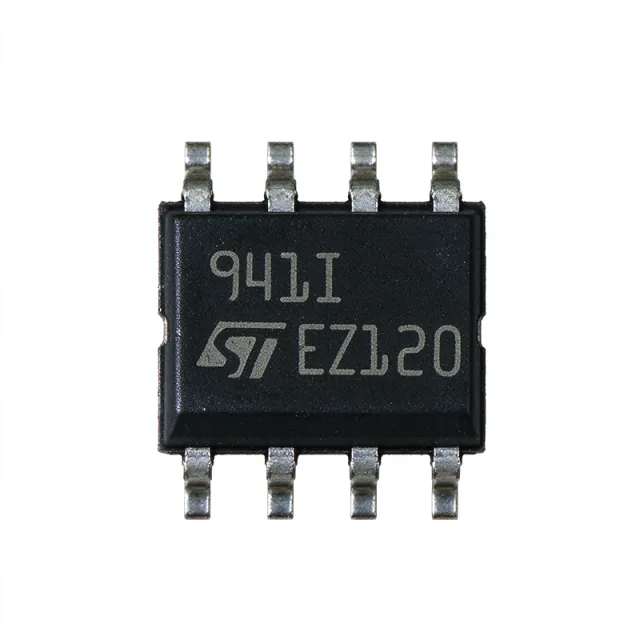
TS941ID - 2.5-10V Rail-to-Rail Op Amp | STMicroelectronics
STMicroelectronics TS941ID is a single-circuit, general-purpose operational amplifier featuring a rail-to-rail output, 2.5 V to 10 V supply operation, and an 8-pin SOIC package. The device belongs to the TS94x micropower operational-amplifier family and is designed for instrumentation, signal buffering, and other low-voltage analog signal-chain applications. Its low-noise operation, high input impedance, and approximately 1 pA input-bias current support accurate handling of high-impedance sources while its rail-to-rail output improves dynamic range near the positive and negative supply rails. An operational amplifier, or op amp, is a high-gain differential amplifier used to amplify, buffer, compare, and filter analog signals. The TS941ID sits within the operational-amplifier hierarchy and operates from a 2.5 V to 10 V supply, making it suitable for battery-powered, industrial-control, test-and-measurement, and portable equipment. Its rail-to-rail output stage allows the output voltage to approach the supply limits more closely than a conventional output stage, although the exact output swing and input common-mode behavior must be checked in the manufacturer datasheet for the selected supply voltage. Key features include a single amplifier configuration, rail-to-rail output, low-noise operation, high input impedance, and very low input-bias current of approximately 1 pA. The 2.5 V minimum supply voltage supports compact, low-energy systems, while the 10 V maximum provides compatibility with common industrial and laboratory supply rails. The manufacturer specifies operation over -40 °C to +85 °C, covering industrial temperature requirements without requiring an automotive-qualified variant. The TS941ID is intended for general-purpose precision signal conditioning rather than as a high-speed communications amplifier. Its micropower-oriented design is valuable when battery current is important, but the precise quiescent-current value should be taken from the manufacturer datasheet. The approximately 1 pA input-bias current is particularly useful with high-impedance sensors because it limits the DC current drawn through the source resistance and helps reduce input-offset errors. Typical applications include sensor-signal conditioning, low-current transimpedance buffering, portable instrumentation, industrial measurement, and general analog signal conditioning. In a transimpedance stage, the TS941ID can be paired with a suitable feedback resistor and compensation capacitor while its low input-bias current reduces bias-current-induced error. In instrumentation, it can buffer inputs before a higher-precision converter or provide gain around sensors whose output range does not use the complete supply span. When designing around the TS941ID, verify input common-mode range, output swing, unity-gain stability, noise, slew rate, and quiescent current against the actual load and supply conditions. Place input, feedback, and decoupling connections for low noise and stable feedback operation, and include adequate output-current margin for capacitive or resistive loads. The 8-pin SOIC footprint is convenient for conventional surface-mount assembly but is not as compact as the smallest QFN packages. This product page consolidates the verified manufacturer information, distributor availability references, family-level alternatives, parameter comparisons, and practical design guidance. It distinguishes confirmed TS941ID data from specifications that still require confirmation from the manufacturer datasheet, helping engineers identify the part faster without presenting unverified values as established facts.
TS941IDT - Micropower Rail-to-Rail Op Amp | STMicroelectronics
The STMicroelectronics TS941IDT is a single-circuit, general-purpose operational amplifier characterized by micropower operation and rail-to-rail output voltage swing. It is packaged in an 8-pin SOIC and is identified as a 10 kHz device. The TS941IDT is intended for low-power signal-conditioning systems where a small amplifier package, low-power operation, and rail-to-rail output capability are useful. An operational amplifier is an analog integrated circuit that amplifies the voltage difference between its non-inverting and inverting inputs. The amplifier belongs to the voltage-feedback operational-amplifier family within the broader linear-amplifier and signal-processing IC hierarchy. Rail-to-rail output operation allows the output to approach the supply rails more closely than a conventional fixed-headroom amplifier, which can simplify signal-range calculations in low-voltage systems. Key characteristics of the TS941IDT include one amplifier circuit per package, micropower operation, rail-to-rail output behavior, and a gain-bandwidth product listed at 10 kHz. These attributes make the device applicable to sensor interfaces, low-level signal conditioning, portable instrumentation, and battery-powered products. Its 8-SOIC outline supports conventional surface-mount assembly while providing separate input, output, supply, and feedback connections. The TS94x-device family is intended for general-purpose precision signal amplification rather than high-speed waveform processing. The 10 kHz gain-bandwidth characteristic favors static or slowly varying signals, including sensor outputs, reference voltages, and slow feedback-control loops. Rail-to-rail output capability improves usable output range, while the single-amplifier package reduces board area when each signal channel requires only one active device. Typical uses include low-power sensor conditioning, portable measurement systems, analog control loops, and interface stages that operate from limited supply voltages. The device can also support low-current sensing and monitoring circuits where continued operation with low power consumption is valuable. Designers should confirm input common-mode range, output swing, supply limits, noise, offset, and stability requirements against the manufacturer datasheet before selecting it for a new signal chain. PCB implementation requires care around the feedback network and supply connections. Place input and output decoupling capacitors close to the device, keep feedback-loop routing compact, and provide a low-impedance ground return. Because the TS941IDT is optimized for micropower applications, component tolerances and leakage currents can influence bias-point accuracy, especially when sensing signals close to the supply rails. This page organizes the available TS941IDT technical information with an application-focused selection guide, drop-in replacement analysis, comparison data, and practical layout guidance. It is intended to help engineers determine whether the TS941IDT's package, bandwidth, rail-to-rail output behavior, and low-power orientation fit the target circuit before committing to a design.
TS941ILT - RRIO Micropower Op Amp, SOT-23-5 | STMicroelectronics
STMicroelectronics TS941ILT is a single-amplifier, rail-to-rail input and output operational amplifier designed for low-power signal conditioning from 2.5 V to 10 V. It is packaged in the compact SOT-23-5 surface-mount package and is specified for operation from -40°C to +85°C. The TS94x family combines general-purpose signal amplification with rail-to-rail operation, allowing the amplifier to process signals near the positive and negative supply rails without requiring a separate mid-supply bias. An operational amplifier is an analog integrated circuit that amplifies the voltage difference between its non-inverting and inverting inputs. The TS941 belongs to the operational-amplifier hierarchy, where it serves as a low-power analog signal-conditioning building block for sensor interfaces, voltage buffers, filters, and low-frequency control circuits. Rail-to-rail input and output behavior is particularly useful when the available signal range occupies much of the supply voltage. The TS941ILT is a single-circuit device, allowing a compact amplifier layout without the extra channel area of dual or quad alternatives. Its 2.5 V to 10 V operating range supports low-voltage battery-powered systems as well as conventional low-voltage analog circuits. The -40°C to +85°C industrial temperature range provides useful margin for industrial, automotive-adjacent, communications, and instrumentation equipment when the complete system requirements permit that temperature range. STMicroelectronics describes the TS94x series as micropower operational amplifiers, making the family relevant to designs in which amplifier current consumption contributes materially to overall power budget. Rail-to-rail operation should be considered alongside output-current capability, noise, offset, stability, and slew-rate requirements; those detailed electrical limits should be checked in the manufacturer datasheet before selecting external feedback components or driving heavy loads. Typical applications include buffering sensor outputs, amplifying low-level analog signals, active filters, threshold detection, and low-frequency signal conditioning. The single SOT-23-5 package also supports portable instruments, battery monitoring systems, industrial transducers, and embedded analog front ends where board area and power consumption are both important design constraints. For implementation, use the manufacturer pin description table to preserve the correct input, output, supply, and offset-null assignments. Place the bypass capacitor close to the supply pin and route the sensitive input and feedback paths away from switching nodes. Verify stability, output swing, input common-mode behavior, and noise performance at the actual supply voltage and operating temperature. This product page combines manufacturer-family operating limits with practical application guidance, SOT-23-5 implementation considerations, a parameter-focused comparison, and drop-in screening notes. Those engineering details help narrow the design choice while leaving final suitability decisions to the complete circuit requirements.
TS942AID - Dual Rail-to-Rail Op Amp, 2.5-10V | STMicroelectronics
The STMicroelectronics TS942AID is a dual rail-to-rail operational amplifier designed for general-purpose instrumentation and low-voltage analog signal conditioning. It operates from a 2.5 V to 10 V supply range, is specified over a -40 °C to +85 °C temperature range, and is packaged in an 8-SOIC. The two amplifier channels are intended for applications requiring rail-to-rail output capability, low input bias current, and compact dual-channel implementation. An operational amplifier is an active semiconductor device that uses high open-loop gain to amplify the difference between two input voltages. The TS942 belongs to the STMicroelectronics TS94x family, which is characterized for operation from 2.5 V to 10 V. Rail-to-rail output capability allows the output voltage to approach the supply rails more closely than a conventional fixed-output amplifier, making the device useful in battery-powered, portable, measurement, and signal-conditioning systems. The TS942AID combines two amplifiers in one 8-SOIC package. The verified product information identifies the part as a standard general-purpose dual amplifier with rail-to-rail operation. Its low-power characteristics and 5 mA per channel output-current capability make it suitable for low-voltage analog systems where component count, supply efficiency, and board area are important. The device can be used for sensor interfaces, instrumentation amplifiers, filtering, comparators, and general voltage amplification. The TS942AID is supplied in an 8-SOIC package, providing a standard surface-mount footprint for leaded analog designs. The dual-channel configuration allows independent signal paths to share one package while preserving the familiar operational-amplifier pin arrangement. Because the device is specified down to 2.5 V, it is appropriate for systems using a 3 V or 3.3 V rail, although the exact input and output common-mode limits should be checked in the manufacturer datasheet for the operating condition. For low-voltage designs, pay attention to output swing, input common-mode range, noise, offset voltage, and stability with the selected load. Place bypass capacitors close to the supply pins and route sensitive input signals away from high-current switching paths. The 8-SOIC footprint also makes the TS942AID convenient for designs that need a straightforward replacement footprint rather than a fine-pitch or exposed-pad package. This product page combines the TS942AID manufacturer family information, exact distributor listing details, package identification, application guidance, and a practical comparison with verified drop-in alternatives. It is intended to help engineers evaluate the TS942AID for 2.5 V to 10 V dual rail-to-rail analog designs and identify compatible replacement options.
TS942AIN - Dual Rail-to-Rail Micropower Op Amp | STMicroelectronics
STMicroelectronics TS942AIN is a dual general-purpose operational amplifier designed for low-voltage, low-power signal-conditioning systems. The device provides rail-to-rail output operation, a 2.5 V to 10 V supply range, and a micropower supply current of approximately 1.2 uA per channel. It is packaged in an 8-pin Mini DIP configuration for through-hole assembly. An operational amplifier is an analog integrated circuit that amplifies the voltage difference between its two inputs while offering high input impedance, low output impedance, and stable operation around the supply rails. The TS942AIN belongs to the broader hierarchy of operational amplifier, analog amplifier, signal-conditioning IC, and power-management-dependent semiconductor. Its rail-to-rail output stage is useful when the required output signal must approach the positive or negative supply limit. The principal features of the TS942AIN include low quiescent current, dual-channel configuration, rail-to-rail output capability, and operation from 2.5 V to 10 V. The low 1.2 uA per-channel supply current reduces the burden on battery-powered or energy-harvesting systems. A typical output current of 5 mA is suitable for normal low-frequency analog signal paths, subject to the load, voltage, and stability limits defined by the manufacturer. The TS94x family is characterized for operation from 2.5 V to 10 V over a -40 °C to +85 °C temperature range. TS942AIN is the dual-amplifier version with a Mini DIP package. The 8-pin through-hole package supports conventional PCB assembly and is convenient when a compact surface-mount package is not required. Rail-to-rail output behavior improves signal swing in low-voltage instrumentation, sensor interfaces, and portable measurement circuits. Typical applications include portable sensor conditioning, low-power monitoring, current-loop interfaces, and low-voltage analog signal processing. In a sensor circuit, the TS942AIN can amplify a small transducer voltage while operating from a compact supply. In a portable measurement system, its micropower operation helps limit standby consumption. When driving larger capacitive loads or operating at higher frequencies, the designer should verify the applicable stability and load-current limits in the manufacturer datasheet. For PCB design, place the device close to the signal source and preserve short analog input traces to reduce susceptibility to noise and parasitic loading. Decouple the power supply with a local bypass capacitor and route return currents away from sensitive signal paths. The manufacturer product page and the TS942AIN datasheet should be used to confirm the exact pin assignment, electrical limits, input common-mode range, output swing, and recommended operating conditions. This page combines the manufacturer family information with practical selection guidance, package details, sourcing information, and engineering considerations. It is intended to help engineers determine whether the TS942AIN’s dual low-power architecture and 8-pin Mini DIP format fit a specific analog design before finalizing the schematic and PCB layout.