Amplifier ICs
بەرهەمەکان (3,200+)

BD3805F-E2 Car Audio Sound Processor | Rohm Semiconductor
The Rohm Semiconductor BD3805F-E2 is a dedicated car-audio sound processor IC identified by distributor listings under the Audio Special Purpose category. The verified product data describes it as an SCF built-in sound processor for car audio and identifies the -E2 variant as a 22-pin SOP device supplied in tape-and-reel packaging. It is intended for automotive audio systems that require a dedicated signal-processing function rather than a general-purpose audio amplifier. An audio sound processor is an application-specific integrated circuit that processes audio signals inside a vehicle infotainment or head-unit platform. Within the broader semiconductor hierarchy, it belongs to the audio special-purpose IC family, which sits alongside audio amplifiers, codecs, DSPs, and interface ICs. Its exact internal processing functions and electrical limits must be confirmed against the Rohm manufacturer datasheet before schematic capture or firmware configuration. The BD3805F-E2 is specifically associated with car-audio sound processing. The verified distributor listings place it among sound-processor and car-audio amplifier products, while an archived BD3805F datasheet describes the base device as an SCF built-in sound processor for car audio. This makes the part most relevant to designers of vehicle head units, source units, and aftermarket automotive audio control platforms. The -E2 ordering code is associated with the 22SOP tape-and-reel package in the verified distributor record. Package choice remains critical for automotive production because PCB land patterns, pin orientation, soldering profiles, and moisture-handling requirements must match the assembled board. No manufacturer pin-assignment table or complete electrical characterization was present in the supplied verification data. When evaluating this device, engineers should obtain the Rohm BD3805F datasheet and confirm supply voltage, interface topology, supported audio paths, control signals, reset requirements, clocking, and production test procedures. The verified web results provide purchasing and classification data but do not establish detailed operating ratings, so those parameters are marked as data needed rather than estimated. This page consolidates verified distributor classification, lifecycle-sourcing context, package information, comparison limitations, and engineering questions around the BD3805F-E2. Its alternative analysis is intentionally limited to parts supported by the supplied cross-reference evidence, avoiding unrelated audio amplifiers or processors that would require board redesign rather than a true drop-in substitution.
BD3806FS-E2 Audio Processor | ROHM Semiconductor
The ROHM Semiconductor BD3806FS-E2 is an audio special-purpose integrated circuit associated with medium-power linear and switching applications. Verified distributor records identify the component as an audio processor and audio channel IC, while package references vary between 22SOP and SSOP-32. The BD3806FS-E2 therefore belongs to the amplifier and audio-processing portion of the broader integrated-circuit hierarchy, where dedicated audio devices condition, amplify, or route low-frequency signals. An audio special-purpose IC is an integrated circuit optimized for functions such as audio amplification, channel control, signal processing, and drive-stage management. Unlike a general-purpose operational amplifier, an audio processor can incorporate application-specific circuitry intended to simplify multi-channel or medium-power audio designs. The supplied records classify the BD3806FS-E2 specifically as an audio processor, but they do not provide a verified datasheet or internal database specifications for its voltage, current, gain, channel count, frequency response, or protection features. The verified distributor classification is the principal functional attribute available for this part. Its application context is identified as medium-power linear and switching applications, indicating that it is associated with audio power-chain design rather than general signal processing. One supplier describes the device as an audio channel, while another labels it an audio processor. The latter appears repeatedly across distributor records and is therefore used as the primary product description in this data set. Physical packaging must be confirmed before PCB design or procurement. Verified sources contain both “22SOP” and “SSOP32” descriptions for BD3806FS-E2. Because the available records conflict and do not provide a complete manufacturer pinout, no reliable pin numbering or exposed-pad arrangement can be published here. The component should be ordered only after its ordering code, package drawing, lead pitch, and terminal mapping have been checked against the current ROHM Semiconductor datasheet or a distributor-controlled CAD and data sheet. BD3806FS-E2 can be evaluated for consumer audio channels, powered speakers, compact stereo systems, and other medium-power audio products in which the circuit requires an integrated audio function rather than a generic signal-path amplifier. Its precise suitability depends on supply voltage, output topology, channel configuration, thermal dissipation, and required protection, none of which can be confirmed from the supplied web evidence. Engineers should therefore avoid making final architecture or layout decisions from the distributor category alone. The primary design caution is to verify package and electrical data before substitution or assembly. A distributor listing may combine historical LAPIS Semiconductor material with a current ROHM Semiconductor record, and inconsistent package descriptions are present in the evidence. Obtain the authoritative datasheet, confirm the exact ordering suffix, and compare every pin function before compiling a footprint or designing a replacement. Distributor availability should also be checked at order time because the provided search results do not contain a stable inventory count or quoted price table. This page consolidates the verified distributor classifications, package conflicts, sourcing links, and available cross-reference evidence for BD3806FS-E2. It deliberately distinguishes confirmed information from missing electrical data and avoids inventing voltage ratings, pin definitions, pricing, drop-in equivalents, or lifecycle claims that were not supplied by the verified sources.

BD3809FS-E2 Audio Processor 22-SOP | ROHM Semiconductor
The ROHM Semiconductor BD3809FS-E2 is an audio processor integrated circuit supplied in a 22-pin SOP package. The verified distributor listing identifies the device as an audio processor, while the DigiKey listing categorizes it as an audio channel IC. The component is intended for audio signal-processing equipment where a dedicated integrated circuit is preferred over a discrete implementation of multiple analog and control functions. It is supplied in tape-and-reel packaging according to the verified product listing, with a stated inventory of 4,609 pieces at the referenced distributor as of the verification date. An audio processor IC is a specialized form of signal-processing semiconductor. In the broader hierarchy, it belongs to the integrated-circuit category and is associated with audio-channel processing, interface, and control functions. Unlike a general-purpose microcontroller or DSP, the BD3809FS-E2 is positioned specifically for audio applications. Exact input formats, output stages, control interfaces, gain settings, distortion limits, voltage requirements, and supported channel configurations are not present in the supplied verified data and should therefore be confirmed in the manufacturer datasheet before schematic capture or PCB layout. The verified catalog data provides several practical procurement and assembly facts. The BD3809FS-E2 is offered as an IC AUDIO PROCESSOR in a 22SOP package. One distributor lists its RoHS status as ROHS3 compliant, and another listing describes the component as tape-and-reel packaged. Digikey identifies the part as available from ROHM Semiconductor and provides access to datasheet, pricing, and availability information. These catalog statements make the part searchable as a dedicated audio-channel solution rather than a generic logic or memory device. The BD3809FS-E2 is relevant to audio-system design, including signal-conditioning modules, compact audio interfaces, and equipment requiring a dedicated audio processor. Because the supplied snippets do not disclose the complete electrical architecture, designers should not assume a particular microphone gain, line-level input sensitivity, speaker-drive capability, channel count, sampling format, or supply voltage. The manufacturer datasheet and pinout are the controlling references for those details. A key engineering consideration is that the 22SOP footprint requires PCB design rules appropriate to the exact lead pitch and outline shown in the manufacturer drawing. Confirm pad dimensions, pin numbering, exposed thermal features if any, soldering profile, and recommended ground layout before releasing artwork. Also verify the logic levels, power rails, decoupling requirements, and analog signal routing against the target system architecture. This page consolidates the verified catalog identity, category, package, RoHS statement, packaging format, distributor availability, and engineering-selection cautions for BD3809FS-E2. It also distinguishes verified facts from parameters that still require datasheet confirmation, helping engineers make an initial sourcing decision without mistaking category-level descriptions for full electrical specifications.

BD3813KS-E2 - 6-Channel Audio Processor | ROHM Semiconductor
The ROHM Semiconductor BD3813KS-E2 is a six-channel Bi-CMOS audio signal processor with independent master-volume control, a 129 dB dynamic range, and a 56-pin SQFP package measuring 10 mm by 10 mm. It supports a 0 dB to -95 dB attenuation range in 1 dB mute steps and can produce a maximum output of 4.2 Vrms under the specified dual-supply conditions. An audio signal processor is an integrated circuit that combines multiple functions used to condition analog audio signals. In the broader electronics hierarchy, it belongs to the signal-processing IC and audio-IC classes, where it sits between source or preamplifier stages and power amplifiers. Rather than merely amplifying signals, this device applies volume, tone, and channel-level control while preserving low residual noise and limiting audible switching transients. The six-channel architecture supports independent master-volume adjustment, making the device suitable for systems that must control several audio paths separately. Its resistance-ladder implementation is specifically intended to reduce residual noise and shock sound during switching. The Bi-CMOS process combines bipolar and CMOS characteristics and supports low-current operation. Additional features include two-wire bass and treble control, as listed for the BD3813KS-E2, and a broad 10 V to 14.6 V operating-supply range. The 129 dB dynamic-range specification applies under the manufacturer's stated tone-bypass, muted-volume, and IHF-A conditions. Maximum output voltage reaches 4.2 Vrms when the device operates from +7 V and -7 V with a 10 kohm load. These conditions are important when designing around headroom: the available output amplitude depends on supply voltage, load impedance, signal level, and the selected control settings. Typical applications include AV receivers, home-theater systems, mini-component audio systems, multichannel amplifiers, active speakers, and other 5.1-channel or 6.1-channel equipment. The device is particularly relevant where multiple amplified channels require coordinated volume control, tone adjustment, or electronic attenuation before the final power-amplifier stage. The main design consideration is supply and signal-path planning. Keep the audio input and output routing short, provide clean bypass capacitors at the supply pins, and confirm the external component values required for the intended tone-control network. Because the 56-pin square package has fine-pitch leads and an exposed thermal structure, careful soldering, handling, and PCB thermal design are required. This product overview combines the manufacturer's feature data with package information, application guidance, engineering considerations, and a conservative replacement analysis. It helps designers evaluate signal-chain fit, output headroom, control architecture, and PCB implementation before selecting the BD3813KS-E2 for a multichannel audio design.

BD3816K1 - 7-Channel Audio Signal Processor | ROHM Semiconductor
The ROHM Semiconductor BD3816K1 is a 7-channel audio signal processor, also described in distributor listings as a 6.1-channel sound processor, intended for multi-channel audio systems. The device operates from a 10 V to 14.6 V supply according to the Mouser listing and is packaged in an 80-pin QFP measuring approximately 20 mm by 14 mm. Its primary function is to process and route multiple audio channels while providing bass and treble controls, making it suitable for home-theater receivers, amplified speakers, car audio systems, and other multi-zone entertainment equipment. The BD3816K1 belongs to the broader category of audio special-purpose integrated circuits. An audio signal processor is a functional block within the signal-chain hierarchy: source audio enters the processor, control logic and internal circuitry condition the signals, and the processed outputs are sent to amplifiers, speakers, or additional audio equipment. Compared with a simple passive tone-control network, an integrated processor can centralize channel selection, volume, bass, treble, and other system functions while reducing external discrete-component requirements. Verified distributor information identifies the BD3816K1 as a 7-channel audio audio-signal processor and identifies a 2-wire bass/treble control interface. The GlobalSpec result lists a serial interface type, an operating current of 40 mA, and an operating temperature range from -20 C to +75 C. The same source also lists supply-voltage entries of 5 V and a 5 V to 7.3 V range, while Mouser identifies a 10 V to 14.6 V operating range. Because these published entries are not mutually consistent, engineers should confirm the exact electrical limits and recommended operating conditions against the applicable ROHM datasheet before committing a design. The 80-QFP package provides the physical pin count and lead arrangement required for a complex multi-channel audio device, but the supplied search results do not expose a complete verified pinout or internal block description. Use the official or archived manufacturer datasheet for pin assignments, control maps, signal-path details, recommended application circuitry, and electrical characteristics. The device is not a power semiconductor, so a safe-operating-area chart is not applicable. Its design should be evaluated around signal integrity, grounding, supply bypassing, control-bus compatibility, channel routing, and thermal performance in the final enclosure. This page combines verified distributor listings, package information, sourcing links, and engineering caveats without inventing unavailable electrical values.

BD3817KS - 7-Ch Audio Signal Processor | ROHM Semiconductor
The ROHM Semiconductor BD3817KS is a 7-channel audio signal processor with a 10-channel input selector, 0.001% THD+N, and adjustable gain from 0 dB to 7 dB in a 100-SQFP package measuring 14 mm by 20 mm. It is designed for high-fidelity audio systems that require centralized volume control and selection among multiple audio sources. An audio signal processor is an integrated circuit that manipulates or routes audio signals while adding control functions such as channel selection, volume adjustment, or gain control. Within the broader semiconductor hierarchy, the BD3817KS belongs to the signal-processing and power-management electronics used in consumer audio, home-theater, and professional audio equipment. Its combination of seven volume-controlled channels and a ten-source selector reduces the need for separate analog routing components. The principal documented features are seven volume-control channels, ten input-selection channels, 0.001% total harmonic distortion plus noise, and a gain-control range of 0 dB to 7 dB. The 100-SQFP package provides 100 electrical contacts in a relatively compact surface-mount footprint. The verified distributor listing describes the device as an audio signal processor rather than a power amplifier, so it should be positioned upstream of output amplification stages. BD3817KS integrates routing and gain control into one dedicated audio-processing device. A 10-channel input selector can organize multiple source paths, while seven independent volume channels support multi-zone or multi-speaker systems. The stated 0.001% THD+N specification is appropriate for evaluating signal-integrity requirements, although the applicable frequency range, measurement bandwidth, and test conditions are not present in the supplied data and should be confirmed in the manufacturer datasheet before design release. Typical uses include home-theater receiver routing, multi-zone listening systems, professional audio consoles, and other equipment combining several analog sources with independent level control. In a home-theater design, the processor can select among set-top-box, disc, console, and auxiliary inputs before the selected channels feed external amplifiers. In an active-speaker or amplifier platform, the same approach supports separate level adjustment for surround or zone channels. PCB implementation should preserve the analog signal paths associated with each selected channel and provide appropriate grounding and decoupling. The verified data does not state the supply voltage, exposed-pad connection, recommended capacitor values, or exact pin assignments, so these details must be taken directly from the manufacturer datasheet. A 100-pin footprint also requires careful component placement to keep routing short and preserve signal integrity. This product record combines the verified distributor identity, channel configuration, package information, THD+N figure, gain range, sourcing links, and application-oriented design guidance. It also distinguishes documented facts from unresolved parameters that require datasheet confirmation, avoiding unsupported substitutions or misleading drop-in recommendations.
BD3818KS - 6-Channel 5.1ch Audio Processor | ROHM
The ROHM Semiconductor BD3818KS is a 5.1-channel sound processor that integrates a mode selector, a five-channel input selector, six-channel volume control, gain amplification, bass, treble, mixing, and dynamic bass boost. The device is supplied in an 80-SQFP package measuring 14 mm by 14 mm. According to the manufacturer datasheet, its six-channel master volume range extends from 0 to -95 dB in 1 dB steps, with mute support. An audio sound processor is a specialized semiconductor that controls and conditions multiple audio channels before they reach amplifiers or transducers. Within the broader product hierarchy, the BD3818KS belongs to the audio signal processor class, which is distinct from a power amplifier. Its role is to select sources, set channel levels, apply tone and dynamic-bass functions, and combine the resulting channels into a usable 5.1-channel signal path. The principal functions documented for the BD3818KS include independent six-channel master volume, a five-channel input selector, a gain amplifier, bass control, treble control, mixing, and dynamic bass boost. The mode and input selectors allow an audio system to route selected sources more flexibly than a fixed analog mixer. The 1 dB volume-step resolution provides finer level adjustment than a continuously variable control implemented solely with external passive components. The BD3818KS and BD3811K1 share the same 5.1-channel sound-processor concept and integrated mode and input selectors. The BD3818KS adds mixing and dynamic bass boost, while the BD3811K1 uses bass boost instead. This distinction is important when comparing the two parts because their control features are not interchangeable even though both devices are associated with the same family documentation. Typical uses include home-theater preamplifier and selector boards, multichannel amplifier control systems, car-audio controllers, and powered speakers that require centralized channel-volume and tone adjustment. The device is intended for systems in which source selection, channel balance, and low-frequency enhancement are implemented digitally or through a remote-control bus rather than by discrete potentiometers. A successful design should preserve the recommended analog signal path, connect decoupling capacitors close to the supply pins, and route all six channels consistently to the downstream amplifier inputs. Designers should also verify the exact control logic, reference-voltage requirements, supported input levels, and unused-pin treatment against the manufacturer datasheet before releasing production artwork. This page consolidates the verified product identity, package information, distributor availability references, function summary, family comparison, and design considerations for the BD3818KS. It also identifies which electrical, pin-level, pricing, compliance, and lifecycle details still require confirmation from the original manufacturer documents.

BD3822FS-E2 - Dual-Channel Audio I/O IC | ROHM Semiconductor
ROHM Semiconductor BD3822FS-E2 is a dual-channel audio signal processor and NTSC/PAL audio I/O interface designed for recording and playback equipment such as DVD recorders. The device is specified for a 9 V operating supply, an ambient operating range of -40°C to +85°C, and a 32-pin SSOP package measuring 5.40 mm in width with 0.8 mm lead pitch. Its primary role is to condition and route audio signals within consumer video and audio equipment. An audio I/O interface is a type of signal-processing integrated circuit that connects analog audio circuitry to the recording or playback signal path. It belongs to the broader audio IC hierarchy, which includes audio amplifiers, codecs, signal processors, converters, and interface controllers. Unlike a power amplifier that primarily drives speakers or headphones, the BD3822FS-E2 manages signal compatibility, channel processing, and system-level audio routing. The BD3822FS-E2 provides two audio channels in a compact 32-pin SSOP-A package. This channel count allows a dual-channel audio path in equipment that must support both recording and playback functions. The 0.8 mm package pitch supports high-density board layouts while retaining a package format commonly used in consumer electronics and legacy multimedia systems. Its stated 9 V supply requirement places it in equipment designed around a nominal 9 V analog power rail. The device is identified as a multi-functional gate and audio I/O interface supporting NTSC and PAL video-system audio applications. This positioning makes it relevant to DVD recorders and related NTSC/PAL audiovisual equipment. Because the interface operates on analog audio signals, board design must account for grounding, signal routing, input/output isolation, and the separation of analog and digital power or return paths where both coexist on the same board. Typical uses include DVD recorder audio boards, NTSC and PAL video equipment, dual-channel recording interfaces, and legacy consumer audiovisual systems. In these applications, the BD3822FS-E2 can serve as the central audio I/O block when the surrounding circuit requires coordinated handling of left and right audio paths. Its operating-temperature range covers both commercial and industrial ambient conditions, although each assembly still requires normal thermal and signal-integrity validation. When designing a replacement circuit, verify the complete pin assignment, exposed connections, power sequencing, and external component requirements against the ROHM Semiconductor BD3822FS datasheet before connecting the IC. The package dimensions alone do not establish pin compatibility. In particular, analog input and output routing, supply decoupling, control logic, and any external crystal or timing components must match the original board architecture. This product record combines the BD3822FS-E2 device identity, package information, documented operating conditions, source links, and application guidance. It also distinguishes the exact -E2 ordering code from the broader BD3822FS family and identifies where engineering verification is required before using the device as a drop-in replacement on an existing PCB.
BD3824FS-E2 - 2-Ch I2C Audio Signal Processor | ROHM | SSOP-32
The ROHM Semiconductor BD3824FS-E2 is a single-chip 2-channel audio signal processor (audio I/O interface IC) built for NTSC/PAL DVD recorder and DVD player audio paths, housed in a 32-pin SSOP-A32 (PDSO32) surface-mount package. It operates from a single 9 V analog supply, is specified over -40 °C to +85 °C ambient, and is fabricated on a BICMOS process. An audio signal processor, also called a sound processor or audio I/O interface IC, is a mixed-signal block that sits between the analog line/tuner input stage and the system's digital-audio or DAC subsystem. Its job is to select the correct source, apply programmable gain and volume, and provide automatic level control so that recorded and played-back material keeps consistent loudness. In the broader hierarchy it belongs to signal-chain ICs -> audio processing -> audio amplifiers and special-purpose analog ICs. The BD3824FS integrates a 5-channel input selector, input gain control, tuner gain control, automatic level control (ALC), a line amplifier, a 2-channel volume control circuit and a power-save ON/OFF function, all addressed over an I2C bus. Because every gain stage is digitally trimmable, a single board revision can serve multiple tuner and line-input routings without changing external passive networks. The datasheet also highlights low distortion and low noise as primary design targets for the audio path. Because the I2C interface, ALC loop and volume block share one silicon die, the chip reduces external op-amps, switches and log/antilog networks. The BD3822FS sibling covers the level-meter and volume role, while BD3824FS covers the line-amplifier role; the two parts are pin compatible, so one board pattern supports both a high-end and a low-end model. Typical uses include DVD recorder and DVD player analog audio boards, NTSC/PAL video deck audio front ends, set-top and video/audio combination decks, and other legacy consumer playback/record equipment that still relies on I2C-programmable analog level control. When laying out the board, keep the I2C pull-ups short and route them away from the audio input traces; the ALC and gain stages amplify whatever noise couples in from the input pins. Also respect the single 9 V analog rail and decouple it locally, since supply ripple modulates the gain stages and the ALC detector. This page brings together the distributor channel listings, the pin-compatible family relationship between BD3822FS and BD3824FS, and practical design notes on I2C control, ALC behaviour and analog layout that are not collected together in the manufacturer datasheet.
BD3827K-E2 - Car Audio Sound Processor | ROHM
ROHM Semiconductor BD3827K-E2 is an SCF built-in sound processor with equalizer for car-audio systems, supplied in an SSOP package. The verified product information identifies the device as a special-purpose audio signal processor and describes the BD3827K family as an SCF built-in sound processor for car audio. These confirmed attributes place it within the broader hierarchy of audio IC, sound processor, car-audio processor, and semiconductor categories. A sound processor is a dedicated analog audio IC that adjusts or conditions multiple audio signal parameters within a vehicle infotainment or head-unit system. By integrating sound-shaping and equalizer functions into one device, the BD3827K family can reduce the number of separate external control components required by a car-audio architecture. Its exact internal signal path, supported filter modes, control interface, and channel configuration must be confirmed from the manufacturer datasheet before a new circuit is released. The verified manufacturer-linked documents identify BD3827K as an SCF sound processor with equalizer functionality for automotive audio. The E2 ordering code is available from DigiKey as part number 846-BD3827K-E2TR-ND. A distributor-provided datasheet copy also identifies the device as lead-free and RoHS compliant. No numerical input-voltage range, output-voltage range, current consumption, channel count, frequency response, control-bus timing, or absolute maximum ratings were present in the supplied search results. BD3827K-E2 belongs to ROHM Semiconductor's legacy audio-processing portfolio and is positioned for car-audio rather than general-purpose signal conditioning. Its equalizer role suggests that the device is intended to compensate for speaker, enclosure, cabin, and source characteristics, subject to confirmation of the specific modes and control options in the datasheet. The device should be evaluated against the exact filter architecture, signal levels, control protocol, and end-product test requirements rather than by package alone. Typical use cases include automotive head units, CD or radio source modules, in-dash audio controllers, car-amplifier input conditioning, and vehicle sound-field adjustment. In these systems, the processor can sit between source audio and downstream amplifiers, allowing tonal corrections to be applied before power amplification. Integration can simplify the analog signal path, but validation must include channel alignment, distortion, noise, clipping, thermal behavior, and automotive operating requirements. The principal design caution is that the available search snippets do not expose a complete pinout or electrical limit table. Engineers should use the ROHM BD3827K datasheet to confirm every pin, supply connection, ground requirement, external component, control signal, and test point before layout or firmware work. The component is an SSOP package, so pin escape and exposed-pad assumptions must not be made without the full package drawing and pin description. This product record consolidates the confirmed manufacturer-linked datasheet information, distributor identification, sourcing links, ordering code, and application context for BD3827K-E2. It also separates verified facts from unavailable numerical parameters, helping engineers locate the authoritative six-page BD3827K datasheet and assess car-audio sound-processing requirements without treating inferred specifications as verified production data.

BD3850FS-E2 Audio Sound Processor | ROHM Semiconductor
The ROHM Semiconductor BD3850FS-E2 is an audio-channel sound processor integrated circuit associated with a 24-pin SSOP-A24 package. It is designed for audio signal-processing systems where multiple sound channels require centralized control rather than discrete analog circuitry. The -E2 suffix identifies the exact ordering configuration, so it should be matched against the manufacturer ordering guide when replacing an existing component. An audio sound processor is a specialized integrated circuit that receives, organizes, and controls audio signals within a larger audio system. In the product hierarchy, it belongs to the broader class of audio amplifiers and then to integrated circuits and semiconductors. Such devices can simplify board partitioning by consolidating channel routing, gain control, or other signal-conditioning functions into one package. The BD3850FS-E2 is identified by its distributors as an Audio Special Purpose or Audio Channel device. The associated documentation describes the device family as a sound processor and shows a 24-pin SSOP-A24 package. This surface-mount package supports compact equipment designs while providing enough external connections for a multi-channel audio architecture. Because this part is specifically intended for audio-channel processing, it is relevant to equipment that routes or conditions multiple sound paths. A sound processor can reduce the number of separate routing and gain-control blocks required around amplifiers, converters, and output stages. Exact channel count, voltage ratings, gain settings, and interface timing should be confirmed from the ROHM Semiconductor datasheet before schematic capture. Typical application directions include surround-sound systems, powered speakers, compact home-audio equipment, and industrial audio panels. Its 24-pin SSOP-A24 package makes it more appropriate for established through-hole-era board layouts than for exceptionally dense portable layouts. Pin assignment, exposed thermal behavior, and decoupling requirements remain central to successful implementation. During PCB design, route analog audio inputs and outputs away from switching nodes and high-current return paths. Confirm that the PCB land pattern matches SSOP-A24 rather than a visually similar 24-pin package. Use the manufacturer reference circuit for recommended input and output networks, power-supply connection, and component values. This product page consolidates the exact ordering code, package information, sourcing structure, and engineering guidance needed to evaluate the BD3850FS-E2. The comparison and design notes also help distinguish package compatibility, circuit integration, and application fit before committing a new audio design to this sound processor.
BD3861FS - 3-Band Audio Equalizer Sound Processor | ROHM
The ROHM BD3861FS is an analog sound processor with a built-in three-band equalizer, controlled through a two-wire serial interface and intended for boom boxes, mini-audio systems, micro-audio systems, and front-stage preamplifiers. The device is offered in a 32-pin SSOP package and is identified by ROHM as a Last Time Buy product following its discontinuation announcement. An audio sound processor is a specialized analog signal-chain IC that adds source selection, tone shaping, and level control functions before a power amplifier. The BD3861FS combines those functions into one IC, allowing a compact consumer-audio design to implement bass, midrange, and treble adjustment without requiring a separate network of analog switches and passive tone-control circuitry. According to the ROHM product page, the key feature is the integrated three-band equalizer. The manufacturer documentation describes high signal-to-noise performance obtained through a two-stage architecture, while the two-wire serial control provides electronic adjustment from a remote-control processor or system controller. The verified sources also identify the family as supporting sound-quality designs that incorporate source selectors and serve as the preamplifier immediately ahead of a power amplifier. Typical applications include boom-box and portable-stereo signal paths, compact micro-audio systems, and preamplifier stages that feed an external audio power amplifier. Its integration can reduce external switching components and simplify control firmware, although the 32-pin SSOP footprint is larger than modern compact audio-controller packages. System designers should confirm the complete pin functions, electrical limits, and serial-command table in the manufacturer datasheet before laying out a new board. Because the BD3861FS is in Last Time Buy status, engineers should avoid new-volume designs unless the supply situation is commercially acceptable and a documented time-buffer plan exists. For an active production program, evaluate a currently supported audio processor with the same required control protocol, source-selection functions, equalizer bands, and system-level pin compatibility instead of assuming that a mechanically similar IC is electrically interchangeable. This page consolidates the verified manufacturer and distributor information, identifies the product's discontinuation status, and separates confirmed capabilities from electrical details that must be confirmed in the original datasheet. Pricing, stock, and remaining-life conditions are quote-dependent and are not presented as guaranteed availability.
BD3861FS-E2 - 2-Channel Audio Signal Processor | ROHM
ROHM BD3861FS-E2 is a two-channel analog audio signal processor with built-in three-band equalization, 2-wire serial control, and a 32-pin SSOP-A package. It operates from a 6.5 V to 9.5 V supply, uses the BiCOMS process, and is designed for stereo audio products requiring volume, tone, source selection, and other audio-control functions. An audio sound processor is an analog integrated circuit that conditions multiple audio channels and provides programmable control functions in equipment such as mini-component stereo systems, boom boxes, compact audio products, and other consumer electronics. Within the broader signal-chain hierarchy, it belongs to the sound-processor IC family, works alongside audio amplifiers and source-selection circuits, and provides a centralized control interface between the system controller and analog audio paths. The BD3861FS-E2 emphasizes signal-to-noise performance through a two-stage implementation of front-volume and rear-volume control. Its resistance-ladder volume and tone implementation is intended to provide low noise and low distortion, while the built-in three-band equalizer supports bass, midrange, and treble adjustment. The 2-wire serial interface reduces control-pin count compared with a parallel-control architecture and simplifies connection to a host controller. ROHM identifies the device as a BiCOMS audio processor. The BD3861FS-E2 is specified for a 6.5 V to 9.5 V supply, an operating temperature range of -25 °C to +75 °C, and a 32-SSOP-A surface-mount package approximately 5.4 mm wide. The 32-pin package provides separate signal and control connections for a two-channel processor, although the complete pin map must be taken from the manufacturer datasheet before PCB routing or replacement. Typical applications include compact stereo systems, boom boxes, mini-component audio equipment, portable audio products, and other two-channel products that require electronic volume and three-band tone control. The serial control interface is particularly useful where a system controller must adjust sound settings while keeping the front-panel wiring compact. In multi-source products, source-selection control can be coordinated with the processor rather than implemented entirely through a separate relay-based network. Designers should confirm the serial protocol, command map, reset requirements, and control timing in the manufacturer datasheet. The audio path should be evaluated for gain structure, clipping, channel separation, and pop-noise behavior across the full input range. PCB layout should keep audio traces short, maintain a continuous ground reference, and isolate control signals from sensitive audio nodes to reduce coupling. This product page organizes the confirmed operating information, lifecycle status, package details, family context, application guidance, and engineering trade-offs into one focused reference for evaluating the BD3861FS-E2 in new or existing stereo audio designs.
BD3870FS-E2 - 2-Channel BiCMOS Audio Processor | ROHM
ROHM BD3870FS-E2 is a two-channel analog audio sound processor with a built-in equalizer and BiCMOS construction, supplied in a 24-pin SSOP-A surface-mount package. The device supports a 4.5 V to 9.5 V supply range and combines input selection, input-gain amplification, volume, bass, treble, surround processing, and loudspeaker equalization functions in one audio signal-processing IC. Its two-wire serial-control architecture allows an external controller to adjust multiple sound parameters while reducing the number of analog control connections. An audio sound processor is a mixed-signal IC positioned between source selection and the power-amplifier stage of a home-audio or compact-audio system. It conditions left and right channel signals and applies gain, tonal balance, surround, and loudspeaker-response functions. Within the broader hierarchy, the BD3870FS-E2 belongs to the audio processor family of analog and mixed-signal integrated circuits, rather than to a power-amplifier category. This distinction matters because its outputs are intended to drive a downstream audio amplifier rather than directly power a loudspeaker. The manufacturer highlights flexible bass characteristics using external components, allowing the center frequency and Q factor to be adjusted according to the speaker system. A mute function assigned to one input pin supports crosstalk suppression during source changes. A surround function can also be implemented without external components. These features make the IC useful in boom boxes, mini-component systems, home-audio products, and other designs requiring programmable tonal shaping within a compact circuit footprint. The BiCMOS process combines bipolar and CMOS circuit technologies, supporting analog signal processing together with low-power digital control functions. Two-wire serial control is particularly useful when a system uses a microcontroller or digital control interface: the host controller can set operating states and sound parameters through a compact command path. Exact internal gain, control-voltage timing, and output-routing details should be taken from the BD3870FS, BD3871FS, BD3872FS, and BD3873FS datasheet before final circuit design. Typical uses include two-channel input selection in mini hi-fi systems, bass and treble adjustment, surround processing for home-audio equipment, and loudspeaker equalization in compact speaker products. Because the device is an audio signal processor rather than a power amplifier, the design must include downstream amplification with adequate output power and appropriate input impedance. For PCB implementation, preserve the pin assignments and exposed-pad requirements of the exact ordering code, place input and output return paths away from switching-power nodes, and decouple the supply pins close to the device. Confirm absolute maximum ratings, recommended operating conditions, external-component values, and the required support-component topology from the manufacturer datasheet before release to production. This product page consolidates the confirmed function, supply range, package information, control architecture, sourcing entry point, and practical design considerations for BD3870FS-E2. It also distinguishes strict footprint-compatible alternatives from related family members that require different circuit or package arrangements, helping engineers assess replacement options without changing the PCB unknowingly.
BD3873FS-E2 - 3-Band Audio Processor | ROHM | Home Audio
The ROHM Semiconductor BD3873FS-E2 is a two-channel audio sound processor with a built-in three-band equalizer, operating from 4.5 V to 9.5 V in a 24-SSOP-A surface-mount package. It integrates input selection, input-gain amplification, volume control, surround processing, bass and treble tone controls, mute control, and loud-speaker equalization functions for compact home-audio systems. An audio sound processor is an analog signal-conditioning IC used between audio sources and a power amplifier. Within the broader semiconductor hierarchy, it belongs to the audio-processor and audio-special-purpose IC category rather than the general-purpose amplifier category. Its purpose is to select and condition multiple stereo inputs, adjust level and tone, and create a surround-sound effect before the signal reaches an external output amplifier. The BD3873FS-E2 provides flexible bass characteristics through external components, allowing the center frequency and Q factor to be tailored rather than being fixed entirely inside the IC. A mute function on one input pin supports crosstalk suppression when an unused source is selected. The device also supports a surround function without additional external components and uses a BiCMOS process to combine bipolar and CMOS functions with low current consumption. Two-wire serial control provides a compact interface for setting operating conditions, reducing the number of external controls needed in a compact audio system. This architecture is useful in boom boxes and mini-component systems, where multiple source inputs, volume, tone, balance-related functions, and surround processing must coexist without consuming excessive board area. The 4.5 V to 9.5 V supply range is compatible with conventional single-rail consumer-audio circuitry operating within that voltage range. Typical applications include compact stereo systems, boom boxes, mini-component audio products, portable consumer-audio equipment, and small television or multimedia sound systems. In these systems, the BD3873FS-E2 can consolidate source selection and tone processing before the power-amplifier stage. Its integrated surround function can reduce external component count when a basic spatial-effect presentation is sufficient. PCB design should preserve the intended analog signal path, maintain short connections around the input and output pins, and follow the manufacturer reference layout and external-component recommendations. The external bass network should be populated and evaluated with its documented resistance and capacitance values. Confirm that the selected two-wire control implementation and mute polarity match the host system before releasing the PCB. This page consolidates the product-page features, package information, functional features, sourcing guidance, and practical integration considerations for the BD3873FS-E2. It also identifies the electrical and environmental parameters that require confirmation in the manufacturer datasheet before a new design is released.

BD3881FV-E2 - 2-Channel Audio Sound Processor | ROHM
The ROHM Semiconductor BD3881FV-E2 is a two-channel audio signal processor and sound controller packaged in a 28-SSOP-B. It is a silicon monolithic integrated circuit intended for radio cassette recorders and mini component stereo systems. The device combines stereo audio signal processing with playback control functions in one dedicated IC, reducing the component count required by conventional analog audio designs. An audio sound processor is a specialized integrated circuit that manages multiple functions within an audio playback system. In the broader product hierarchy, it belongs to the audio IC category, which sits below signal-processing integrated circuits and above general-purpose analog and digital semiconductors. Unlike a power amplifier that primarily drives speakers, this device performs control and signal-processing tasks around the program source and audio path. The BD3881FV is identified as a two-channel processor, allowing left- and right-channel audio functions to be handled in one package. Its 28-SSOP-B package is intended for surface-mount PCB assembly, while the -E2 ordering suffix identifies the specific packaged orderable configuration. The manufacturer's datasheet describes the BD3881FV family as a sound processor for radio cassette recorders and mini component stereo equipment. The BD3881FV-E2 is designed to simplify dual-channel audio subsystem implementation compared with discrete control networks. Its integrated processor architecture can centralize channel-related signal handling and reduce repeated component placement. The exact input/output levels, control voltage ranges, channel parameters, and internal block functions should be confirmed against the manufacturer datasheet before setting analog biasing, timing, or system gain around the device. Typical applications include radio cassette recorder decks, compact stereo systems, cassette playback equipment, and legacy consumer-audio products in which two-channel program processing is required. In these systems, the IC can support the audio-control path while separate amplification stages provide the power needed to drive the speakers. Care should be taken to match the package footprint and pin functions when adapting the design to a different processor or controller. For a new design, use the manufacturer pin-description table and typical application circuit to establish input, output, control, supply, and ground connections. Verify absolute maximum ratings, recommended operating conditions, and external component values before layout. The 28-pin surface-mount package also benefits from short analog traces, adequate ground-plane continuity, and decoupling placed close to the supply pins. This product record combines the manufacturer application description with practical engineering guidance, package information, sourcing instructions, and a transparent drop-in-replacement assessment. It is intended to help engineers determine fit, establish the correct supporting documents, and plan an audio-control PCB implementation without relying on generic category descriptions.

BD3882FV-E2 - 2-Channel Sound Processor | ROHM
The ROHM Semiconductor BD3882FV-E2 is a 2-channel audio sound processor designed for radio cassette recorders and mini component stereo systems, housed in a 40-pin SSOP-B package. Its primary identifiers are the BD3882FV-E2 ordering code, 2-channel audio signal processing, and the 40-SSOP-B surface-mount package. An audio sound processor is an application-specific integrated circuit that combines multiple functions required by analog audio equipment. Within the product hierarchy, it is an audio signal processor, an integrated circuit, and a semiconductor. Unlike a general-purpose DSP, this device is optimized for compact cassette and stereo systems, where recording and playback signal paths require coordinated level and mode control rather than programmable digital processing. ROHM describes the BD3882FV family as a sound processor for radio cassette recorders and mini component stereos. The BD3882FV-E2 is categorized as an audio special-purpose IC and a 2-channel device. Its 40-SSOP-B package supports dense PCB layouts while providing the pin count needed for a multifunction analog audio subsystem. The -E2 ordering suffix identifies the specific supplied device variant. The architecture is described as a silicon monolithic integrated circuit, and a related technical listing identifies the BD3882 as a BiCMOS audio circuit. This combination places the device between simple discrete audio control and more complex programmable processing. Its implementation is intended for ordinary audio-visual, office-automation, communications, electrical-appliance, and electronic-toy equipment, as stated in the ROHM datasheet. Typical uses include cassette-recorder playback and recording control, mini stereo signal routing, home-audio channel processing, and compact multimedia equipment. In these systems, the sound processor can organize dual-channel audio functions while reducing the number of separate analog control components. The 40-pin package is particularly relevant where board area is constrained but multiple audio signal paths must remain accessible. Designers should use the pin-description table, typical application circuit, and electrical characteristics in the manufacturer datasheet when assigning each signal. Input and output decoupling, grounding, signal levels, mode-control logic, and supply bypassing must follow the recommended circuit because the device is intended for a specific analog audio architecture rather than general-purpose signal routing. This page consolidates the device identity, package, channel count, application role, ordering information, source links, and engineering guidance into a compact selection reference. It also distinguishes documented BD3882FV family information from the exact BD3882FV-E2 ordering variant and focuses replacement decisions on verified, pin-compatible options.

BD3888FS-E2 Audio Sound Processor | ROHM Semiconductor
The ROHM Semiconductor BD3888FS-E2 is an audio-channel sound processor designed for television audio systems. It is identified as an Audio Special Purpose integrated circuit and is supplied in a surface-mount Small Outline Package (SOP). The device is associated with surround-sound processing and television audio applications, providing a dedicated solution for reproducing and processing audio channels in compact consumer-electronics designs. An audio sound processor is a specialized type of audio IC. Within the broader product hierarchy, it belongs to audio-channel processing, then audio signal processing, then consumer audio integrated circuits, and ultimately the semiconductor category. Unlike a power amplifier, the primary function of this device is signal processing rather than output-current amplification. Its exact internal architecture, supported channel configuration, operating limits, and external interfaces must be established from the ROHM datasheet before implementation. The BD3888FS-E2 is packaged for automated surface-mount assembly and is marked as lead-free and RoHS-compliant. This combination makes it suitable for production boards that require a compact, solderable audio-processing component. The ordering suffix identifies the specific ROHM packaged part, while BD3888FS is the base device designation used in datasheet references and cross-reference searches. ROHM describes BD3888FS as an audio sound processor for TV applications. This positioning makes the device relevant to television mainboards, analog and digital television audio paths, surround-sound decoding systems, and legacy audio modules requiring a dedicated processor. Evaluation should include the television's channel format, system clock, control interface, analog signal levels, grounding arrangement, and required bypass network before the component is committed to a new design. The BD3888FS-E2 can also serve as a functional reference when evaluating sound processors for consumer television equipment. Because it is a specialized audio-channel IC rather than a general-purpose amplifier, replacement work should focus on equivalent processing functions, pin compatibility, control timing, and system-level bus behavior. The manufacturer pin-description table should govern board layout and signal assignments. A careful design process starts with the ROHM BD3888FS datasheet, then confirms package dimensions, pin functions, supply requirements, clock assumptions, and external component values. PCB reviewers should preserve the documented decoupling topology, keep analog audio routing short, and separate sensitive signal paths from noisy digital or switching-regulator sections wherever the reference configuration permits. This product page combines the verified BD3888FS-E2 identity, packaging, compliance, and sourcing information with a parameter-by-parameter comparison framework and practical integration guidance. It also distinguishes confirmed drop-in substitutions from related family parts, helping engineers evaluate the device without treating merely similar sound processors as electrically and mechanically interchangeable.

BUF634AIDDAR - 210MHz 250mA High-Speed Buffer | Texas Instruments
The Texas Instruments BUF634AIDDAR is a 36 V, 210 MHz high-speed open-loop buffer with 250 mA output current capability and a 3750 V/us slew rate, housed in an 8-pin SOIC PowerPad (DDA) package. A buffer amplifier is a unity-gain voltage follower that isolates a high-impedance source from a low-impedance load, providing current gain without voltage gain. Within the power-management and signal-chain hierarchy, the BUF634A sits between precision amplifiers and their loads, forming part of the broader family of high-speed operational amplifier and buffer ICs used in analog front ends. Key features include pin-selected bandwidth from 35 MHz to 210 MHz, adjustable via an external resistor between the V- and BW pins, an internal output current limit, and integrated thermal shutdown protection. Quiescent current is only 1.5 mA when configured for the 35 MHz bandwidth, making the part efficient for low-power designs that still need bursts of high output drive. Architecturally, the BUF634A is a high-fidelity open-loop buffer that can operate standalone or inside the feedback loop of an op amp to boost output current. The wide supply range of +/-2.25 V to +/-18 V (4.5 V to 36 V total) supports both low-voltage and high-voltage analog rails, while the PowerPad SOIC-8 package provides a low thermal-impedance path to the PCB for dissipating heat during sustained high-current output. Typical applications include high-performance audio headphone and line drivers, precision instrumentation signal buffering, and driving ADC input or coaxial cable loads where 250 mA peak current and wide bandwidth are required simultaneously. A key design consideration is thermal management: at large output currents and voltage swings, estimate power dissipation and use the exposed PowerPad soldered to a copper pour to keep junction temperature within limits; the BW pin resistor trades bandwidth against quiescent current. This page synthesizes distributor pricing, drop-in alternatives, pinout data, and practical design notes not found in the manufacturer datasheet, as of 2026-09-13.
BUF634AIDR - 210MHz, 250mA High-Speed Buffer | Texas Instruments
The Texas Instruments BUF634AIDR is a 36-V, 210-MHz, 250-mA output high-speed open-loop buffer amplifier supplied in an 8-pin SOIC (0.154 inch, 3.90 mm width) surface-mount package. As an upgraded member of the BUF634A family, it drives up to 250 mA of output current while offering an adjustable bandwidth from 35 MHz to 210 MHz, set by a single external resistor connected between the V- and BW pins. A buffer amplifier (also called a unity-gain amplifier or voltage follower) is a signal-conditioning stage that isolates a high-impedance source from a low-impedance load while preserving voltage amplitude. Within the analog signal-chain hierarchy, buffers sit between operational amplifiers and power drivers, providing the high output-current capability that general-purpose op amps lack, without adding closed-loop gain or instability. Key differentiating specifications of the BUF634AIDR include its 250 mA push-pull output-current capability, 36-V supply rating (suitable for dual-supply rails up to +/-18 V), and the user-adjustable 35 MHz to 210 MHz bandwidth. The bandwidth pin allows designers to trade bandwidth for quiescent power, an unusual and valuable feature in a monolithic buffer. The device operates as a standalone open-loop driver or inside an op-amp feedback loop to boost output drive current. Technically, the BUF634A is a high-fidelity, open-loop bipolar buffer. Because it operates open-loop, it adds no phase shift typical of compensated amplifiers, making it stable when placed inside the feedback loop of high-speed op amps such as the TLE207x or TL082 families, which the manufacturer identifies as common companions. The push-pull output stage sources and sinks current symmetrically, improving linearity under reactive loads. Typical applications include high-speed line drivers, video signal distribution, ADC input driving, and audiophile headphone-amplifier output stages, where the combination of 250 mA drive and wide bandwidth maintains signal fidelity. Industrial test instrumentation also benefits from its robust supply range. A key design consideration is bandwidth selection: setting the external BW resistor for just enough bandwidth minimizes quiescent current and high-frequency noise pickup, while the full 210 MHz setting maximizes slew-driven transient performance at higher power. This page synthesizes distributor pricing, verified drop-in replacement data from TI engineering forums, and practical design guidance not found in the manufacturer datasheet alone.

BUF634FKTTT - 250mA 180MHz High-Speed Buffer | TI
The Texas Instruments BUF634FKTTT is a 250 mA high-speed unity-gain open-loop buffer amplifier with 180 MHz bandwidth and 2000 V/us slew rate, housed in a 5-pin TO-263 (DDPAK/KTT) package rated from -40C to +125C. A buffer amplifier is a unity-gain analog stage whose sole purpose is to provide current drive and isolation between a high-impedance source and a low-impedance load. In the power-management and signal-chain hierarchy, buffers sit between precision op amps and their loads, preventing the output stage of the amplifier from dissipating load current internally - a phenomenon known as thermal feedback that degrades offset and drift specifications. The defining feature of the BUF634 is its ability to operate inside the feedback loop of an op amp to multiply available output current up to 250 mA, eliminate thermal feedback, and dramatically improve capacitive load drive. Its 2000 V/us slew rate and 180 MHz bandwidth preserve the speed of the host amplifier, while the wide supply range of +/-2.25V to +/-18V (4.5V to 36V total) covers virtually all precision analog rails. Internally, the BUF634 is a complementary class-AB emitter-follower architecture with a bandwidth-select pin (BW). Tying BW to V- engages the full 180 MHz / 10 mA-standby mode; leaving BW open reduces quiescent current for power-sensitive designs at reduced bandwidth. The KTT DDPAK-5 tab provides a low-thermal-resistance path to the PCB copper for sustained 250 mA output currents. Typical applications include output-current boosting of precision op amps in test and measurement front ends, cable and capacitive-load drivers in data acquisition systems, video and IF signal distribution, and loop-powered actuator drivers in industrial control. Design consideration: place a small series resistor or short snubber at the output when driving long cables, and keep the BW pin connection as short as possible to avoid RF pickup in high-speed mode. This page synthesizes verified distributor data, the TI BUF634 family cross-reference, and practical design guidance in one place - information not consolidated in the manufacturer datasheet alone.

BUF634P - 250mA, 180MHz High-Speed Buffer | Texas Instruments
The Texas Instruments BUF634P is a 250 mA high-speed, unity-gain open-loop buffer amplifier with a pin-selected bandwidth of 30 MHz or 180 MHz, a 2000 V/us slew rate, and a wide supply range of +/-2.25 V to +/-18 V, housed in an 8-pin PDIP (P) package. A buffer amplifier (also called a unity-gain voltage follower) is an analog IC that replicates its input voltage at its output while providing high input impedance and low output impedance. In the signal-chain hierarchy, the buffer sits downstream of op amps, DACs, and sensors, isolating gain stages from heavy or reactive loads. Buffers are a subset of operational amplifier analog front ends within the broader category of amplifiers and linear ICs. Key differentiating features include the 250 mA continuous output current capability, the unique pin-selectable bandwidth: connecting the BW pin to V+ yields the full 180 MHz bandwidth, while leaving it open reduces bandwidth to 30 MHz and cuts quiescent current to only 1.5 mA. Internal current limiting and thermal shutdown protection provide robust fault tolerance, and the +/-18 V supply range supports high-voltage analog systems. Architecturally, the BUF634 is an open-loop, unity-gain buffer with no external compensation requirements, making it inherently stable and free of phase-reversal issues. Because it operates open-loop, inserting it inside an op amp feedback loop increases output current, eliminates thermal feedback errors at the op amp input stage, and dramatically improves capacitive-load drive capability - a technique documented in the manufacturer datasheet application section. Typical applications include headphone amplifiers (where 250 mA drives low-impedance headphones directly), op amp output current boosting in test and measurement equipment, video distribution and cable driving, and PLC/analog output modules. The BUF634P is also a perennial favorite in high-end DIY audio buffer stages. Design-wise, keep the BW pin short to V+ only when slew and bandwidth demand it; the 30 MHz mode saves over 20 mA of quiescent current in multi-channel designs. On 8-pin PDIP, thermal resistance limits continuous dissipation - verify power at high load currents. This page synthesizes verified distributor data, family cross-references, and practical design guidance not found in the manufacturer datasheet alone.
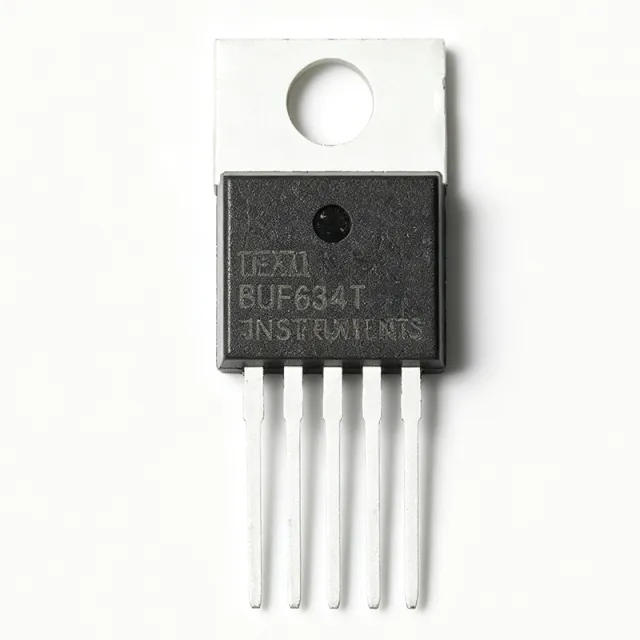
BUF634T - 250mA High-Speed Buffer, 2000V/us | Texas Instruments
The Texas Instruments BUF634T is a 250 mA high-speed, unity-gain, open-loop buffer amplifier with a 2000 V/us slew rate, pin-selected 180 MHz bandwidth, and a wide supply range of up to plus or minus 18 V, housed in a 5-pin TO-220-5 package. A buffer amplifier (also called a unity-gain voltage follower) is a specialized amplifier stage with a gain of one that isolates a high-impedance source from a low-impedance load. In the signal-chain hierarchy, buffers sit between operational amplifiers and their loads: an op amp provides voltage gain while the buffer provides current gain, preventing load-induced distortion and thermal feedback inside the gain element. Buffers are a core building block of analog power management and output driver design. Key features of the BUF634T include 250 mA of continuous output current, an extremely fast 2000 V/us slew rate, and a unique pin-selected bandwidth mode: connecting the BW pin to V- enables the full 180 MHz bandwidth (1.5 mA typical quiescent... 30 MHz mode draws only 1.5 mA... full 180 MHz mode draws approximately 11 mA). Internal current limiting and thermal shutdown protection provide robustness against output shorts and overloads. The device is fabricated on a bipolar process optimized for speed and drive capability rather than precision offset. Architecturally, the BUF634 is a completely open-loop, unity-gain buffer, so it adds no phase shift from feedback compensation and can be placed inside an op amp feedback loop to boost output current, eliminate thermal feedback errors in the op amp input stage, and improve capacitive load drive without oscillation risk. Typical applications include headphone amplifier output stages (a classic pairing with the OPA627 or OPA134), video distribution and line driving, op amp output current boosting for test and measurement instrumentation, and capacitive load isolation for ADC input drivers and cable drivers. Design consideration: the BUF634T is not a precision amplifier - offset voltage and drift are far looser than a precision op amp, so place it inside an overall feedback loop when DC accuracy matters. Power dissipation scales with load current and supply headroom, so the TO-220-5 tab should be heat-sunk for sustained high-current operation. This page synthesizes distributor pricing, drop-in alternative analysis, and practical design notes not found in the manufacturer datasheet.
BUF634U - 250mA, 180MHz High-Speed Buffer | Texas Instruments
The Texas Instruments BUF634U is a 250 mA high-speed unity-gain open-loop buffer amplifier featuring a 2000 V/us slew rate and a pin-selected bandwidth of up to 180 MHz, housed in an 8-pin SOIC (SO-8, 3.90 mm width) surface-mount package. A buffer amplifier is a unity-gain voltage follower that isolates a high-impedance source from a low-impedance load while delivering substantial output current. Within the power-management and signal-chain hierarchy, buffers sit between amplifiers and loads, extending the drive capability of operational amplifiers, ADCs, and filters. Buffers trade voltage gain for current gain, and the BUF634 is a classic open-loop buffer architecture in which the output stage is driven directly by the input, minimizing transient distortion. Key features include 250 mA of output current, a 2000 V/us slew rate that preserves fast edges, a wide supply range of +/-2.25 V to +/-18 V (4.5 V to 36 V total), and a low 1.5 mA quiescent current when operated in the 30 MHz low-power bandwidth mode selected via the bandwidth pin. Internal current limiting and thermal shutdown protection guard the device against overload faults. Technically, the BUF634 combines a high-speed bipolar input stage with a push-pull class-AB output stage. The pin-selected bandwidth (30 MHz or 180 MHz) lets designers trade quiescent power for speed: low-power mode suits battery and portable designs, while full-bandwidth mode supports fast pulse and video signal chains. Because it is open-loop, phase reversal is not an issue and it can be placed inside an op-amp feedback loop to boost output current, eliminate thermal feedback on the input stage, and improve capacitive load drive. Typical applications include op-amp output current boosting in instrumentation amplifiers, line drivers for video and communications, headroom-limited audio headphone amplifiers, and capacitive-load driving in data-acquisition front ends. A key design consideration: the bandwidth-select pin must be tied appropriately (to V- for 180 MHz or open with capacitor for 30 MHz); leaving it floating can produce unpredictable frequency response. Note that the BUF634U is designated not recommended for new designs (NRND); TI recommends the BUF634A as a pin-compatible upgrade. This page synthesizes distributor pricing, drop-in alternatives, application guidance, and lifecycle information not consolidated in the manufacturer datasheet.