Speicher-ICs
Unterkategorien
Produkte (459)

HMAA8GR7CJR4N-RD - 64GB DDR4-3200 ECC RDIMM | SK hynix
The SK hynix HMAA8GR7CJR4N-RD is a 64GB DDR4 registered DIMM (RDIMM) with ECC, operating at 3200 MT/s (PC4-25600) at 1.2V in a 288-pin dual-rank (2Rx4) form factor. A registered DIMM (RDIMM) is a server-class memory module that buffers the command and address signals through a register IC before they reach the DRAM chips, reducing electrical loading on the memory controller and enabling higher module counts per channel than unbuffered UDIMMs. Within the memory hierarchy, RDIMMs belong to the DDR4 SDRAM family, itself part of the broader volatile dynamic random access memory (DRAM) category used in servers, workstations, and data-center platforms. Error-correcting code (ECC) adds extra check bits (x4/x72 organization) so single-bit memory errors can be detected and corrected in flight, which is essential for uptime-critical computing. Key features of the HMAA8GR7CJR4N family include 64GB capacity organized as 8Gx72, dual rank (2Rx4) with 36 4Gb x4 Flipchip SDP DDR4 components, 3200 Mbps transfer rate (PC4-25600), and 1.2V operation for reduced power compared with DDR3. The -RD suffix in this MPN denotes the module speed-temperature grade configuration of the 16Gb C-die based RDIMM family (HMAA8GR7CJR4N / HMAA4GR7CJR8N / HMAA4GR7CJR4N), per the SK hynix 16Gb C-die RDIMM datasheet. Architecturally, the module uses 16Gb C-die (CJR) DDR4 components mounted on a 288-pin registered ECC DIMM PCB with a register and SPD hub. The x4 DRAM device width, combined with ECC, enables Chipkill-class reliability when paired with server memory controllers. CL22 timing at 3200 MT/s provides a first-word latency of approximately 13.75 ns, balancing bandwidth and latency for virtualization workloads. Typical applications include enterprise servers (Dell PowerEdge, HPE ProLiant, Lenovo ThinkSystem), virtualization hosts, and data-center compute nodes that require high-density, ECC-protected memory at DDR4-3200 speeds. Design consideration: verify that your server platform supports DDR4-3200 RDIMMs and populate memory channels symmetrically (same module type per channel) to maximize bandwidth; mixing module grades can force derating to lower speeds. This page synthesizes distributor stock data, drop-in alternatives, and practical deployment notes not found in the manufacturer datasheet.
HMAA8GR7DJR4N-VK - 64GB DDR4-2666 RDIMM 288-Pin | SK hynix
The SK hynix HMAA8GR7DJR4N-VK is a 64 GB DDR4 registered DIMM (RDIMM) with ECC, operating at 2666 MT/s (PC4-21300) at 1.2V in a 288-pin DIMM package, organized 2Rx4 (dual rank, x4 DRAM configuration) for server main memory. A registered DIMM (RDIMM) is a memory module that buffers the address, command, and control signals through a register chip before they reach the DRAM devices. This buffering reduces the electrical load on the memory controller, allowing servers to support higher module counts per channel than unbuffered UDIMMs. RDIMMs occupy the top of the memory hierarchy for mission-critical computing: memory module -> registered DIMM -> DDR4 SDRAM family -> volatile main memory. The HMAA series is based on SK hynix 8Gb-class DDR4 DRAM die in FBGA packaging. Key features include 64 GB capacity per module, dual-rank x4 organization which enables single-bit error correction with the on-module ECC logic, a 288-pin edge connector with keyed notches that prevent insertion into incompatible slots, and a 1.2V supply typical of the DDR4 generation, cutting module power roughly in half versus DDR3 at equivalent bandwidth. The -VK speed grade is qualified for 2666 MT/s operation in server platforms. The registered architecture uses a register IC on the command/address path and a onboard PMIC (management power rail per JEDEC DDR4 RDIMM definition) to deliver stable VDD to the DRAM stacks. At 2666 MT/s with CL19-class latency, the module sustains approximately 21.3 GB/s per channel of theoretical peak bandwidth. Thermal behavior is managed through a thermal sensor option and spreader-free standard-height PCB. Typical applications include enterprise server main memory for 2-socket rack servers such as Dell PowerEdge, HPE ProLiant, and Lenovo ThinkSystem platforms, virtualization hosts with high VM density, and in-memory database workloads where capacity per channel directly determines workload footprint. Data-center memory upgrades and OEM server builds are the primary purchase contexts. Design and installation consideration: this RDIMM must only be installed in registered-memory server platforms; it is electrically and mechanically incompatible with desktop UDIMM or SODIMM slots. Mixing -VK parts with different speed grades typically forces the whole channel down to the lowest common speed. This page synthesizes distributor availability data, same-footprint drop-in alternatives within the SK hynix DDR4 RDIMM family, and practical deployment notes beyond the raw part number decode.
HMCG78AEBRA107N - 16GB DDR5-4800 ECC RDIMM | SK hynix
The SK hynix HMCG78AEBRA107N is a 16GB DDR5-4800 ECC Registered DIMM (RDIMM) server memory module operating at 1.1V in a 288-pin DIMM form factor, configured as single-rank 1Rx8 with PC5-38400 bandwidth and CL40 latency. A Registered DIMM (RDIMM) is a memory module that buffers the address and command signals through a register chip before they reach the DRAM devices. This buffering reduces the electrical load on the memory controller, allowing servers and workstations to support more memory modules per channel than unbuffered UDIMMs. Within the memory hierarchy, RDIMM sits between standard desktop UDIMMs and load-reduced LRDIMMs, and with on-die ECC plus registered operation it is the standard choice for enterprise-class reliability. Key features of the HMCG78AEBRA107N include the DDR5 architecture with 4800 MT/s data rate, ECC Registered operation for server-grade data integrity, 1.1V operating voltage for reduced power consumption versus DDR4's 1.2V, and the standard 288-pin DIMM connector. The x8 device width and single-rank configuration simplify population rules on dual-socket platforms. DDR5's split power delivery, moving the PMIC onto the module, improves signal integrity and power efficiency. Technically, the module transfers data across a 64-bit data interface at 4800 MT/s, yielding PC5-38400 bandwidth of 38.4 GB/s per module. On-die ECC (ODECC) within the DDR5 DRAM devices corrects internal single-bit errors, while the registered architecture supports deeper memory populations. DDR5 doubles the number of independent banks versus DDR4, improving concurrency for virtualized workloads. Typical applications include enterprise servers, blade systems, virtualization hosts, cloud computing nodes, and high-end workstations that specify DDR5-4800 RDIMM support. Design and integration consideration: always verify that the target platform explicitly lists DDR5 RDIMM support - DDR5 modules are not backward compatible with DDR4 slots, and mixing RDIMM with UDIMM or LRDIMM is not supported on most platforms. This page synthesizes distributor pricing, cross-reference data, and platform compatibility guidance for the HMCG78AEBRA107N not found on any single manufacturer or distributor page.
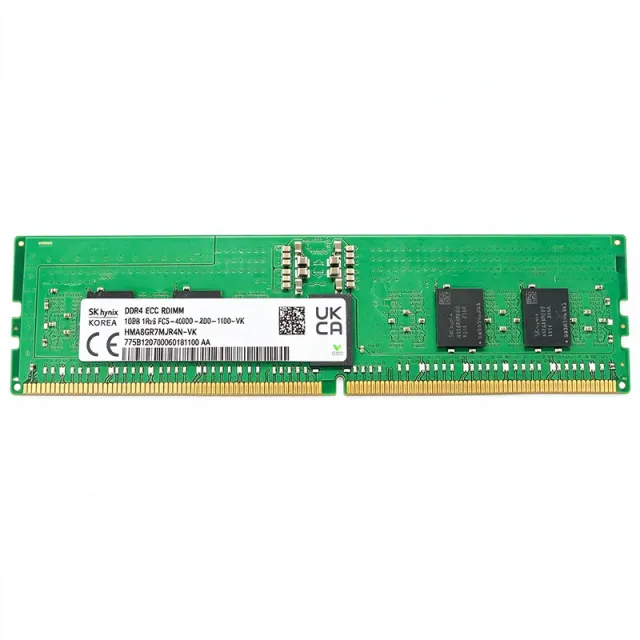
HMCG78AEBRA115N - 16GB DDR5-4800 ECC RDIMM | SK hynix
The SK hynix HMCG78AEBRA115N is a 16GB DDR5-4800 ECC registered DIMM (RDIMM) operating at 4800 MHz (PC5-38400) with a 1.1V supply, organized as a single-rank 1Rx8 module in a 288-pin registered form factor. A registered DIMM (RDIMM) is a server memory module that buffers the address and command signals through a register chip between the memory controller and the DRAM devices. In the memory-system hierarchy, DDR5 SDRAM is the fifth generation of double-data-rate synchronous dynamic random-access memory; the RDIMM variant reduces electrical loading on the controller, allowing more DIMMs per channel than unbuffered UDIMMs, and on-die ECC (ODECC) within the DDR5 DRAM devices improves data integrity for enterprise platforms. Key features of this module include the 16GB single-rank 1Rx8 organization, the DDR5-4800 data rate (PC5-38400 bandwidth class), the CAS latency CL40 rating, and 1.1V low-voltage operation that reduces power per bit versus DDR4-3200 RDIMMs, which typically require 1.2V. The 288-pin registered form factor is electrically keyed to prevent installation in desktop UDIMM sockets. Architecturally, the module integrates DDR5 DRAM devices with on-die ECC, a register for command/address buffering, and a Serial Presence Detect (SPD) hub that stores module timing and configuration data read by the server BIOS at power-up. The 1Rx8 configuration minimizes rank interleave complexity and lowers controller load for entry-level platforms. Typical applications include entry-level virtualization hosts, edge compute nodes, and small-scale servers and workstations from vendors such as Dell and HPE that require JEDEC-standard DDR5-4800 registered memory. Design consideration: always verify the platform supports DDR5-4800 RDIMM at 1Rx8 population in the intended slot rules; mixing ranks or speeds may force the bus to a lower data rate. This page synthesizes distributor pricing context, drop-in alternatives within the SK hynix HMCG78 family, and practical design notes not found on a single manufacturer datasheet.
HMCG78AEBRA168N - 16GB DDR5-4800 ECC RDIMM | SK hynix
The SK hynix HMCG78AEBRA168N is a 16GB DDR5-4800 ECC Registered DIMM (RDIMM) memory module rated at PC5-38400 (4800 MT/s), organized as 1Rx8 with CAS Latency 40, operating from a 1.1V supply on a 288-pin DDR5 UDIMM/RDIMM edge-connector footprint for enterprise servers and workstations. A Registered DIMM (RDIMM) is a memory module that buffers the command, address, and control signals through a register (RCD) before they reach the DRAM chips. This buffering reduces electrical loading on the memory controller, allowing servers to support higher module counts and larger total memory capacity than unbuffered memory. RDIMMs sit in the hierarchy of server memory: DRAM IC -> memory module -> memory subsystem of a data-center server, alongside LRDIMMs (which additionally buffer data) and UDIMMs/SODIMMs (unbuffered, client-class). ECC (Error Correcting Code) is a mandatory feature in this class, correcting single-bit errors to protect data integrity in always-on systems. Key features of the HMCG78AEBRA168N include 4800 MT/s data rate at PC5-38400 bandwidth class, on-module ECC for single-bit error correction, and the DDR5 1.1V low-voltage operating point that cuts module power versus DDR4 1.2V RDIMMs. The DDR5 architecture also splits each module into two independent 32-bit subchannels and moves the power management IC (PMIC) onto the module, improving channel efficiency and power regulation granularity. The 1Rx8 organization uses single-rank, x8-wide DRAM configuration, minimizing rank interleaving overhead and controller loading. Technically, the module builds on SK hynix 1z-nm-class DDR5 DRAM die with on-die ECC (ODE), which corrects bit errors internal to the DRAM array before they propagate on the data bus. The registered architecture uses a DDR5 Registering Clock Driver to offload CA signal loading. CL40 (CAS Latency 40) at 4800 MT/s yields roughly 16.7 ns effective tCL, a typical operating point for the DDR5-4800 server JEDEC speed bin. Typical applications include enterprise rack servers, high-performance workstations, virtualization and database hosts, and blade systems from Dell, HPE, Lenovo, and Supermicro that accept DDR5-4800 RDIMMs. Design consideration: verify that the platform BIOS lists this exact 1Rx8 16GB speed bin as validated; mixed-rank and mixed-vendor populations may force lower common speeds. This page adds distributor pricing context, drop-in alternatives, compatibility guidance, and practical design notes beyond what the manufacturer datasheet provides.
HMCG78AGBUA081N - 16GB DDR5-5600 UDIMM | SK Hynix | Desktop
The SK Hynix HMCG78AGBUA081N is a 16GB DDR5 unbuffered non-ECC UDIMM memory module operating at 5600 MT/s (PC5-44800) with 1.1V supply voltage, housed in a 288-pin DIMM form factor for desktop platforms. A UDIMM (unbuffered dual in-line memory module) is a memory module whose signals connect directly from the DRAM chips to the memory controller without an additional register or buffer chip. In the memory hierarchy, it sits below registered (RDIMM) and load-reduced (LRDIMM) server modules, which trade latency for capacity. UDIMMs are the standard choice for consumer and commercial desktops, workstations, and entry-level embedded boards, where capacity per channel (typically two slots) is limited and lowest-possible latency is preferred. Key features of this module include 16GB capacity organized as 2Gx64, built from eight 2Gx8 DDR5 DRAM devices in a single-rank (1Rx8) configuration. It runs at the DDR5-5600 JEDEC-standard speed grade, corresponding to PC5-44800 bandwidth, with a CAS latency of CL46 at the standard 1.1V operating voltage. The 288-pin package uses the DDR5 UDIMM edge connector with on-module Power Management IC (PMIC) that moves voltage regulation off the motherboard, improving signal integrity and power efficiency versus DDR4. Technically, DDR5 doubles the number of independent banks per device (32 banks across 8 bank groups) versus DDR4 and splits each module into two independent 32-bit sub-channels, improving effective bandwidth utilization for multi-threaded workloads. The single-rank x8 organization simplifies command scheduling and typically yields strong overclocking headroom on enthusiast platforms; this Hynix die family is well known in the overclocking community. Typical applications include desktop PC memory upgrades, workstation builds, mini-PCs, industrial control PCs, and gaming systems requiring validated JEDEC-compliant DDR5-5600 memory. Design consideration: verify your CPU and motherboard BIOS officially support DDR5-5600 UDIMMs in the intended slot configuration; many consumer platforms de-rate to lower speeds with four populated DIMM slots. This page synthesizes distributor pricing, drop-in alternatives, and practical design notes not found in the manufacturer datasheet.
HMCG78AGBUA084N - 16GB DDR5-5600 UDIMM | SK hynix
The SK hynix HMCG78AGBUA084N is a 16GB unbuffered non-ECC DDR5 UDIMM memory module operating at 5600 MT/s (DDR5-5600B) with a 288-pin SDP-UDIMM package and a 2Gx64 organization built from eight 2Gx8, 8-channel DDR5 DRAM components in a single-rank (1Rx8) configuration. A UDIMM (unbuffered dual in-line memory module) is a memory module that connects its DRAM devices directly to the memory controller without a register or buffer between them. Within the memory hierarchy it sits as DDR5 SDRAM -> DIMM module -> main memory subsystem of a PC, workstation, or embedded x86/ARM platform. Unbuffered modules offer the lowest latency and are standard in desktop and client platforms, while registered (RDIMM) variants serve servers where signal loading demands buffering. Key features of this module include the DDR5-5600 data rate, which doubles the bandwidth of the prior DDR4-3200 generation to roughly 44.8 GB/s per module; on-module power management that moves PMIC regulation onto the module for cleaner 1.1V-class power delivery; and DDR5's on-die ECC plus two independent 32-bit sub-channels per module, which improve reliability and effective concurrency for client workloads. Architecturally, the module uses eight 2Gx8 DDR5 DRAM dies in a single rank. DDR5's bank-group architecture and burst length of 16 (BL16) allow finer-grained access compared with DDR4's BL8, raising effective bus utilization. The 1Rx8 configuration means all DRAMs share one chip-select, simplifying controller mapping in single-module desktop systems. Typical applications include desktop PCs and DIY system builds around Intel 12th-generation-and-newer or AMD AM5 platforms, small workstations and mini-PCs needing a 16GB-per-slot density, and embedded industrial x86 designs that specify JEDEC-standard DDR5-5600 UDIMMs. For design and upgrade purposes, verify platform support for DDR5-5600 (JEDEC standard); installing this module on an older DDR4 board is physically and electrically impossible because DDR5 DIMMs are notched differently and run at 1.1V-class signaling. Always install modules per the motherboard manual slot-order guidance for best memory-channel training. This page synthesizes distributor stock and pricing context, drop-in alternative cross-references, and practical selection notes not found in the manufacturer datasheet.
HMCG78AHBRA289N - 16GB DDR5-6400 ECC RDIMM | SK Hynix
The SK Hynix HMCG78AHBRA289N is a 16GB DDR5-6400 ECC registered DIMM (RDIMM) operating at 6400 MT/s (PC5-51200) on a 1.1V supply, configured as a single-rank (1Rx8) module on a 288-pin DIMM package with CL52 CAS latency. It is designed for entry-level virtualization, edge compute, and small-scale servers. A registered DIMM (RDIMM) is a memory module that buffers the address and command signals through a register chip before they reach the DRAM devices. This buffering reduces the electrical load presented to the memory controller, allowing servers to support more modules per channel than unbuffered UDIMMs. Within the memory hierarchy, DDR5 RDIMMs sit above consumer UDIMMs and SODIMMs in the server and workstation memory category, and belong to the broader class of DRAM memory modules used as main system memory. Key features of the HMCG78AHBRA289N include the DDR5 architecture with on-die ECC and on-module ECC registered signaling, a 6400 MT/s data rate per pin (6.4 billion transfers per second), PC5-51200 bandwidth classification, and a low 1.1V operating voltage that reduces power consumption versus DDR4 equivalents. The 1Rx8 single-rank x8 organization simplifies memory population rules in entry servers and typically offers lower latency and easier overclock-free stable operation than dual-rank alternatives at equal capacity. Technically, the module builds on SK Hynix DDR5 SDRAM die featuring bank-group architecture, two independent 32-bit (with 8-bit ECC) subchannels per module, and integrated power management that moves the PMIC onto the module for finer voltage regulation. The CL52 CAS latency corresponds to approximately 16.25 ns at 6400 MT/s, delivering a balance of bandwidth and latency suited to virtualization workloads. Typical applications include entry-level virtualization hosts, edge compute appliances, small-scale tower and rack servers, and embedded industrial compute nodes that use standard 288-pin DDR5 RDIMM slots and require registered memory with ECC for data integrity. Design consideration: verify that your platform memory controller explicitly supports DDR5-6400 RDIMMs; on platforms validated only to DDR5-4800 or DDR5-5600, this module will down-clock to the highest supported JEDEC speed grade, which is safe but reduces available bandwidth. This page synthesizes distributor availability, drop-in family alternatives, and practical deployment notes not found on any single distributor listing.
HMCG78AHBRA471N - 16GB DDR5-6400 RDIMM ECC | SK Hynix
The SK Hynix HMCG78AHBRA471N is a 16GB DDR5-6400 MT/s (PC5-51200) ECC Registered DIMM (RDIMM) with a 1Rx8 single-rank x8 organization, 52 CAS latency (CL52), operating at 1.1V on a 288-pin DIMM package. An RDIMM (Registered DIMM) is a server-class memory module that buffers the address and command signals through a register chip before they reach the DRAM devices. This buffering reduces the electrical load on the memory controller, allowing servers to support more DIMMs per channel and higher total memory capacities than unbuffered UDIMMs. In the memory hierarchy, RDIMM sits under the broader categories of DDR5 SDRAM memory module, dynamic RAM, and volatile semiconductor memory, and it is the standard choice for enterprise servers, storage systems, and workstations. Key features of this module include a 6400 MT/s data rate delivering 51.2 GB/s of peak bandwidth per module, on-module ECC (Error Correcting Code) that detects and corrects single-bit memory errors for data integrity, and the low 1.1V operating voltage of the DDR5 generation, which reduces power consumption versus the 1.2V of DDR4. DDR5 architecture also moves the power management IC onto the module itself, improving power delivery granularity. The 1Rx8 organization uses single-rank x8 DRAM devices, which typically offer lower controller load and better power characteristics than dual-rank equivalents, at the cost of peak parallelism. The 288-pin edge connector is the standard JEDEC-defined footprint for DDR5 server memory; DDR5 RDIMMs are mechanically keyed so they cannot be inserted into DDR4 or DDR3 slots. Typical applications include entry-level virtualization hosts, edge compute nodes, small-scale business servers, storage controllers, and network appliances that require reliable registered DDR5 memory. Design consideration: always verify that the host platform BIOS and CPU memory controller explicitly support 6400 MT/s RDIMMs; otherwise the module will default to a lower JEDEC speed bin. This page synthesizes distributor pricing, same-footprint SK Hynix alternatives, and practical deployment notes not found on individual distributor listings.
HMCG78AHBWA315N - 16GB DDR5-6400 CSODIMM | SK hynix | Servers
The SK hynix HMCG78AHBWA315N is a 16GB DDR5-6400 Clocked SODIMM (CSODIMM) memory module built from 2Gx8 8-channel DRAM devices in a 262-pin small outline DIMM form factor. The W variant in the HMCG78 family denotes a clocked (registered-style) SODIMM for compact edge and server-class systems. A SODIMM (Small Outline Dual In-line Memory Module) is a compact memory module format used where full-size UDIMMs and RDIMMs do not fit, such as laptops, mini-PCs, network appliances, and blade servers. DDR5 is the fifth generation of double data rate synchronous DRAM, doubling the banks and burst length of DDR4 and moving power management onto the module via an on-module PMIC. In the memory hierarchy, this module sits at the system-main-memory level above caches and below storage. Key features of the HMCG78 series include DDR5-6400 data rate (PC5-51200), 1Rx8 single-rank organization delivering 16GB per module, and 1.1V operation per the JEDEC DDR5 standard. The module integrates on-die ECC (ODECC) at the DRAM device level and an on-module power management IC (PMIC) that regulates the 1.1V VDD rail locally, reducing load on the host board. Technically, DDR5-6400 provides 51.2 GB/s peak bandwidth per channel in 64-bit configurations, with burst length 16 and two independent 32-bit subchannels per DIMM for improved concurrency. The 2Gx8 configuration reflects eight 16Gb-class DRAM devices per the SK hynix [2Gx8 8C] organization cited in distributor listings. Typical applications include edge servers, compact network appliances, high-performance laptops and mini workstations that accept clocked SODIMM modules, and embedded industrial systems requiring DDR5 bandwidth in a low-profile footprint. Design consideration: verify that the host memory controller and BIOS support DDR5-6400 on CSODIMM modules; if the platform tops out at DDR5-5600, the module will downclock, and mixed-module populations typically run at the slowest common speed. Confirm 262-pin slot orientation and M.2-slot mechanical clearance before layout. This page synthesizes distributor pricing, same-brand drop-in module alternatives, and practical design notes not found in the manufacturer datasheet.
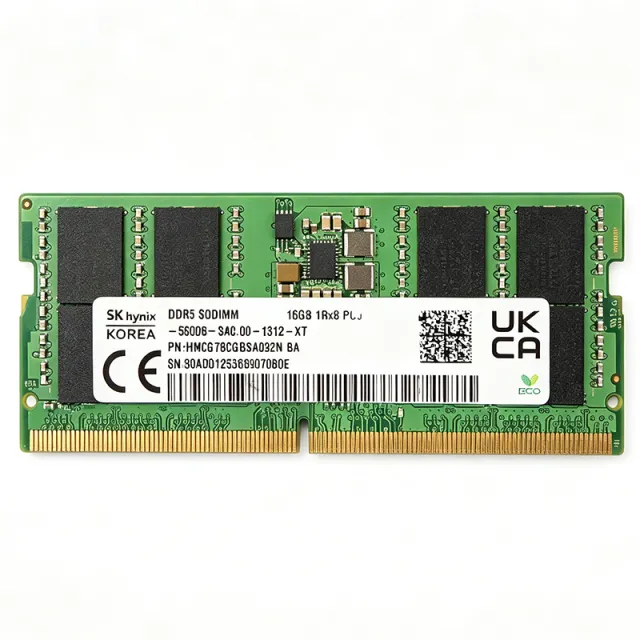
HMCG78MEBSA092N - 16GB DDR5 4800 SODIMM | SK Hynix | Laptop Memory
The SK Hynix HMCG78MEBSA092N is a 16GB unbuffered non-ECC DDR5 SODIMM memory module operating at 4800 MT/s (PC5-38400 / PC5-4800B class) at 1.1V, housed in a 262-pin SO-DIMM form factor for laptops, mobile workstations, and mini PCs. A DDR5 SODIMM (Small Outline Dual In-line Memory Module) is a compact memory module defined by the JEDEC DDR5 standard for space-constrained mobile computing platforms. Within the memory hierarchy, it sits as main system memory (DRAM) below CPU cache and above storage, and DDR5 doubles the bank groups and burst length (BL16) versus DDR4 while moving the power management IC (PMIC) onto the module itself. Key features of this module include 16GB capacity in a single-rank 1Rx8 organization built from eight 2Gx8 DDR5 DRAM devices, 4800 MT/s data rate for 38.4 GB/s peak bandwidth per 64-bit channel, and the DDR5 on-module PMIC that improves power integrity versus DDR4. DDR5 native on-die ECC improves data reliability while the module remains non-ECC from the host perspective. Technically, the module configures as 2Gx64 (1Gx64 per rank equivalent addressing), uses the DDR5 262-pin SODIMM edge connector with a single notch key, and supports CL40 latency at the JEDEC 4800 profile. The 1.1V VDD lowers power versus DDR4 1.2V, important for battery-operated notebooks. Typical applications include laptop and notebook memory upgrades, mobile workstations, mini PCs, and embedded x86/ARM compute platforms with 262-pin DDR5 SODIMM sockets. It is marketed as a direct replacement for systems specifying Hynix HMCG78MEBSA092N or HMCG78MEBSA095N. Design and upgrade consideration: verify the host BIOS supports JEDEC DDR5-4800 unbuffered non-ECC SODIMMs and populate matched modules per the platform manual; DDR5 SODIMMs are not backward-compatible with DDR4 sockets. This page synthesizes distributor stock, cross-reference equivalents (OWC, Integral, NEMIX RAM), and practical design notes beyond what the manufacturer datasheet provides.
HMCG84AGBRA191N - 32GB DDR5-5600 ECC RDIMM | SK Hynix
The SK Hynix HMCG84AGBRA191N is a 32GB DDR5-5600 ECC registered DIMM (RDIMM) operating at 1.1V with CL46 latency, 1Rx4 single-rank organization, and a 288-pin DIMM form factor with PC5-44800 bandwidth classification. An RDIMM (Registered DIMM) is a server-class memory module that buffers address and command signals through a registering clock driver (RCD) before they reach the DRAM devices. This buffering reduces electrical loading on the memory controller, allowing servers to populate more DIMM slots per channel than with unbuffered UDIMMs. RDIMMs sit within the memory hierarchy as a type of DDR5 SDRAM module, belonging to the broader category of volatile main-memory components used in computing systems. Key features include DDR5-5600 MT/s data rate for high memory bandwidth, on-die ECC and side-band ECC support for data integrity in servers, a low 1.1V operating voltage that reduces power draw and thermal load compared to DDR4 RDIMMs, and single-rank 1Rx4 organization that maximizes population flexibility on dual-processor server boards. The 288-pin form factor is the standard DDR5 server module connector. Architecturally, DDR5 splits each module into two independent 32-bit subchannels, improving memory access efficiency. On-die ECC corrects internal DRAM cell errors before they reach the bus, while the registered interface and x4 DRAM devices provide robust error containment for enterprise workloads. At 5600 MT/s, the module delivers 44.8 GB/s peak bandwidth per module. Typical applications include edge compute nodes, low-VM-density virtualization hosts, general-purpose rack servers, and enterprise storage controllers where 32GB-per-DIMM density at DDR5-5600 speed is the sweet spot for cost and performance. Design consideration: verify that your server platform, BIOS, and memory controller officially support DDR5-5600 RDIMMs at the target population; many platforms derate speed as DIMMs per channel increase. This page synthesizes distributor pricing, drop-in SK Hynix family alternatives, and practical deployment notes not found in a single manufacturer datasheet.
HMCG84AHBRA290N - 32GB DDR5-6400 ECC RDIMM | SK Hynix
The SK Hynix HMCG84AHBRA290N is a 32GB DDR5-6400 ECC Registered DIMM (RDIMM) operating at 6400 MT/s (PC5-51200), CAS Latency 52, at 1.1V, in a 288-pin DIMM form factor. This single-rank x4 module targets enterprise servers, edge compute nodes, and general-purpose data center hosts. A Registered DIMM (RDIMM) is a type of server memory module that buffers the address and command signals through a register chip, reducing the electrical load on the memory controller and allowing more modules per channel than unbuffered UDIMMs. Within the memory hierarchy, RDIMM sits between LRDIMM (which buffers data too) and UDIMM (unbuffered), making it the standard choice for most two-socket server platforms. Key features include DDR5 architecture with on-die ECC and link ECC, a 6400 MT/s data rate yielding up to 51.2 GB/s peak bandwidth per module, and a 1.1V operating voltage that reduces power draw roughly 30% versus DDR4 RDIMMs at comparable bandwidth. The module also integrates a 5-bit SPD hub (PMIC-managed power delivery) per JEDEC DDR5 requirements. The 1Rx4 single-rank x4 organization uses x4 DRAM devices whose inherent ECC assists with high-reliability operation and supports post-package repair in data center service. SK Hynix manufactures both the DRAM dies and the assembled module, ensuring full-stack qualification. Typical applications include AI inference and training nodes, virtualization hosts with low VM density, cloud compute instances, and high-performance database servers requiring validated ECC RDIMM bandwidth. Design consideration: verify your server platform's Qualified Vendor List (QVL), as 6400 MT/s operation often requires 1DPC (one DIMM per channel) population; two DIMMs per channel may downclock to 5600 MT/s. This page synthesizes distributor availability, same-brand drop-in RDIMM alternatives, and platform-selection guidance not consolidated in any single manufacturer page.
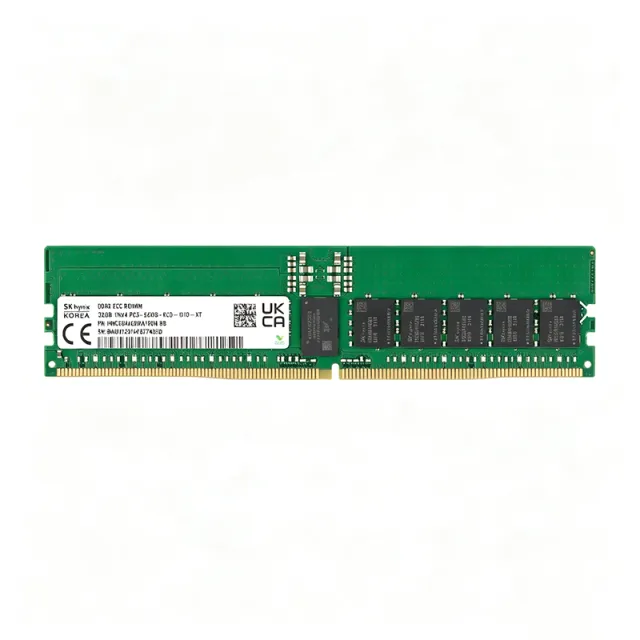
HMCG84AHBRA478N - 32GB DDR5-6400 ECC RDIMM | SK Hynix
The SK Hynix HMCG84AHBRA478N is a 32GB DDR5-6400 ECC registered DIMM (RDIMM) operating at 6400 MT/s (PC5-51200) with CL52 latency at 1.1V, built in a 288-pin single-rank x4 configuration for enterprise server platforms. A registered DIMM (RDIMM) is a server-class memory module that buffers the command and address signals through a register IC before they reach the DRAM array. This buffering reduces the electrical load on the memory controller, allowing servers to populate more DIMM slots per channel than with unbuffered desktop UDIMMs. RDIMMs sit within the broader hierarchy of synchronous dynamic random-access memory (SDRAM) and are the standard choice in datacenter servers, storage controllers, and virtualization hosts. The x4 DRAM device organization works hand-in-hand with on-die ECC and side-band ECC to correct single-bit errors, improving uptime. Key features of this module include 6400 MT/s data rate on the DDR5 interface, a CAS latency of 52 clocks, single-rank x4 organization that optimizes register-to-DRAM signal integrity, and the DDR5 standard 1.1V operating voltage, which lowers memory-subsystem power roughly 20-30% versus DDR4 at comparable bandwidth. On-die ECC (ODECC) corrects errors internal to each DRAM die before they propagate onto the module bus. The HMCG84AHBRA478N uses SK Hynix 1R x4 DDR5 DRAM devices managed by a registered clock driver (RCD), providing deterministic command timing across the 288-pin edge connector. PC5-51200 bandwidth classification corresponds to approximately 51.2 GB/s theoretical peak per module at 6400 MT/s, suiting memory-bandwidth-hungry workloads such as edge compute nodes and low-VM-density virtualization hosts. Typical applications include general-purpose 2-socket rack servers, edge computing appliances, hyperconverged infrastructure (HCI) nodes, and enterprise storage controllers that specify DDR5-6400 RDIMMs. When designing or upgrading, always verify that the server platform, BIOS, and CPU memory controller officially support DDR5-6400 RDIMMs; most platforms down-clock to the highest mutually supported JEDEC speed grade if 6400 MT/s is not validated. Mixing ranks, speeds, or vendors within a channel is discouraged. This page synthesizes distributor availability data, same-brand drop-in alternatives within the SK Hynix HMCG family, and practical deployment notes not found on the manufacturer product page.
HMCG84MEBRA107N - 32GB DDR5-4800 ECC RDIMM | SK Hynix
The SK Hynix HMCG84MEBRA107N is a 32GB DDR5-4800 ECC registered DIMM (RDIMM) operating at 4800 MT/s (PC5-38400) on a 1.1V supply, in a 288-pin SDP-RDIMM form factor with CL40 latency. A registered DIMM (RDIMM) is a server-class memory module that buffers the address and command signals through a register IC before they reach the DRAM devices. This buffering reduces the electrical load on the memory controller, allowing servers to populate more DIMM slots per channel than with unbuffered UDIMMs. RDIMMs sit within the memory hierarchy of DDR5 SDRAM -> registered memory module -> server memory subsystem, and are the default choice for data-center platforms built on Intel Xeon Scalable and AMD EPYC processors. Key features of this module include the 32GB capacity organized as 1Rx4, the DDR5-4800 transfer rate (PC5-38400 bandwidth), and on-module ECC with registered signaling per the JEDEC DDR5 RDIMM architecture. DDR5 brings the power management IC (PMIC) on-module, cutting the host board's voltage-regulation burden, while the 1.1V operating voltage lowers system power compared with DDR4's 1.2V. The dual-data-rate DDR5 architecture with two independent 32-bit sub-channels per module improves effective memory concurrency, and the CL40 CAS latency at 4800 MT/s yields a 16.67 ns base cycle time. On-die ECC within each DRAM die plus link ECC protects against cell-level faults, complementing the registered ECC path expected by the server memory controller. Typical applications include general-purpose 2-socket rack servers, edge-compute and low-VM-density hosts, virtualization platforms, and workstation-class boards with RDIMM slots. Its 32GB density balances per-channel capacity and cost, making it a common baseline DIMM for 256GB-class server configurations. When designing or upgrading, verify the host platform's Qualified Vendor List (QVL), because server BIOSes only train speeds that the CPU memory controller and module register IC both support; mixing 1Rx4 and 2Rx4 modules on one channel may drop the trained speed below 4800 MT/s. This page synthesizes distributor pricing, drop-in RDIMM alternatives, comparison data, and practical deployment notes not found on the manufacturer datasheet alone.
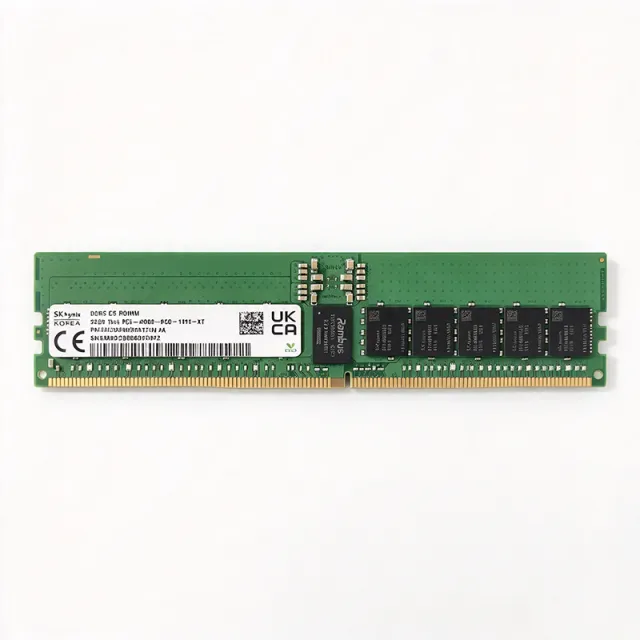
HMCG84MEBRA174N - 32GB DDR5-4800 ECC RDIMM | SK hynix | Server Memory
The SK hynix HMCG84MEBRA174N is a 32GB DDR5-4800 (PC5-38400) ECC registered DIMM (RDIMM) with CAS latency CL40, operating at 1.1V on a 288-pin RDIMM form factor. It delivers 38.4 GB/s of peak bandwidth per module for next-generation server and cloud infrastructure. Registered DIMM memory is a class of memory module that places a registering buffer between the DRAM devices and the memory controller. This buffering reduces the electrical load on the controller, allowing servers to populate more DIMM slots per channel than with unbuffered memory. In the hierarchy of memory technologies, the RDIMM sits between consumer UDIMMs and load-reduced DIMMs (LRDIMMs), and it is the standard choice for enterprise servers, workstations, and cloud compute hosts that require both capacity and reliability. Key features of the HMCG84MEBRA174N include on-die ECC correction, which detects and corrects single-bit errors at the DRAM die level, side-band management for out-of-band health monitoring via the SMBus/I2C serial presence-detect interface, and the DDR5 architecture's dual 32-bit sub-channels per module that improve effective concurrency versus DDR4. The 1.1V operating voltage cuts module power draw roughly 20-30% versus equivalent DDR4-3200 RDIMMs, lowering data center thermal load. The module uses DDR5 DRAM devices organized x4 and is available in single-rank (1Rx4) configurations per most distributor listings; some listings describe a dual-rank (2Rx4) variant, so rank should be confirmed with the supplier before mixing modules in the same channel. DDR5's on-module power management IC (PMIC) converts the 12V/5V server rail to the 1.1V DRAM rail locally, improving signal integrity and power delivery granularity. Typical applications include general-purpose 2-socket servers, edge compute nodes, low-VM-density virtualization hosts, and cloud infrastructure memory pools where 32GB per DIMM balances cost and channel density. Intel Xeon Scalable (Sapphire Rapids/Emerald Rapids) and AMD EPYC (Genoa/Bergamo) platforms with DDR5 RDIMM support are the primary host environments. When designing or upgrading, always populate DIMMs in pairs matched in speed, rank, and capacity, and verify platform qualified vendor list (QVL) support for DDR5-4800 registered modules. Mixing 1Rx4 and 2Rx4 modules on the same channel may reduce achievable speed. This page synthesizes distributor stock and pricing data, drop-in SK hynix DDR5 RDIMM alternatives, and practical deployment notes not consolidated in any single manufacturer or distributor listing.
HMCG88AEBRA168N - 32GB DDR5 4800 ECC RDIMM | SK hynix
The SK hynix HMCG88AEBRA168N is a 32GB DDR5 ECC Registered DIMM (RDIMM) server memory module operating at 4800 MT/s (PC5-38400 bandwidth) with CL40 latency at 1.1V, housed in a 288-pin DIMM form factor. DDR5 RDIMM (Registered Dual In-line Memory Module) is the enterprise-class memory standard for servers and workstations. Unlike consumer UDIMMs, an RDIMM uses a register to buffer address and command signals, reducing electrical load on the memory controller and enabling higher module counts per channel. DDR5 doubles the number of independent channels per DIMM versus DDR4 (two 32-bit subchannels) and moves the power management IC (PMIC) onto the module, improving signal integrity and power efficiency at the 1.1V operating voltage. Key features of the HMCG88AEBRA168N include 32GB capacity in a dual-rank x8 organization, ECC (Error Correcting Code) for detecting and correcting single-bit memory errors that could otherwise crash a server, 4800 MT/s data rate conforming to the PC5-38400 DDR5 speed grade, and CL40 CAS latency. The 1.1V standard DDR5 voltage keeps power draw and thermal output low in dense chassis. The registered architecture and on-die ECC make this module suited to data-intensive workloads where uptime matters: virtualization hosts, database servers, and high-memory-density blade systems. Dual-rank organization improves effective bandwidth through interleaving in many server workloads. Typical applications include enterprise rack servers, hyper-converged infrastructure, cloud compute nodes, and workstation memory upgrades requiring validated ECC RDIMMs. Design and procurement consideration: always verify that the target server platform (CPU and BIOS) supports DDR5-4800 RDIMMs and the installed rank count per channel, as population rules affect achievable speed. Note that RDIMMs are not interchangeable with consumer UDIMMs or LRDIMMs. This page consolidates distributor pricing, cross-referenced drop-in alternatives, and practical deployment notes not found in a single manufacturer listing, so engineers and IT buyers can validate compatibility in one place.
HUH721010ALE600 - 10TB 7200RPM SATA Enterprise HDD | Western Digital
The Western Digital HUH721010ALE600 (formerly HGST Ultrastar He10) is a 10 TB enterprise-class 3.5-inch SATA hard disk drive spinning at 7200 RPM with a 256 MB cache buffer and SATA 6 Gb/s interface. It belongs to the Ultrastar DC HC510 family and uses conventional Perpendicular Magnetic Recording (PMR) technology rather than shingled recording, making it drop-in compatible with any enterprise SATA backplane. An enterprise hard disk drive is a rotating magnetic storage device engineered for 24/7 operation in data center servers, network-attached storage arrays, and hyperscale object storage. Within the storage hierarchy, HDDs sit beneath SSDs in $/GB but above tape in access latency, occupying the bulk-capacity tier. The HUH721010ALE600 specifically targets the helium-sealed, high-density 10 TB tier with workload ratings suitable for RAID rebuilds and sequential archive workloads. Key differentiating features of this model include a 10 TB raw capacity, a 7200 RPM spindle speed delivering ~225 MB/s sequential throughput, a 256 MB DRAM cache for command queuing, 512e (4K sector) advanced format with 512n emulation, and a helium-filled hermetically sealed enclosure that reduces platter drag and allows 7 platters to be stacked in the standard 26.1 mm z-height. The drive is rated for 550 TB/year workloads and 2.5 million hours MTBF, double that of desktop drives, with a 5-year limited warranty. Architecturally, the HUH721010ALE600 uses a 7-disk, 14-head design with PMR for predictable write performance in RAID arrays. Rotational vibration (RV) sensors maintain throughput when deployed in densely-packed multi-drive chassis. The SATA 6 Gb/s host interface delivers up to 600 MB/s of theoretical bandwidth, ample for the drive's real-world ceiling of ~225 MB/s sequential read. Typical applications include hyperscale object storage, video surveillance NVR arrays with retention over 30 days, cold-data archiving for medical imaging or scientific datasets, mid-range NAS/SAN capacity tiers, and backup targets for virtual machine repositories. The helium platform's power efficiency (typically 6-8 W idle) makes it competitive against 10 TB air-filled drives in 24/7 data center duty cycles. One important design consideration when deploying the HUH721010ALE600 is thermal management. Although helium reduces internal friction, ambient intake temperatures above 40°C shorten component life. Drive bay backplanes should provide at minimum 100 LFM airflow and the host SAS/SATA controller must support 4K native or 512e sectors; legacy 512B-only HBAs require drive firmware reconfiguration or replacement. This page synthesizes distributor pricing, decode-level alternative information, and field-deployment notes not consolidated in the OEM datasheet, supporting procurement and storage architect decisions on 10 TB enterprise helium HDDs.
K3K9K90BM-JGCT - Samsung LPDDR5 SDRAM | Samsung Electronics
The Samsung K3K9K90BM-JGCT is an LPDDR5 (Low Power Double Data Rate 5) SDRAM component from Samsung Electronics, supplied in a fine-pitch ball grid array (FBGA) package. Samsung's K3K9 part-number prefix identifies the LPDDR5 DRAM family, the BM code designates the FBGA ball-map/package option, and the JGCT suffix encodes the speed-bin and operating-temperature grade. Exact density, data rate, and voltage for this specific ordering code are not published in the retrieved data and must be confirmed against the official Samsung LPDDR5 datasheet before design-in. LPDDR5 is a type of mobile DRAM defined by the JEDEC LPDDR5 (JESD209-5) standard family. Mobile DRAM sits within the broader memory hierarchy as a synchronous dynamic random-access memory optimized for low power rather than absolute bandwidth, and it forms the main-memory tier in smartphones, tablets, and edge-AI platforms alongside the application processor. Key characteristics of the LPDDR5 family include dramatically lower operating and standby power than LPDDR4X, a simplified command/address architecture, bank-group architecture with 16n prefetch, and per-byte write masking that improves efficiency for AI workloads. Speed bins in the family span from 4800 Mbps up to 6400 Mbps for standard LPDDR5, with LPDDR5X parts such as the Samsung K3KL9L90CM-MGCT extending to 7500 Mbps. Architecturally, LPDDR5 reduces the clocking overhead by transmitting command/address at lower rates while data pins run at full rate, and it introduces DVFS (dynamic voltage frequency scaling) with two operating ranges that let the SoC trade bandwidth against power in real time. These features make LPDDR5 the dominant main-memory standard for flagship mobile SoCs. Typical applications include flagship and mid-tier smartphone main memory, tablet and notebook (Always-Connected PC) memory, automotive infotainment and ADAS domains, and edge-AI accelerators where memory bandwidth per watt is the limiting factor. Design consideration: LPDDR5 signal integrity requires length-matched fly-by routing, on-die termination tuning, and SoC memory-controller training; always verify the exact speed bin (JGCT vs MGCP/BGCT) against the controller's supported data-rate table. This page synthesizes distributor search data, Samsung family cross-references, and drop-in alternative analysis not found in a single manufacturer source.
K3KCKC0BM-JGCT - LPDDR5 64Gb DRAM SDRAM | Samsung
The Samsung K3KCKC0BM-JGCT is a 64 Gb LPDDR5 (Low Power Double Data Rate 5) DRAM SDRAM device, part of Samsung Semiconductor's K3K series of mobile-class dynamic random access memory for next-generation mobile, automotive, and edge-computing platforms. The K3KC density code designates a 64 Gb organization implemented in Samsung's advanced DRAM process, and the -JGCT speed-grade suffix identifies a bin within the LPDDR5 product family that also includes the related 6400 Mbps pin-speed K3LKCKC0BM-MGCP variant. LPDDR5 is a type of DRAM (dynamic random access memory) optimized for low power consumption and high bandwidth. Within the memory hierarchy, LPDDR5 sits at the top of the mobile DRAM taxonomy: DRAM -> synchronous DRAM (SDRAM) -> LPDDR family -> LPDDR5/LPDDR5X. Compared with LPDDR4X, the LPDDR5 generation introduced a redesigned clocking architecture (WCKCK word clock), bank group architecture improvements, DVFSC (Dynamic Voltage Frequency Scaling Center), and per-device power management that delivered roughly 20% power savings and up to 6400 Mbps pin speed, enabling approximately 51.2 GB/s of bandwidth per 64-bit bus. Key features of the K3K series include high density in a compact fine-pitch ball grid array (FBGA) package, low-voltage operation with dynamic voltage scaling, deep power-down and partial-array self-refresh modes for standby power reduction, and on-die termination for signal integrity at multi-gigabit data rates. These characteristics make the device suitable for flagship smartphone application processors, AI accelerators at the edge, automotive infotainment and ADAS domains, and 5G modems where bandwidth per watt is the dominant metric. The related Samsung part K3LKCKC0BM-MGCP, documented in distributor inventories, is specified as an IC DRAM LPDDR5 64 Gb at 6400 Mbps pin speed, which anchors the parametric envelope of this K3KC family member. Typical applications include mobile SoC main memory, automotive digital cockpits, network edge appliances, and low-power inference modules. In each case the 64 Gb density reduces chip count versus stacking lower-density die, simplifying power delivery and PCB routing. A key design consideration is signal integrity: at multi-gbps pin speeds, LPDDR5 requires length-matched fly-by or point-to-point routing, careful VDDQ decoupling, and compliance with the JEDEC LPDDR5 ball map defined for the chosen package. This page synthesizes distributor inventory signals, same-family alternatives, and practical design notes not found in a single manufacturer document, providing engineering and sourcing value in one reference.

K3KL1L10GM-JGCT - 32Gb LPDDR5X-7500 DRAM | Samsung
The Samsung K3KL1L10GM-JGCT is a 32Gb (4 GB) LPDDR5X DRAM memory IC delivering LPDDR5X-7500 data rates on a x64 interface, housed in a 441-ball FBGA package. It is Samsung's premium low-power DRAM aimed at flagship mobile and edge-AI platforms. LPDDR (Low Power Double Data Rate) DRAM is a class of synchronous dynamic random-access memory optimized for low operating voltage and high bandwidth per watt, forming the main-memory tier of the memory hierarchy in embedded and mobile systems (DRAM -> low-power DRAM -> LPDDR5X -> LPDDR5X-7500). Compared with conventional DDR4/DDR5, LPDDR5X trades socketed modularity for soldered-down density, deeper power-down states, and per-byte energy efficiency. Key features include 32Gb single-die density, an LPDDR5X-7500 interface (up to 7500 MT/s) on a x64 organization, and roughly 1.25x higher speed with about 25% better power efficiency than the previous LPDDR5 generation, according to Samsung product literature. Advanced link training and enhanced speed modes enable reliable operation at the highest bin. Technically, the device uses Samsung leading-edge DRAM process technology with a x64 bus architecture suited to SoC memory controllers from Qualcomm and MediaTek class application processors. The FBGA ball grid array provides short, controlled-impedance traces on the PCB, supporting the multi-gigabit signaling rates; fly-by-free point-to-point topologies are typical. Typical applications include AI edge accelerators and in-vehicle infotainment/high-performance compute modules, flagship smartphone main memory, and industrial high-speed vision systems where LPDDR5X frequency headroom is required. Design consideration: LPDDR5X-7500 signal integrity demands strict length-matched routing, reference-plane continuity, and controller-side equalization calibration during boot; verify the SoC memory controller supports the 7500 MT/s bin and JEDEC LPDDR5X training sequences before layout. This page synthesizes distributor stock data, drop-in same-family alternatives, and practical design notes not found in the Samsung datasheet.
K3KL2L20DM-JGCT - 48Gb LPDDR5X 7500Mbps DRAM | Samsung
The Samsung Electronics K3KL2L20DM-JGCT is a 48 Gb LPDDR5X (Low Power Double Data Rate 5X) SDRAM memory IC organized x64, delivering data rates up to 7500 Mbps in a 441-ball FBGA package. It operates from multiple supply rails (1.8 V, 1.05 V, 0.9 V, and 0.5 V) across an operating temperature range of -25C to +85C and is currently in mass production. LPDDR5X is the premium tier of the low-power DRAM family defined by JEDEC. A DRAM (dynamic random access memory) stores each bit in a capacitor within a memory cell, requiring periodic refresh; the LPDDR lineage (LPDDR4 -> LPDDR4X -> LPDDR5 -> LPDDR5X) prioritizes bandwidth-per-watt for battery-powered and thermally constrained systems. Within the power-management hierarchy of a modern SoC platform, LPDDR5X sits at the top of the mobile memory stack, offering roughly 1.25x higher speed and 25% better power efficiency than the previous LPDDR5 generation. Key features of the K3KL2L20DM-JGCT include the 7500 Mbps pin speed (targeting the LPDDR5X 7.5 Gbps speed bin), the dense 48 Gb per-die organization in x64 mode, and the fine-pitch 441-ball FBGA (fine-pitch ball grid array) surface-mount package that minimizes trace length and signal integrity degradation on the memory bus. The multi-rail power architecture (VDD1/VDD2/VDDQ domains at 1.8/1.05/0.9/0.5 V) enables aggressive dynamic voltage and frequency scaling (DVFS). Architecturally, LPDDR5X extends LPDDR5 signaling with deeper link ECC and adaptive frequency scaling, preserving channel compatibility while pushing the interface into the multi-gigabit regime. Careful fly-by routing, on-die termination tuning, and reference voltage training are essential at 7500 Mbps. Typical applications include AI edge accelerators and in-vehicle infotainment/ADAS platforms, as well as flagship smartphones, tablets, and networking equipment where memory bandwidth per watt is a primary design constraint. According to distributor listings, the part is described as a 48 Gb low-power DRAM for AI and in-vehicle devices. A key design consideration: at 7.5 Gbps, PCB stackup, length matching, and power-integrity of the 0.5 V VDDQ rail dominate system margin - budget for comprehensive signal-integrity simulation and eye-diagram validation. This page synthesizes distributor stock and pricing signals, same-family drop-in variants, and practical LPDDR5X design notes not found in the manufacturer datasheet.
K3KL3L30CM-BGCT - LPDDR5X-7500 64Gb DRAM | Samsung
The Samsung Electronics K3KL3L30CM-BGCT is a 64 Gbit LPDDR5X SDRAM organized as x64 and rated for an LPDDR5X-7500 data rate (7500 MT/s), packaged in a compact ball-grid-array (BGA) footprint optimized for mobile SoC integration. LPDDR5X (Low Power Double Data Rate 5X) is an JEDEC-standard extension of the LPDDR5 memory specification that raises signaling speeds and lowers operating voltage for bandwidth-hungry, power-constrained platforms. In the memory hierarchy it sits as high-speed main system memory: SDRAM -> DDR SDRAM -> LPDDR -> LPDDR5 -> LPDDR5X, bridging the SoC's memory controller directly to stacked DRAM die on a shared bus. Key features of this device include its high 64 Gbit per-package density achieved through stacked DRAM die technology, the x64 bus width that supports wide parallel data transfers, and the LPDDR5X-7500 speed grade delivering 12 GB/s per pin of peak bandwidth. Low core voltage operation reduces dynamic and standby power, which is critical for battery-operated designs, and multi-die packaging minimizes board area versus discrete DRAM solutions. Architecturally, the part uses Samsung's advanced DRAM process with die stacking in a mobile-optimized BGA. LPDDR5X signaling relies on low-voltage I/O with training-based read/write calibration, on-die termination, and dynamic frequency and voltage scaling managed by the host memory controller per the JEDEC LPDDR5X specification. Typical applications include flagship smartphone and tablet main memory, AI edge computing modules, high-performance portable computing platforms, automotive infotainment, and embedded industrial controllers needing high bandwidth with strict power budgets. Design considerations: LPDDR5X routing requires length-matched, impedance-controlled fly-by or point-to-point topologies, careful power-integrity design for the low core rails, and full JEDEC-compliant initialization and training sequences in the host controller. This page synthesizes distributor sourcing data, verified web listings, and drop-in alternative guidance not found in the manufacturer datasheet.

K3KL3L30CM-BGCU - 64Gb LPDDR5X DRAM 8533Mbps | Samsung
The Samsung Semiconductor K3KL3L30CM-BGCU is a 64 Gb (8 GB) LPDDR5X low-power dynamic random access memory (DRAM) supporting data rates up to 8533 Mbps, housed in a 496-ball FBGA (BGCU) package for mobile SoC integration. As a stacked multi-die DRAM, it targets AI accelerators, in-vehicle computing platforms, and flagship mobile devices. LPDDR5X SDRAM is the extended-performance variant of LPDDR5 low-power DRAM, a class of volatile memory that refreshes stored data dynamically and is optimized for high bandwidth per watt. In the memory hierarchy it sits above LPDDR5 and below HBM (High Bandwidth Memory): LPDDR -> low-power DRAM -> DRAM -> semiconductor memory IC. LPDDR5X devices such as this one are the dominant main-memory choice for smartphones, tablets, automotive ADAS domain controllers, and edge-AI modules where power budget and bandwidth both matter. According to Samsung Semiconductor product material, the LPDDR5X family delivers speeds up to 1.25x faster and 25% better power efficiency than the previous LPDDR5 generation, with the premium tier reaching 8.5 Gbps and up to 64 GB capacity per module for IT-industry and automotive devices. The K3KL3L30CM-BGCU exemplifies this: at 8533 Mbps per pin it enables memory bandwidths suitable for large language-model inference at the edge and high-resolution sensor fusion. Technically, the device uses Samsung advanced DRAM process technology with stacked die in a compact FBGA-496 ball grid array. The x64 memory organization provides wide parallel access, and LPDDR5X dynamic voltage scaling plus deep power-down states reduce average power in bursty AI workloads. Compared with LPDDR5 at 6400 Mbps, the 8533 Mbps rate raises peak bandwidth by roughly one third at similar or lower energy per bit. Typical applications include flagship smartphone application-processor main memory, automotive infotainment and ADAS compute platforms, AI edge modules and robotics, and high-performance tablet or notebook memory subsystems. Design consideration: LPDDR5X requires strict length-matched fly-by routing, a well-defined VDDQ power rail with fast transient response, and SoC memory-controller training support for the 8533 Mbps gear; verify controller compatibility before layout. This page synthesizes distributor stock listings, drop-in alternative analysis, and practical integration guidance not found in the manufacturer datasheet. Pricing is quote-based (RFQ) as of 2026-09-04.