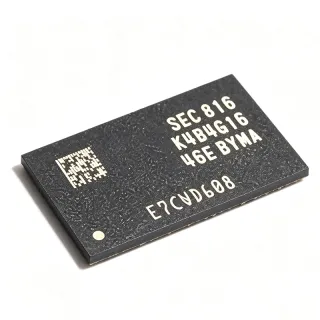
K3KL3L30CM-BGCT - LPDDR5X-7500 64Gb DRAM | Samsung
Teilenummer: K3KL3L30CM-BGCT ✓ Aktiv| Menge | Stückpreis | Gesamt |
|---|---|---|
| 1 | $0 | $0,00 |
| 10 | $0 | $0,00 |
| 100 | $0 | $0,00 |
| 500 | $0 | $0,00 |
| 1.000 | $0 | $0,00 |
K3KL3L30CM-BGCT Übersicht
LPDDR5X (Low Power Double Data Rate 5X) is an JEDEC-standard extension of the LPDDR5 memory specification that raises signaling speeds and lowers operating voltage for bandwidth-hungry, power-constrained platforms. In the memory hierarchy it sits as high-speed main system memory: SDRAM -> DDR SDRAM -> LPDDR -> LPDDR5 -> LPDDR5X, bridging the SoC's memory controller directly to stacked DRAM die on a shared bus.
Key features of this device include its high 64 Gbit per-package density achieved through stacked DRAM die technology, the x64 bus width that supports wide parallel data transfers, and the LPDDR5X-7500 speed grade delivering 12 GB/s per pin of peak bandwidth. Low core voltage operation reduces dynamic and standby power, which is critical for battery-operated designs, and multi-die packaging minimizes board area versus discrete DRAM solutions.
Architecturally, the part uses Samsung's advanced DRAM process with die stacking in a mobile-optimized BGA. LPDDR5X signaling relies on low-voltage I/O with training-based read/write calibration, on-die termination, and dynamic frequency and voltage scaling managed by the host memory controller per the JEDEC LPDDR5X specification.
Typical applications include flagship smartphone and tablet main memory, AI edge computing modules, high-performance portable computing platforms, automotive infotainment, and embedded industrial controllers needing high bandwidth with strict power budgets.
Design considerations: LPDDR5X routing requires length-matched, impedance-controlled fly-by or point-to-point topologies, careful power-integrity design for the low core rails, and full JEDEC-compliant initialization and training sequences in the host controller.
This page synthesizes distributor sourcing data, verified web listings, and drop-in alternative guidance not found in the manufacturer datasheet.
Drop-in-Alternativen für K3KL3L30CM-BGCT – gleiches Gehäuse, Pin-kompatibel. Bauteile mit anderem Gehäuse, die eine PCB-Überarbeitung erfordern, sind ausgeschlossen.
Varianten dieser Serie
Modelle derselben Serie, die drop-in-kompatibel sind mit K3KL3L30CM-BGCT (gleiche Bauform und Footprint) – abweichend in Memory Type, Package, Interface, Density, Data Rate.
Schnellvergleichstool – Wählen Sie Alternativbauteile für den Direktvergleich:
K3LKCKC0BM-MGCP
✅ Drop-In ⚠️ Spezifikationen ungeprüft✓ Auf Lager
$65.625 / Stück
Datenblatt ansehen →K3LKBKB0BM-MGCP
✅ Drop-In ⚠️ Spezifikationen ungeprüft✓ Auf Lager
$46.62 / Stück
Datenblatt ansehen →K3KL3L30CM-BGCT Grenzwerte & elektrische Eigenschaften
| Speichertyp | LPDDR5X SDRAM |
| Density | 64 Gbit |
| Speicherorganisation | x64 |
| Speed Grade | LPDDR5X-7500 (7500 MT/s) |
| Technology | Stacked DRAM die, mobile BGA |
| Montageart | Surface Mount (BGA) |
| Standards Compliance | JEDEC LPDDR5X specification |
| Application Class | Mobile / embedded main memory |
K3KL3L30CM-BGCT standard Pinbelegungsleitfaden
Pinbelegung für K3KL3L30CM-BGCT (standard-Gehäuse). Dieser digitale IC umfasst GPIO, Kommunikationsschnittstellen (UART, SPI, I2C) und Versorgungspins. Alternative Pin-Funktionen und Konfigurationsoptionen entnehmen Sie dem Herstellerdatenblatt. Unverzichtbar für Embedded-System-Design und PCB-Layout.

Keine detaillierten Pinbelegungsdaten verfügbar für K3KL3L30CM-BGCT.
Siehe die Datenblatt für die vollständige Pin-Konfiguration.
Typische Anwendungen
K3KL3L30CM-BGCT ist geeignet für 6 Anwendungs: Flagship Smartphone Main Memory, Edge AI Inference Modules, Portable Computing Platforms, Automotive Infotainment, Industrial Embedded Controllers, Networking and Communication Equipment.
Flagship Smartphone Main Memory
The K3KL3L30CM-BGCT is purpose-built for flagship smartphone main memory, where its 64 Gbit density provides 8 GB in a single stacked-die package and its LPDDR5X-7500 rating (7500 MT/s per pin, x64 bus) supplies the bandwidth needed by modern application processors running multitasking, 5G modems, and on-device AI. Its low-voltage LPDDR5X interface reduces dynamic power, directly extending battery life. Placed point-to-point with the SoC memory controller on length-matched traces, the device achieves full rate only after controller read/write training; designers must budget PCB layer count and decoupling to sustain 7500 MT/s signal integrity in the constrained phone form factor.
Empfohlen
Edge AI Inference Modules
Edge AI accelerators and AI SoCs stream model weights and activations at high sustained rates, and the K3KL3L30CM-BGCT addresses this with 64 Gbit capacity and LPDDR5X-7500 bandwidth, minimizing weight spillover to slower storage. The x64 organization maximizes parallel data transfer, while LPDDR5X low-voltage I/O keeps power within the thermal envelope of fanless edge devices. In typical designs the DRAM connects point-to-point to the AI SoC's LPDDR5X controller; the high per-pin rate of 7500 MT/s reduces the need for wider, more expensive x128 channel designs. Signal-integrity closure and power-integrity design on the VDDQ rail are the main engineering challenges.
Empfohlen
Portable Computing Platforms
Tablets, convertible notebooks, and compact computing modules use the K3KL3L30CM-BGCT as main memory because 64 Gbit in one package lets designers populate 8 GB or, with two packages, 16 GB without increasing board area beyond a single mobile BGA footprint. The LPDDR5X-7500 speed grade feeds integrated GPUs and high-resolution displays with adequate bandwidth, while LPDDR5X power features such as dynamic frequency scaling let the OS shed memory power during idle. Compared with LPDDR5 at lower rates, the extra per-pin bandwidth at 7500 MT/s improves sustained multitasking and content-creation performance per watt in thermally limited fanless enclosures.
Empfohlen
Automotive Infotainment
Automotive cockpit SoCs driving multi-display clusters, navigation, and in-cabin AI benefit from the K3KL3L30CM-BGCT's combination of 64 Gbit density and LPDDR5X-7500 bandwidth, which supports fluid graphics compositing and voice-assistant workloads. Note, however, that this ordering code is positioned as a mobile/consumer part; automotive programs must confirm temperature-grade qualification and Samsung's automotive flow documentation before design-in, or specify an automotive-qualified LPDDR5X variant. When qualified, the stacked-die BGA mounts near the cockpit SoC with short, impedance-controlled flight paths, and the low VDDQ operation helps meet in-vehicle power budgets under idle and active states.
Empfohlen
Industrial Embedded Controllers
Industrial controllers, vision systems, and data-logging gateways increasingly run Linux-class workloads that demand DRAM capacity beyond what LPDDR4 offers, making the K3KL3L30CM-BGCT's 64 Gbit LPDDR5X a fit where high bandwidth (7500 MT/s) and compact footprint are both required. Industrial memory sourcing favors the long-lifecycle documentation and traceability XAIPART provides. Design-in requires an SoC with an LPDDR5X controller and careful attention to the harsher ambient temperature range; verify the device's operating temperature spec against the enclosure environment. The stacked-die package reduces PCB real estate versus multiple smaller DRAM packages on dense controller boards.
Empfohlen
Networking and Communication Equipment
High-throughput networking platforms such as 5G small-cell baseband cards, enterprise Wi-Fi access points, and edge routers use LPDDR5X-class memory to buffer packets and run management software. The K3KL3L30CM-BGCT's 7500 MT/s rate and x64 bus provide the sustained bandwidth these packet-processing workloads demand, while 64 Gbit of capacity supports large flow tables and buffered bursts. The low-voltage interface also reduces thermal load in sealed outdoor enclosures. As with all LPDDR5X designs, power integrity on VDDQ and impedance-controlled point-to-point routing between the DRAM and the communication SoC are essential to run reliably at full speed.
Empfohlen
Technische Referenzdaten für K3KL3L30CM-BGCT – Vergleich, Designhinweise und Compliance-Informationen.
Auswahlhilfe
Vergleich mit Alternativen
| Parameter | Dieses Produkt | K3LKCKC0BM-MGCP | K3LKBKB0BM-MGCP |
|---|---|---|---|
| Brand | Samsung Electronics | Samsung Electronics | Samsung Electronics |
| Package | Mobile BGA (stacked die) | Mobile BGA | Mobile BGA |
| Interface Standard | JEDEC LPDDR5X | JEDEC LPDDR-class | JEDEC LPDDR-class |
| Mounting Type | Surface Mount | Surface Mount | Surface Mount |
Wichtigste Unterscheidungsmerkmale
- Highest density in single package simplifies memory subsystem (vs. K3LKCKC0BM-MGCP)
- LPDDR5X-7500 speed grade (vs. K3LKBKB0BM-MGCP)
- Trade-off: mobile/consumer positioning (vs. Automotive-qualified LPDDR5X variants)
Designhinweise
At LPDDR5X-7500 (7500 MT/s), the K3KL3L30CM-BGCT operates at one of the fastest mobile DRAM signaling rates. Route the DRAM-to-SoC bus as a point-to-point topology with impedance-controlled traces (typically 40-55 ohm single-ended), tight length matching within byte lanes, minimal vias, and continuous reference planes. Budget the controller training margin - gross topology errors cannot be corrected by read/write training algorithms. Follow Samsung's LPDDR5X layout application notes for skew and flight-time budgets.
LPDDR5X uses very low VDDQ signaling, so power-integrity design dominates reliability at 7500 MT/s. Place low-ESR ceramic decoupling capacitors directly at the BGA ball field for core and VDDQ rails, use plane-based power distribution with low loop inductance, and verify rail droop against the device's AC timing margins under worst-case switching patterns. Estimated: dynamic power scales with frequency squared, so the jump to 7500 MT/s from LPDDR5-6400 increases I/O switching power roughly 37% at equal loadings - plan the regulator and thermal budget accordingly.
Do not assume drop-in compatibility with other brands' LPDDR5X: ball maps, package outlines, and initialization/training behavior differ between Samsung, Micron, and SK Hynix. Always verify the exact ordering code suffix (density, speed grade, package, temperature) against the Samsung datasheet before purchase, since one changed letter changes the device. Also confirm the host SoC's memory controller explicitly supports LPDDR5X, not only LPDDR5, and obtain Samsung's material declarations for compliance claims.
Compliance-Informationen
Compliance declarations for this specific ordering code were not present in the verified web data; request Samsung material declaration sheets to confirm.