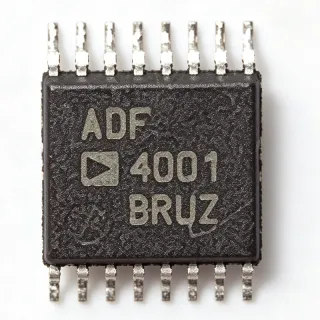
AD4000BRUZ-RL7 - 16-Bit 2MSPS SAR ADC | Analog Devices
Teilenummer: AD4000BRUZ-RL7 ✓ Aktiv| Menge | Stückpreis | Gesamt |
|---|---|---|
| 1 | $40.24 | $40,24 |
| 10 | $36.5 | $365,00 |
| 100 | $32.8 | $3.280,00 |
| 500 | $29.1 | $14.550,00 |
| 1.000 | $25.4 | $25.400,00 |
AD4000BRUZ-RL7 Übersicht
An ADC (Analog-to-Digital Converter) is a device that converts an analog voltage or current into a digital number proportional to the magnitude of the signal. SAR (Successive Approximation Register) ADCs use a binary search algorithm to determine the digital output, offering a good balance of speed, resolution, and power consumption. They are widely used in data acquisition systems, industrial process control, medical instrumentation, and communication systems where precision and speed are required.
Key features of the AD4000BRUZ-RL7 include 16-bit resolution, 2 MSPS sampling rate, pseudo differential input, and Easy Drive technology that reduces input drive requirements. The device operates from a single 1.8V analog supply and a separate digital supply, with a typical power dissipation of only 3.5 mW at 2 MSPS. It also features a high-Z mode for reduced input current and an extended acquisition phase, simplifying the front-end design.
The AD4000BRUZ-RL7 uses a precision SAR architecture with an internal reference buffer and supports both SPI and daisy-chain interfaces. The Easy Drive feature allows direct connection to high-impedance sensors without an external driver amplifier, reducing component count and power consumption. The device also includes a temperature sensor and a 4-wire SPI interface for easy integration with microcontrollers and DSPs.
Typical applications include data acquisition systems, industrial automation, medical imaging, and portable instrumentation. The high speed and low power make it suitable for battery-powered devices, while the precision and Easy Drive features enable accurate measurements in noisy environments.
When designing with the AD4000BRUZ-RL7, ensure proper decoupling of the analog and digital supplies and use a low-impedance reference source. The device requires a conversion clock and a serial clock for data output; careful layout of the analog input and reference traces is essential to maintain accuracy.
Drop-in-Alternativen für AD4000BRUZ-RL7 – gleiches Gehäuse, Pin-kompatibel. Bauteile mit anderem Gehäuse, die eine PCB-Überarbeitung erfordern, sind ausgeschlossen.
Varianten dieser Serie
Modelle derselben Serie, die drop-in-kompatibel sind mit AD4000BRUZ-RL7 (gleiche Bauform und Footprint) – abweichend in Interface, Sampling Rate, Input Type, Package, Resolution.
Schnellvergleichstool – Wählen Sie Alternativbauteile für den Direktvergleich:
AD4000BRUZ
✅ Drop-In✓ Auf Lager
$8.1 / Stück
Datenblatt ansehen →AD4004BRUZ
✅ Drop-In ⚠️ Spezifikationen ungeprüft✓ Auf Lager
$6.25 / Stück
Datenblatt ansehen →AD4008BRUZ
✅ Drop-In ⚠️ Spezifikationen ungeprüft✓ Auf Lager
$3.73 / Stück
Datenblatt ansehen →AD4000BRUZ-RL7 Grenzwerte & elektrische Eigenschaften
| Auflösung | 16 bits |
| Abtastrate | 2 MSPS |
| Input Type | Pseudo differential |
| Number of Inputs | 1 |
| Schnittstelle | SPI, daisy-chain |
| Supply Voltage (Analog) | 1.8 V |
| Supply Voltage (Digital) | 1.8 V to 5 V |
| Power Dissipation | 3.5 mW at 2 MSPS |
| Gehäuse | 16-lead TSSOP |
| Betriebstemperaturbereich | -40°C to +125°C |
| Montageart | Surface Mount |
| RoHS-Status | Compliant |
| Easy Drive | Yes |
AD4000BRUZ-RL7 Pin-Konfiguration
| Pin 1 | VIN — Analog input |
| Pin 2 | REF — Reference input |
| Pin 3 | GND — Ground |
| Pin 4 | VDD — Analog supply |
| Pin 5 | VIO — Digital supply |
| Pin 6 | SCLK — Serial clock |
| Pin 7 | SDI — Serial data in |
| Pin 8 | SDO — Serial data out |
| Pin 9 | CNV — Convert input |
| Pin 10 | GND — Ground |
| Pin 11 | VDD — Analog supply |
| Pin 12 | REF — Reference input |
| Pin 13 | VIN — Analog input |
| Pin 14 | GND — Ground |
| Pin 15 | VIO — Digital supply |
| Pin 16 | GND — Ground |
Typische Anwendungen
AD4000BRUZ-RL7 ist geeignet für 6 Anwendungs: Data Acquisition Systems, Industrial Automation, Medical Instrumentation, Portable Instrumentation, Communication Systems, Test and Measurement.
Data Acquisition Systems
The AD4000BRUZ-RL7 is ideal for high-speed data acquisition systems requiring 16-bit precision at 2 MSPS. Its Easy Drive technology simplifies front-end design by allowing direct connection to sensors without an external driver amplifier, reducing component count and power consumption. The pseudo differential input rejects common-mode noise, making it suitable for industrial environments. With a low power dissipation of 3.5 mW, it is also suitable for multi-channel systems where power is a concern. The SPI interface enables easy integration with microcontrollers and DSPs, and the daisy-chain feature allows multiple ADCs to share a single serial bus, simplifying system design.
Empfohlen
Industrial Automation
In industrial automation, the AD4000BRUZ-RL7 provides accurate, high-speed conversion for process control, motor control, and condition monitoring. Its 16-bit resolution and 2 MSPS sampling rate enable precise measurement of fast-changing signals. The device operates over a wide temperature range (-40°C to +125°C), ensuring reliability in harsh environments. The Easy Drive feature reduces the need for external buffering, lowering system cost and complexity. The pseudo differential input helps reject ground noise, which is common in industrial settings. The SPI interface allows direct connection to industrial microcontrollers, and the daisy-chain capability simplifies wiring in multi-channel systems.
Empfohlen
Medical Instrumentation
The AD4000BRUZ-RL7 is well-suited for medical instrumentation such as patient monitoring, diagnostic imaging, and laboratory equipment. Its high accuracy and low power consumption are critical for battery-operated devices. The 16-bit resolution provides fine detail for physiological signals, while the 2 MSPS sampling rate captures fast transients. The Easy Drive technology allows direct connection to high-impedance sensors like ECG electrodes, simplifying the analog front-end. The small TSSOP package saves board space, and the wide temperature range ensures reliable operation in clinical environments. The SPI interface enables seamless integration with medical-grade microcontrollers.
Empfohlen
Portable Instrumentation
For portable instruments like handheld multimeters, data loggers, and field analyzers, the AD4000BRUZ-RL7 offers a balance of performance and power efficiency. Its 3.5 mW power dissipation at 2 MSPS extends battery life, and the 1.8V analog supply is compatible with low-voltage batteries. The Easy Drive feature reduces the need for external components, saving space and cost. The pseudo differential input allows accurate measurement of small signals in the presence of common-mode noise. The SPI interface is simple to interface with low-power microcontrollers, and the daisy-chain feature enables multi-channel expansion without additional I/O pins.
Empfohlen
Communication Systems
In communication systems, the AD4000BRUZ-RL7 is used for baseband signal processing, software-defined radio, and spectrum analysis. Its 2 MSPS sampling rate and 16-bit resolution provide sufficient dynamic range for many communication signals. The low power dissipation is beneficial in portable and remote communication devices. The Easy Drive technology simplifies the interface to RF front-ends, and the pseudo differential input helps reject interference. The SPI interface allows direct connection to FPGAs and DSPs, and the daisy-chain feature enables multiple ADCs to be used in phased-array systems. The wide temperature range ensures reliable operation in outdoor equipment.
Empfohlen
Test and Measurement
The AD4000BRUZ-RL7 is a key component in test and measurement equipment such as oscilloscopes, spectrum analyzers, and data acquisition cards. Its high speed and precision enable accurate capture of waveforms and transient events. The 16-bit resolution provides fine amplitude resolution, and the 2 MSPS sampling rate is sufficient for many audio and low-frequency applications. The Easy Drive feature reduces the burden on front-end amplifiers, and the pseudo differential input allows accurate measurement of floating signals. The SPI interface is compatible with common test equipment controllers, and the daisy-chain feature allows multiple channels to be synchronized. The device's low power dissipation is an advantage in portable test instruments.
Empfohlen
Zusammenfassung der empfohlenen Produkte
Technische Referenzdaten für AD4000BRUZ-RL7 – Vergleich, Designhinweise und Compliance-Informationen.
Auswahlhilfe
Vergleich mit Alternativen
| Parameter | Dieses Produkt | AD4000BRUZ | AD4004BRUZ | AD4008BRUZ | AD4000BRMZ-RL7 |
|---|---|---|---|---|---|
| Package | 16-lead TSSOP | 16-lead TSSOP | 16-lead TSSOP | 16-lead TSSOP | 10-lead MSOP |
| Brand | Analog Devices | Analog Devices | Analog Devices | Analog Devices | Analog Devices |
| Resolution | 16 bits | 16 bits | 18 bits | 20 bits | 16 bits |
| Sampling Rate | 2 MSPS | 2 MSPS | 2 MSPS | 2 MSPS | 2 MSPS |
| Input Type | Pseudo differential | Pseudo differential | Pseudo differential | Pseudo differential | Pseudo differential |
| Power Dissipation | 3.5 mW | 3.5 mW | 3.5 mW | 3.5 mW | 3.5 mW |
| Interface | SPI, daisy-chain | SPI, daisy-chain | SPI, daisy-chain | SPI, daisy-chain | SPI, daisy-chain |
| Operating Temperature | -40°C to +125°C | -40°C to +125°C | -40°C to +125°C | -40°C to +125°C | -40°C to +125°C |
Wichtigste Unterscheidungsmerkmale
- Easy Drive technology reduces input drive requirements (vs. AD7980BRMZ)
- Higher sampling rate of 2 MSPS (vs. AD7980BRMZ)
- Pseudo differential input for better noise rejection (vs. AD7980BRMZ)
Designhinweise
The AD4000BRUZ-RL7 requires a clean 1.8V analog supply (VDD) and a separate digital supply (VIO) that can range from 1.8V to 5V. Use low-dropout regulators (LDOs) to generate these supplies and place 0.1uF and 10uF decoupling capacitors close to the VDD and VIO pins. The reference input (REF) should be driven by a low-impedance source, such as a precision reference buffer, to ensure accurate conversions.
For optimal performance, separate analog and digital ground planes and connect them at a single point near the ADC. Route the analog input (VIN) and reference (REF) traces away from digital signals to minimize noise coupling. Use a solid ground plane under the ADC and avoid routing high-speed digital traces beneath the analog input. Place the ADC close to the signal source to reduce trace inductance.
A common mistake is driving the analog input with a high-impedance source without considering the ADC's input capacitance. The Easy Drive feature reduces this issue, but it is still important to ensure the source can settle within the acquisition time. Also, avoid exceeding the absolute maximum ratings on the input pins. Use a series resistor (e.g., 10-50 ohms) to limit input current if overvoltage is possible. Ensure the reference voltage is stable and within the specified range.
Compliance-Informationen
RoHS compliance is indicated by the 'Z' suffix in the part number. Other compliance details are not specified in the provided data.