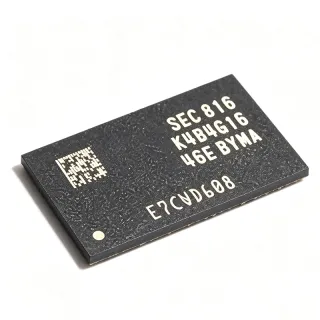
K4AAG165WA-BCRC - 16Gb DDR4 SDRAM, FBGA-96 | Samsung | DRAM
Teilenummer: K4AAG165WA-BCRC ✓ Aktiv| Menge | Stückpreis | Gesamt |
|---|---|---|
| 1 | $79.74 | $79,74 |
| 10 | $76.5 | $765,00 |
| 100 | $72.1 | $7.210,00 |
| 500 | $68.4 | $34.200,00 |
| 1.000 | $64.9 | $64.900,00 |
K4AAG165WA-BCRC Übersicht
A DDR4 SDRAM is a synchronous dynamic random-access memory, the fifth generation of the DDR (Double Data Rate) SDRAM standard hierarchy: DRAM -> DDR SDRAM -> DDR4 SDRAM -> volatile memory -> semiconductor memory. DDR4 transfers data on both clock edges, achieving high bandwidth at a reduced 1.2V supply versus the 1.5V of DDR3, cutting power consumption by roughly 25% according to Samsung's official DDR4 product page. DDR4 devices use a bank-group architecture, internal refresh schemes, and low-voltage SSTL12 I/O to deliver the bandwidth required by servers, PCs, and embedded systems.
Key features of the K4AAG165WA family include 16 Gb density in a single die, x16 organization suited to 16-bit memory buses, industrial operating temperature support (the -BCWE variant of this family is rated -40C to +95C per LCSC), and 1.2V core supply consistent with the JEDEC DDR4 ecosystem. The FBGA-96 package provides a compact footprint for dense memory arrays on SO-DIMMs, UDIMMs, RDIMMs, and memory-down PCB designs.
Architecturally, the device implements the DDR4 bank-group topology, burst-length 8 access, programmable CAS latency, and on-die termination. Command, address, data, DQS strobes, and power/ground balls follow the standard x16 DDR4 ball map defined in the Samsung datasheet (K4AAG165WA, 23-page DDR4 SDRAM Memory datasheet, 961 KB).
Typical applications include memory-down designs for industrial controllers, networking equipment, embedded single-board computers, and notebook or desktop DRAM module manufacturing where 16 Gb x16 components populate 2 GB-per-chip 16-bit memory channels.
Design consideration: DDR4 length-matching, on-die termination settings, and VTTQ termination require careful signal-integrity engineering; always follow the Samsung datasheet routing guidelines and the memory controller's recommended ZQ calibration and refresh intervals.
This page adds value beyond the datasheet by consolidating drop-in same-family alternatives (including BCPB/BCWE/BCRC speed-grade and W/T-die variants), pricing tiers, application pairings, and practical design notes synthesized from distributor and manufacturer data not found in a single source.
Drop-in-Alternativen für K4AAG165WA-BCRC – gleiches Gehäuse, Pin-kompatibel. Bauteile mit anderem Gehäuse, die eine PCB-Überarbeitung erfordern, sind ausgeschlossen.
Varianten dieser Serie
Modelle derselben Serie, die drop-in-kompatibel sind mit K4AAG165WA-BCRC (gleiche Bauform und Footprint) – abweichend in Package, Data Rate, RoHS Status, Interface, Memory Type.
Schnellvergleichstool – Wählen Sie Alternativbauteile für den Direktvergleich:
K4AAG165WA-BCWE
✅ Drop-In✓ Auf Lager
$62.4 / Stück
Datenblatt ansehen →K4AAG165WA-BCPB
✅ Drop-In ⚠️ Spezifikationen ungeprüft✓ Auf Lager
$63.79 / Stück
Datenblatt ansehen →K4AAG165WC-BCWE
✅ Drop-In📋 Referenzalternative (nicht im Katalog)
K4AAG165WC-BCRC
✅ Drop-In📋 Referenzalternative (nicht im Katalog)
K4AAG165WA-BCRC Technische Daten
| Speichertyp | DDR4 SDRAM (Volatile DRAM) |
| Speichergröße | 16 Gb (2 GB) |
| Memory Organization | 1G x 16 |
| Memory Interface | DDR4 SDRAM Interface |
| Versorgungsspannung | 1.2 V |
| Technology | DDR4 |
| Gehäuse | FBGA-96 (96-ball Fine-Pitch Ball Grid Array) |
| Montageart | Surface Mount |
| Speed Grade Suffix | -BCRC |
| Datasheet | Samsung K4AAG165WA DDR4 SDRAM Memory, 23 pages |
| Memory Format | DRAM |
| RoHS-Status | unknown |
K4AAG165WA-BCRC fbga-96 (96-ball fine-pitch ball grid array) Pinbelegungsleitfaden
Pinbelegung für K4AAG165WA-BCRC (fbga-96 (96-ball fine-pitch ball grid array)-Gehäuse). Pin-Nummerierung, Funktionen und Anschlussdiagramme sind im Herstellerdatenblatt definiert. Entnehmen Sie diesem den genauen Footprint und Lötrichtlinien.

Keine detaillierten Pinbelegungsdaten verfügbar für K4AAG165WA-BCRC.
Siehe die Datenblatt für die vollständige Pin-Konfiguration.
Typische Anwendungen
K4AAG165WA-BCRC ist geeignet für 6 Anwendungs: Memory-Down Industrial Controllers, Networking and Communication Equipment, Embedded Single-Board Computers, DRAM Module Manufacturing (DIMMs), Automotive-Adjacent Telematics and Display Units, Security and Video Surveillance.
Memory-Down Industrial Controllers
Industrial controllers, PLCs, and edge gateways frequently use memory-down DDR4 rather than modules to save space and improve reliability in vibration-prone environments. The K4AAG165WA-BCRC delivers 2 GB of DDR4 on a single 96-ball FBGA chip, letting a single x16 device serve the full 16-bit bus of a typical industrial SoC without chip-select fan-out. At 1.2V, it fits industrial 24V systems with efficient point-of-load regulators, and the family's wide temperature grades (the BCWE sibling is rated -40C to +95C per LCSC) cover uncontrolled factory-floor enclosures. Because it is soldered rather than socketed, contact-failure modes common to SO-DIMM connectors are eliminated, improving mean time between failures in continuous-duty automation equipment.
Empfohlen
Networking and Communication Equipment
Switches, routers, and 5G small-cell equipment need high-bandwidth packet buffering and lookup-table memory with minimal footprint. The K4AAG165WA-BCRC provides 2 GB of DDR4 at family data rates up to 3200 Mbps per pin, giving network processors sufficient bandwidth for line-rate forwarding buffers while the x16 organization keeps the physical bus compact. The FBGA-96 package allows dense stacking of multiple devices around a network SoC on a single PCB layer budget. At 1.2V, per-chip power is roughly 25% lower than equivalent DDR3, which matters in thermally constrained fanless telecom hardware. Place devices close to the controller and follow DDR4 fly-by routing to maintain timing margin at speed.
Empfohlen
Embedded Single-Board Computers
Single-board computers and system-on-module makers use 16 Gb x16 DDR4 components like the K4AAG165WA-BCRC to reach 2 GB or 4 GB system memory with only one or two chips, maximizing the memory capacity of small 2 GB-class boards without populating both x16 chip-selects. The device's DDR4 interface pairs directly with mainstream ARM application processors that support 16-bit DDR4 channels and multiple die revisions, though the controller's qualified-vendor list should include both the WA and WC die families. The 96-ball FBGA footprint fits inside module edge keep-outs, and 1.2V operation simplifies the module power tree. Soldered-down DRAM also improves shock resistance for vehicle-mounted and portable embedded designs.
Empfohlen
DRAM Module Manufacturing (DIMMs)
Memory module manufacturers populate UDIMMs, SO-DIMMs, and RDIMMs with commodity 16 Gb x16 DDR4 chips; the K4AAG165WA-BCRC serves as the x16 building block for 2 GB-per-rank module configurations. Using uniform 16 Gb x16 devices across both sides of a PCB enables 2 GB chips per rank with a 64-bit main bus assembled from four x16 devices, matching standard module topologies defined in the Samsung DDR4 datasheet. Consistent speed binning (the BCRC bin) across all chips on a module is critical, since mixed bins force the whole module down to the slowest grade. FBGA-96 footprint standardization across the K4AAG165WA family allows module builders to swap speed grades or die revisions without changing the assembly stencil.
Empfohlen
Automotive-Adjacent Telematics and Display Units
Digital cockpit displays, telematics control units, and ADAS camera hubs built on automotive-qualified application processors require soldered DDR4 with wide temperature tolerance. The K4AAG165WA family's industrial temperature grades (BCWE rated -40C to +95C per LCSC data) address the cabin and near-engine thermal envelopes of these systems, while the 2 GB per chip density supports map storage buffers, camera frame buffering, and infotainment workloads on a single x16 device. Note that for functional-safety programs, a Samsung automotive-qualified DDR4 part number must be selected instead of the commercial BCRC suffix; this device suits non-safety telematics, displays, and aftermarket hardware. Use the memory controller's die-revision support list to validate WA versus WC dies before production.
Empfohlen
Security and Video Surveillance
Network video recorders, AI camera edge boxes, and video-analytics appliances buffer multiple high-resolution video streams in local memory before encoding or inference. The K4AAG165WA-BCRC supplies 2 GB of 1.2V DDR4 per chip, allowing a compact four-chip array to provide 8 GB of analytics working memory on a 64-bit DDR4 bus. The 3200 Mbps-class family bandwidth sustains simultaneous multi-stream writes while the processor reads frames for object detection, and the x16 organization halves the chip count versus x8-only designs. In passively cooled surveillance hardware, DDR4's reduced 1.2V power (about 25% below DDR3 per Samsung) directly lowers enclosure temperature rise, improving HDD and optics reliability in sealed outdoor housings.
Empfohlen
Zusammenfassung der empfohlenen Produkte
Technische Referenzdaten für K4AAG165WA-BCRC – Vergleich, Designhinweise und Compliance-Informationen.
Auswahlhilfe
Vergleich mit Alternativen
| Parameter | Dieses Produkt | K4AAG165WA-BCWE | K4AAG165WA-BCPB | K4AAG165WC-BCWE | K4AAG165WC-BCRC |
|---|---|---|---|---|---|
| Package | FBGA-96 | FBGA-96 - same | FBGA-96 - same | FBGA-96 - same | FBGA-96 - same |
| Brand | Samsung Electronics | Samsung Electronics | Samsung Electronics | Samsung Electronics | Samsung Electronics |
| Memory Size | 16 Gb (2 GB) | 16 Gb (2 GB) | 16 Gb (2 GB) | 16 Gb (2 GB) | 16 Gb (2 GB) |
| Memory Organization | 1G x 16 | 1G x 16 | 1G x 16 | 1G x 16 | 1G x 16 |
| Supply Voltage | 1.2 V | 1.2 V | 1.2 V | 1.2 V | 1.2 V |
| Die Revision | A-die (K4AAG165WA) | A-die | A-die | C-die (W-die revision) | C-die (W-die revision) |
Wichtigste Unterscheidungsmerkmale
- Full 2 GB density on a single x16 chip (vs. K4A8G165WC-BCRC)
- Higher speed headroom available in-pin-compatible siblings (vs. K4AAG165WA-BCWE)
- A-die maturity versus newer W-die (vs. K4AAG165WC-BCRC)
Designhinweise
DDR4 x16 interfaces at 2666-3200 Mbps class data rates require controlled-impedance routing (40 ohm single-ended typical for data lines per standard DDR4 design practice), length matching within the datasheet skew budgets, and correct on-die termination (ODT) settings from your memory controller's ZQ calibration. Fly-by routing of address/command lines with per-device soldered termination, or point-to-point routing for single-chip memory-down designs, must follow the Samsung K4AAG165WA datasheet layout guidelines. Simulate the full channel including package parasitics before committing the PCB stack-up.
Build the power tree around the DDR4 rails defined in the Samsung datasheet: 1.2V VDD/VDDQ plus the VPP rail, each with bulk and high-frequency ceramic decoupling at every ball pair per the datasheet reference decoupling table. For single-chip memory-down designs, a small synchronous buck per rail is sufficient; for multi-chip modules, add a VTTQ termination regulator sized for the x16 bus transient current. DDR4's 1.2V operation draws roughly 25% less current-path power than DDR3 at 1.5V, but peak simultaneous-switch current still dictates decoupling density.
Verify the die revision and speed bin before reflow: the K4AAG165WA (A-die) and K4AAG165WC (C-die) share the FBGA-96 footprint but some memory controllers maintain qualified die-revision lists, and timing registers may need adjustment when swapping between WA and WC dies or between BCRC and BCWE speed bins. Also confirm the exact -BCRC temperature range in the Samsung datasheet rather than assuming the -40C to +95C rating documented for the BCWE sibling, and obtain RoHS certificates for the specific suffix and date code for regulatory submissions.
Compliance-Informationen
Compliance status for the -BCRC suffix is not stated in the retrieved web data. Samsung current-production DDR4 is generally RoHS/lead-free packaged, but confirm via Samsung environmental documentation for the exact suffix and date code before regulatory submission.