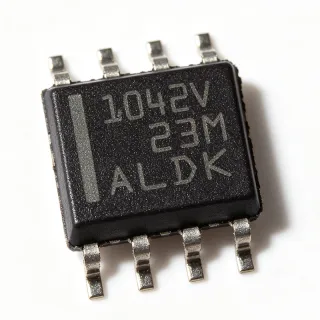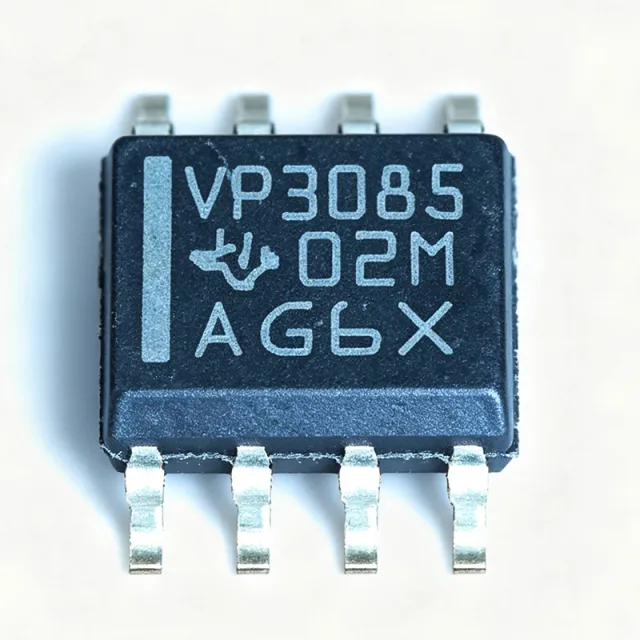
SN65HVD3085EDR - 5V Half-Duplex RS-485 Transceiver | TI
Teilenummer: SN65HVD3085EDR ✓ Aktiv| Menge | Stückpreis | Gesamt |
|---|---|---|
| 1 | $0.65 | $0,65 |
| 10 | $0.52 | $5,20 |
| 100 | $0.43 | $43,00 |
| 500 | $0.37 | $185,00 |
| 1.000 | $0.32 | $320,00 |
SN65HVD3085EDR Übersicht
An RS-485 transceiver is a differential line interface IC that converts single-ended logic signals into balanced differential signals for robust serial communication. Within the interface IC hierarchy, it sits between a UART/MCU and the physical twisted-pair bus, providing the electrical drive, receiver threshold, and bus-fault tolerance defined by the TIA/EIA-485A standard.
Key features include operation from a 4.5V to 5.5V supply, signaling rates up to 20 Mbps (per the SNx5HVD308xE family data), a small SOIC-8 footprint, and an operating temperature range of -40C to +85C. Controlled driver output transition times reduce EMI and reflections, while the low-power design minimizes quiescent supply current for multi-node networks.
Architecturally, the device uses a differential driver with three-state outputs and a differential receiver with fail-safe inputs. Driver (DE) and receiver enable (/RE) pins allow half-duplex direction control from a standard MCU GPIO. Bus pins A and B tolerate the fault conditions required by the RS-485 standard, supporting reliable operation in electrically noisy industrial environments.
Typical applications include industrial automation and Modbus RTU networks, building and HVAC control buses, battery-management and motor-control communication links, and point-to-multipoint serial links over twisted pair. The 20 Mbps class speed also suits fast industrial backbones needing short frame times.
Design tip: use fail-safe biasing resistors on the A/B bus lines and terminate both cable ends with 120 ohm resistors to prevent reflections and receiver chatter on idle buses.
This page synthesizes distributor pricing, drop-in alternatives, pinout data, and practical design notes not consolidated in the manufacturer datasheet. Pricing references as of 2026-08-29 (LCSC from $0.3185).
Drop-in-Alternativen für SN65HVD3085EDR – gleiches Gehäuse, Pin-kompatibel. Bauteile mit anderem Gehäuse, die eine PCB-Überarbeitung erfordern, sind ausgeschlossen.
Varianten dieser Serie
Modelle derselben Serie, die drop-in-kompatibel sind mit SN65HVD3085EDR (gleiche Bauform und Footprint) – abweichend in Package, Signaling Rate, Supply Voltage, Function, RoHS Status.
Schnellvergleichstool – Wählen Sie Alternativbauteile für den Direktvergleich:
SN65HVD3082EDR
✅ Drop-In✓ Auf Lager
Preis auf Anfrage
Datenblatt ansehen →SN65HVD3085ED
✅ Drop-In ⚠️ Spezifikationen ungeprüft📋 Referenzalternative (nicht im Katalog)
SN75HVD3085ED
✅ Drop-In ⚠️ Spezifikationen ungeprüft📋 Referenzalternative (nicht im Katalog)
SN65LBC176DR
✅ Drop-In ⚠️ Spezifikationen ungeprüft✓ Auf Lager
$1.2727 / Stück
Datenblatt ansehen →SP3085EEN-L
✅ Drop-In📋 Referenzalternative (nicht im Katalog)
SN65HVD3085EDR Technische Daten
| Protocol | RS-485, RS-422 (TIA/EIA-485A compliant) |
| Duplex Mode | Half-duplex |
| Number of Drivers / Receivers | 1 / 1 |
| Versorgungsspannung | 4.5 V to 5.5 V |
| Signaling Rate | Up to 20 Mbps |
| Betriebstemperatur | -40C to +85C |
| Gehäuse | SOIC (D), 8 pins |
| Montageart | Surface Mount |
| Receiver Hysteresis | Specified in manufacturer datasheet |
| Bus Pin ESD / Fault Tolerance | Per TIA/EIA-485A requirements |
| Driver Output Transition Time | Controlled (slew-limited for long cables) |
| Isolation | None (non-isolated) |
| Funktion | Low-power half-duplex RS-485 transceiver |
| Standard Packaging | Tape & Reel (R suffix) |
| RoHS-Status | Compliant (per Abacus Technologies listing) |
| REACH Status | Compliant (per Abacus Technologies listing) |
SN65HVD3085EDR Pin-Konfiguration
| Pin 1 | RO — Receiver output. If /RE is low, RO is active; if /RE is high, RO is high impedance. |
| Pin 2 | /RE — Receiver enable (active low). Low enables receiver output RO; high disables and tri-states RO. |
| Pin 3 | DE — Driver enable (active high). High enables driver outputs A and B; low puts driver in three-state. |
| Pin 4 | D — Driver input. Logic level on D is driven differentially onto A and B when DE is high. |
| Pin 5 | GND — Ground connection. |
| Pin 6 | A — Driver output / receiver input (noninverting bus line). |
| Pin 7 | B — Driver output / receiver input (inverting bus line). |
| Pin 8 | VCC — Power supply, 4.5 V to 5.5 V. Decouple with 0.1 uF ceramic capacitor. |
Typische Anwendungen
SN65HVD3085EDR ist geeignet für 6 Anwendungs: Industrial Automation and Modbus Networks, Building Automation and HVAC Control, Battery Management System (BMS) Communication, Motor Control and Drives, Security and Surveillance Systems, Point-to-Point and Multipoint Serial Links over Twisted Pair.
Industrial Automation and Modbus Networks
In factory automation and Modbus RTU/ASCII networks, dozens of PLCs, drives, and remote I/O modules share one twisted-pair bus. The SN65HVD3085EDR fits this role because its TIA/EIA-485A compliance, 4.5V-5.5V operation, and half-duplex DE//RE direction control match the master/slave polling model exactly. Its controlled output transition times limit reflections when the bus is long and stubs exist. Place 120 ohm termination at both cable ends and fail-safe bias resistors so idle periods do not chatter the receiver; its -40C to +85C rating covers cabinet environments.
Empfohlen
Building Automation and HVAC Control
Building controllers, VAV boxes, chillers, and energy meters commonly communicate over RS-485 (BACnet MS/TP and Modbus). The SN65HVD3085EDR is appropriate because its slew-controlled driver edges reduce EMI near sensing circuits and its low-power design keeps quiescent draw low across many networked nodes. The 20 Mbps class capability also accommodates faster backbone segments. In rooftop and mechanical rooms with wide temperature swings, the -40C to +85C operating range maintains link integrity, and the small SOIC-8 footprint suits dense controller boards.
Empfohlen
Battery Management System (BMS) Communication
Stacked battery modules in energy-storage and EV systems frequently daisy-chain over RS-485 or CAN. The SN65HVD3085EDR serves the inter-module link where a 5V rail is available: the differential A/B pair rejects common-mode noise generated by switching power stages, and bus-fault tolerance per TIA/EIA-485A protects against wiring faults during service. Keep the transceiver ground-referenced per module and consider digital isolators when stacking introduces large ground shifts. Its controlled transition times help signal integrity on the long harness runs between modules.
Empfohlen
Motor Control and Drives
Inverter and servo drive systems use RS-485 links between the drive controller and operator panels or supervisory PLCs. The SN65HVD3085EDR's differential receiver rejects the large common-mode noise from PWM switching, and its bus fault tolerance supports the electrically harsh cabinet environment. Route the A/B twisted pair away from motor phase cables and use 120 ohm termination at both ends. The 20 Mbps class rate supports fast parameter synchronization, while the SOIC-8 package keeps board area small inside dense gate-driver and control PCBs.
Empfohlen
Security and Surveillance Systems
PTZ cameras, access-control panels, and door controllers often use RS-485 (Pelco-D/P and OSDP-style buses) for long cable runs between the head end and remote devices. The SN65HVD3085EDR is a good fit because its differential signaling tolerates the long unshielded runs typical of buildings, and the half-duplex enable pins allow a single MCU UART to handle both camera control commands and telemetry responses. Slew-controlled edges limit radiated emissions in cable bundles, and the -40C to +85C range covers outdoor camera enclosures.
Empfohlen
Point-to-Point and Multipoint Serial Links over Twisted Pair
For general-purpose UART extension beyond a few meters, the SN65HVD3085EDR converts MCU TTL serial into robust differential signaling. At short cable lengths the 20 Mbps class rate supports near-UART line-rate throughput, while its TIA/EIA-485A receiver thresholds and fail-safe behavior keep the link stable when idle. Add 120 ohm termination at both ends and a common-mode bias network per the TI datasheet. The low quiescent power makes it viable in always-on gateways, kiosks, and embedded appliances powered from a 5V USB or industrial rail.
Empfohlen
Zusammenfassung der empfohlenen Produkte
Technische Referenzdaten für SN65HVD3085EDR – Vergleich, Designhinweise und Compliance-Informationen.
Auswahlhilfe
Vergleich mit Alternativen
| Parameter | Dieses Produkt | SN65HVD3082EDR | SN65LBC176DR | SP3085EEN-L |
|---|---|---|---|---|
| Package | SOIC-8 (D) | SOIC-8 (D) - same | SOIC-8 (D) - same | SOIC-8 - same |
| Brand | Texas Instruments | Texas Instruments | Texas Instruments | MaxLinear (Exar) |
| Supply Voltage | 4.5 V to 5.5 V | 4.5 V to 5.5 V | 5 V | 5 V |
| Duplex | Half-duplex | Half-duplex | Half-duplex | Half-duplex |
| Standard Compliance | TIA/EIA-485A | TIA/EIA-485A | RS-485 | RS-485 |
| RoHS | Compliant | Compliant | Compliant | Compliant |
Wichtigste Unterscheidungsmerkmale
- 20 Mbps class signaling rate in low-power half-duplex footprint (vs. SN65HVD3082EDR)
- Full industrial temperature range (vs. SN75HVD3085ED)
- Cross-brand second source documented (vs. SP3085EEN-L)
Designhinweise
Place a 0.1 uF ceramic decoupling capacitor within 2-3 mm of the VCC pin (pin 8), with a solid ground return to pin 5. Route the A/B differential pair as a tightly coupled twisted pair or matched-length pair on the PCB, keeping stubs to the termination resistor under 1-2 cm. Keep the RO/D logic traces short and away from the bus lines to avoid crosstalk into the receiver input during transmit. Per TI SNx5HVD308xE family datasheet guidance, controlled transition times help but layout still dominates at 20 Mbps class rates.
Tie /RE (pin 2) and DE (pin 3) together and drive from a single GPIO for classic half-duplex direction control; leaving /RE floating leaves RO undefined and can cause UART framing errors. Always include 120 ohm termination at both physical bus ends, not at every node, and add fail-safe bias resistors (typically 560-680 ohm to VCC and GND, sized against the receiver threshold in the datasheet) so an idle bus does not chatter RO. Do not exceed the 5.5V supply maximum, and remember the 5V logic pins are not 3.3V tolerant without a level translator.
The SN65HVD3085E targets up to 20 Mbps class signaling, so choose cable length and rate together: for very long runs (hundreds of meters), drop the baud rate and consider the slower SN65HVD3082E whose heavier slew limiting further suppresses reflections. Estimated rule of thumb used by RS-485 designers: rate x length products near 10^7-10^8 bit-m/s are workable with proper termination. Measure rise time at the far node during bring-up; visible ringing means termination value or stub length needs revision.
Compliance-Informationen
Per Abacus Technologies listing: EU RoHS Compliant, REACH Compliant, PFAS: NO, DRC Conflict Free.