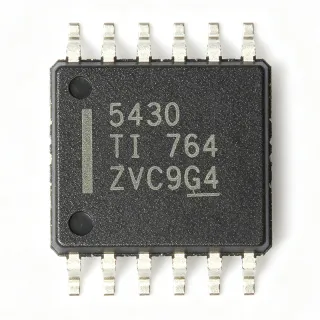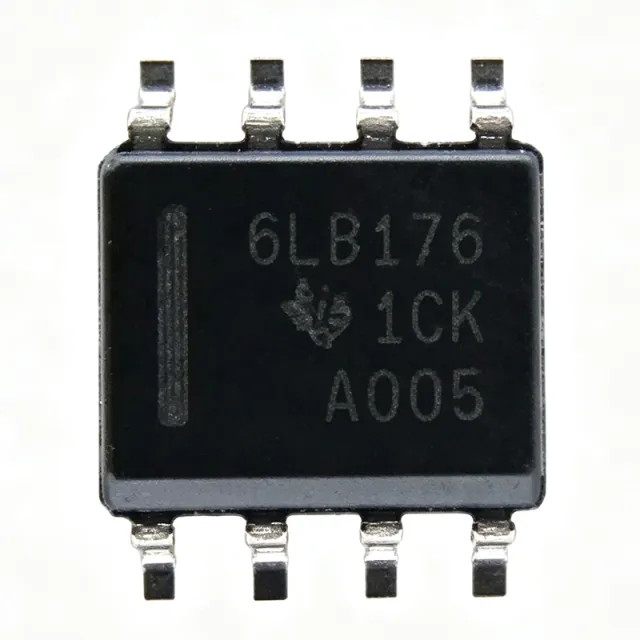
SN65LBC176DR - 10Mbps RS-485 Transceiver 5V | Texas Instruments
MPN: SN65LBC176DR ✓ Active| Qty | Unit Price | Extended |
|---|---|---|
| 1 | $2.1818 | $2.18 |
| 10 | $1.5758 | $15.76 |
| 100 | $1.3939 | $139.39 |
| 500 | $1.3333 | $666.65 |
| 1,000 | $1.2727 | $1,272.70 |
SN65LBC176DR Overview
A differential bus transceiver is an interface IC that converts single-ended logic signals into differential signals for transmission over twisted-pair cable, providing high noise immunity for industrial data networks. The SN65LBC176 belongs to the RS-485/RS-422 transceiver family within the broader hierarchy of interface ICs and line drivers, and it meets or exceeds the requirements of ANSI TIA/EIA-485 (RS-485) and ISO 8482:1987 (E).
Key features include a driver enable (DE, active-high) and receiver enable (RE, active-low) that can be tied together to form a single direction-control pin, low-skew LinBiCMOS technology designed for high-speed serial and parallel data transmission, and bus fault protection across a -10V to +15V common-mode range. The driver outputs differential signals on pins A and B while the receiver accepts differential input, allowing direct connection to the multipoint bus. One driver and one receiver per device simplify point-to-point and multidrop network nodes.
The LinBiCMOS process yields low power consumption with high output drive, supporting bus loading of up to 32 unit loads and cable lengths of several thousand feet at lower data rates. Typical applications include industrial automation networks, motor-drive communication links, building automation, energy metering, and any half-duplex RS-485 fieldbus requiring 10 Mbps throughput.
Design tip: bias the bus with fail-safe resistor dividers (typically 560 ohm to the A-line pull-down and B-line pull-up) and terminate both bus ends with 120 ohm to prevent reflections and ensure a defined receiver state when all drivers are disabled.
Drop-in alternatives for SN65LBC176DR — same package, pin-to-pin compatible. Different-package parts requiring PCB rework are excluded.
Variants in this series
Same-series models that are drop-in compatible with SN65LBC176DR (same form factor and footprint) — differing in Function, Package, RoHS Status, Signaling Rate, Supply Voltage.
Quick Comparison Tool — Select alternative parts for side-by-side comparison:
SN65HVD3085EDR
✓ In Stock
$0.32 / Unit
View Datasheet →SN65HVD255DR
✓ In Stock
$1.12 / Unit
View Datasheet →SN65LBC176ADR
📋 Reference alternative (not in catalog)
SN75LBC176D
📋 Reference alternative (not in catalog)
ST485BDR
📋 Reference alternative (not in catalog)
MAX485ESA
📋 Reference alternative (not in catalog)
SN65LBC176DR Specifications
| Function | Half-duplex RS-485/RS-422 transceiver |
| Signaling Rate | 10 Mbps (max) |
| Supply Voltage | 5 V (nominal) |
| Duplex | Half |
| Transmitters / Receivers | 1 / 1 |
| Protocol Compliance | ANSI TIA/EIA-485 (RS-485), ISO 8482:1987 (E) |
| Fault Protection | -10 V to 15 V common-mode bus range |
| Driver Enable | DE, active-high |
| Receiver Enable | RE, active-low |
| Technology | LinBiCMOS, low skew |
| Operating Temperature | -40C to +85C |
| Package | 8-SOIC (D), 3.90 mm width |
| Mounting Type | Surface Mount |
| Number of Pins | 8 |
| Bus Loading | Up to 32 unit loads (multipoint) |
| RoHS Status | Compliant |
SN65LBC176DR Pin Configuration
| Pin 1 | RO — Receiver output |
| Pin 2 | RE — Receiver enable (active low) |
| Pin 3 | DE — Driver enable (active high) |
| Pin 4 | D — Driver input |
| Pin 5 | GND — Ground |
| Pin 6 | A — Driver output / receiver input, non-inverting bus line |
| Pin 7 | B — Driver output / receiver input, inverting bus line |
| Pin 8 | VCC — 5V power supply |
Typical Applications
SN65LBC176DR is suitable for 6 applications: Industrial Automation Fieldbus, Motor Drive Communication Links, Building Automation and HVAC, Energy Metering Networks, Security and Surveillance Camera Buses, Point-to-Point Serial Links and Legacy Board Repair.
Industrial Automation Fieldbus
Factory networks such as Modbus RTU and Profibus-class links rely on half-duplex RS-485 multidrop buses. The SN65LBC176DR fits because its 10 Mbps signaling rate exceeds typical 9600-bps-to-1-Mbps fieldbus needs, and its -10V to +15V common-mode tolerance survives ground-potential differences between machines. DE/RE tied together give one-wire direction control from an MCU UART, and 32-unit-load drive supports dense node counts on a single twisted pair terminated at both ends.
Recommended
Motor Drive Communication Links
Variable-frequency drives and servo amplifiers use RS-485 links between the drive controller and remote HMI or PLC. The SN65LBC176DR suits this environment: the -40C to +85C range covers enclosure temperatures near power electronics, and LinBiCMOS low-skew design preserves differential signal integrity over shielded cable in high-EMI switch-mode surroundings. The -10V to +15V fault range tolerates motor-ground noise, while fail-safe biasing keeps the receiver defined when the drive is disabled.
Recommended
Building Automation and HVAC
BACnet MS/TP and similar building protocols run half-duplex RS-485 at 9.6 to 115.2 kbps over long controller-area buses. The SN65LBC176DR supports cable lengths of several thousand feet at these rates, and its 3-state driver allows dozens of controllers on one pair. Fail-safe biasing at the bus head end guarantees a defined idle state, and the 5V SOIC-8 footprint drops directly into legacy controller boards designed for classic RS-485 transceivers.
Recommended
Energy Metering Networks
Smart-meter concentrators poll meters over RS-485 runs through switchgear where common-mode transients occur. The SN65LBC176DRs -10V to +15V bus fault protection and TIA/EIA-485 compliance directly address these conditions, while its 10 Mbps headroom supports future high-speed reading campaigns. The 8-SOIC package fits compact meter PCBs, and its wide -40C to +85C rating survives outdoor meter cabinets; external TVS diodes are recommended on A/B for surge-prone installations.
Recommended
Security and Surveillance Camera Buses
PTZ camera control uses RS-485 (Pelco-D/P style) half-duplex links from DVR/controller to multiple camera heads on one twisted pair. The SN65LBC176DRs 3-state outputs and combined DE/RE direction pin match the multidrop addressing model, and its low-skew LinBiCMOS circuitry keeps 9.6-to-115.2-kbps control traffic clean even on long cable runs. The -40C to +85C range suits outdoor camera enclosures, and bus fault tolerance adds resilience to lightning-induced transients.
Recommended
Point-to-Point Serial Links and Legacy Board Repair
For high-speed serial backhaul between two boards (up to 10 Mbps) or repairing legacy RS-422/RS-485 cards, the SN65LBC176DR is a direct fit because it meets both ANSI RS-485 and ISO 8482:1987 (E). Its standard SOIC-8 footprint lets it substitute aged transceivers without PCB rework, and the low driver-receiver skew supports clocked parallel links as well as UART-style serial traffic, per the TI datasheet application guidance.
Recommended
Recommended Products Summary
Engineering reference data for SN65LBC176DR — comparison, design guidance, and compliance information.
Selection Guide
Comparison with Alternatives
| Parameter | This Product | SN65LBC176ADR | SN75LBC176D | SN65HVD3085EDR | ST485BDR |
|---|---|---|---|---|---|
| Package | 8-SOIC (D) | 8-SOIC (D) - same | 8-SOIC (D) - same | 8-SOIC (D) - same | 8-SOIC - same footprint |
| Brand | Texas Instruments | Texas Instruments | Texas Instruments | Texas Instruments | STMicroelectronics |
| Signaling Rate | 10 Mbps | 30 Mbps | 10 Mbps | 200 kbps | approx. 250 kbps |
| Supply Voltage | 5 V | 5 V | 5 V | 3.3 V / 5 V | 5 V |
| Operating Temperature | -40C to +85C | -40C to +85C | 0C to +70C | -40C to +85C | -40C to +85C |
| Duplex | Half | Half | Half | Half | Half |
| Protocol Compliance | ANSI RS-485, ISO 8482:1987 (E) | ANSI RS-485, ISO 8482:1987 (E) | ANSI RS-485 | ANSI TIA/EIA-485-A | ANSI RS-485/RS-422 |
Key Differentiators
- 10 Mbps signaling rate (vs ST485BDR)
- 30 Mbps upgrade path (vs SN65LBC176ADR)
- Extended bus fault tolerance (vs SN65HVD3085EDR)
Design Notes
Terminate both physical ends of the twisted-pair bus with 120 ohm resistors matching cable characteristic impedance, and place a 0.1 uF decoupling capacitor within 2 mm of the VCC pin (pin 8) to ground. At 10 Mbps edge rates, stubs longer than a few centimeters on A/B traces cause reflections - route A and B as a matched pair with ground reference, directly to the connector.
Add fail-safe biasing at one point on the bus (typically 560 ohm pull-up on B and 560 ohm pull-down on A at the master node) so the receiver output stays defined when all drivers are tri-stated. Do not omit this - the SN65LBC176 receiver does not include integrated fail-safe inputs, and an unterminated idle bus produces random RO transitions interpreted as framing errors.
Tie DE (pin 3) and RE (pin 2) together and drive them from a single GPIO for one-wire direction control; add a 10 kohm pull-down so the node defaults to receive mode during MCU reset. In electrically noisy motor-drive or surge-exposed environments, add bidirectional TVS diodes on A and B lines to chassis ground and consider an isolated transceiver such as ISO1050 for large ground-potential differences.
Compliance Information
RoHS compliant per TI product page. AEC-Q100 qualification not stated for standard part (SN65LBC176Q variant exists for automotive-grade applications per TI family description).