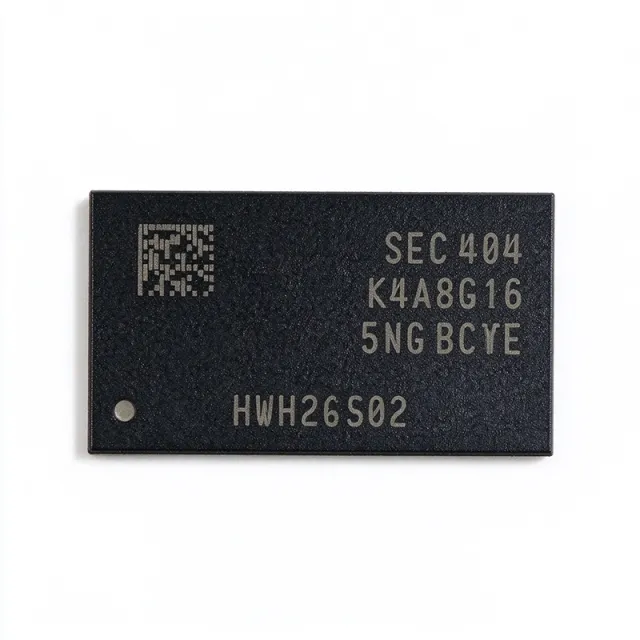
Quick Answers: What Is the K4A8G165WG-BCWE and Is It in Stock?
The Samsung K4A8G165WG-BCWE is an 8 Gbit DDR4 SDRAM organized as 512M × 16, running at 3200 Mbps (PC4-25600) from a 1.2 V supply in a 96-ball FBGA package. It operates from 0 °C to +85 °C, draws 20 mA typical operating current, and uses Samsung's B-die process with a 19 ns row cycle time (tRC). The part is Active, in stock at 99,999 units with a 1-unit minimum order, and priced from $29.5313 in the 1,000+ unit tier on XAIPART as of 2026-10-14. It is RoHS compliant, lead-free, and surface mount, with a parallel interface that connects directly to memory controllers in CPUs, SoCs, network processors, and FPGAs.
| Parameter | Verified value |
|---|---|
| Manufacturer | Samsung |
| Memory type | DDR4 SDRAM |
| Density / organization | 8 Gbit / 512M × 16 |
| Data rate | 3200 Mbps (PC4-25600) |
| Supply voltage | 1.2 V |
| Typical operating current | 20 mA |
| Row cycle time (tRC) | 19 ns |
| Package / mounting | FBGA-96 / surface mount |
| Operating temperature | 0 °C to +85 °C |
| Die technology | B-die |
| Interface | Parallel |
| Lifecycle / stock / MOQ | Active / 99,999 units / 1 |
Reach for this part where a wide bus matters more than placement count: four x16 devices build a full 64-bit rank with 4 GB of capacity (4 × 8 Gbit = 32 Gbit). The verified application list covers server main memory, networking switches and routers, industrial embedded systems, high-end consumer electronics, automotive infotainment, and FPGA-based prototyping. The K4A8G165WG-BCWE product page carries current stock and tier pricing, and the XAIPART component catalog lists the 2666 Mbps and 16 Gb Samsung parts discussed below.
Takeaway: 8 Gbit, 512M × 16, 3200 Mbps, 1.2 V, 0 °C to +85 °C, FBGA-96, Active with 99,999 units available — confirm your controller runs DDR4-3200 and that the rail holds 1.2 V before you commit the BOM line.
Technical Guide: How Do You Select and Design In This DDR4 SDRAM?
Three numbers decide whether the K4A8G165WG-BCWE fits: 3200 Mbps, 512M × 16, and 1.2 V. If your memory controller tops out at DDR4-2666, the Samsung K4A8G165WC-BCTD or K4A8G165WB-BCTD cover the same 8 Gb density at 2666 Mbps. If you need more capacity per device, the 16 Gb K4AAG165WB-MCTD appears in the verified comparison set — but its organization and pin compatibility are not stated in the data set, so treat it as a capacity path rather than a drop-in.
Power and decoupling. The verified pinout lists five VDD balls (A1, E1, J1, N1, U1) and four VDDQ balls (C1, G1, L1, R1), interleaved with VSS and VSSQ ground balls. The design guidance in the product data calls for 0.1 µF and 1 µF decoupling capacitors near the VDD and VDDQ pins. Place the 0.1 µF parts within a few millimeters of each ball group, add bulk capacitance on the 1.2 V rail, and keep the VDDQ plane separate from the VDD plane until the single-point tie. The device also needs a reference voltage (VREF) for the command and address bus.
Command, address and strobe routing. The key control pins in the verified pinout are CK (U2) and CK# (U3), CS# (T2), CKE (T3), ODT (V2), RESET# (V3), RAS# (P3), CAS# (R2), WE# (R3), bank addresses BA0–BA2 (N2, N3, P2), and address inputs A0–A13 (F2, F3, G2, G3, H2, H3, J2, J3, K2, K3, L2, L3, M2, M3). Route CK/CK# as a matched differential pair, match DQS0 (E2) and DQS0# (E3) to their DQ byte lanes, and terminate the address and command bus with ODT enabled at the controller. The device supports burst length 8 (BL8), on-die termination, and programmable CAS latency; the mode register map and initialization sequence live in the datasheet.
Signal integrity at 3200 Mbps. A DDR4-3200 interface leaves little margin. Use controlled-impedance traces, keep controller-to-DRAM stub lengths short, reference DQ and DQS to a solid VSSQ plane, and follow the datasheet layout guidelines. Reflections on the address bus surface as tRC violations, and the 19 ns tRC is the parameter that caps how often a row can be reopened — 1 / 19 ns = 52.6 million row activations per second, per device.
Thermal envelope. The rated range is 0 °C to +85 °C, the commercial range. In dense line cards, stacked modules, or sealed enclosures, verify airflow across the package. The verified data set does not list junction-to-ambient thermal resistance, so pull that figure from the datasheet if you plan to run near the upper limit.
Initialization checklist.
- Sequence RESET# (V3) and CKE (T3) in the datasheet order before issuing any mode register write.
- Set ODT (V2) to match controller drive strength and trace impedance at 3200 Mbps.
- Program CAS latency and burst length (BL8 is supported) for the target speed bin and clock frequency.
- Verify VREF tracking across the full 0 °C to +85 °C range, not just at 25 °C.
- Confirm the 1.2 V rail holds tolerance under the 20 mA typical load plus transient switching current.
Takeaway: decouple every VDD/VDDQ ball group with 0.1 µF plus 1 µF, generate VREF from a clean 1.2 V source, and close timing against the 20 mA typical current and 19 ns tRC before releasing the layout.
Alternatives & Comparison: What Parts Can Replace the K4A8G165WG-BCWE?
The table below compares the K4A8G165WG-BCWE against the substitution options named in the verified data set. Cells marked 'Not stated in verified data' are absent from the XAIPART record and must be confirmed on the manufacturer datasheet before design-in.
| Parameter | K4A8G165WG-BCWE | K4A8G165WC-BCWE | K4A8G165WC-BCTD | Micron MT40A1G8WE-075E |
|---|---|---|---|---|
| Memory type | DDR4 SDRAM | DDR4 SDRAM | DDR4 SDRAM | DDR4 SDRAM |
| Density | 8 Gbit | 8 Gb | 8 Gb | 8 Gb |
| Organization | 512M × 16 | Not stated in verified data | Not stated in verified data | x16 |
| Data rate | 3200 Mbps | 3200 Mbps | 2666 Mbps | 3200 Mbps |
| Supply voltage | 1.2 V | Not stated in verified data | Not stated in verified data | Not stated in verified data |
| Package | FBGA-96 | Not stated in verified data | Not stated in verified data | FBGA-96 (per database comparison note) |
| Operating temperature | 0 °C to +85 °C | Not stated in verified data | Not stated in verified data | Not stated in verified data |
| Typical operating current | 20 mA | Not stated in verified data | Not stated in verified data | Not stated in verified data |
| Die family | B-die | Not stated in verified data | Not stated in verified data | Not stated in verified data |
| Substitution status per verified data | Baseline part | Pin-compatible Samsung option at the same 3200 Mbps | Cost-effective option when 2666 Mbps is sufficient; timing parameters differ | Drop-in in many applications; verify pin compatibility and timing |
Read the compatibility claims carefully. The verified record states that the K4A8G165WC-BCWE is pin-compatible with the K4A8G165WG-BCWE, and separately states that the two are different part numbers that are 'likely pin-compatible' with similar specifications, where the G and C characters may indicate different die revisions or speed grades. Those two statements do not agree on how certain the pin-level match is. Resolve the conflict with a ball-map comparison — do not run a blind drop-in on a DDR4-3200 layout.
Cross-brand substitution follows the same rule. The Micron MT40A1G8WE-075E is an 8 Gb DDR4 x16 part at 3200 Mbps and is described as a drop-in for many applications; the SK Hynix H5AN8G6NDJR-UHC is listed as a cross-brand option with no specifications in the verified data set. Confirm package ball-out, ODT behavior, and timing on the receiving design before either part goes on the AVL.
The datasheet reference adds one more check. The verified datasheet URL resolves to a 69-page document titled K4A8G165WB, not K4A8G165WG. Treat the WB document as the closest available reference for the family, and confirm the exact revision against the marking on incoming parts. The design lesson is simple: same density and same data rate do not prove a drop-in — the ball map, the die revision, and the timing table do.
Takeaway: the only same-speed, same-density alternative with an explicit pin-compatibility claim is the Samsung K4A8G165WC-BCWE; every other option needs a ball-map and timing review before design-in.
Industry Insight: Where Does the K4A8G165WG-BCWE Sit in the Supply Chain?
The part is Active, so Samsung has not moved it to end-of-life in the verified record. XAIPART shows 99,999 units available with an MOQ of 1, which means single-unit prototyping and volume builds pull from the same stock position. Distributor statements in the verified FAQ record that DigiKey lists the part as ships today, LCSC and icDirectory both report stock, and Win Source and Octopart also list availability — a multi-channel supply picture rather than a single-source bottleneck.
Pricing shows two different snapshots. XAIPART tier pricing as of 2026-10-14 runs $50.625 at 1 unit, $36.5625 at 10, $32.3438 at 100, $30.9375 at 500, and $29.5313 at 1,000+. The verified FAQ, dated 2026-08-19, records LCSC at $44.97 for 500 units and GlobalChipmall at $52.90 for 1 unit. These are different dates, different channels, and different quantity breaks, so they must not be averaged: use the XAIPART tiers for XAIPART buys and re-quote other channels on the day you order. Note also that the single-unit XAIPART tier ($50.625) sits above the $29.5313 base price in the record — the base price is the 1,000+ unit figure, not the MOQ-1 figure.
The verified data set carries no wafer allocation, market-share, or lead-time statistics for DDR4 beyond those distributor stock statements, so third-party commentary on DDR4 capacity shifts is not anchored to this record. For the broader capacity picture that affects all memory sourcing, XAIPART's coverage of SEMI's 300 mm fab equipment outlook is a useful planning input, and the XAIPART Blog tracks component lifecycle changes.
Compliance is settled: the part is RoHS compliant and lead-free, so it needs no exemption review in a new design.
Takeaway: Active status, 99,999 units, MOQ 1, and a $29.5313 price at 1,000+ units make this a low-risk line item today — but pin the AVL to a specific die revision (WG versus WB or WC), because the on-file datasheet documents the WB variant.
Trends & Outlook: What Should DDR4 Buyers Watch?
Speed-grade premiums. Within the verified Samsung 8 Gb set, the K4A8G165WG-BCWE runs 3200 Mbps while the BCTD variants run 2666 Mbps. If your controller and board can close timing at 2666 Mbps, the slower grade is the natural cost lever; pricing for those variants is not in the verified data set, so quote both before deciding.
Wide-bus economics. The x16 organization builds a 64-bit rank from four devices totaling 4 GB (4 × 8 Gbit = 32 Gbit). That is fewer placements than an x8 build, which cuts board area and BOM line count on network processors and FPGA designs where the controller exposes a 16-bit lane group.
Power stays the differentiator. The verified data states that 1.2 V DDR4 operation reduces power consumption by approximately 25% versus DDR3L. At 20 mA typical operating current, one device dissipates 24 mW (1.2 V × 0.020 A); a four-device rank is roughly 96 mW typical. The verified data set does not include peak or refresh currents, so budget those from the datasheet when sizing the supply.
Unit economics. Buying at the 1,000+ tier instead of single units cuts the price from $50.625 to $29.5313, a 41.7% reduction. Per gigabit that is $6.328 at 1 unit versus $3.691 at 1,000+ units — a concrete reason to consolidate memory purchases into fewer, larger orders instead of spot-buying.
Temperature and qualification limits. This device covers 0 °C to +85 °C only. Designs that must survive under-hood or outdoor conditions fall outside that envelope, and the verified application notes direct automotive programs to AEC-Q100 qualified parts instead. Plan the thermal path early if the enclosure has no forced airflow.
Availability discipline. Stock positions and distributor quotes move. The XAIPART record is dated 2026-10-14 and the distributor quotes recorded in the FAQ are dated 2026-08-19. Recheck both before releasing a purchase order, and confirm the B-die revision, since the verified data credits B-die parts with overclocking headroom and stable performance under load.
Takeaway: buy the 3200 Mbps B-die part when bandwidth headroom justifies it, consolidate orders to reach the $29.5313 tier, and verify die revision and thermal margin before volume release.
Commentaires
Soyez le premier à commenter.
🔐 Veuillez vous connecter pour publier un commentaire.
Vous n'avez pas de compte ? vous inscrire