Produits (50 000+)

STM32L4A6VGT6 - 80MHz Cortex-M4 MCU | STMicroelectronics
STM32L4A6VGT6

STM32L4A6VGT6 - 80MHz Cortex-M4 MCU | STMicroelectronics

STMicroelectronics STM32L4A6VGT6 is an ultra-low-power 32-bit microcontroller based on the Arm Cortex-M4 RISC core, operating up to 80 MHz with 1 MB of embedded Flash memory in a 100-pin LQFP package. The device combines a 320 KB SRAM configuration, a floating-point unit, USB OTG, LCD support, and AES hardware encryption for compact embedded-control designs. A microcontroller is a programmable semiconductor that integrates a processor core, nonvolatile program memory, volatile data memory, peripherals, and communication interfaces on one package. The STM32L4 belongs to the MCU hierarchy within embedded processors and semiconductor control devices. Its Cortex-M4 architecture executes firmware efficiently while programmable timers, communication peripherals, and analog interfaces support real-time sensing, communications, and actuator control. Principal features include an 80 MHz operating frequency, 1 MB of Flash program storage, 320 KB of SRAM, 32-bit processing, and a hardware floating-point unit. USB OTG supports connected USB device and host-oriented designs, while the LCD interface targets embedded human-machine interfaces. AES hardware acceleration improves encrypted-data throughput without assigning cryptography to the central processing unit. The STM32L4A6VGT6 is especially useful when moderate processing performance and energy-conscious operation are required without moving to a larger package. Its 100-pin LQFP (14x14 mm) format exposes substantially more I/O than smaller MCU packages, supporting multiple external peripherals and mixed-signal interfaces. The Arm Cortex-M4 core and integrated floating-point hardware also provide a practical balance between computational capability, embedded software ecosystem, and board complexity. Typical applications include industrial sensor controllers, USB-connected data acquisition units, secure access-control equipment, low-power environmental monitors, compact human-machine interfaces, and connected battery-powered instruments. In these systems, the microcontroller can execute control logic, process sensor data, operate timers, and manage communications while retaining a broad set of peripheral interfaces. PCB design should follow the manufacturer pinout and reference-manual guidance for decoupling, clock stability, reset circuitry, and exposed interface routing. Confirm every peripheral assignment, power-domain requirement, and alternate-function selection in the STM32L4A6xG documentation before finalizing the schematic and PCB footprint. This product page combines manufacturer device positioning, distributor identification, package and memory details, drop-in same-family options, application guidance, and design-focused engineering notes to support faster component evaluation and sourcing decisions.

Devis Contact
STM32L4A6ZGT6 - 80MHz 1MB Flash Cortex-M4 MCU | STMicroelectronics
STM32L4A6ZGT6

STM32L4A6ZGT6 - 80MHz 1MB Flash Cortex-M4 MCU | STMicroelectronics

The STMicroelectronics STM32L4A6ZGT6 is an ultra-low-power 32-bit microcontroller built around the Arm Cortex-M4 processor with floating-point unit, operating at up to 80 MHz and providing 1 MB of Flash memory, 320 KB of SRAM, USB OTG FS, AES and HASH acceleration, audio support, and an external SMPS in a 144-LQFP 20 x 20 mm package. An ultra-low-power microcontroller is an embedded semiconductor designed to execute firmware while minimizing energy consumption during active processing, standby, and low-power operating states. The STM32L4 family belongs to the embedded-processing hierarchy: microcontroller, 32-bit RISC processor, Arm Cortex-M4 core, and energy-efficient MCU platform. This combination makes it appropriate for connected products that must balance responsive application processing, peripheral connectivity, and constrained power budgets. The headline capabilities include an 80 MHz Arm Cortex-M4F core, 1 MB of program Flash, and 320 KB of SRAM. The MCU also integrates a floating-point unit, USB OTG full-speed connectivity, AES and HASH cryptographic hardware, audio capabilities, and an external switched-mode power-supply interface. These resources support demanding control tasks while reducing the need for discrete peripherals in compact embedded systems. Technically, the STM32L4A6xG architecture combines a high-performance 32-bit RISC core with extensive low-power peripherals and multiple connectivity options. The Cortex-M4F processor includes hardware floating-point acceleration for suitable control and signal-processing workloads. Its memory organization provides substantial code and working space for protocol stacks, human-machine interfaces, data acquisition, and connected industrial or medical equipment. Typical applications include USB-connected portable instruments, industrial sensor hubs, low-power data loggers, human-machine interface controllers, and embedded audio systems. The 144-pin package provides a high peripheral count for designs that need parallel communication, analog input, display control, storage interfaces, and USB in one device. Developers can prototype with the STM32 NUCLEO-L4A6ZG platform before moving to a production board. Design considerations center on power configuration, decoupling, clock planning, and pin multiplexing. Confirm the external SMPS topology, supported operating ranges, and peripheral pin assignments in the STM32L4A6xG datasheet. Keep high-current and analog-sensitive routing separated where practical, and validate the final power budget in sleep, stop, and standby modes. This page combines the key specifications, practical application guidance, drop-in comparison, pin and power-design considerations, and sourcing information for engineers evaluating the STM32L4A6ZGT6 as a compact, low-power Cortex-M4 platform.

Devis Contact
STM32L4P5AGI6 - 120MHz Cortex-M4 1MB Flash MCU | ST
STM32L4P5AGI6

STM32L4P5AGI6 - 120MHz Cortex-M4 1MB Flash MCU | ST

STMicroelectronics STM32L4P5AGI6 is an ultra-low-power 32-bit Arm Cortex-M4 microcontroller with a maximum clock frequency of 120 MHz, 1 MB of Flash memory, and a 169-UFBGA package measuring 7 mm by 7 mm. The STM32L4P5AG family combines the Cortex-M4 processor with floating-point capability, USB OTG, and DFSD support for compact embedded systems that need efficient control, connectivity, and data acquisition. An ultra-low-power microcontroller is a semiconductor designed to execute firmware while minimizing energy consumption during active operation and low-power states. In the product hierarchy, this MCU belongs to the STM32L4+ Series, combines a 32-bit Arm Cortex-M4 RISC processor with 150 DMIPS processing capability, and provides dedicated USB OTG and DFSD functionality. These characteristics place it between general-purpose embedded control and applications requiring low-power operation, USB connectivity, or efficient file-based data transfer. The headline configuration combines a 120 MHz Arm Cortex-M4 core, 1 MB of Flash memory, and a 7 mm by 7 mm UFBGA package. The Cortex-M4 architecture provides a 32-bit execution environment with hardware floating-point capability for control loops, signal processing, and other workloads that benefit from efficient arithmetic. USB OTG support extends the design beyond standalone control by enabling USB-connected peripherals, configuration tools, data acquisition systems, and human-interface devices. DFSD support is another defining feature for designs that need to manage external storage through the dedicated storage interface. Depending on the memory and board implementation, this capability can support recording, firmware resources, logs, or buffered application data without assigning those transfers to general-purpose GPIO pins. The combination of 1 MB of internal Flash, USB OTG, DFSD, and the Cortex-M4 processor supports a broad range of embedded control tasks in a compact package. Typical uses include low-power USB data-acquisition equipment, industrial control modules, portable measurement instruments, connected sensors, compact consumer devices, and embedded systems that store data on external media. The 169-UFBGA package minimizes board area, but its fine-pitch ball grid and exposed thermal-management requirements make careful PCB layout and assembly essential. Engineers should assign every UFBGA ball and exposed-pad connection according to the manufacturer's pinout and land-pattern guidance before layout release. Because this package has 169 balls and no publicly listed ball-by-ball pin map appears in the available product references, use the official package drawing and pin-description tables when defining the footprint, power planes, and manufacturing constraints. This product record combines the core STM32L4P5AGI6 specifications, sourcing guidance, application context, and design cautions. It also distinguishes verified technical facts from package information that must be taken directly from the manufacturer datasheet, helping engineers plan schematic capture, PCB layout, firmware support, and supply-chain decisions with fewer preventable integration errors.

Devis Contact
STM32L4P5CET6 - 120MHz Cortex-M4 512KB MCU | STMicroelectronics
STM32L4P5CET6

STM32L4P5CET6 - 120MHz Cortex-M4 512KB MCU | STMicroelectronics

The STMicroelectronics STM32L4P5CET6 is an ultra-low-power 32-bit Arm Cortex-M4 microcontroller with a floating-point unit, 120 MHz maximum CPU frequency, and 512 KB of Flash memory in a 48-LQFP 7 x 7 mm package. The device integrates USB OTG and DFSDM peripherals for connected, low-power data-acquisition designs. Its STM32L4+ architecture supports multiple low-power operating modes for portable, industrial, medical, and connected applications. An ultra-low-power microcontroller is a semiconductor device designed to execute firmware while minimizing energy consumption during both active and inactive operation. The STM32L4 family belongs to the hierarchy of 32-bit MCU, embedded processor, microcontroller, and semiconductor. Flexible power management lets firmware match clock, peripheral, and sleep states to workload conditions, extending operating time in battery-powered equipment. Key features include a 120 MHz Arm Cortex-M4F core, 150 DMIPS processing capability, 512 KB of Flash, and a supply range of 1.71 V to 3.6 V. The family also supports LCD-TFT control and an external switched-mode power supply as listed in the manufacturer datasheet. Low-power characteristics include 150 nA in VBAT mode for the real-time clock and backup registers and 22 nA shutdown current. USB OTG and DFSDM expand the device's utility for connected sensors, data loggers, and human-interface systems. The Cortex-M4F architecture combines a 32-bit RISC instruction set with single-precision floating-point hardware, allowing efficient control-loop and signal-processing calculations. FlexPowerControl provides multiple performance and power-consumption modes, while Stop and Standby modes reduce activity when the application does not require continuous processing. The external SMPS option can support more demanding power-management arrangements when the board design requires it. Typical applications include low-power USB data loggers, industrial sensor nodes, portable medical monitoring equipment, connected industrial controls, and compact LCD-based human-interface panels. The USB OTG interface supports USB-connected data transfer, while DFSDM supports applications that need specialized digital-to-analog signal acquisition or filtering. The 48-LQFP package remains inspectable and serviceable for prototypes and medium-volume assemblies. Design around the 1.71 V to 3.6 V operating range and verify every external pin's analog, USB, debug, and supply requirements against the manufacturer pin-definition table. Decoupling, VDDA filtering, BOOT configuration, clock stability, and programming-test access must be planned before PCB routing. Firmware changes can affect wake behavior, USB enumeration, and low-power measurements even when the replacement uses the same package. This page combines device specifications, practical power-management guidance, application fit, package constraints, and drop-in alternative analysis. It is intended to help engineers determine whether the STM32L4P5CET6 provides the required memory, timing, peripheral mix, and thermal operating margin for compact embedded systems.

Devis Contact
STM32L4P5CEU6 - 120MHz Cortex-M4 MCU | STMicroelectronics
STM32L4P5CEU6

STM32L4P5CEU6 - 120MHz Cortex-M4 MCU | STMicroelectronics

STMicroelectronics STM32L4P5CEU6 is an ultra-low-power 32-bit Arm Cortex-M4 microcontroller with a 120 MHz operating frequency, 512 KB of Flash memory, USB OTG, DFSDM support, and a 48-pin UFQFPN package measuring 7 x 7 mm. It belongs to the STM32L4+ Series and is designed for compact, low-power embedded systems requiring substantial Flash capacity and a high-performance 32-bit processing core. An ultra-low-power microcontroller is an embedded processing device optimized to minimize energy consumption during active operation, sleep, standby, and shutdown states. The STM32L4+ family combines an Arm Cortex-M4 processor, embedded memory, analog and digital peripherals, and low-power management into one integrated device. This MCU hierarchy connects microcontrollers to embedded processors, embedded controllers, and semiconductor solutions for battery-powered and always-on equipment. Key features of the STM32L4P5CEU6 include a maximum CPU frequency of 120 MHz, 512 KB of Flash memory, a 32-bit Arm Cortex-M4 core, USB OTG support, and DFSDM capability. The 48-pin UFQFPN package reduces board area compared with leaded packages while supporting the high pin count needed for mixed-signal and connectivity functions. The manufacturer describes the STM32L4P5xx family as an ultra-low-power MCU and FPU platform within the STM32L4+ Series. The Arm Cortex-M4 architecture provides a balanced combination of processing performance, efficient interrupt handling, and embedded software support. At 120 MHz, the STM32L4P5CEU6 is suitable for control loops, human-interface processing, sensor aggregation, and connected embedded products that need more memory and peripheral connectivity than a basic low-end microcontroller. Its USB OTG capability also supports USB-connected data acquisition, configuration, and control applications. Typical uses include industrial sensor nodes, medical monitoring equipment, USB data loggers, building-control modules, energy meters, compact instrumentation, and portable diagnostic products. DFSDM support is especially relevant to designs using sigma-delta converters, while the 512 KB Flash allocation accommodates larger firmware images and application logic than many entry-level MCUs. Designers should confirm all peripheral pin assignments, exposed-pad connections, decoupling requirements, clock limits, and voltage-domain constraints in the STM32L4P5xx manufacturer datasheet. Because this exact 48-pin UFQFPN variant is not represented in the available package-diagram library, use a manufacturer pinout and land-pattern drawing when assigning PCB tracks. This page combines the verified STM32L4P5CEU6 product identity, a practical application map, purchasing guidance, and engineering-focused comparisons. It also identifies where pin-compatible replacement certainty is limited, helping engineers avoid treating a similar microcontroller specification as proof of drop-in electrical and software compatibility.

Devis Contact
STM32L4P5CGT6 - 120MHz 1MB Flash MCU | STMicroelectronics
STM32L4P5CGT6

STM32L4P5CGT6 - 120MHz 1MB Flash MCU | STMicroelectronics

The STMicroelectronics STM32L4P5CGT6 is an ultra-low-power 32-bit microcontroller built around a 120 MHz Arm Cortex-M4 processor, with 1 MB of Flash memory in a 48-pin LQFP package measuring 7 x 7 mm. It supports a 1.71 V to 3.6 V power supply and combines a low-power operating architecture with extensive connectivity for embedded, industrial, medical, and IoT equipment. An ultra-low-power microcontroller is an embedded controller optimized to complete its workload while minimizing energy consumption during active operation, standby, shutdown, and battery-backed states. The STM32L4P5CG family belongs to the STM32L4+ Series and combines an Arm Cortex-M4 RISC core with integrated memory, security, analog, communications, and low-power peripherals. This hierarchy places it between general-purpose microcontrollers and highly integrated embedded processors. Principal features include 120 MHz maximum processing frequency, 1 MB of Flash memory, USB OTG and DFSD support, and a 1.71 V to 3.6 V operating supply range. The family also offers Batch Acquisition Mode for selected analog conversions and exceptionally low standby-oriented current: 150 nA in VBAT mode for the real-time clock and backup registers, plus 22 nA in Shutdown mode with five wakeup pins. The Cortex-M4 architecture provides 32-bit arithmetic, single-precision floating-point capability, and efficient event-driven control suitable for real-time signal acquisition and protocol handling. Integrated low-power features let a design remain responsive without continuously running the main processor. USB OTG expands the peripheral set for direct connectivity, while DFSD support is relevant to storage-oriented embedded systems that require efficient external data transfer. Typical uses include battery-powered medical sensors, industrial condition-monitoring terminals, compact data loggers, USB-connected instruments, and low-power IoT gateways. The MCU is especially useful when a design needs deterministic control, moderate Flash capacity, and several low-energy operating states without adding a separate external memory or interface controller. Designers should follow the manufacturer's pin, decoupling, clock, and low-power configuration guidance in the STM32L4P5CG datasheet. In particular, verify the power budget across Run, Stop, Standby, Shutdown, and VBAT modes, and confirm analog or USB signal conditioning when those interfaces are enabled. Start-up firmware should also configure debug access and unused pins before deployment. This page consolidates the manufacturer's family specifications, exact-package sourcing details, practical power-mode guidance, and a focused replacement assessment. It helps engineers distinguish genuine same-footprint options from devices that are only functionally similar before committing to an LQFP-48 redesign.

Devis Contact
STM32L4P5CGU6 - 120MHz 1MB Cortex-M4 MCU | STMicroelectronics
STM32L4P5CGU6

STM32L4P5CGU6 - 120MHz 1MB Cortex-M4 MCU | STMicroelectronics

The STMicroelectronics STM32L4P5CGU6 is an ultra-low-power 32-bit Arm Cortex-M4 microcontroller with FPU, a 120 MHz operating frequency, 1 MB of internal Flash memory, and a 48-pin UFQFPN 7 x 7 mm package. It is designed for embedded systems that require substantial code and data storage, low-power operation, and integrated connectivity. The STM32L4+ family combines a high-performance Cortex-M4 core with energy-conscious peripherals for balanced industrial, medical, and consumer designs. An ultra-low-power microcontroller is a semiconductor device designed to maintain useful processing capability while minimizing energy consumption. The STM32L4+ series belongs to the hierarchy of microcontrollers, embedded processors, and low-power semiconductor devices. It is particularly suitable for battery-powered equipment, portable instruments, connected sensors, and control systems that spend substantial time in sleep or low-power modes while retaining fast response when processing is required. The STM32L4P5CGU6 provides up to 1 MB of Flash for firmware, 320 KB of SRAM for working memory, and operation up to 120 MHz. According to the STMicroelectronics product family information, the device family supports up to 150 DMIPS and includes USB OTG, DFSD, LCD-TFT, and external SMPS capabilities. Its operating supply range extends from 1.71 V to 3.6 V, while the specified temperature range covers -40°C to +85°C. Its Arm Cortex-M4 processor includes a floating-point unit for efficient handling of real-valued calculations used in signal processing, measurement, and control algorithms. The combination of 120 MHz performance and 1 MB of Flash separates application code from time-critical routines, allowing larger protocol stacks, user interfaces, logging functions, and safety-oriented control logic to be integrated without immediately exceeding memory constraints. Typical uses include connected medical monitors, industrial data loggers, low-power sensor hubs, USB-connected embedded equipment, small TFT human-interface systems, and compact battery-powered controllers. USB OTG can simplify direct host or device connectivity, while DFSD support is useful for designs requiring external storage operation through compatible card interfaces. The external SMPS option can support systems requiring a regulated internal supply for external components. Power configuration is a central design consideration because the device operates from a maximum of 3.6 V. Decoupling, exposed-pad connection, clock planning, firmware run modes, and low-power peripheral assignments should be reviewed together. Keep the exposed thermal pad connected to the ground plane, route high-current and sensitive signals carefully, and confirm all peripheral operating limits against the manufacturer datasheet. This product summary consolidates the processor, memory, package, environmental, and interface characteristics into a design-oriented reference. It also supports direct comparison with same-family options, application-based selection, and identification of the points that require confirmation in the complete STM32L4P5 hardware documentation before a PCB or firmware release.

Devis Contact
STM32L4P5VET6 - 120MHz Cortex-M4 MCU, 512KB Flash | STMicroelectronics
STM32L4P5VET6

STM32L4P5VET6 - 120MHz Cortex-M4 MCU, 512KB Flash | STMicroelectronics

The STMicroelectronics STM32L4P5VET6 is an ultra-low-power 32-bit microcontroller based on the Arm Cortex-M4 processor, operating at up to 120 MHz with 512 KB of embedded Flash memory in a 100-pin LQFP package measuring 14 mm by 14 mm. The device integrates USB OTG, DFSDM, and 12-bit conversion capabilities for connected, low-power industrial and embedded systems. An ultra-low-power microcontroller is an integrated semiconductor that combines a processor core, memory, peripherals, and communication interfaces on one device. The STM32L4+ family belongs to the Arm Cortex-M4 microcontroller hierarchy and targets applications where responsive real-time processing must coexist with low standby current, efficient active-mode operation, and compact embedded control. The STM32L4P5VET6 provides a 120 MHz Arm Cortex-M4 core, 32-bit architecture, and 512 KB of Flash for firmware and application code. Its 100-pin LQFP package supports a broad peripheral complement for sensor acquisition, communications, human-machine interfaces, and connected industrial equipment. The listed feature set includes USB OTG and DFSDM, while the 12-bit ADC and DAC resources support precision measurement and signal generation. The high-performance Cortex-M4 architecture uses a reduced instruction set and includes floating-point capability for efficient digital signal processing and control-loop calculations. USB OTG supports direct USB connectivity for configuration, data transfer, and peripheral interfacing, while DFSDM provides a dedicated path for high-rate digital signal acquisition from external converters. These integrated functions reduce reliance on external interface devices in compact designs. Typical applications include industrial sensor hubs, building automation controllers, USB-connected data-acquisition systems, portable medical or test equipment, low-power edge nodes, and compact motor-control or measurement products. The combination of 512 KB Flash, USB connectivity, and 120 MHz processing is particularly useful when local control logic, communications, and signal processing must share one microcontroller. PCB design should preserve clean separation between analog and digital signals, route high-speed or USB interfaces with controlled impedance, and place decoupling capacitors close to the supply pins. Firmware must also be validated against the device pin definitions and peripheral requirements in the manufacturer datasheet before PCB routing or production release. This page combines device specifications, practical application guidance, and engineering-focused comparisons to support MCU selection, schematic review, PCB planning, and sourcing decisions for the STM32L4P5VET6.

Devis Contact
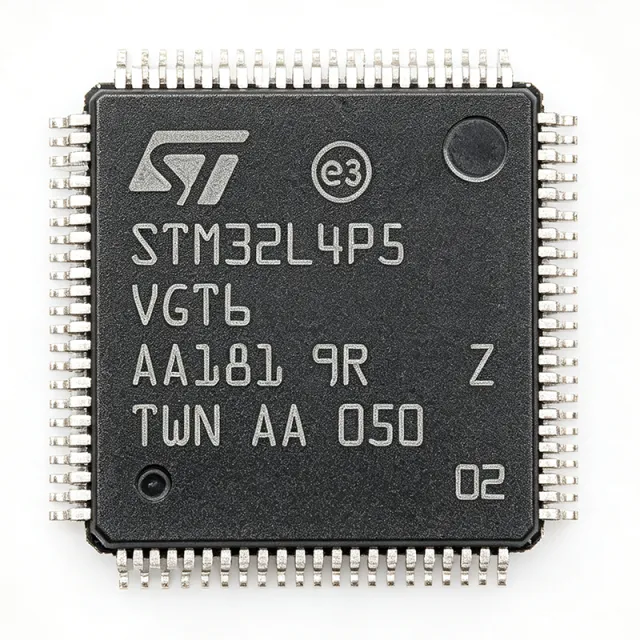
STM32L4P5VGT6 - Ultra-Low-Power Cortex-M4 MCU | STMicroelectronics
STM32L4P5VGT6

STM32L4P5VGT6 - Ultra-Low-Power Cortex-M4 MCU | STMicroelectronics

The STMicroelectronics STM32L4P5VGT6 is an ultra-low-power 32-bit microcontroller based on the ARM Cortex-M4 core with FPU, operating at up to 120 MHz. It delivers 213 DMIPS and 550 CoreMark, making it suitable for a wide range of battery-powered and energy-efficient applications. The device is housed in a 100-pin LQFP package (14x14 mm) and offers up to 1 MB of flash memory and 320 KB of SRAM. What is an ARM Cortex-M4 microcontroller? It is a 32-bit processor core designed for embedded systems, featuring a single-cycle multiply-accumulate (MAC) unit, hardware divide, and optional single-precision floating-point unit (FPU). The Cortex-M4 is part of the ARM Cortex-M family, which includes the M0, M0+, M3, M4, and M7 cores, each optimized for different performance and power trade-offs. In the system hierarchy, a microcontroller (MCU) integrates the processor core, memory, and peripherals on a single chip, serving as the central processing unit in embedded systems such as IoT devices, industrial controllers, and consumer electronics. Key features include a rich set of analog peripherals: two 12-bit DACs, three 12-bit ADCs with hardware oversampling, two operational amplifiers, two comparators, and an internal voltage reference buffer. The device also integrates advanced digital peripherals: two CAN FD controllers, one USB 2.0 OTG FS/HS, one SDMMC interface, and a flexible memory controller (FMC) for external memory expansion. The STM32L4P5VGT6 supports multiple low-power modes, including Sleep, Low-power Run, Low-power Sleep, Stop 0/1/2, and Standby, with a typical current consumption of 100 nA in Standby mode with backup domain. The STM32L4P5VGT6 is built on ST's ultra-low-power technology, featuring a dynamic voltage scaling (DVS) capability that adjusts the core voltage to optimize power consumption at different operating frequencies. The device includes a hardware cryptographic accelerator (AES, DES, 3DES) and a true random number generator (TRNG), enhancing security for connected applications. The rich set of timers includes two advanced-control timers, six general-purpose timers, two basic timers, and two low-power timers, providing precise timing and PWM generation. Typical applications include IoT nodes, smart meters, portable medical devices, industrial sensors, and wearable devices. The ultra-low-power modes and high integration make it ideal for battery-powered systems requiring long operational life. The device also supports a wide operating temperature range of -40°C to +85°C, suitable for industrial environments. When designing with this MCU, pay attention to the power supply decoupling: place a 100 nF capacitor close to each VDD pin and a 4.7 uF capacitor at the main power input. For low-power operation, configure the GPIOs to analog mode when unused to reduce leakage current. The STM32L4P5VGT6 is supported by STM32CubeMX and STM32CubeL4 firmware package, simplifying development.

USD $11,14 Contact
STM32L4P5ZGT6 - 120MHz Cortex-M4 MCU | STMicroelectronics
STM32L4P5ZGT6

STM32L4P5ZGT6 - 120MHz Cortex-M4 MCU | STMicroelectronics

The STMicroelectronics STM32L4P5ZGT6 is an ultra-low-power 32-bit Arm Cortex-M4 microcontroller with a 120 MHz maximum clock frequency, 1 MB of flash memory, and a 144-lead LQFP package measuring 20 mm by 20 mm. It belongs to the STM32L4+ Series and combines high-performance processing with low-power operation for embedded control, communications, and sensor-intensive systems. An ultra-low-power microcontroller is a semiconductor designed to balance application-processing performance with minimized energy consumption. The STM32L4+ family combines an Arm Cortex-M4 processor core, embedded flash, SRAM, digital and analog peripherals, and low-power operating modes in one integrated device. This hierarchy places the STM32L4P5ZG within STM32L4+ Series devices, Arm Cortex-M microcontrollers, 32-bit microcontrollers, and integrated semiconductor solutions for energy-conscious embedded systems. The headline features include a 120 MHz operating frequency, 1 MB of flash organized as 1 M x 8, and USB OTG support. A 150 DMIPS capability is identified in the STM32L4P5ZG datasheet listing, while the Mouser listing identifies USB OTG and DFSD support. These capabilities make the device suitable for applications requiring substantial local code storage, moderate real-time computation, and peripheral connectivity without relying on a separate memory device. The 144-LQFP package provides a large, readily routable pin count for designs that need numerous external interfaces. The manufacturer identifies the STM32L4P5xx devices as members of the STM32L4+ ultra-low-power family based on the Arm Cortex-M4 32-bit RISC core. Its combination of 1 MB flash and a 120 MHz clock supports responsive control loops, protocol handling, human-interface processing, and supervisory firmware within a single controller. Typical applications include industrial sensor hubs, USB-connected data-acquisition devices, building automation controllers, portable medical monitoring equipment, smart access terminals, and DFSD-based storage systems. In each case, the local flash capacity can hold firmware and configuration data, while the Cortex-M4 core handles real-time processing and the broad package pin count supports external sensors, communications, and power-management circuitry. PCB design should preserve clean supply distribution and appropriate decoupling around the controller because numerous high-speed digital and analog functions share the package. Firmware and peripheral assignments should follow the STM32L4P5ZG manufacturer datasheet, particularly for alternate-function pins, power domains, clock configuration, and analog inputs. Firmware portability should be evaluated through STM32CubeMX and STM32CubeIDE rather than assuming that an equivalent microcontroller has identical peripheral behavior. This product page combines the manufacturer family information, exact MPN characteristics, package details, sourcing options, replacement analysis, and practical engineering guidance. It is intended to help engineers verify fit, understand trade-offs, and plan a controlled transition from the STM32L4P5ZGT6 to any proposed alternate.

Devis Contact
STM32L4Q5AGI6 - 120MHz Cortex-M4 1MB MCU | STMicroelectronics
STM32L4Q5AGI6

STM32L4Q5AGI6 - 120MHz Cortex-M4 1MB MCU | STMicroelectronics

The STMicroelectronics STM32L4Q5AGI6 is an ultra-low-power 32-bit Arm Cortex-M4 microcontroller with FPU, rated up to 120 MHz, 1 MB of Flash, and 320 KB of SRAM in a 169-UFBGA 7 mm × 7 mm package. It delivers up to 150 DMIPS while combining low-power operation with integrated USB OTG, DFSD, AES, and PKA capabilities. A microcontroller is a programmable system-on-chip that integrates a CPU core, nonvolatile program memory, volatile data memory, peripherals, and interface controllers on one semiconductor device. The STM32L4 family belongs to the Arm Cortex-M microcontroller hierarchy and targets embedded control, communications, sensor processing, human-machine-interface, and low-power edge applications. Arm Cortex-M4 processors use the Thumb instruction set and support efficient interrupt-driven real-time control. Verified headline features include an Arm Cortex-M4 core, 120 MHz maximum operating frequency, 150 DMIPS performance, 1 MB Flash, and 320 KB SRAM. The part also provides an FPU, LCD-TFT support, USB OTG, DFSD, hardware AES, and PKA. These resources combine high processing throughput with a broad peripheral set, reducing the need for external memory, cryptographic accelerators, storage controllers, and display-interface logic in compact embedded systems. The STM32L4 architecture targets power-constrained products while retaining a broad set of communication and security interfaces. Flash capacity supports substantially larger firmware than smaller Cortex-M devices, while SRAM accommodates buffers, protocol stacks, graphics state, and real-time workloads. Hardware AES and PKA are particularly useful when a design must protect data or execute cryptographic operations with less software overhead. USB OTG expands connectivity options for peripherals, storage, charging, and host or device roles. Typical applications include connected industrial sensors, USB data acquisition, secure access-control terminals, low-power data loggers, compact human-machine-interface controllers, and embedded gateways. The 169-UFBGA package minimizes board area but requires careful escape routing, inspection, and assembly planning. Because the complete exposed-pad pin map and detailed electrical limits are not contained in the supplied search records, engineers should confirm them against the official STMicroelectronics STM32L4Q5xx datasheet before layout or firmware deployment. For robust implementation, preserve the datasheet-required decoupling near supply pins, route high-speed and sensitive signals with controlled return paths, and validate standby, wake-up, USB, and peripheral timing in the final board. Programming tooling, bootloader behavior, clock configuration, and low-power modes should also be verified from the official device documentation rather than inferred from distributor summaries. This page combines verified manufacturer and distributor information, procurement links, application engineering guidance, and explicit data gaps for pin-level and pricing validation. It is intended to accelerate component discovery while preserving traceability to the official STM32L4Q5xx datasheet and current distributor records as of 2026-10-23.

Devis Contact
STM32L4Q5CGT6 - 1MB Cortex-M4 MCU | STMicroelectronics | Ultra-Low-Power
STM32L4Q5CGT6

STM32L4Q5CGT6 - 1MB Cortex-M4 MCU | STMicroelectronics | Ultra-Low-Power

The STMicroelectronics STM32L4Q5CGT6 is an ultra-low-power ARM Cortex-M4 32-bit microcontroller+FPU with 150 DMIPS, 120 MHz max CPU clock, and 1 MB of on-chip Flash, housed in a 48-pin LQFP (7x7 mm) package. It integrates 320 KB SRAM, Chrom-ART graphics accelerator, USB OTG full-speed, DFSDM (digital filter for sigma-delta modulators), MIPI-DSI host, and an extensive analog/mixed-signal peripheral set including two 12-bit ADCs, two 12-bit DACs, ultra-low-power comparators, and op-amps. An MCU (microcontroller unit) is a single-chip computer that integrates a CPU core, program/data memory, and programmable I/O peripherals. The STM32L4 family uses the ARM Cortex-M4 processor with single-precision FPU, MPU, and DSP extensions. Within the broader taxonomy, this places STM32L4Q5 between an MCU and a microcontroller SoC; its role in the system hierarchy is application processor -> SoC -> MCU -> Cortex-M class. Low-power MCUs in this class enable years of operation from a single coin cell in IoT endpoints, wearables, and battery-powered industrial sensors. Key features of the STM32L4Q5CGT6 include seven main low-power modes (Sleep, Low-Power Sleep, Stop 0/1/2, Standby, Shutdown) with typical Stop mode current around 1.1 uA and Standby current of 30 nA with RTC. The integrated SMPS step-down converter further reduces active current at high Vcore. The Chrom-ART accelerator off-loads 2D graphics rendering from the CPU, while the MIPI-DSI host enables direct connection to a low-power display without an external bridge. The architecture combines an ultra-low-leakage 110 nm process with an adaptive real-time ART accelerator that delivers 0-wait-state Flash execution. Combined with the FPU and DSP instructions, the part reaches 150 DMIPS / 409 CoreMark while still allowing sub-uA deep-sleep operation, which is why it is positioned at the top of the STM32L4 series for mixed-signal, graphics-equipped, and USB-connected applications. Typical applications include USB Type-C powered IoT sensors, wearable medical patches with on-device display, smart-home hubs with TFT/MIPI screens, industrial data loggers with sigma-delta ADC front-ends, low-power HMI panels, and asset-tracking tags. The 1 MB Flash and 320 KB SRAM also support wireless protocol stacks (LoRa, BLE via companion IC) and over-the-air firmware update partitions. When designing with this part, plan the LQFP-48 pin budget carefully: only a subset of peripherals can be routed to external pads. Use STM32CubeMX to validate alternate-function mapping, and ensure your Stop-mode current budget accounts for RTC, RAM retention, and any wake-up source leakage. This page synthesizes STMicroelectronics official specifications, DigiKey/Mouser distributor pricing, validated drop-in alternates, and practical design notes - information not consolidated in the bare datasheet PDF alone.

Devis Contact
STM32L4Q5CGU6 - 120MHz Cortex-M4 MCU | STMicroelectronics
STM32L4Q5CGU6

STM32L4Q5CGU6 - 120MHz Cortex-M4 MCU | STMicroelectronics

STMicroelectronics STM32L4Q5CGU6 is an ultra-low-power 32-bit microcontroller with an Arm Cortex-M4 core, 120 MHz maximum clock frequency, and 1 MB of Flash memory. The device is housed in a 48-UFQFPN package measuring 7 x 7 mm and includes USB OTG and DFSD support according to the manufacturer product listing. Its combination of Cortex-M4 processing, substantial embedded Flash, and a compact package makes it suitable for connected embedded systems requiring flexible peripherals and efficient local processing. A microcontroller is a programmable semiconductor that integrates a processor core, memory, and peripherals into one device. The STM32L4Q5CGU6 belongs to the STM32L4+ ultra-low-power microcontroller family, a member of the broader STM32 embedded-processing portfolio. Its Arm Cortex-M4 core uses a 32-bit RISC architecture, while the embedded Flash provides 1 MB of program storage. This combination supports compact control systems that need more code and data capacity than small general-purpose MCUs while retaining low-power operating characteristics. The headline features are a 120 MHz Cortex-M4 core, 1 MB of Flash, and a 48-pin 7 x 7 mm UFQFPN package. The listed USB OTG capability supports systems requiring USB connectivity, while DFSD support extends the device's storage-oriented peripheral capabilities. Its compact package reduces board footprint, although the 48-pin UFQFPN format requires careful PCB layout, exposed-pad thermal management, and fine-pitch assembly. The operating system and USB documentation should be reviewed against the intended application before committing a design to production. Technically, the STM32L4Q5CGU6 combines a conventional Arm Cortex-M4 processor core with dedicated embedded memory and configurable peripherals in a single package. The Cortex-M4 core is suitable for interrupt-driven control, communications, data acquisition, and supervisory firmware. At 120 MHz, it provides substantially more compute headroom than low-clock-rate microcontrollers, while the 1 MB Flash capacity reduces pressure on external program storage. The UFQFPN package has a lower profile than leaded packages but requires a thermal-pad layout and careful inspection of pin assignments in the manufacturer pinout. Typical applications include USB-connected industrial controls, compact data loggers, sensor-hub controllers, DFSD-based portable equipment, and low-power industrial or medical monitoring products. In a sensor-hub design, the MCU can sample and process local inputs, manage low-power operating modes, and provide a USB data path to a host. In portable instrumentation, 1 MB of Flash can hold application firmware, calibration tables, and protocol handlers while the compact package preserves board area. The primary design consideration is PCB implementation. Place the decoupling network and exposed-pad connection exactly as specified by the manufacturer layout guidelines, and verify the pin-to-pad mapping and thermal requirements against the official STM32L4Q5CG documentation. Software replacement should also be validated because a mechanically similar MCU can differ in peripheral mapping, clock behavior, low-power features, or device errata. This product page combines the manufacturer's family positioning with distributor package, memory, frequency, USB, DFSD, and sourcing information. It also provides application-oriented design guidance, selection criteria, and a structured comparison framework for engineers evaluating an STM32L4-class embedded design.

Devis Contact
STM32L4Q5VGT6 - Ultra-Low-Power ARM Cortex-M4 MCU | STMicroelectronics
STM32L4Q5VGT6

STM32L4Q5VGT6 - Ultra-Low-Power ARM Cortex-M4 MCU | STMicroelectronics

The STM32L4Q5VGT6 is an ultra-low-power microcontroller from STMicroelectronics, featuring an ARM Cortex-M4 core with FPU and DSP instructions, running at up to 120 MHz. It is part of the STM32L4 series, designed for high performance and low power consumption, making it ideal for battery-powered and energy-efficient applications. An ARM Cortex-M4 microcontroller is a 32-bit processor core designed for embedded systems, offering a balance of performance and power efficiency. It includes a floating-point unit (FPU) for efficient mathematical computations and DSP instructions for signal processing. The STM32L4 series is known for its ultra-low-power modes, including sleep, stop, and standby, which are critical for extending battery life in portable devices. Key features of the STM32L4Q5VGT6 include 1 MB of flash memory and 320 KB of SRAM, providing ample storage for complex applications. It operates from 1.71V to 3.6V, with a wide temperature range of -40°C to +85°C. The device integrates a rich set of peripherals, including multiple USART, SPI, I2C, USB OTG FS, CAN, and advanced analog features such as a 16-bit ADC and a 12-bit DAC. It also includes a true random number generator (TRNG) and a cryptographic acceleration unit for secure applications. The STM32L4Q5VGT6 is built on a 40nm process technology, enabling low dynamic power consumption. It features a flexible power management system with multiple power domains, allowing designers to optimize power usage. The device supports various low-power modes, with typical current consumption as low as 100 nA in standby mode, making it suitable for always-on applications. Typical applications include industrial sensors, smart meters, medical devices, wearable devices, and IoT nodes. Its combination of performance, low power, and rich peripherals makes it a versatile choice for a wide range of embedded systems. When designing with this MCU, it is essential to consider the power supply decoupling and proper grounding to ensure stable operation. The device requires a 1.8V to 3.6V supply, and it is recommended to use a 100nF capacitor close to each power pin. Additionally, the internal LDO can be used to generate the core voltage, but external regulators may be needed for higher efficiency in battery-powered designs.

Devis Contact
STM32L4R5AGI6 - 120MHz Cortex-M4 | STMicroelectronics
STM32L4R5AGI6

STM32L4R5AGI6 - 120MHz Cortex-M4 | STMicroelectronics

The STMicroelectronics STM32L4R5AGI6 is an ultra-low-power 32-bit ARM Cortex-M4 microcontroller operating up to 120 MHz, with 1 MB of Flash memory, 640 KB of SRAM, 112 I/O, and a 169-ball UFBGA package measuring 7 x 7 mm. It is designed for compact embedded systems that require strong performance, energy efficiency, and extensive peripheral integration. An ultra-low-power microcontroller is a semiconductor device optimized to minimize energy consumption while executing real-time control, communications, sensor-processing, and user-interface tasks. The STM32L4 family combines the Arm Cortex-M4 processor ecosystem with power-management modes, fast wake-up behavior, and integrated peripherals, placing it within the hierarchy of microcontroller, embedded processor, and semiconductor. Key features include an Arm Cortex-M4 core with floating-point capability, operation up to 120 MHz, 1 MB of program Flash, 640 KB of SRAM, and a 1.71 V to 3.6 V operating supply range. The device supports USB OTG and DFSD functions, while its low-power modes include a 305 nA VBAT mode for the RTC and backup registers and a 33 nA shutdown mode. These characteristics suit applications where standby current can determine battery life. The STM32L4R5AGI6 integrates extensive embedded resources around a single-core Cortex-M4 architecture. Its 169-ball UFBGA package exposes substantially more connection options than a typical small-outline MCU, supporting dense designs with numerous GPIO, communications, debug, power, and peripheral connections. The package is 7 x 7 mm, making it useful where component density and routing flexibility are more important than ease of manual rework. Typical uses include industrial sensor nodes, connected measurement equipment, USB peripheral controllers, secure access terminals, compact data loggers, and low-power embedded control systems. The MCU can service interrupt-driven sampling and protocol processing while retaining multiple low-power states between active periods. PCB design should preserve short return paths for the 1.71 V to 3.6 V supply rails and place decoupling capacitors close to the relevant power pins. Because the 169-ball package has a dense footprint, verify land pattern, ball assignments, exposed thermal considerations, and assembly process against the manufacturer datasheet before fabrication. This product overview combines core electrical specifications, package constraints, low-power behavior, application guidance, and verified component references to support faster MCU selection and board-design planning.

Devis Contact
STM32L4R5QGI6 - 120MHz Cortex-M4 MCU, 1MB Flash | STMicroelectronics
STM32L4R5QGI6

STM32L4R5QGI6 - 120MHz Cortex-M4 MCU, 1MB Flash | STMicroelectronics

STMicroelectronics STM32L4R5QGI6 is an ultra-low-power 32-bit Arm Cortex-M4 microcontroller with FPU, 120 MHz maximum clock frequency, and 1 MB of Flash memory in a 132-pin UFBGA package. The device operates from a 1.71 V to 3.6 V supply and combines USB OTG, DFSD storage support, extensive GPIO, and low-power sensing capabilities in a compact 7 x 7 mm footprint. An ultra-low-power microcontroller is an embedded semiconductor designed to execute firmware while minimizing energy consumption during active operation, standby, shutdown, and battery-backed operation. The STM32L4R5 belongs to the STM32L4 family hierarchy of Arm Cortex-M4 MCUs, combining real-time processing efficiency, embedded Flash, SRAM, analog and digital peripherals, and multiple low-power modes for compact sensing and control systems. Key characteristics include a 120 MHz Arm Cortex-M4 core with floating-point unit, 1 MB of embedded Flash, a 1.71 V to 3.6 V operating supply range, and USB OTG connectivity. FlexPowerControl supports low-power operation, while the verified family data specifies 33 nA shutdown current and 305 nA VBAT mode consumption for RTC and 32 backup registers. DFSD support expands the design options available for secure digital storage and firmware data workloads. The STM32L4R5 architecture is tailored for high-throughput, low-power embedded control. Its 32-bit Cortex-M4 processor includes hardware floating-point support for efficient control-loop, signal-processing, and math-heavy calculations. A large pin count provides extensive peripheral connectivity, while the 7 x 7 mm UFBGA package supports compact PCB layouts when adequate assembly capability and careful escape-routing are available. Typical applications include industrial sensor nodes, compact data loggers, USB-connected embedded controllers, low-power industrial equipment, DFSD-based portable systems, and battery-operated sensing platforms. The combination of 1 MB Flash and USB OTG also makes the MCU suitable for firmware-intensive peripheral control where local code storage and direct USB connectivity are valuable. Designers should confirm the complete pin assignment, exposed-pad requirements, supported peripherals, decoupling network, and operating-temperature grade against the manufacturer datasheet before layout release. High-density UFBGA construction also requires assembly-capable interconnect, solder-mask-defined geometry, and adequate thermal design for the selected power budget. This page consolidates verified distributor specifications, same-brand drop-in candidates, lifecycle information, application guidance, and practical design cautions. It distinguishes electrically similar devices from verified same-package alternatives so engineers can evaluate replacement decisions without assuming that a shared family designation guarantees pin-to-pin compatibility.

Devis Contact
STM32L4R5QII6 - 120MHz Cortex-M4 MCU | STMicroelectronics
STM32L4R5QII6

STM32L4R5QII6 - 120MHz Cortex-M4 MCU | STMicroelectronics

The STMicroelectronics STM32L4R5QII6 is an ultra-low-power 32-bit Arm Cortex-M4 microcontroller rated up to 120 MHz, with 2 MB of Flash memory, 640 KB of SRAM, and a 132-pin UFBGA package measuring 7 x 7 mm. It belongs to the STM32L4+ family and combines an FPU, USB OTG, DFSD support, and low-power operating modes for compact embedded systems. An ultra-low-power microcontroller is an embedded processing device designed to maintain useful computation while minimizing energy use. The STM32L4+ architecture combines a microcontroller, real-time control capability, data storage, and communication peripherals within a single silicon device. Its low-power design is intended for battery-powered, industrial, sensor, and connected products where energy efficiency contributes directly to battery life or heat management. Key features include operation from a 1.71 V to 3.6 V power supply, a maximum core frequency of 120 MHz, and low-power consumption figures including 305 nA in VBAT mode for the RTC and backup registers and 33 nA in shutdown mode. The STM32L4R5QII6 also provides 110 I/O, USB OTG, an FPU, and DFSD capability, allowing one device to control peripherals, acquire data, and communicate with a host or service interface. The device combines 2 MB of Flash with 640 KB of SRAM to support firmware, boot code, data logging, graphics buffers, and real-time control workloads. Its Arm Cortex-M4 processor supports single-precision floating-point instructions, which accelerates control calculations and digital filtering without requiring a separate accelerator. The STM32L4+ low-power feature set includes FlexPowerControl, Batch Acquisition Mode, and dedicated backup-domain functions. Typical applications include industrial sensor nodes, compact data loggers, USB-connected instrumentation, low-power condition-monitoring equipment, and embedded control products with limited board area. The 7 x 7 mm UFBGA package supports dense designs, but it requires careful PCB layout, controlled assembly, and reliable power and decoupling networks to achieve predictable low-noise operation. Power design should preserve the 1.71 V to 3.6 V operating range and place the required bypass capacitors close to the supply and ground pins. Firmware and board validation should also account for the 110 I/O limit and the high pin density of the 132-pin package. Use the manufacturer pin-description and land-pattern tables when assigning tracks and planning assembly. This page combines manufacturer specifications, package details, drop-in candidates, application guidance, and engineering-oriented design notes to support MCU selection, PCB planning, firmware bring-up, and sourcing decisions.

Devis Contact
STM32L4R5VGT6 - 120MHz Cortex-M4 MCU 1MB | STMicroelectronics
STM32L4R5VGT6

STM32L4R5VGT6 - 120MHz Cortex-M4 MCU 1MB | STMicroelectronics

The STMicroelectronics STM32L4R5VGT6 is an ultra-low-power 32-bit Arm Cortex-M4 microcontroller with a floating-point unit, operating frequency up to 120 MHz, 1 MB of flash memory, and 640 KB of SRAM in a 100-pin LQFP package measuring 14 x 14 mm. It integrates USB OTG and DFSD support, combining general-purpose embedded control with low-power operation and digital signal-processing capability. An ultra-low-power microcontroller is designed to balance processing performance, energy efficiency, and real-time control. The STM32L4 family belongs to the Arm Cortex-M4 microcontroller category and combines a processor core, embedded memory, communications peripherals, analog interfaces, and security-oriented peripherals within one device. Its Cortex-M4 architecture supports efficient digital signal processing and floating-point calculations while maintaining a broad embedded-control feature set. Key characteristics include a 120 MHz maximum clock, 1 MB of flash, 640 KB of SRAM, and Arm Cortex-M4 instruction-set compatibility. USB OTG provides a standard peripheral interface for USB-connected control, data acquisition, or configuration applications. DFSD support expands the device's usefulness for external storage workflows, while the large SRAM capacity allows more data buffering and protocol processing to remain inside the microcontroller. The STM32L4R5VGT6 combines a high-performance 32-bit core with low-power-oriented design. Its 1 MB flash supports larger embedded applications, and its 100-pin LQFP package provides a high pin count for external peripheral connections. Operating-voltage information identifies 1.8 V, 2.5 V, and 3.3 V supply options, allowing the device to fit industrial, communications, consumer, and embedded-control platforms whose interfaces and external components match those voltage levels. Typical applications include USB-connected industrial control, low-power data loggers, sensor acquisition systems, digital audio processing, building automation equipment, and compact embedded gateways. The Cortex-M4 floating-point unit is particularly useful for control loops and signal-processing workloads that benefit from single-precision arithmetic without requiring a separate DSP. PCB design should account for the 100 exposed leads, high-pin-count routing requirements, and the device's USB and storage interfaces. Confirm pin assignments, decoupling requirements, clock configuration, and peripheral multiplexing in the manufacturer datasheet and reference manual before releasing the PCB layout. This page combines the STM32L4R5VGT6's core specifications, sourcing structure, family alternatives, and application guidance to support faster component selection and hardware planning for embedded-product teams.

Devis Contact
STM32L4R5VIT6 - 2MB Flash Cortex-M4 MCU 120MHz | STMicroelectronics
STM32L4R5VIT6

STM32L4R5VIT6 - 2MB Flash Cortex-M4 MCU 120MHz | STMicroelectronics

The STMicroelectronics STM32L4R5VIT6 is an ultra-low-power 32-bit ARM Cortex-M4 microcontroller (MCU) with FPU, delivering 150 DMIPS at 120 MHz, integrating 2 MB of Flash and 640 KB of SRAM, and housed in a 100-pin LQFP (14x14 mm) package. The part belongs to the STM32L4+ Series and operates from a 1.71 V to 3.6 V supply, with a separate I/O rail that can go down to 1.08 V, supporting modern low-voltage sensor and memory interfacing. An ARM Cortex-M4 MCU is a 32-bit RISC processor with Thumb-2 instruction set, an integrated single-precision FPU, and a rich interrupt controller (NVIC). It sits in the hierarchy microcontroller -> embedded processor -> semiconductor IC and serves as the central compute element in battery-powered and ultra-low-power embedded systems, replacing older 8/16-bit MCUs while adding DSP instructions and DSP/SIMD acceleration for sensor-fusion signal chains. Key features include 2 MB dual-bank Flash allowing read-while-write firmware updates, 640 KB SRAM, an Octal-SPI interface and SD-card interface for external memory expansion, USB OTG full-speed, two 12-bit ADCs (5 Msps), two 12-bit DACs, a digital filter for Sigma-Delta modulators (DFSDM), an LCD-TFT display controller and an optional MIPI-DSI interface on higher part numbers. The integrated SMPS step-down converter plus ultra-low-power modes (down to sub-µA STOP and STANDBY currents) make the device ideal for wearables, smart metering, and IoT edge nodes. Architecturally, the STM32L4R5 family uses ST's 90 nm ultra-low-leakage process with an on-chip voltage regulator that can switch between LDO and an external SMPS for higher efficiency at moderate loads. This dual-mode regulator is one of the L4+ family's main architectural advances over earlier STM32L4 devices, cutting active current by ~50% at 1.8 V systems. Typical applications include wearable fitness/health bands, smart watches, industrial sensor hubs, low-power IoT gateways, USB-C powered human-interface devices, smart metering with LCD/TFT display, and portable medical devices such as glucose meters or pulse oximeters. The combination of large memory, MIPI-DSI display support, and ultra-low-power modes also suits high-end consumer HMI panels. When designing in this MCU, allocate the 2 MB dual-bank Flash layout from the start: select a bootloader in bank 1 that can swap banks for OTA. Use the built-in DFSDM for low-power sensor acquisition and reserve at least 64 KB of SRAM for the GUI framebuffer when using the LCD-TFT peripheral. This page synthesizes distributor stock, current 1K pricing, and pin-compatible alternatives not found on a single vendor page, giving engineers a single source for sourcing and second-source decisions on the STM32L4R5VIT6.

Devis Contact
STM32L4R5ZGT6 - 120MHz Cortex-M4 1MB Flash MCU | ST
STM32L4R5ZGT6

STM32L4R5ZGT6 - 120MHz Cortex-M4 1MB Flash MCU | ST

STMicroelectronics STM32L4R5ZGT6 is an ultra-low-power 32-bit microcontroller built around the Arm Cortex-M4 processor, operating at up to 120 MHz with 1 MB of flash memory in a 144-pin LQFP 20 mm × 20 mm package. The device combines a 120 MHz Cortex-M4 core, 1 MB flash, 640 KB SRAM, and an extensive set of embedded peripherals for connected industrial, medical, consumer, and IoT equipment. An ultra-low-power microcontroller is an embedded processing device optimized to balance compute performance with standby, stop, and low-power-run efficiency. The STM32L4R5ZGT6 belongs to the STM32L4+ Series, combining a high-performance Arm Cortex-M4 RISC core with energy-conscious peripherals. This hierarchy places it above general-purpose Cortex-M microcontrollers in applications that require both real-time processing and constrained power budgets. Principal features include a 32-bit Arm Cortex-M4 core with floating-point capability, operation up to 120 MHz, 1 MB of flash, 640 KB of SRAM, and a 144-LQFP package. The STM32L4+ family also supports advanced connectivity and security-oriented use cases, including USB OTG, DFSD capability, and efficient management of sensor, display, storage, and communications peripherals. Its large pin count provides broad external I/O access for mixed-signal embedded platforms. The STM32L4R5 architecture is suited to control loops that must execute predictably while retaining multiple low-power operating modes. Its Cortex-M4 instruction set supports digital signal processing and control-oriented routines, while the integrated memory reduces external bus pressure for common workloads. The 1 MB flash capacity also allows substantial firmware, boot code, configuration data, and application logic to reside on-chip, supporting standalone designs with limited external storage requirements. Typical applications include industrial monitoring and control equipment, connected energy meters, medical instrumentation, USB-connected data loggers, low-power sensor hubs, and compact human-interface systems. In an energy meter, the device can combine measurement, calendar, communications, and local display-control tasks while using low-power modes between update intervals. In medical equipment, deterministic processing and a broad peripheral complement help consolidate functions while reducing board area. PCB design should begin with the complete manufacturer pin description and package drawing because the 144-pin LQFP footprint provides many power, ground, analog, debug, communication, and general-purpose I/O assignments. Keep sensitive analog inputs away from fast-switching digital nets, provide the specified decoupling and power filtering, and route debug and communications interfaces to accessible test points. This product page combines the STM32L4R5ZGT6 core, memory, package, interface, and lifecycle information with sourcing guidance and engineering-oriented application analysis. It also separates exact catalog facts from replacement decisions, helping teams determine whether a proposed substitution truly preserves the 144-pin footprint, firmware environment, peripheral mapping, and electrical requirements.

Devis Contact
STM32L4R5ZIT6 - 32-bit ARM Cortex-M4 MCU 120MHz 2MB Flash LQFP-144 | STMicroelectronics
STM32L4R5ZIT6

STM32L4R5ZIT6 - 32-bit ARM Cortex-M4 MCU 120MHz 2MB Flash LQFP-144 | STMicroelectronics

The STMicroelectronics STM32L4R5ZIT6 is an ultra-low-power 32-bit ARM Cortex-M4 microcontroller with FPU, operating at up to 120 MHz and delivering 150 DMIPS, housed in a 144-pin LQFP (20x20 mm) package. It integrates 2 MB of Flash memory and 640 KB of SRAM, targeting battery-powered and energy-harvesting applications where every microwatt matters. The device operates from a 1.71 V to 3.6 V power supply across -40 °C to 85/125 °C temperature ranges. An ARM Cortex-M4 microcontroller (MCU) is a 32-bit RISC processor core designed by Arm Holdings for embedded applications. It combines high computational performance with low power consumption, and the M4 variant adds a single-precision floating-point unit (FPU) plus DSP extensions. In the broader taxonomy, the STM32L4R5 belongs to the ultra-low-power microcontroller family (STM32L series), which sits below the mainstream STM32F series and above the ultra-low-power STM32L0 in ST's power-versus-performance spectrum. The "plus" designation (STM32L4+) indicates the higher-performance 120 MHz sub-family with Chrom-GRC graphics support. Key features of the STM32L4R5ZIT6 include a FlexPowerControl architecture with multiple low-power modes (Shutdown at 33 nA, VBAT mode at 305 nA, Batch Acquisition Mode for partial wake-up), USB OTG with internal PHY, and a DFSDM (Digital Filter for Sigma-Delta Modulators) peripheral for sensor hub applications. It also features a Chrom-ART Accelerator for 2D graphics and an Octo-SPI interface for high-speed external Flash, along with cryptographic and AES-256 hardware accelerators for IoT security. The device integrates the Cortex-M4 core with FPU and Memory Protection Unit, plus ST's ART Accelerator (Adaptive Real-Time memory accelerator) that allows 0-wait-state execution from Flash at the full 120 MHz clock speed. Up to 640 KB SRAM includes 32 KB of SRAM2 with parity check, retained in Standby mode and accessible via SRAM-based boot for secure firmware update. The LQFP-144 package exposes the full STM32L4R5 peripheral set: 3x 12-bit ADC (16-bit with oversampling), 2x DAC, 4x op-amps, 2x comparators, multiple timers, TFT controller, and MIPI-DSI support requires the larger BGA package. Typical applications include wearable health monitors, smart sensors, IoT edge nodes, industrial HMI panels, low-power wireless modules (BLE/LoRa companion), battery-powered data loggers, and energy-harvesting systems. The 2 MB Flash supports over-the-air firmware updates and rich graphical user interfaces on small TFT displays without external memory. When designing with the STM32L4R5ZIT6, use ST's STM32CubeMX and STM32CubeIDE toolchain for code generation, pin multiplexing, and power-consumption profiling. Source decoupling requires 100 nF X7R ceramic on every VDD/VDDA pair; the integrated SMPS step-down converter (when present on L4+ variants) should be configured with a 10 µH inductor per the application note AN4621. The LQFP-144 thermal performance typically permits 500 mA peak current draw at 120 MHz with a 2-layer FR4 board. This page synthesizes distributor pricing tiers, drop-in compatible same-family STM32 alternatives, application-tailored companion MPNs, and practical low-power design guidance that complements the manufacturer datasheet.

Devis Contact
STM32L4R5ZIT6P - Cortex-M4 MCU 120MHz 2MB Flash | STMicroelectronics
STM32L4R5ZIT6P

STM32L4R5ZIT6P - Cortex-M4 MCU 120MHz 2MB Flash | STMicroelectronics

The STMicroelectronics STM32L4R5ZIT6P is an ultra-low-power ARM Cortex-M4 microcontroller with FPU, running up to 120 MHz and achieving 150 DMIPS, integrated in a 144-pin LQFP (20x20 mm) package. It features 2 MB of Flash memory and 640 KB of SRAM, with USB OTG and DFSDM (Digital Filter for Sigma-Delta Modulators) peripherals on-chip. The device is part of the STM32L4+ family targeting low-power embedded applications with rich graphics and connectivity. An ultra-low-power MCU is a microcontroller specifically architected to minimize energy use across active, sleep, deep-sleep, and shutdown modes, enabling battery-powered and energy-harvesting designs. Within the system hierarchy, the STM32L4+ sits at the high end of ST's ultra-low-power line, above the STM32L0 and STM32L1 families, and below the Cortex-M7 based STM32F7/H7 high-performance lines. The Cortex-M4 core adds DSP extensions and a single-precision FPU, making it suitable for signal-processing tasks that the Cortex-M0+ cannot handle efficiently. Key features include a 120 MHz Cortex-M4 core with FPU and MPU, 2 MB dual-bank Flash supporting read-while-write, 640 KB SRAM including 16 KB SRAM2 with parity, a 1.8V core supply with internal SMPS step-down converter for ultra-low-power Run mode, and an extensive peripheral set including USB OTG full-speed, three SPIs, three I2C, six USART/UARTs, two SAIs, one CAN, one SDMMC, and a 12-bit ADC with 5 Msps throughput. The Chrom-ART 2D graphics accelerator and OctoSPI Flash interface support modern display and memory expansion requirements. Typical applications include low-power IoT sensor nodes, wearable health monitors, industrial HMI with TFT displays, smart meters, asset tracking with BLE or LoRa, and battery-powered data loggers. The 144-LQFP package provides generous GPIO (over 100 pins) for complex designs with multiple peripherals. When designing with this part, evaluate the package size relative to your PCB - the 144-LQFP (20x20 mm) footprint is among the largest in the STM32 family; the smaller 64-LQFP or 48-LQFP variants of the same silicon may suffice if your GPIO budget is smaller. The internal SMPS requires careful PCB layout to minimize EMI.

Devis Contact
STM32L4R7VIT6 - 120MHz Cortex-M4 MCU, 2MB Flash | STMicroelectronics
STM32L4R7VIT6

STM32L4R7VIT6 - 120MHz Cortex-M4 MCU, 2MB Flash | STMicroelectronics

STMicroelectronics STM32L4R7VIT6 is an ultra-low-power 32-bit Arm Cortex-M4 microcontroller operating at up to 120 MHz, with 2 MB of Flash memory, 640 KB of SRAM, and 83 I/O in a 100-LQFP 14 mm × 14 mm package. The device also supports USB OTG and DFSD functionality. A microcontroller is a programmable semiconductor that integrates a processor core, memory, peripherals, and communication interfaces onto one package. In the product hierarchy, the STM32L4R7VIT6 is an Arm Cortex-M4 MCU within the STM32L4+ Series, combining general-purpose embedded processing with energy-conscious operation. Its 32-bit architecture makes it suitable for compact control systems that require more processing capability than an 8- or 16-bit MCU while retaining integrated flash, RAM, and peripheral resources. The principal features of the STM32L4R7VIT6 include a 120 MHz Cortex-M4 core, 2 MB of embedded Flash, 640 KB of SRAM, and 83 GPIO. The Arm Cortex-M4 processor includes floating-point capability for control calculations, while the large SRAM supports data buffering and application state. USB OTG provides a USB interface for data exchange or device connectivity, and the DFSD peripheral supports dedicated flash-storage access. Its operating-supply options include 1.8 V, 2.5 V, and 3.3 V rails, allowing integration with systems using common embedded voltage levels. The 100-LQFP package exposes a substantially larger pin count than small-outline packages, supporting numerous general-purpose and application-specific connections while remaining compatible with conventional leaded assembly methods. The STM32L4R7 family is positioned for connected, low-power embedded products where flash capacity, SRAM, USB, and digital I/O must coexist in one device. Typical uses include industrial sensor controllers, portable measurement equipment, USB-connected data-acquisition units, DFSD-based data loggers, building automation endpoints, and compact control boards. The 83 available I/O can connect sensors, displays, communications transceivers, actuators, and discrete inputs without requiring a large number of external interface components. Designers should plan the PCB around the 100-LQFP footprint, assign pins according to the manufacturer pin-description table, and preserve the required decoupling and routing geometry. The 1.8 V, 2.5 V, and 3.3 V supply options must be matched to the selected internal regulator and clock configuration. Firmware should also validate USB suspend behavior, DFSD timing, peripheral pin reassignment, and the memory map before production. This product record combines the manufacturer's family overview with distributor technical summaries and organizes the information for engineering selection. It highlights the core, memory, package, interface, and supply information that determine whether the STM32L4R7VIT6 fits a connected embedded design.

Devis Contact
STM32L4R7ZIT6 - 120MHz Cortex-M4 MCU, 2MB Flash | STMicroelectronics
STM32L4R7ZIT6

STM32L4R7ZIT6 - 120MHz Cortex-M4 MCU, 2MB Flash | STMicroelectronics

The STMicroelectronics STM32L4R7ZIT6 is an ultra-low-power 32-bit Arm Cortex-M4 microcontroller with a 120 MHz maximum clock, 2 MB of Flash memory, 640 KB of SRAM, USB OTG, DFSD support, and a 144-lead LQFP package measuring 20 mm by 20 mm. It combines high processing performance with the low-power characteristics required by the STM32L4+ product family. An ultra-low-power microcontroller is an embedded processing component designed to maintain useful computational performance while minimizing energy consumption during active, sleep, and low-power operating states. The STM32L4+ family integrates an Arm Cortex-M4 RISC core, memory, communications peripherals, security functions, and analog resources into a single device. This places the MCU within the hierarchy of embedded controller, microcontroller, and semiconductor. Key device attributes include a 32-bit Cortex-M4 core operating up to 120 MHz, 2 MB of Flash, and 640 KB of SRAM. The available feature set includes USB OTG and DFSD, while the 1.8 V, 2.5 V, and 3.3 V supply options support multiple embedded system architectures. Its 144-LQFP package provides a large pin count for external memory, communications, mixed-signal, and general-purpose I/O expansion. The STM32L4+ architecture combines a high-performance 32-bit core with energy-focused operating modes, allowing designers to balance computation and duty-cycled power consumption. The Cortex-M4 instruction set supports efficient control and signal-processing workloads, while the integrated memory reduces external data access for many applications. USB OTG expands the device's connectivity options, and DFSD support broadens its use in systems requiring dedicated flash-storage interfaces. Typical applications include industrial sensor hubs, building-automation controllers, low-power data loggers, USB-connected embedded equipment, motor and current-monitoring systems, and connected industrial products. The 144-pin package is particularly useful when a design requires numerous peripheral interfaces, greater I/O availability, or connections to external memory and communication transceivers. The principal design consideration is careful power-domain and decoupling management across the numerous supply pins. Keep sensitive analog and digital paths separated where practical, place required bypass capacitors close to their associated supply pins, and follow the manufacturer pin-description and recommended-layout tables when assigning the 144 package leads. Validate firmware, clock, USB, and peripheral configurations before production release. This page consolidates the manufacturer's device description with distributor technical attributes, package details, application guidance, and drop-in comparison information. It also identifies engineering points that require confirmation against the manufacturer datasheet, including the complete pin map, detailed power consumption, peripheral configuration limits, and lifecycle documentation.

Devis Contact