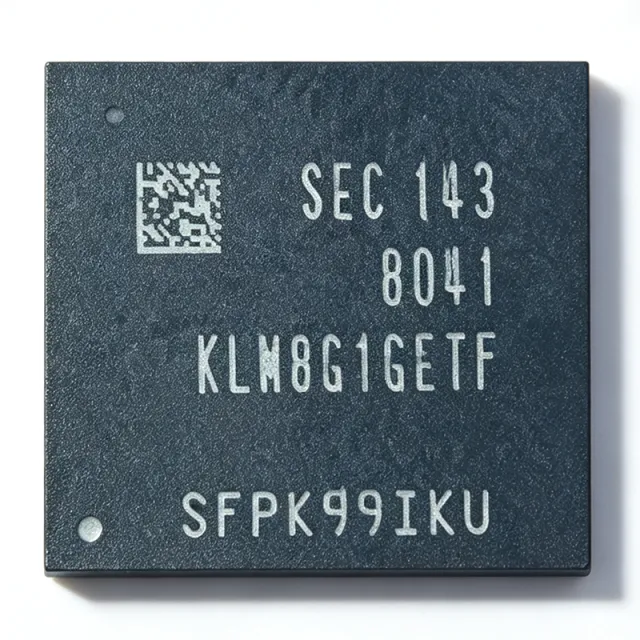
KLM8G1GETF-B041 - 8GB eMMC 5.1 Flash, 153-FBGA | Samsung
Référence : KLM8G1GETF-B041 ✗ Fin de vie| Qté | Prix unitaire | Total |
|---|---|---|
| 1 | $27.12 | $27,12 |
| 10 | $25.76 | $257,60 |
| 100 | $24.41 | $2 441,00 |
| 500 | $23.18 | $11 590,00 |
| 1 000 | $22.02 | $22 020,00 |
KLM8G1GETF-B041 Présentation
An eMMC (embedded MultiMediaCard) is an embedded flash storage solution that integrates NAND flash die and a standard MMC controller in a single BGA package. It sits within the memory hierarchy as non-volatile embedded storage, managed through the JEDEC-standard MMC protocol v5.1, which presents a simple read/write register interface to the host processor instead of raw NAND management.
Key features include eMMC 5.1 specification compatibility, built-in wear leveling, bad block management, ECC error correction, a hardware reset function, and secure write protection. Because the controller handles flash management internally, host software complexity is dramatically reduced compared with raw NAND.
Technically, the device exposes a x1 or x4-bit or x8-bit data bus operating under MMC protocol v5.1, with VDDF at 3V for the NAND area and VCCQ at 1.8V or 3V for the interface. Samsung positions its eMMC eSTORAGE family as offering superior power efficiency and fast speed for slim mobile designs. The integrated controller performs erase management, wear leveling, and error correction transparently.
Typical applications include smartphone and tablet main storage, smart home and IoT hubs, industrial HMI and data loggers, set-top boxes, and automotive infotainment head units. The 153-FBGA footprint and industry-standard interface allow drop-in swap between compliant 8GB eMMC 5.1 parts.
Design consideration: verify the exact FBGA ball-map suffix, because suffix digits such as -B041 versus -B001 can encode different ball grid arrays, making physically incompatible parts that look identical on paper.
This page synthesizes distributor pricing, drop-in alternative analysis, lifecycle alerts, and practical migration notes not found in the Samsung datasheet.
Alternatives de remplacement direct pour KLM8G1GETF-B041 — même boîtier, compatible broche à broche. Les références à boîtier différent nécessitant une retouche du PCB sont exclues.
Variantes de cette série
Modèles de la même série directement compatibles avec KLM8G1GETF-B041 (même facteur de forme et même empreinte) — différant par Memory Type, Mounting Type, Operating Temperature, Package.
Outil de comparaison rapide — sélectionnez des références alternatives pour une comparaison côte à côte :
KLM4G1FETE-B041
✓ En stock
$6.5625 / unité
Voir la fiche technique →ASFC8G31MA-51BIN
📋 Alternative de référence (hors catalogue)
KLM8G1GETF-B041 Valeurs maximales et caractéristiques électriques
| Type de mémoire | eMMC (embedded MultiMediaCard), MLC NAND |
| Taille de mémoire | 64 Gbit (8 GByte) |
| Interface | eMMC 5.1 (MMC protocol v5.1), x1/x4/x8-bit bus |
| Supply Voltage - NAND (VDDF/VCC) | 3 V |
| Supply Voltage - Interface (VDD/VCCQ) | 1.8 V or 3 V (dual) |
| Boîtier | 153-Pin FBGA |
| Température de fonctionnement | -25C to +85C |
| Type de montage | Surface Mount (BGA) |
| Wear Leveling | Built-in |
| Bad Block Management | Built-in |
| ECC Error Correction | Built-in |
| Hardware Reset | Yes |
| Secure Write Protection | Yes |
| Standard Compliance | eMMC 5.1 specification compatible (JEDEC standard interface) |
| Brand Family | Samsung eMMC eSTORAGE |
Guide de configuration des broches du KLM8G1GETF-B041 153-pin fbga
Configuration des broches du KLM8G1GETF-B041 (boîtier 153-pin fbga). Ce circuit intégré numérique comprend des GPIO, des interfaces de communication (UART, SPI, I2C) et des broches d'alimentation. Consultez la fiche technique du fabricant pour les fonctions alternatives des broches et les options de configuration. Indispensable pour la conception de systèmes embarqués et la conception de circuits imprimés.

Aucune donnée de brochage détaillée disponible pour KLM8G1GETF-B041.
Consultez la fiche technique pour la configuration complète des broches.
Applications typiques
KLM8G1GETF-B041 convient pour 6 applications: Smartphone and Tablet Main Storage, Industrial HMI and Data Loggers, Smart Home and IoT Hubs, Set-Top Boxes and Smart TVs, Automotive Infotainment (Non-Safety), Networking Equipment and Routers.
Smartphone and Tablet Main Storage
Samsung's eMMC eSTORAGE family, including the KLM8G1GETF-B041, was designed for slim mobile products, with the datasheet citing superior power efficiency and fast speed. Its 8 GB MLC capacity suits mainstream smartphones and tablets running Android or RTOS stacks, and the eMMC 5.1 controller offloads wear leveling, ECC, and bad block management from the host SoC, reducing driver complexity. In the circuit, the device connects via CLK, CMD, and DAT0-DAT7 to the application processor, with VCCQ selectable at 1.8V for lower I/O power or 3V for legacy hosts. The -25C to +85C range covers typical consumer environments, and hardware reset allows reliable recovery after system crashes.
Recommandé
Industrial HMI and Data Loggers
Industrial human-machine interfaces and data loggers benefit from the KLM8G1GETF-B041's -25C to +85C operating range and its integrated secure write protection, which prevents accidental or malicious overwriting of boot and configuration partitions. The built-in wear leveling extends endurance under the small random writes typical of logging workloads, while ECC continuously corrects MLC NAND bit errors. On the board, the eMMC occupies a compact 153-FBGA footprint near the MCU or MPU, powered from 3V VCC/VDDF and 1.8V or 3V VCCQ. Because the part is EOL, industrial designers should qualify the footprint-compatible ASFC8G31MA-51BIN second source during the same validation cycle.
Recommandé
Smart Home and IoT Hubs
IoT gateways and smart home hubs need local non-volatile storage for firmware images, device credentials, and buffered telemetry, and the KLM8G1GETF-B041's 8 GB eMMC 5.1 provides this within a small BGA footprint. The MMC protocol v5.1 interface works with the native eMMC controllers found in common Linux-capable SoCs, so no external controller or FTL software is needed - the on-chip controller handles ECC, bad block management, and wear leveling. Hardware reset permits watchdog-driven recovery in unattended deployments, and secure write protection safeguards the bootloader region. Its 3V/1.8V dual-supply scheme matches typical IoT power trees, keeping overall system power efficiency high.
Recommandé
Set-Top Boxes and Smart TVs
Set-top boxes and smart TV platforms use eMMC as the primary storage for the operating system, channel databases, and application caches. The KLM8G1GETF-B041's x8-bit data bus under MMC v5.1 provides the sequential and random-read bandwidth these platforms demand for fast boot and responsive UI, while Samsung's power-efficient eSTORAGE design helps meet standby power budgets. The MLC NAND with managed wear leveling withstands the write patterns of EPG updates and cache churn. Integration requires only CLK, CMD, and DAT[7:0] routing to the SoC, plus decoupling on the 3V VCC and 1.8V/3V VCCQ rails, making it a compact, low-external-component-count storage solution.
Recommandé
Automotive Infotainment (Non-Safety)
In-vehicle infotainment and navigation head units without safety-critical requirements can use eMMC for map data, media assets, and the OS image. The KLM8G1GETF-B041's +85C upper limit covers most cabin-mounted electronics environments, and its -25C floor is acceptable for interior modules. The integrated controller's wear leveling and ECC sustain longevity across ignition-cycled write bursts, while hardware reset supports the robust power-fail behavior demanded by vehicle crank events. Note that this part is not documented as AEC-Q100 qualified in the provided data, so automotive projects must perform their own qualification and should verify whether a Q-grade eMMC variant is required by the tier-1 specification.
Recommandé
Networking Equipment and Routers
Wireless routers, gateways, and NVR-class networking equipment store firmware, configuration, and log data on eMMC. The KLM8G1GETF-B041's 8 GB capacity comfortably hosts dual-firmware (A/B) images plus persistent logs, and its eMMC 5.1 protocol interface connects directly to the SoC's eMMC host controller, eliminating glue logic. Built-in bad block management and ECC remove the reliability burden from host software, and secure write protection defends the bootloader against flash-borne attacks - increasingly important for network-edge devices. The compact 153-FBGA package fits dense router PCBs, and the dual 3V/1.8V supply rails integrate into standard networking power architectures.
Recommandé
Récapitulatif des produits recommandés
Données de référence d'ingénierie pour KLM8G1GETF-B041 — comparaison, recommandations de conception et informations de conformité.
Guide de sélection
Comparaison avec les alternatives
| Paramètre | Ce produit | KLM4G1FETE-B041 | ASFC8G31MA-51BIN |
|---|---|---|---|
| Package | 153-Pin FBGA | 153-FBGA (same family footprint) | 153-FBGA - same footprint per Alliance comparison PDF |
| Brand | Samsung Electronics | Samsung Electronics | Alliance Memory (Micron-brand listed in Manufacturer Reference) |
| Capacity | 8 GB (64 Gbit) | 4 GB | 8 GB |
| Interface Standard | eMMC 5.1 (MMC protocol v5.1) | eMMC 5.1 | eMMC 5.1 |
Principaux différenciateurs
- Samsung-integrated flash management reduces host software burden (vs Raw NAND solutions (e.g., K6X0808C1D-family SRAM/NAM setups))
- Still purchasable in volume despite EOL reports (vs ASFC8G31MA-51BIN)
- x8-bit bus flexibility with dual VCCQ (vs KLM4G1FETE-B041)
Notes de conception
Never assume suffix interchangeability within the Samsung KLM family: IClee's part-number analysis warns that suffix digits such as -B041 versus -B001 can encode entirely different ball grid arrays, making same-base-number parts physically incompatible with your PCB. Before approving any second source or alternate lot, compare the 153-ball map in the datasheet ball-by-ball (CLK, CMD, DAT0-DAT7, RST_n, VCC, VCCQ) against your layout netlist.
Design the power tree with two rails: 3V for the NAND area (VCC/VDDF) and 1.8V or 3V for the host interface (VCCQ/VDD). Prefer 1.8V VCCQ in new designs to reduce I/O switching power in mobile and battery products. Follow the power-up sequence defined in the Samsung datasheet - supplying VCCQ before VCC or floating RST_n during power ramp can leave the eMMC controller in an undefined state and cause boot failures.
Route the CLK, CMD, and DAT[7:0] lines as a matched-length group for x8 operation; eMMC 5.1 high-speed modes are sensitive to skew between clock and data strobes. Provide a solid ground reference under the bus, place 100 nF decoupling close to each VCC/VCCQ ball, and reserve a thermal via array under the FBGA for reflow inspection. Because the part is EOL, consider designing the land pattern to also accept the ASFC8G31MA-51BIN second source for supply continuity.
Informations de conformité
Compliance status was not stated in the provided web data; consult the official Samsung product page or datasheet for RoHS/REACH declarations. Not documented as AEC-Q100 qualified.



