Espressif Systems

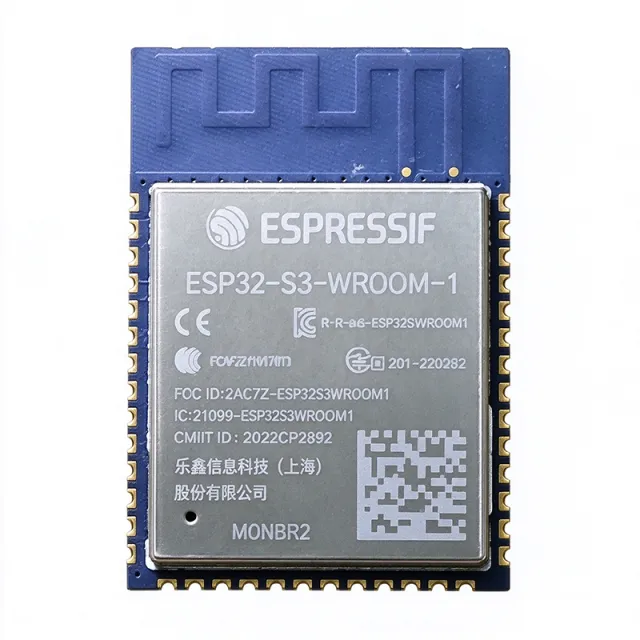
ESP32-S3-WROOM-1 - Wi-Fi 4 + BLE 5 Module, Xtensa LX7 Dual-Core | Espressif

MPN: ESP32-S3-WROOM-1 ✓ Aktif
3.0 V to 3.6 V Vdss 18.0 mm x 25.5 mm x 3.1 mm (WROOM-1) Package 8 MB Quad SPI Memory
MOQ: 1 |

ESP32-S3-WROOM-1 Ringkasan

The Espressif ESP32-S3-WROOM-1 is a 2.4 GHz Wi-Fi 4 (802.11 b/g/n) and Bluetooth 5 (LE) MCU module built around the ESP32-S3 series SoC, integrating an Xtensa dual-core 32-bit LX7 microprocessor with vector instructions for AI/ML acceleration. It is supplied as a surface-mount module with on-board PCB antenna, flash up to 16 MB (variant-dependent) and optional PSRAM up to 16 MB, exposed through up to 36 GPIOs. Common ordering codes include N8 (8 MB flash, no PSRAM), N16 (16 MB flash, no PSRAM), N8R8 (8 MB flash, 8 MB PSRAM), and N16R8 (16 MB flash, 8 MB PSRAM).

A Wi-Fi + Bluetooth LE module is a self-contained radio subsystem that combines an RF transceiver, baseband, MCU, antenna, and regulatory shielding into a single reflow-solderable package. The module drops by several orders of magnitude of PCB RF design effort for the host product, exposing digital interfaces (UART, SPI, I2C, I2S, USB-OTG) instead of 50-ohm traces. Within the system hierarchy, an ESP32 module sits between the SoC layer and the finished connected-product (module -> wireless SoC -> 32-bit microcontroller -> embedded computing platform). The S3 series specifically adds vector instructions for SIMD-style acceleration of neural-network inference.

Key features include hardware acceleration for neural network and signal processing workloads (vector instructions + ESP-DSP/VIEW libraries), integrated 2.4 GHz radio with Wi-Fi 4 (802.11 b/g/n, up to 150 Mbps) + Bluetooth 5 (LE) + Bluetooth Mesh, USB OTG 1.1 with on-chip PHY (no external bridge required), and rich peripherals including SPI, I2S, I2C, UART, ADC, DAC, TWAI (CAN), LCD, camera interface, RMT, pulse counters, and motor PWM. The module supports secure boot, flash encryption, and a hardware crypto accelerator (AES, SHA, RSA, HMAC, digital signature).

Architecturally, the LX7 dual-core runs at up to 240 MHz with 512 KB SRAM, 2 MB PSRAM-internal block, and an additional 8 MB external PSRAM on R8 variants. Wi-Fi and Bluetooth share a single antenna through the on-module RF switch; the LX7 + radio architecture is the same die family as the bare ESP32-S3 chip, packaged with crystal, flash, RF matching network, and a copper-pour PCB antenna on the module substrate.

Typical applications include AIoT endpoints (voice wake-word, on-device keyword spotting), smart-home hubs with Matter/Bluetooth Mesh, USB-HID devices (the S3 brings native USB-OTG so no UART bridge is needed), wearables with LCD/camera, industrial sensor nodes with TWAI (CAN), and low-cost Wi-Fi/BLE bridge boards.

For new designs, observe the strapping-pin (GPIO0/3/45/46) boot-state requirements and ensure the on-module antenna keep-out zone is respected on the host PCB; failure to do so is the most common reason an otherwise-correct ESP32-S3 design has poor RF range.

This page synthesizes Espressif datasheet specifications, family-level parametric positioning, and same-footprint alternatives - giving a one-stop overview that individual distributor listings cannot.

Alternatif penggantian untuk ESP32-S3-WROOM-1 — paket yang sama, pin-pada-pin kompatibel. Bagian paket yang berbeda memerlukan kerja ulang PCB diabaikan.

ESP32-S3-WROOM-1-N16R8

Espressif Systems
ESP32-S3R8 · Dual-core Xtensa 32-bit LX7, up to 240 MHz · 16 MB Quad SPI · 8 MB Octal SPI · 802.11 b/g/n, 2.4 GHz · Bluetooth 5 (LE) · PCB trace antenna · 36 GPIOs

Kontak untuk harga

Lihat Datasheet →

ESP32-S3-WROOM-1-N16R8

Espressif Systems
ESP32-S3R8 · Dual-core Xtensa 32-bit LX7, up to 240 MHz · 16 MB Quad SPI · 8 MB Octal SPI · 802.11 b/g/n, 2.4 GHz · Bluetooth 5 (LE) · PCB trace antenna · 36 GPIOs

Kontak untuk harga

Lihat Datasheet →

ESP32-S3-WROOM-1U

Espressif Systems
Xtensa dual-core 32-bit LX7 (ESP32-S3 SoC) · 802.11 b/g/n, 2.4 GHz · Bluetooth 5 (LE) · Up to 16 MB (variant dependent) · Up to 16 MB (variant dependent) · Up to 36 GPIOs · External antenna via U.FL connector (antenna not included) · Neural network computing and signal processing acceleration

Kontak untuk harga

Lihat Datasheet →

ESP32-S3-WROOM-1-N8R8

Same footprint and PCB antenna; flash 8 MB unchanged, adds 8 MB Octal PSRAM. Pin-to-pin compatible.

📋 Alternatif referensi (tidak dalam katalog)

ESP32-S3-WROOM-1U-N16R2

Espressif Systems
Dual-core Xtensa LX7 (ESP32-S3R2 SoC) · 240 MHz · 16 MB quad SPI · 2 MB quad SPI (die integrated in module) · 802.11 b/g/n, 2.4 GHz · Bluetooth 5.0 LE · External via U.FL (IPEX) connector, antenna not included · 3.0 V to 3.6 V (3.3 V typical)

Kontak untuk harga

Lihat Datasheet →

ESP32-S3-WROOM-1 Spesifikasi (diterbitkan produsen)

Module Series ESP32-S3-WROOM-1
Wi-Fi Standard 802.11 b/g/n (Wi-Fi 4), 2.4 GHz, up to 150 Mbps
Bluetooth Bluetooth 5 (LE), Bluetooth Mesh
Processor Xtensa LX7 dual-core 32-bit, up to 240 MHz
Vector Instructions Yes (128-bit, for ML/AI acceleration)
On-chip SRAM 512 KB
Flash (variant N8) 8 MB Quad SPI
Flash (variant N16) 16 MB Quad SPI
PSRAM (variant R8) 8 MB Octal SPI
PSRAM (variant R16) 16 MB Octal SPI
GPIOs (exposed) Up to 36
Antenna On-board PCB antenna (WROOM-1) / external IPEX (WROOM-1U)
USB USB OTG 1.1 with on-chip PHY (USB-CDC supported)
Operating Voltage 3.0 V to 3.6 V
Suhu Kerja -40 C to +85 C
Package Dimensions 18.0 mm x 25.5 mm x 3.1 mm (WROOM-1)
Tipe Mounting Surface Mount (castellated pads)
Status RoHS Compliant

Konfigurasi Pin ESP32-S3-WROOM-1

Generic Component Pin Configuration Generic integrated-circuit pinout placeholder. Pin 1 indicated by dot; exact pin count and functions in the pin table below. 1 N 2 N-1 3 N-2 4 N-3 Pin Configuration See pin table below for pin functions Package-specific diagram not available
Pin produk 1 GND — Ground reference
Pin produk 2 3V3 — Module power supply, 3.0-3.6 V
Pin produk 3 EN — Chip-enable / reset (active high, internal pull-up)
Pin produk 4 IO0 — GPIO0 / strapping pin (boot mode)
Pin produk 5 IO1 — GPIO1 / ADC1_CH0
Pin produk 6 IO2 — GPIO2 / ADC1_CH1
Pin produk 7 IO3 — GPIO3 / strapping pin
Pin produk 8 IO4 — GPIO4 / ADC1_CH3
Pin produk 9 IO5 — GPIO5 / ADC1_CH4
Pin produk 10 IO6 — GPIO6 / ADC1_CH5
Pin produk 11 IO7 — GPIO7 / ADC1_CH6
Pin produk 12 IO8 — GPIO8 / ADC1_CH7
Pin produk 13 IO9 — GPIO9
Pin produk 14 IO10 — GPIO10
Pin produk 15 IO11 — GPIO11
Pin produk 16 IO12 — GPIO12
Pin produk 17 IO13 — GPIO13
Pin produk 18 IO14 — GPIO14
Pin produk 19 IO15 — GPIO15
Pin produk 20 IO16 — GPIO16
Pin produk 21 IO17 — GPIO17
Pin produk 22 IO18 — GPIO18 / USB_D-
Pin produk 23 IO19 — GPIO19 / USB_D+
Pin produk 24 IO20 — GPIO20
Pin produk 25 IO21 — GPIO21
Pin produk 26 IO35 — GPIO35 / strapping pin (boot mode)
Pin produk 27 IO36 — GPIO36 / strapping pin (boot mode)
Pin produk 28 IO37 — GPIO37
Pin produk 29 IO38 — GPIO38
Pin produk 30 IO39 — GPIO39
Pin produk 31 IO40 — GPIO40
Pin produk 32 IO41 — GPIO41
Pin produk 33 IO42 — GPIO42 (TXD0)
Pin produk 34 IO43 — GPIO43 (RXD0)
Pin produk 35 IO44 — GPIO44
Pin produk 36 IO45 — GPIO45 / strapping pin (VDD_SPI voltage)
Pin produk 37 IO46 — GPIO46 / strapping pin (boot mode, ROM messages)
Pin produk 38 IO47 — GPIO47
Pin produk 39 IO48 — GPIO48
Pin produk 40 GND — Ground reference (additional thermal pad)
Pin produk 41 GND — Ground reference (additional thermal pad)

Karakteristik Kuasa & Thermal

Suhu Beroperasi -40 C to +85 C

Parameter kuasa masuk dan thermal untuk ESP32-S3-WROOM-1 seperti dipublikasikan oleh produsen.

Aplikasi Umum

ESP32-S3-WROOM-1 cocok untuk 6 aplikasis: AIoT Endpoint with Voice Wake-Word, Smart-Home Hub with Matter / Bluetooth Mesh, USB-HID Macro Pad / Custom Input Device, Wearable with LCD and Camera Interface, Industrial Sensor Node over TWAI (CAN Bus), Low-Cost Wi-Fi/BLE Bridge Board.

🧩

AIoT Endpoint with Voice Wake-Word

The ESP32-S3-WROOM-1 fits AIoT endpoint applications because it integrates both the wireless radio and vector-instruction acceleration for on-device keyword spotting. The LX7 dual-core runs at up to 240 MHz and the 128-bit vector instructions accelerate the matrix-multiply steps in a quantized CNN wake-word model; Espressif's ESP-SR library supports wake-word and speech-recognition models out of the box. With 8 MB PSRAM (N8R8) the model can stay resident without streaming, and the on-chip USB OTG allows direct debugging from a host PC. Versus using a bare ESP32-S3 chip, the module removes the need for a host-side 50-ohm RF match and FCC pre-scan.

🏭

Smart-Home Hub with Matter / Bluetooth Mesh

The ESP32-S3-WROOM-1 is well suited to smart-home gateway and end-node designs because it carries Wi-Fi 4, Bluetooth 5 LE, and Bluetooth Mesh in one module. Per the Espressif datasheet the radio supports Bluetooth 5 LE Coded PHY (long-range) and 802.11 b/g/n simultaneously, enabling Matter-over-Wi-Fi plus a BLE commissioning channel on the same device. The 36 GPIOs let you directly drive relays, keypads, and sensors without an expander, and the hardware crypto engine secures commissioning keys. Using the module rather than the bare SoC lets a smart-home product skip the costly FCC/CE pre-compliance RF path.

🖥️

USB-HID Macro Pad / Custom Input Device

The ESP32-S3-WROOM-1 is ideal for USB-HID devices because its on-chip USB OTG 1.1 PHY removes the need for any external UART-to-USB bridge, unlike ESP32-WROOM-32. According to Espressif documentation, the S3 USB stack supports HID, CDC, MSC, and Vendor classes, so the same firmware can present as a keyboard, mouse, or composite device. The vector instructions allow per-keypress custom logic (e.g. RGB animation profiles) without taxing the Wi-Fi stack. Power can be drawn from the USB bus directly, eliminating a regulator.

📱

Wearable with LCD and Camera Interface

The ESP32-S3-WROOM-1 supports wearables with integrated camera and LCD interfaces because it exposes parallel-8/16-bit camera and LCD busses through the GPIO matrix. The ESP32-S3 die includes dedicated LCD and camera peripherals, and the WROOM-1 module brings them to the castellated pads. N8R8/N16R8 variants give the PSRAM required to buffer camera frames; ESP32-WROOM-32E lacks both the camera interface and vector instructions for image preprocessing. The 18.0 x 25.5 mm module plus 3.1 mm height suits watch-format enclosures.

🏭

Industrial Sensor Node over TWAI (CAN Bus)

The ESP32-S3-WROOM-1 is a strong fit for industrial CAN-bus sensor nodes because it integrates an on-die TWAI (CAN) controller compatible with ISO 11898-1. According to the Espressif datasheet, the TWAI peripheral supports both Classic CAN and CAN FD, enabling 1 Mbps industrial backbones without an external CAN controller. Wi-Fi or BLE brings wireless commissioning alongside the CAN wire, and the wide -40 C to +85 C operating range matches industrial temperature grades. Compared to bare ESP32-S3, the module shortens design cycles by removing the 50-ohm RF match work.

🌐

Low-Cost Wi-Fi/BLE Bridge Board

The ESP32-S3-WROOM-1 suits bridge-board designs that translate between BLE peripherals and Wi-Fi cloud endpoints because it can run both stacks concurrently. Espressif's ESP-IDF and Arduino cores support simultaneous Wi-Fi station + BLE GATT operation, with the dual LX7 cores running the two stacks in parallel. N16R8 (16 MB flash, 8 MB PSRAM) gives headroom for OTA staging and TLS buffers. The module's on-board antenna plus castellation pads also let you place it on a 2-layer host PCB without RF-specific stackup.

Ringkasan Produk Direkomendasikan

ESP32-S3-WROOM-1-N8R8 Same family, with PSRAM for larger ML models Digunakan di dalam: AIoT Endpoint with Voice Wake-Word, Wearable with LCD and Camera Interface, Industrial Sensor Node over TWAI (CAN Bus) INMP441 I2S MEMS microphone commonly paired with ESP-SR Digunakan di dalam: AIoT Endpoint with Voice Wake-Word MAX98357A I2S Class-D amplifier for audio feedback Digunakan di dalam: AIoT Endpoint with Voice Wake-Word ESP32-S3-WROOM-1-N16R8 Espressif Systems Digunakan di dalam: Smart-Home Hub with Matter / Bluetooth Mesh, Low-Cost Wi-Fi/BLE Bridge Board MCP23017 I2C 16-bit GPIO expander for additional relay channels Digunakan di dalam: Smart-Home Hub with Matter / Bluetooth Mesh HLK-PM01 AC-DC 5 V module for mains-powered smart-switch designs Digunakan di dalam: Smart-Home Hub with Matter / Bluetooth Mesh ESP32-S3-WROOM-1-N8 Espressif Systems Digunakan di dalam: USB-HID Macro Pad / Custom Input Device SK6812RGBW Addressable RGB-LED commonly driven by RMT Digunakan di dalam: USB-HID Macro Pad / Custom Input Device Kailh Choc V1 Low-profile mechanical key switches for macro pads Digunakan di dalam: USB-HID Macro Pad / Custom Input Device OV2640 2 MP camera module commonly used with ESP32-S3 Digunakan di dalam: Wearable with LCD and Camera Interface ST7789V 240x320 IPS LCD widely supported by Arduino_GFX Digunakan di dalam: Wearable with LCD and Camera Interface TJA1051T NXP Semiconductors Digunakan di dalam: Industrial Sensor Node over TWAI (CAN Bus) MAX3485 RS-485 transceiver for half-duplex industrial fieldbus Digunakan di dalam: Industrial Sensor Node over TWAI (CAN Bus) ESP32-C6-WROOM-1 Companion module for Wi-Fi 6 / Thread / Zigbee bridges Digunakan di dalam: Low-Cost Wi-Fi/BLE Bridge Board AMS1117-3.3 LDO regulator for clean 3.3 V supply from USB Digunakan di dalam: Low-Cost Wi-Fi/BLE Bridge Board
What is the ESP32-S3-WROOM-1?
The ESP32-S3-WROOM-1 is a surface-mount Wi-Fi and Bluetooth LE MCU module based on the Espressif ESP32-S3 SoC. It combines an Xtensa dual-core 32-bit LX7 processor, 2.4 GHz Wi-Fi 802.11b/g/n, Bluetooth 5 LE, an on-board PCB antenna, flash, and optional PSRAM in one module. According to the Espressif ESP32-S3-WROOM-1 and ESP32-S3-WROOM-1U datasheet, it supports up to 36 GPIOs and vector instructions for neural-network and signal-processing workloads.
What are the key specifications of ESP32-S3-WROOM-1 that engineers should know?
The ESP32-S3-WROOM-1 combines a 240 MHz Xtensa dual-core LX7 processor, 2.4 GHz Wi-Fi 802.11b/g/n, Bluetooth 5 LE, 512 KB of internal SRAM, and a 2 MB internal PSRAM block. Depending on the order code, flash can reach 16 MB and external PSRAM can reach 16 MB. The module also provides USB-OTG 1.1 with an on-chip PHY, secure boot, flash encryption, hardware cryptography, and up to 36 GPIOs. Espressif documents these functions in the ESP32-S3-WROOM-1 and ESP32-S3-WROOM-1U datasheet.
Where can I download the ESP32-S3-WROOM-1 datasheet PDF?
The official ESP32-S3-WROOM-1 datasheet PDF is available from Espressif at the documentation URL on this product page. The PDF covers module specifications, pin definitions, functional descriptions, electrical characteristics, dimensions, and the ESP32-S3-WROOM-1 and ESP32-S3-WROOM-1U family comparison. Use the manufacturer document for the authoritative footprint and pin definitions when laying out a host PCB or selecting an ESP32-S3-WROOM-1 ordering code.
Where can I find the ESP32-S3-WROOM-1 pinout and module pin definitions?
The ESP32-S3-WROOM-1 pin definitions are in the Espressif ESP32-S3-WROOM-1 and ESP32-S3-WROOM-1U datasheet, including the module pin table and pin-selection guidance. Engineers should also review the ESP-IDF ESP32-S3 hardware documentation for strapping pins, USB routing, and GPIO constraints. The module has up to 36 GPIOs, but some pins are reserved for boot control, flash or PSRAM functions, USB operation, or other module-level requirements.
What is the difference between ESP32-S3-WROOM-1 and ESP32-S3-WROOM-1U?
The principal difference is antenna construction: ESP32-S3-WROOM-1 uses an on-board PCB antenna, while ESP32-S3-WROOM-1U provides an external antenna connector. Both belong to the same ESP32-S3 module family and use the ESP32-S3 series SoC. A board designed around the WROOM-1 PCB antenna should not be treated as an RF-equivalent to the WROOM-1U without checking the land pattern, antenna area, connector placement, and enclosure requirements in the manufacturer datasheet.
What is the ESP32-S3-WROOM-1 pinout used for boot strapping?
The ESP32-S3 boot-strapping considerations apply particularly to GPIO0, GPIO3, GPIO45, and GPIO46. These pins influence reset and boot behavior, so external pull networks, test points, and attached circuitry must not disturb the required startup levels. Use the pin-description table in the Espressif datasheet and the ESP32-S3 hardware reference when assigning these pins. In particular, USB D− and D+ must remain suitable for native USB operation when that interface is used.
Can ESP32-S3-WROOM-1 support USB HID devices?
Yes, the ESP32-S3-WROOM-1 includes USB-OTG 1.1 with an on-chip PHY, allowing a USB connection without an external USB-to-UART bridge. It can therefore support keyboard, mouse, controller, storage, and other USB peripheral or HID designs when the firmware and host device implement the required USB classes. The host PCB must route D− and D+ as a controlled differential pair and provide the interface circuitry required by the USB implementation.
Which ESP32-S3-WROOM-1 ordering code should I choose for AI applications?
Choose the ESP32-S3-WROOM-1 variant according to model size, working-memory needs, and peripheral bandwidth rather than AI capability alone. Every ESP32-S3 module includes vector instructions, but the N16R8 configuration provides 16 MB flash and 8 MB external PSRAM for larger models and working buffers. The N8 configuration provides 8 MB flash without external PSRAM. Confirm the model partition, runtime memory footprint, and display or camera requirements before finalizing the order code.
When should I choose ESP32-S3-WROOM-1 over ESP32-WROOM-32E?
Choose ESP32-S3-WROOM-1 when the design benefits from the S3’s dual-core 240 MHz LX7 processor, vector instructions, USB-OTG with an on-chip PHY, and broader AI-oriented acceleration. The ESP32-WROOM-32E belongs to the earlier ESP32 generation, so firmware, peripheral availability, and performance requirements must be reassessed rather than assuming a transparent software or hardware substitution. ESP32-S3-WROOM-1 is preferable when local signal processing, USB connectivity, or machine-learning workloads justify the newer architecture.
Can ESP32-S3-WROOM-1-N8R8 replace the base ESP32-S3-WROOM-1?
ESP32-S3-WROOM-1-N8R8 is a pin-compatible member of the ESP32-S3-WROOM-1 module family with 8 MB flash and 8 MB external PSRAM. It is appropriate when that memory combination matches the application, but the base MPN represents a family with variant-dependent flash and PSRAM options. Review the module footprint, ordering-code memory map, antenna configuration, and firmware image requirements before using the N8R8 ordering code as a direct substitution.
What is the best drop-in replacement for ESP32-S3-WROOM-1?
The closest drop-in choices are ordering-code variants of the ESP32-S3-WROOM-1 family that retain the module footprint and pin assignment. ESP32-S3-WROOM-1-N16R8 matches the 16 MB flash and 8 MB PSRAM configuration, while ESP32-S3-WROOM-1-N8 offers 8 MB flash without external PSRAM. Memory capacity must match the firmware and working-memory requirements, and the WROOM-1U antenna configuration should not be selected automatically because its external antenna implementation differs.
Is ESP32-S3-WROOM-1 suitable for industrial sensor nodes?
The ESP32-S3-WROOM-1 is suitable for industrial sensor nodes that need local processing, wireless connectivity, and flexible peripheral interfaces. Its TWAI interface supports CAN-oriented industrial networks, while I2C and SPI suit common sensors, and the LX7 cores can aggregate and preprocess data locally. For deployed equipment, review the operating-temperature limits, supply-voltage range, radio certification, and enclosure effects before treating the module as a finished industrial component.
Where can I buy ESP32-S3-WROOM-1 and what is its lead time?
Use the Request a Quote form on this page to request ESP32-S3-WROOM-1 availability, current lead time, and a volume quotation. Stock, pricing, and lead time can vary by ordering code, flash and PSRAM configuration, packaging, and production volume, so they should be confirmed for the exact suffix required by the design. The request can also identify whether N8, N16, N8R8, N16R8, or another module configuration is the intended part.
What is the price of ESP32-S3-WROOM-1?
Use the Request a Quote form on this page for the current ESP32-S3-WROOM-1 quotation and volume pricing. The base MPN represents a module family, and the exact ordering code affects flash capacity, PSRAM, antenna construction, and potentially purchasing terms. A quotation request should identify the complete suffix, expected annual usage, required delivery date, and packaging preference so the commercial response matches the intended production configuration.
Is ESP32-S3-WROOM-1 in stock?
Current ESP32-S3-WROOM-1 stock should be confirmed through the Request a Quote form on this page using the complete ordering code. Availability may differ between N8, N16, N8R8, N16R8, and other variants because each has a distinct memory configuration. For new production designs, submit the required suffix, quantity, packaging preference, and target delivery schedule rather than relying on a generic family-level stock statement.
What tools can program and configure the ESP32-S3-WROOM-1?
The ESP32-S3-WROOM-1 is supported by the Espressif ESP-IDF software development framework and associated ESP-IDF programming and flashing tools. A host system can communicate with the module through its serial programming interface, while USB-OTG provides an additional native USB path for supported workflows. Confirm the boot-strapping configuration, USB routing, and firmware image format in the ESP32-S3 hardware documentation before selecting between serial and USB programming.
Is ESP32-S3-WROOM-1 RoHS compliant and suitable for automotive use?
The RoHS status of ESP32-S3-WROOM-1 must be confirmed from the current Espressif product documentation or declaration of conformity. The module also requires separate assessment for automotive use; its wireless features and package temperature requirements do not by themselves establish AEC-Q100 qualification. Industrial and consumer designs can use the module subject to voltage, temperature, RF, and environmental limits, while automotive production should require an explicitly qualified part and supporting compliance documentation.

Data referensi engineering untuk ESP32-S3-WROOM-1 — pembandingan, panduan desain, dan informasi konformitas.

Panduan Pemilihan

Choose ESP32-S3-WROOM-1 (N8 variant) for cost-sensitive new Wi-Fi/BLE designs that need USB, AI/ML acceleration, or Bluetooth 5 long-range. Switch to the -N16R8 variant when your firmware requires more than 8 MB flash or you need PSRAM for camera frames or larger ML models. If your product is sealed inside a metal enclosure, choose -WROOM-1U with an external antenna; otherwise the on-board PCB antenna gives the best BOM cost. For pure Wi-Fi 6 / Thread / Zigbee designs, look at ESP32-C6-WROOM-1 instead; for AI workloads that exceed LX7 vector throughput, look at ESP32-P4. Stick with ESP32-WROOM-32E only when you have an existing validated WROOM-32 firmware base and no AI/USB features are needed.

Pembandingan dengan Alternatif

Parameter Umum Produk Ini ESP32-S3-WROOM-1-N16 ESP32-S3-WROOM-1-N8R8 ESP32-S3-WROOM-1-N16R8 ESP32-S3-WROOM-1U ESP32-S3-WROOM-1U-N16
Brand Espressif Systems Espressif Systems Espressif Systems Espressif Systems Espressif Systems Espressif Systems
Package / Footprint SMD Module, 18.0 x 25.5 mm, castellated pads SMD Module, 18.0 x 25.5 mm, same SMD Module, 18.0 x 25.5 mm, same SMD Module, 18.0 x 25.5 mm, same SMD Module, 18.0 x 25.5 mm, same SMD Module, 18.0 x 25.5 mm, same
Antenna On-board PCB antenna On-board PCB antenna On-board PCB antenna On-board PCB antenna External IPEX connector External IPEX connector
Flash 8 MB Quad SPI 16 MB Quad SPI 8 MB Quad SPI 16 MB Quad SPI 4 MB Quad SPI 16 MB Quad SPI
PSRAM None None 8 MB Octal SPI 8 MB Octal SPI None None
Wi-Fi Standard 802.11 b/g/n (Wi-Fi 4), 2.4 GHz 802.11 b/g/n (Wi-Fi 4), 2.4 GHz 802.11 b/g/n (Wi-Fi 4), 2.4 GHz 802.11 b/g/n (Wi-Fi 4), 2.4 GHz 802.11 b/g/n (Wi-Fi 4), 2.4 GHz 802.11 b/g/n (Wi-Fi 4), 2.4 GHz
Bluetooth Bluetooth 5 (LE), Bluetooth Mesh Bluetooth 5 (LE), Bluetooth Mesh Bluetooth 5 (LE), Bluetooth Mesh Bluetooth 5 (LE), Bluetooth Mesh Bluetooth 5 (LE), Bluetooth Mesh Bluetooth 5 (LE), Bluetooth Mesh
USB OTG Yes (on-chip PHY) Yes (on-chip PHY) Yes (on-chip PHY) Yes (on-chip PHY) Yes (on-chip PHY) Yes (on-chip PHY)
Operating Voltage 3.0 V to 3.6 V 3.0 V to 3.6 V 3.0 V to 3.6 V 3.0 V to 3.6 V 3.0 V to 3.6 V 3.0 V to 3.6 V

Diferensiator Kunci

  • Vector instructions for AI/ML acceleration (vsESP32-WROOM-32E)
  • Native USB OTG with on-chip PHY (vsESP32-WROOM-32E)
  • Dual LX7 cores versus single-core ESP32-S2 (vsESP32-S2-WROOM-1)

Catatan Desain

The ESP32-S3-WROOM-1 module has a defined antenna keep-out zone that must be respected on the host PCB. Per the Espressif hardware design guidelines, no copper (including ground pours, traces, or component bodies) should be placed under the antenna area; a minimum of 6 mm clearance from the antenna edge is required. Placing metal or copper too close is the single most common cause of poor Wi-Fi/BLE range in otherwise correct designs - field returns almost always trace back to this rule.

Strapping pins GPIO0, GPIO3, GPIO45 and GPIO46 control boot behavior and must be in the correct state at reset. According to the Espressif datasheet, GPIO45 also selects the VDD_SPI voltage that powers the in-package flash, so leaving it floating or wired incorrectly can prevent boot entirely. If you need these pins for application use, add external weak pull-ups or use them only after boot - never drive them low during reset.

Power the module from a 3.3 V LDO with at least 500 mA peak capability (peak Wi-Fi TX draws ~500 mA bursts). A 10 uF bulk plus 100 nF decoupling cap placed within 3 mm of the module's 3V3 pin is the minimum recommended; bypass with a 1 uF cap if the host supply is shared with other high-current loads. Avoid routing the 3V3 trace under the antenna - the impedance change at 2.4 GHz can shift the match.

Estimated: at continuous Wi-Fi TX at maximum output power, the module dissipates approximately 0.8-1.0 W into the host PCB. With a typical castellation-only thermal path, junction-to-ambient thermal resistance is on the order of 30 C/W, so a worst-case rise of 30 C above ambient is realistic. The castellated module pads give the best heat-spreading when soldered to a copper pour, not a small signal trace.

Informasi Konformitas

RoHS
Compliant
REACH
Compliant
AEC-Q100
Bebas Logam Lengket
Bebas Halogena
Unknown
Mineral Konflik
Compliant

RoHS compliance per Espressif product page and DigiKey product listing (15200089). Module is lead-free. AEC-Q100 not applicable - this is a consumer/industrial module, not an automotive-qualified part; no Espressif S3 module variant is AEC-Q100 qualified as of 2026-10-11.

Data disahkan pada: 2026-10-11 — data disahkan dan disusun oleh tim engineering komponen XAIPART

Pencarian Terkait

ESP32-S3-WROOM-1 ESP32-S3-WROOM-1 datasheet ESP32-S3-WROOM-1-N8 ESP32-S3-WROOM-1-N16R8 ESP32-S3-WROOM-1 price ESP32-S3-WROOM-1 vs ESP32-WROOM-32 ESP32-S3-WROOM-1 USB OTG ESP32-S3-WROOM-1 pinout ESP32-S3-WROOM-1 AI ML module ESP32-S3-WROOM-1 drop-in replacement Espressif ESP32-S3 module buy what is the difference between ESP32-S3-WROOM-1 and WROOM-1U ESP32-S3-WROOM-1 Bluetooth 5 LE long range ESP32-S3-WROOM-1 strapping pins GPIO45

Komponen dan Istilah Terkait

Espressif Systems ESP32-S3-WROOM-1 ESP32-S3-WROOM-1-N8 ESP32-S3-WROOM-1-N16 ESP32-S3-WROOM-1-N8R8 ESP32-S3-WROOM-1-N16R8 ESP32-S3-WROOM-1U ESP32-S3-WROOM-1U-N16 ESP32-S3 SoC Xtensa LX7 Wi-Fi 4 (802.11 b/g/n) Bluetooth 5 LE Bluetooth Mesh USB OTG 1.1 Quad SPI flash Octal SPI PSRAM RoHS AEC-Q100 Matter TWAI (CAN) AIoT voice wake-word castellated module PCB antenna IPEX / MHF connector
Kutipan Cepat RFQ
Isi detail lengkap — tim penjualan kami akan membalas dalam 24 jam
Nomor Part Manufaktur Paket QTY Harga Target Lengkap
✓
Kutipan telah disubmit!

Kami akan membalas email Anda dalam 24 jam

1
RFQ Dikirim
2
Kutipan Diterima
3
Order Ditempatkan
4
Pembayaran
5
Dikirim
6
Dikirim
Lihat Detil RFQ
