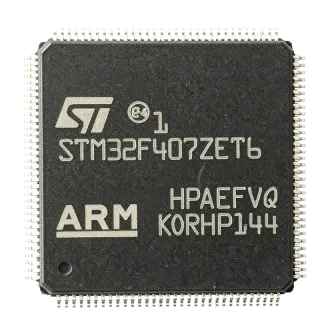
STM32F415ZGT6 - 168MHz ARM Cortex-M4F MCU, 1MB Flash | STMicroelectronics
MPN: STM32F415ZGT6 ✓ AktifSTM32F415ZGT6 Ringkasan
What is an ARM Cortex-M4F microcontroller? It is a 32-bit processor core designed for embedded systems that require a balance of performance, power efficiency, and advanced digital signal processing (DSP) capabilities. The 'F' suffix indicates the presence of a hardware floating-point unit, which accelerates mathematical operations for applications like motor control, audio processing, and sensor fusion. In the system hierarchy, a microcontroller (MCU) integrates the processor core, memory, and peripherals on a single chip, serving as the 'brain' of embedded systems. The STM32F4 series sits in the high-performance tier of ST's STM32 portfolio, positioned above the mainstream F1/F3 series and below the higher-end F7/H7 series.
Key features of the STM32F415ZGT6 include a 168 MHz CPU with 210 DMIPS performance, 1 MB of Flash memory, 192 KB of SRAM, and a comprehensive set of peripherals: three 12-bit ADCs (up to 24 channels), two 12-bit DACs, advanced timers, and multiple communication interfaces (USART, SPI, I2C, USB OTG FS/HS, CAN, SDIO, and Ethernet MAC). The device also features a true random number generator (RNG), a cryptographic acceleration cell (AES, DES, 3DES), and a camera interface (DCMI). These features make it ideal for applications requiring high computational throughput and rich connectivity.
From a technical architecture perspective, the STM32F415ZGT6 is built on a 90nm process technology, offering a good balance of performance and power consumption. The Cortex-M4F core includes a single-precision FPU and DSP instructions, enabling efficient execution of complex algorithms. The memory architecture uses a Harvard bus structure with separate instruction and data buses, allowing simultaneous access to Flash and SRAM. The device supports a wide supply voltage range of 1.8V to 3.6V, with a comprehensive clock management system including a PLL, multiple internal/external oscillators, and a real-time clock (RTC).
Typical applications include industrial motor control, medical devices, consumer electronics, IoT gateways, and audio processing. The combination of high-speed ADC, advanced timers, and Ethernet MAC makes it particularly well-suited for real-time control and networked systems. For example, in a motor control application, the advanced PWM timers and high-resolution ADC enable precise current and speed regulation.
When designing with this device, pay attention to power supply decoupling: place a 100nF capacitor close to each VDD pin and a 4.7uF bulk capacitor on the main supply. Also, ensure proper configuration of the boot pins (BOOT0 and BOOT1) to select the desired boot source. The device supports in-circuit programming and debugging via SWD and JTAG interfaces, facilitating development.
Alternatif penggantian untuk STM32F415ZGT6 — paket yang sama, pin-pada-pin kompatibel. Bagian paket yang berbeda memerlukan kerja ulang PCB diabaikan.
Variasi di dalam seri ini
Model-series yang sama yang kompatibel dengan penggantian STM32F415ZGT6 (sama faktor bentuk dan footprint) — berbeda di dalam Package, ADC, Communication Interfaces, Timers, Core.
STM32F407ZGT6
✅ Drop-In✓ Ada di Gudang
$5.25 / Satuan
Lihat Datasheet →STM32F417ZGT6
✅ Drop-InKontak untuk harga
Lihat Datasheet →STM32F415ZGT7
✅ Drop-In ⚠️ Spesifikasi Tidak Disahkan📋 Alternatif referensi (tidak dalam katalog)
STM32F405ZGT6
✅ Drop-In ⚠️ Spesifikasi Tidak DisahkanKontak untuk harga
Lihat Datasheet →STM32F415ZGT6 Rating Maksimal & Karakteristik Listrik
| Core | ARM Cortex-M4F with FPU |
| Frekuensi Bawah Maximum | 168 MHz |
| Flash Memory | 1 MB |
| SRAM | 192 KB |
| Tegangan Pemuat | 1.8V to 3.6V |
| Paket | LQFP144 (20x20 mm) |
| Jumlah Pin | 144 |
| GPIO Pins | 114 |
| ADC | 3x 12-bit, up to 24 channels |
| DAC | 2x 12-bit |
| Timers | Advanced-control, general-purpose, basic, and low-power timers |
| Communication Interfaces | USART, SPI, I2C, USB OTG FS/HS, CAN, SDIO, Ethernet MAC |
| Suhu Kerja | -40C to +85C |
| Status RoHS | Compliant |
| DSP Instructions | Yes |
| Floating-Point Unit | Single-precision |
Konfigurasi Pin STM32F415ZGT6
| Pin produk 1 | PE2 — GPIO / alternate functions |
| Pin produk 2 | PE3 — GPIO / alternate functions |
| Pin produk 3 | PE4 — GPIO / alternate functions |
| Pin produk 4 | PE5 — GPIO / alternate functions |
| Pin produk 5 | PE6 — GPIO / alternate functions |
| Pin produk 6 | VBAT — Backup battery supply |
| Pin produk 7 | PC13 — GPIO / RTC tamper |
| Pin produk 8 | PC14 — GPIO / OSC32_IN |
| Pin produk 9 | PC15 — GPIO / OSC32_OUT |
| Pin produk 10 | PF0 — GPIO / OSC_IN |
| Pin produk 11 | PF1 — GPIO / OSC_OUT |
| Pin produk 12 | PF2 — GPIO |
| Pin produk 13 | PF3 — GPIO |
| Pin produk 14 | PF4 — GPIO |
| Pin produk 15 | PF5 — GPIO |
| Pin produk 16 | PF6 — GPIO |
| Pin produk 17 | PF7 — GPIO |
| Pin produk 18 | PF8 — GPIO |
| Pin produk 19 | PF9 — GPIO |
| Pin produk 20 | PF10 — GPIO |
| Pin produk 21 | VSS — Ground |
| Pin produk 22 | VDD — Power supply |
| Pin produk 23 | PF11 — GPIO |
| Pin produk 24 | PF12 — GPIO |
| Pin produk 25 | PF13 — GPIO |
| Pin produk 26 | PF14 — GPIO |
| Pin produk 27 | PF15 — GPIO |
| Pin produk 28 | PG0 — GPIO |
| Pin produk 29 | PG1 — GPIO |
| Pin produk 30 | PG2 — GPIO |
| Pin produk 31 | PG3 — GPIO |
| Pin produk 32 | PG4 — GPIO |
| Pin produk 33 | PG5 — GPIO |
| Pin produk 34 | PG6 — GPIO |
| Pin produk 35 | PG7 — GPIO |
| Pin produk 36 | PG8 — GPIO |
| Pin produk 37 | PG9 — GPIO |
| Pin produk 38 | PG10 — GPIO |
| Pin produk 39 | PG11 — GPIO |
| Pin produk 40 | PG12 — GPIO |
| Pin produk 41 | PG13 — GPIO |
| Pin produk 42 | PG14 — GPIO |
| Pin produk 43 | PG15 — GPIO |
| Pin produk 44 | VSS — Ground |
| Pin produk 45 | VDD — Power supply |
| Pin produk 46 | PD0 — GPIO / crystal oscillator |
| Pin produk 47 | PD1 — GPIO / crystal oscillator |
| Pin produk 48 | PD2 — GPIO |
| Pin produk 49 | PD3 — GPIO |
| Pin produk 50 | PD4 — GPIO |
| Pin produk 51 | PD5 — GPIO |
| Pin produk 52 | PD6 — GPIO |
| Pin produk 53 | PD7 — GPIO |
| Pin produk 54 | PD8 — GPIO |
| Pin produk 55 | PD9 — GPIO |
| Pin produk 56 | PD10 — GPIO |
| Pin produk 57 | PD11 — GPIO |
| Pin produk 58 | PD12 — GPIO |
| Pin produk 59 | PD13 — GPIO |
| Pin produk 60 | PD14 — GPIO |
| Pin produk 61 | PD15 — GPIO |
| Pin produk 62 | PC0 — GPIO / ADC input |
| Pin produk 63 | PC1 — GPIO / ADC input |
| Pin produk 64 | PC2 — GPIO / ADC input |
| Pin produk 65 | PC3 — GPIO / ADC input |
| Pin produk 66 | VSSA — Analog ground |
| Pin produk 67 | VDDA — Analog power supply |
| Pin produk 68 | PC4 — GPIO / ADC input |
| Pin produk 69 | PC5 — GPIO / ADC input |
| Pin produk 70 | PB0 — GPIO / ADC input |
| Pin produk 71 | PB1 — GPIO / ADC input |
| Pin produk 72 | PB2 — GPIO |
| Pin produk 73 | PB3 — GPIO / JTDO |
| Pin produk 74 | PB4 — GPIO / NJTRST |
| Pin produk 75 | PB5 — GPIO |
| Pin produk 76 | PB6 — GPIO / I2C1_SCL |
| Pin produk 77 | PB7 — GPIO / I2C1_SDA |
| Pin produk 78 | BOOT0 — Boot mode selection |
| Pin produk 79 | PB8 — GPIO / I2C1_SCL |
| Pin produk 80 | PB9 — GPIO / I2C1_SDA |
| Pin produk 81 | VSS — Ground |
| Pin produk 82 | VDD — Power supply |
| Pin produk 83 | PE7 — GPIO |
| Pin produk 84 | PE8 — GPIO |
| Pin produk 85 | PE9 — GPIO |
| Pin produk 86 | PE10 — GPIO |
| Pin produk 87 | PE11 — GPIO |
| Pin produk 88 | PE12 — GPIO |
| Pin produk 89 | PE13 — GPIO |
| Pin produk 90 | PE14 — GPIO |
| Pin produk 91 | PE15 — GPIO |
| Pin produk 92 | PB10 — GPIO / I2C2_SCL |
| Pin produk 93 | PB11 — GPIO / I2C2_SDA |
| Pin produk 94 | PB12 — GPIO / SPI2_NSS |
| Pin produk 95 | PB13 — GPIO / SPI2_SCK |
| Pin produk 96 | PB14 — GPIO / SPI2_MISO |
| Pin produk 97 | PB15 — GPIO / SPI2_MOSI |
| Pin produk 98 | PD8 — GPIO / USART3_TX |
| Pin produk 99 | PD9 — GPIO / USART3_RX |
| Pin produk 100 | PD10 — GPIO / USART3_CK |
| Pin produk 101 | PD11 — GPIO / USART3_CTS |
| Pin produk 102 | PD12 — GPIO / USART3_RTS |
| Pin produk 103 | PD13 — GPIO |
| Pin produk 104 | PD14 — GPIO |
| Pin produk 105 | PD15 — GPIO |
| Pin produk 106 | PC6 — GPIO / I2S2_MCK |
| Pin produk 107 | PC7 — GPIO / I2S2_MCK |
| Pin produk 108 | PC8 — GPIO / SDIO_D0 |
| Pin produk 109 | PC9 — GPIO / SDIO_D1 |
| Pin produk 110 | PA0 — GPIO / ADC input / WKUP |
| Pin produk 111 | PA1 — GPIO / ADC input |
| Pin produk 112 | PA2 — GPIO / USART2_TX |
| Pin produk 113 | PA3 — GPIO / USART2_RX |
| Pin produk 114 | VSS — Ground |
| Pin produk 115 | VDD — Power supply |
| Pin produk 116 | PA4 — GPIO / SPI1_NSS |
| Pin produk 117 | PA5 — GPIO / SPI1_SCK |
| Pin produk 118 | PA6 — GPIO / SPI1_MISO |
| Pin produk 119 | PA7 — GPIO / SPI1_MOSI |
| Pin produk 120 | PA8 — GPIO / USB_OTG_FS_SOF |
| Pin produk 121 | PA9 — GPIO / USB_OTG_FS_VBUS |
| Pin produk 122 | PA10 — GPIO / USB_OTG_FS_ID |
| Pin produk 123 | PA11 — GPIO / USB_OTG_FS_DM |
| Pin produk 124 | PA12 — GPIO / USB_OTG_FS_DP |
| Pin produk 125 | PA13 — GPIO / SWDIO |
| Pin produk 126 | PA14 — GPIO / SWCLK |
| Pin produk 127 | PA15 — GPIO / JTDI |
| Pin produk 128 | PC10 — GPIO / SDIO_D2 |
| Pin produk 129 | PC11 — GPIO / SDIO_D3 |
| Pin produk 130 | PC12 — GPIO / SDIO_CK |
| Pin produk 131 | PD0 — GPIO / crystal oscillator |
| Pin produk 132 | PD1 — GPIO / crystal oscillator |
| Pin produk 133 | PD2 — GPIO |
| Pin produk 134 | PD3 — GPIO |
| Pin produk 135 | PD4 — GPIO |
| Pin produk 136 | PD5 — GPIO |
| Pin produk 137 | PD6 — GPIO |
| Pin produk 138 | PD7 — GPIO |
| Pin produk 139 | VSS — Ground |
| Pin produk 140 | VDD — Power supply |
| Pin produk 141 | PB0 — GPIO / ADC input |
| Pin produk 142 | PB1 — GPIO / ADC input |
| Pin produk 143 | PB2 — GPIO |
| Pin produk 144 | PB3 — GPIO / JTDO |
Aplikasi Umum
STM32F415ZGT6 cocok untuk 6 aplikasis: Industrial Motor Control, IoT Gateway, Medical Device, Audio Processing, Smart Home Controller, Test and Measurement.
Industrial Motor Control
The STM32F415ZGT6 is ideal for industrial motor control due to its advanced timers (TIM1/TIM8) that generate complementary PWM with dead-time insertion, and its high-speed 12-bit ADCs that sample phase currents. The FPU accelerates field-oriented control (FOC) algorithms, enabling efficient and precise motor drives. In a typical application, the MCU reads current sensors via the ADC, executes the FOC algorithm in the FPU, and outputs PWM signals to the gate driver. The Ethernet MAC allows remote monitoring and diagnostics. Compared to lower-end MCUs, the 168 MHz clock and DSP instructions reduce control loop latency, improving dynamic response. Designers should ensure proper isolation between power and control stages and use the ADC's injected channels for synchronized sampling.
Direkomendasikan
IoT Gateway
The STM32F415ZGT6 serves as a powerful IoT gateway processor, connecting sensors and devices to the cloud. Its Ethernet MAC and USB OTG interfaces enable wired and wireless connectivity, while multiple UARTs/SPIs/I2Cs interface with various sensors and communication modules (e.g., Wi-Fi, LoRa). The cryptographic acceleration and RNG enhance security for TLS/DTLS protocols. In a typical gateway, the MCU aggregates data from sensors, processes it locally, and transmits it to the cloud via Ethernet or a cellular module. The 1 MB Flash allows storing firmware and buffering data. The FPU accelerates data processing, such as sensor fusion algorithms. Designers should consider power consumption and use low-power modes when idle. The device's industrial temperature range ensures reliable operation in outdoor environments.
Direkomendasikan
Medical Device
The STM32F415ZGT6 is suitable for medical devices such as patient monitors, infusion pumps, and diagnostic equipment. Its high-performance core and FPU enable real-time signal processing for ECG, EEG, and other biosignals. The multiple ADCs and DACs interface with analog front-ends, while the USB OTG supports connectivity to PCs or mobile devices. The cryptographic acceleration ensures secure data transmission, complying with health data privacy regulations. In a typical patient monitor, the MCU samples ECG signals via the ADC, processes them with digital filters, and displays the waveform on an LCD. The device's low power consumption and wide supply voltage range support battery operation. Designers must follow medical safety standards (e.g., IEC 60601) and ensure proper isolation and EMC protection.
Direkomendasikan
Audio Processing
The STM32F415ZGT6 is well-suited for audio processing applications such as audio effects processors, voice recognition, and active noise cancellation. The Cortex-M4F with FPU and DSP instructions efficiently executes audio algorithms like FIR/IIR filters, FFT, and codecs. The I2S interface connects to audio codecs, and the DAC can output analog audio directly. In a typical audio effects processor, the MCU receives digital audio via I2S, applies effects (e.g., reverb, equalization) in real-time, and outputs the processed audio. The 168 MHz clock ensures low latency. The device's large SRAM (192 KB) buffers audio samples. Designers should pay attention to clock jitter and use a dedicated audio PLL for high-quality audio. The low noise ADC and DAC contribute to high signal-to-noise ratio.
Direkomendasikan
Smart Home Controller
The STM32F415ZGT6 acts as a central controller in smart home systems, managing lighting, HVAC, security, and appliances. Its rich connectivity (Ethernet, USB, UART, SPI, I2C) allows integration with various smart home protocols (e.g., Zigbee, Z-Wave, Wi-Fi). The device's low power modes enable energy-efficient operation. In a typical smart home hub, the MCU communicates with sensors and actuators, processes user commands, and provides a web interface via Ethernet. The cryptographic acceleration secures communication with cloud services. The 1 MB Flash stores the hub's firmware and configuration. Designers should implement over-the-air (OTA) updates using the dual-bank Flash feature. The device's industrial temperature range ensures reliable operation in home environments.
Direkomendasikan
Test and Measurement
The STM32F415ZGT6 is used in test and measurement equipment such as oscilloscopes, data loggers, and signal generators. Its high-speed ADCs (up to 2.4 MSPS) and DACs enable precise signal acquisition and generation. The advanced timers provide accurate time base and triggering. In a typical data logger, the MCU samples multiple analog channels, timestamps the data, and stores it on an SD card via SDIO. The USB OTG allows connection to a PC for data analysis. The FPU accelerates signal processing, such as FFT for spectrum analysis. The device's wide supply voltage range and low power consumption support portable instruments. Designers should use external precision references and careful PCB layout to maintain measurement accuracy.
Direkomendasikan
Ringkasan Produk Direkomendasikan
Data referensi engineering untuk STM32F415ZGT6 — pembandingan, panduan desain, dan informasi konformitas.
Panduan Pemilihan
Pembandingan dengan Alternatif
| Parameter Umum | Produk Ini | STM32F407ZGT6 | STM32F417ZGT6 | STM32F415ZGT7 | STM32F405ZGT6 | LPC4357FET256 |
|---|---|---|---|---|---|---|
| Package | LQFP144 | LQFP144 | LQFP144 | LQFP144 | LQFP144 | BGA256 |
| Brand | STMicroelectronics | STMicroelectronics | STMicroelectronics | STMicroelectronics | STMicroelectronics | NXP Semiconductors |
| Core | ARM Cortex-M4F | ARM Cortex-M4F | ARM Cortex-M4F | ARM Cortex-M4F | ARM Cortex-M4F | ARM Cortex-M4F + M0 |
| Max Clock Frequency | 168 MHz | 168 MHz | 168 MHz | 168 MHz | 168 MHz | 204 MHz |
| Flash Memory | 1 MB | 1 MB | 1 MB | 1 MB | 1 MB | 1 MB |
| SRAM | 192 KB | 192 KB | 192 KB | 192 KB | 192 KB | 136 KB |
| Cryptographic Acceleration | Yes (AES, DES, 3DES) | No | Yes (AES, DES, 3DES) | Yes (AES, DES, 3DES) | No | No |
| Ethernet MAC | Yes | Yes | Yes | Yes | No | Yes |
Diferensiator Kunci
- Integrated cryptographic acceleration and RNG (vsSTM32F407ZGT6)
- Higher SRAM than some alternatives (vsLPC4357FET256)
- Pin-compatible with F4 family (vsSTM32F405ZGT6)
Catatan Desain
Decouple each VDD pin with a 100nF ceramic capacitor placed as close as possible to the pin. Additionally, place a 4.7uF bulk capacitor on the main supply rail. For VDDA, use a dedicated 1uF capacitor and a ferrite bead to isolate analog noise. Ensure VSSA is connected to a clean ground plane.
For the LQFP144 package, use a 4-layer PCB with a solid ground plane. Route high-speed signals (Ethernet, USB) with controlled impedance (e.g., 90 ohms differential for USB). Keep crystal oscillator traces short and away from high-current switching traces. Place the decoupling capacitors on the bottom side directly under the MCU if possible.
Ensure BOOT0 pin is pulled low for normal boot from Flash. If using SWD debugging, note that PA13 (SWDIO) and PA14 (SWCLK) are shared with GPIO; do not use them as GPIO in production without disabling debug. Also, the VBAT pin must be connected to a battery or tied to VDD to preserve RTC functionality.
Informasi Konformitas
RoHS and REACH compliant per STMicroelectronics product page. Not AEC-Q100 qualified; for automotive use, consider STM32F415ZGT7 (extended temp) or other automotive-grade variants.