STMicroelectronics

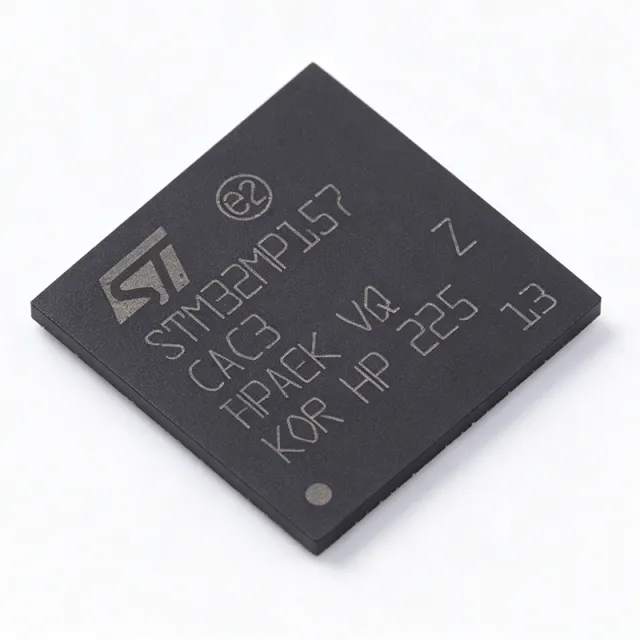
STM32MP157CAC3 - Dual Cortex-A7 650MHz + M4 MPU | ST

部品番号: STM32MP157CAC3 ✓ 生産中
在庫あり 1〜3営業日以内に発送
361-TFBGA (12x12 mm) Package 650 MHz Speed
開始価格 $24.2 USD / 個
MOQ: 1 |
価格更新日: 2026-09-05
ボリューム価格
数量 単価 小計
1 $33.1 $33.10
10 $30.5 $305.00
100 $27.9 $2,790.00
500 $25.8 $12,900.00
1,000 $24.2 $24,200.00
ℹ️ すべての価格はUSDです

STM32MP157CAC3 概要

The STMicroelectronics STM32MP157CAC3 is a heterogeneous microprocessor (MPU) combining dual Arm Cortex-A7 application cores at 650 MHz with a Cortex-M4 real-time coprocessor at 209 MHz, housed in a 361-ball TFBGA package (12x12 mm per DigiKey listing) rated -40C to +125C.

An MPU (microprocessor unit) is a general-purpose processor that runs rich operating systems such as Linux or Android, unlike a microcontroller (MCU) that executes bare-metal or RTOS firmware from on-chip flash. The STM32MP1 series bridges both worlds: the Cortex-A7 subsystem handles Linux-based user interfaces and networking, while the Cortex-M4 core delivers deterministic real-time control, all on one die. This heterogeneous architecture reduces system complexity and BOM cost compared with a discrete MPU-plus-MCU two-chip solution.

Key features include 2x Ethernet GMAC with 1-Gbps RGMII compliance per IEEE-802.3ab, 2x USB 2.0 OTG, 8x UART, 5x I2C, 5x SPI, 2x CAN FD, an OpenGL ES 2.0-capable 3D GPU, MIPI DSI display interface, and a 12-bit ADC with up to 16 channels. Memory support spans 16-bit DDR3/DDR3L/LPDDR2/LPDDR3 plus NAND, NOR, and SRAM controllers. A cryptographic accelerator covers AES, DES, 3DES, SHA-1, SHA-256, and MD5 with secure boot support.

The device is fabricated on a 28nm FD-SOI process, delivering roughly 1300 DMIPS from the dual Cortex-A7 cores plus 240 DMIPS from the Cortex-M4, with multiple low-power modes (Sleep, Stop, Standby). Core voltage is 1.2 V with I/O rails from 1.8 V to 3.3 V.

Typical applications include industrial HMI panels, smart home and IoT gateways, medical monitoring devices, and edge nodes needing Linux connectivity alongside hard real-time motor control or sensor acquisition on the M4 core.

Design consideration: use the STPMIC1 PMIC for the required multi-rail power sequencing (VDD, VDD_CPU, VDD_IO) and apply impedance-controlled DDR3 routing with proper termination for signal integrity.

This page synthesizes distributor pricing, drop-in same-family alternatives, and practical design notes not found in the manufacturer datasheet.

ドロップイン代替品: STM32MP157CAC3 — 同一パッケージでピン互換。PCBの作り直しが必要な異なるパッケージの部品は除外されています。

このシリーズのバリエーション

同一シリーズでドロップイン互換のモデル: STM32MP157CAC3 (同一形状・フットプリント) — 相違点: Core Processor, Package, Number of Cores, Security, Series.

STMicroelectronics
Core Processor: Arm Cortex-A7 32-bit RISC
Number of Cores: 2 (1x Cortex-A7 + 1x Cortex-M4)
Series: STM32MP1 (STM32MP151A)
比較対象 STM32MP157CAC3 →
STMicroelectronics
Package: 257-TFBGA (10x10 mm)
Security: Family offered with or without HW crypto and secure boot (confirm for this ordering code)
比較対象 STM32MP157CAC3 →
STMicroelectronics
Core Processor: Arm Dual Cortex-A7 + Arm Cortex-M4
Number of Cores: 3 (2x Cortex-A7, 1x Cortex-M4)
比較対象 STM32MP157CAC3 →
STMicroelectronics
Core Processor: ARM Cortex-A7 + Cortex-M4
Package: 361-TFBGA (12x12)
Number of Cores: 2 Core, 32-Bit
比較対象 STM32MP157CAC3 →
STMicroelectronics
Core Processor: Arm dual Cortex-A7 + Cortex-M4
比較対象 STM32MP157CAC3 →
STMicroelectronics
Core Processor: ARM Cortex-A7 dual-core + Cortex-M4
Package: LFBGA-448 (18x18 mm, 0.8 mm pitch)
Number of Cores: 3 (2x A7 + 1x M4)
比較対象 STM32MP157CAC3 →

クイック比較ツール — 並列比較する代替部品を選択:

STM32MP157CAD3

✅ ドロップイン
📦 361-TFBGA
same STM32MP157 die with GPU, different speed/temperature grade suffix; pin-to-pin compatible

📋 参考代替品(カタログ未掲載)

STM32MP157CAD3T

✅ ドロップイン
📦 361-TFBGA
same die as STM32MP157CAD3, tape-and-reel ordering variant of a verified cross-reference

📋 参考代替品(カタログ未掲載)

STM32MP153CAC3

✅ ドロップイン
STMicroelectronics
📦 361-TFBGA
Arm Dual Cortex-A7 + Arm Cortex-M4 · 3 (2x Cortex-A7, 1x Cortex-M4) · 650 MHz · 209 MHz · 32-bit · STM32MP1 · 209 MHz, 650 MHz · 361-TFBGA (12x12 mm)

✓ 在庫あり

価格はお問い合わせください

データシートを見る →

STM32MP157FAD7

✅ ドロップイン
STMicroelectronics
📦 361-TFBGA
ARM Cortex-A7 dual-core + Cortex-M4 · 650 MHz (A7) / 209 MHz (M4) · 3 (2x A7 + 1x M4) · 708 KB (internal SRAM) · External (DDR3/DDR3L/LPDDR2) · Ethernet (10/100/1000), USB 2.0 OTG, UART, SPI, I2C, CAN FD, SDMMC · DMA, ADC, DAC, Timers, Watchdog, RTC

✓ 在庫あり

$16.8 / 個

データシートを見る →

STM32MP151AAD3

✅ ドロップイン
STMicroelectronics
📦 361-TFBGA
ARM Cortex-A7 (1 core) + ARM Cortex-M4 coprocessor · 32-Bit · 650 MHz · 209 MHz · STM32MP1 · 35 interfaces · 25 · TFT display controller

✓ 在庫あり

$7.42 / 個

データシートを見る →

STM32MP133CAG3

✅ ドロップイン
📦 361-TFBGA
reduced peripheral/graphics subset per FindMyChip cross-reference; same 361-TFBGA footprint

📋 参考代替品(カタログ未掲載)

STM32MP157CAC3 最大定格&電気的特性

Core Processor Dual Arm Cortex-A7 + Arm Cortex-M4
Cortex-A7 Max Frequency 650 MHz
Cortex-M4 Max Frequency 209 MHz
Architecture 32-bit, 2+1 core heterogeneous
Series STM32MP1
Ethernet 2x GMAC, 1-Gbps RGMII (IEEE-802.3ab)
USB 2x USB 2.0 OTG
UART 8x
SPI 5x
I2C 5x
CAN 2x CAN FD
GPU 3D GPU (OpenGL ES 2.0)
Display Interface TFT / MIPI DSI
DRAM Controller 16-bit DDR3/DDR3L/LPDDR2/LPDDR3
Security Crypto accelerator (AES, DES, 3DES, SHA-1, SHA-256, MD5), secure boot
動作温度 -40C to +125C
パッケージ 361-TFBGA (12x12 mm)
実装タイプ Surface Mount
RoHS ステータス Compliant

STM32MP157CAC3 361-tfbga (12x12 mm) ピン配置ガイド

STM32MP157CAC3 (361-tfbga (12x12 mm) パッケージ) のピン配置。 このデジタルICには、GPIO、通信インターフェース (UART、SPI、I2C)、および電源ピンが含まれています。代替ピン機能と設定オプションについては、メーカーのデータシートを参照してください。組み込みシステム設計とPCBレイアウトに不可欠です。

STM32MP157CAC3 の 361-tfbga (12x12 mm) パッケージピン配置図

詳細なピン配置データはありません: STM32MP157CAC3.

詳細は データシート をご参照ください。

主な用途

STM32MP157CAC3 の用途: 6 件s: Industrial HMI Panels, Smart Home and IoT Gateways, Medical Monitoring Devices, Edge AI and Vision Nodes, Building Automation Controllers, Consumer Appliances with Displays.

🏭

Industrial HMI Panels

The STM32MP157CAC3 fits industrial human-machine interface panels because its 3D GPU (OpenGL ES 2.0) and MIPI DSI display controller drive touchscreen UIs while the dual Cortex-A7 at 650 MHz runs Linux-based visualization software. Industrial protocols ride on 2x Ethernet GMAC (1-Gbps RGMII per IEEE-802.3ab), 2x CAN FD, and 8x UART, letting one chip replace an MPU plus separate fieldbus controller. The Cortex-M4 at 209 MHz handles safety-critical I/O scanning deterministically under OpenAMP. Its -40C to +125C rating and secure boot via the crypto accelerator (AES, SHA-256) satisfy factory-floor robustness and firmware integrity requirements that consumer-grade application processors cannot meet.

🧩

Smart Home and IoT Gateways

Smart home and IoT edge gateways benefit from the STM32MP157CAC3's combination of Linux-capable dual Cortex-A7 cores and rich connectivity: 2x Ethernet for WAN/LAN bridging, 2x USB 2.0 OTG for cellular or Wi-Fi dongles, and SDMMC for storage. The Cortex-M4 coprocessor continuously samples Zigbee, Thread, or sensor radio interfaces at 209 MHz while Linux manages cloud connectivity, cutting latency for local automation rules. The cryptographic accelerator covering AES and SHA-256 with secure boot secures OTA firmware updates, a hard requirement for consumer IoT. Multiple low-power modes (Sleep, Stop, Standby) on the 28nm FD-SOI process reduce standby consumption for always-on wall-powered gateways.

💊

Medical Monitoring Devices

The STM32MP157CAC3 serves medical monitoring equipment where the -40C to +125C industrial grade, deterministic Cortex-M4 core, and secure boot chain support regulatory-oriented designs. The M4 at 209 MHz acquires physiological signals from the 12-bit, 16-channel ADC with hard real-time timing, while dual Cortex-A7 cores at 650 MHz run the Linux UI, charting, and network telemetry over 1-Gbps Ethernet or USB. The cryptographic engine (AES, 3DES, SHA-256, MD5) protects patient-data links and authenticated firmware. A single heterogeneous device consolidates signal chain control and UI processing, shrinking the BOM of bedside monitors, infusion interfaces, and portable diagnostic terminals.

🖥️

Edge AI and Vision Nodes

For edge nodes that preprocess camera or sensor data, the STM32MP157CAC3 provides Linux-level connectivity and application logic while offloading deterministic sampling to the Cortex-M4. Although the 3D GPU targets graphics rather than neural inference, the dual Cortex-A7 at 650 MHz (about 1300 DMIPS total) runs lightweight vision preprocessing, and the MIPI DSI/TFT pipeline outputs local previews. Gigabit RGMII Ethernet streams processed data to servers; CAN FD and UART link to actuators. Designers needing heavier inference pair this MPU with an external accelerator over USB or Ethernet, using the STM32MP157CAC3 as the deterministic control and communications hub of the node.

⚡

Building Automation Controllers

Building automation controllers use the STM32MP157CAC3 to merge BMS protocol gateways and local control loops on one die. Two CAN FD interfaces and dual GMAC Ethernet (IEEE-802.3ab RGMII) carry BACnet/MS-TP and IP traffic, while 5x SPI, 5x I2C, and 8x UART connect HVAC sensors, meters, and drivers. The Cortex-M4 executes deterministic control loops (damper, valve, PID) at 209 MHz independent of Linux maintenance and reboots on the Cortex-A7 side, improving availability. Secure boot and the crypto accelerator protect controller firmware in accessible building infrastructure, and the -40C to +125C range covers rooftop and mechanical-room environments.

📱

Consumer Appliances with Displays

Connected appliances - coffee machines, ovens, thermostats with rich UIs - map well to the STM32MP157CAC3: the 3D GPU and MIPI DSI interface render animated touch interfaces, dual Cortex-A7 cores run Linux application stacks with Wi-Fi/BLE dongles on USB 2.0 OTG, and the Cortex-M4 manages motor, heater, and sensor loops in real time. The 28nm FD-SOI process and Standby mode cut standby power toward regulatory limits. One-chip integration of UI, connectivity, and control displaces an MCU-plus-processor two-chip design, reducing BOM cost and certification surface, while STMicroelectronics' long-lifetime industrial-grade commitment suits appliance service-life expectations.

What is the STM32MP157CAC3 and what are its key specifications?
The STM32MP157CAC3 is an STMicroelectronics STM32MP1 heterogeneous microprocessor with dual Arm Cortex-A7 cores at 650 MHz plus a Cortex-M4 coprocessor at 209 MHz. It integrates a 3D GPU, MIPI DSI display controller, 2x Ethernet (RGMII per IEEE-802.3ab), 2x USB 2.0 OTG, 8x UART, 5x SPI/I2C, 2x CAN FD, DDR3/LPDDR memory control, and crypto acceleration, in a 361-TFBGA package rated -40C to +125C.
What is the price of STM32MP157CAC3?
As of 2026-09-06, the STM32MP157CAC3 is listed at approximately $33.10 for single-unit quantity on LCSC, with volume discounts at authorized distributors. Octopart aggregates pricing from 10 distributors, so comparing sources is worthwhile. XAIPART tiered pricing starts at $33.10 (qty 1) and drops to about $24.20 at 1000 pieces. Prices fluctuate with allocation cycles, so verify live stock before ordering production volumes.
Where to buy STM32MP157CAC3 online?
The STM32MP157CAC3 can be purchased from DigiKey (product page 10326844), Mouser, LCSC (C1555607), Octopart-listed distributors, and XAIPART. DigiKey states 'ships today' availability, and icDirectory reported in stock as of May 18, 2026. For production quantities, request quotes from at least two authorized distributors; for prototypes, XAIPART and LCSC offer the lowest single-unit friction. Always confirm the exact suffix CAC3 when ordering.
Is STM32MP157CAC3 in stock and what is the lead time?
Yes, the STM32MP157CAC3 shows active distributor stock: DigiKey lists 'buy now, ships today', LCSC lists it in stock (C1555607), and icDirectory reported 18,700 pcs as of May 18, 2026. Typical lead time from authorized stock is 1-3 days for small quantities. For high-volume orders beyond distributor stock, direct STMicroelectronics factory lead times can extend to several months, so plan procurement accordingly.
What is the difference between STM32MP157CAC3 and STM32MP157CAD3?
The STM32MP157CAC3 and STM32MP157CAD3 share the same STM32MP157 silicon family, dual Cortex-A7 + Cortex-M4 architecture, and 361-TFBGA footprint; Octopart's comparison shows both as active STM32MP1 microprocessors in tray packaging. The suffix differences denote speed/temperature grade and feature tiers per STMicroelectronics ordering codes. Consult the ordering-information section of the STMicroelectronics datasheet to confirm the exact grade difference before substituting one for the other in a design.
Can STM32MP153CAC3 replace STM32MP157CAC3?
The STM32MP153CAC3 is a same-family sibling in the same 361-TFBGA footprint, but it is not a full functional replacement: the STM32MP157 integrates a 3D GPU and DSI display interface that the STM32MP153 omits. If your design does not use the GPU or MIPI DSI display, the STM32MP153CAC3 works as a drop-in with firmware verification. If graphics output is used, keep the STM32MP157CAC3 or a higher-grade STM32MP157 variant.
What is the best drop-in replacement for STM32MP157CAC3?
The best drop-in replacements are same-family STM32MP1 parts sharing the 361-TFBGA footprint: STM32MP157CAD3 (same GPU feature set, different grade), STM32MP153CAC3 (no GPU), and per FindMyChip cross-reference data, STM32MP157CAD3T, STM32MP151AAD3, and STM32MP133CAG3. Because these are mask-set siblings, PCB layout, pinout, and power design carry over; only firmware and BSP feature checks (GPU, display, security) are needed.
Is there a cross-brand equivalent for STM32MP157CAC3 from another manufacturer?
No verified pin-to-pin cross-brand equivalent exists for the STM32MP157CAC3. Its 361-ball 0.8 mm TFBGA pinout and STM32MP1-specific power/boot scheme are proprietary to STMicroelectronics, and no NXP i.MX or TI Sitara part matches this footprint pin-for-pin. Migration to another vendor requires a board redesign. Verified cross-reference searches (DigiKey, FindMyChip, x-refs) return only STMicroelectronics STM32MP1-family substitutes, confirming same-brand-only drop-in options.
Is STM32MP157CAC3 suitable for running Linux?
Yes, the STM32MP157CAC3 is designed to run Linux. The dual Arm Cortex-A7 cores at 650 MHz deliver approximately 1300 DMIPS, sufficient for embedded Linux with a graphical HMI, networking stack, and application logic. STMicroelectronics provides an OpenSTLinux distribution with Yocto Project support, device trees, and a starter package. The companion Cortex-M4 at 209 MHz handles real-time control under Linux via the OpenAMP/remoteproc framework, offloading deterministic tasks from the non-real-time Linux side.
Does the STM32MP157CAC3 need a PMIC, and which one?
Yes, practical designs use the STMicroelectronics STPMIC1 PMIC. The MPU requires multiple sequenced rails (VDD, VDD_CPU, VDD_IO plus DDR termination supplies), and the STPMIC1 integrates all required buck and LDO outputs with correct power-up/down sequencing controlled over I2C. Discrete regulator designs are possible but must strictly follow the datasheet power-sequencing order to avoid latch-up or boot failures. STMicroelectronics reference designs (STM32MP157x-EV1) document the recommended rail sequencing in detail.
Where to download the STM32MP157CAC3 datasheet PDF?
Download the STM32MP157CAC3 datasheet PDF directly from STMicroelectronics at https://www.st.com/resource/en/datasheet/stm32mp157c.pdf. This official document covers the STM32MP157C/F family, describing the dual Cortex-A7 800 MHz-class MPU with Cortex-M4 coprocessor, 3D GPU, TFT/DSI display, 37 communication interfaces, 29 timers, advanced analog, and crypto features. Mirror copies exist on alldatasheet.com and datasheets.com, but always prefer the manufacturer's site for the latest revision to avoid outdated electrical specifications.
What is the STM32MP157CAC3 vs STM32MP151AAD3 - which is better?
For display and graphics applications, the STM32MP157CAC3 is better: it adds a 3D GPU and MIPI DSI interface that the STM32MP151AAD3 lacks, making it the choice for HMIs and consumer panels. The STM32MP151AAD3 (headless variant family) suits applications needing Cortex-A7 Linux processing without graphics output, often at lower cost. Both run the same OpenSTLinux BSP, so software porting is minimal. Choose based solely on whether your product needs GPU-accelerated or DSI-connected display output.
What are the DDR memory options for the STM32MP157CAC3?
The STM32MP157CAC3 supports 16-bit DDR3, DDR3L, LPDDR2, and LPDDR3 DRAM through its integrated DDR controller, allowing code and data execution for Linux (typically 512 MB to 1 GB on reference designs). It also provides a flexible external memory controller for NAND, NOR, and SRAM used for boot media. DDR routing requires length-matched, impedance-controlled traces with proper termination per the datasheet layout guidelines; signal integrity at DDR speeds is the most common source of board bring-up failures on this device.
What is the operating temperature range of STM32MP157CAC3?
The STM32MP157CAC3 operates from -40C to +125C junction/ambient per distributor listings (chipdig datasheet summary states -40 to 125 deg C), making it suitable for industrial environments. The 'C' temperature-grade code in the ordering nomenclature corresponds to this industrial range; higher-grade suffixes (e.g., 'D') extend qualification. For thermally constrained enclosures, account for the 28nm FD-SOI process power dissipation and verify junction temperature margins using the thermal data in the STMicroelectronics datasheet under your actual workload.

エンジニアリング参考データ: STM32MP157CAC3 — 比較、設計ガイダンス、コンプライアンス情報。

選定ガイド

Choose the STM32MP157CAC3 when your product needs Linux with a graphical touchscreen interface plus hard real-time control: its dual Cortex-A7 at 650 MHz runs OpenSTLinux while the 209 MHz Cortex-M4 handles deterministic I/O, and the 3D GPU with MIPI DSI drives rich UIs - capabilities the pin-compatible STM32MP153CAC3 (no GPU) and STM32MP151AAD3 (headless) lack. For headless gateways or controllers without displays, save cost with STM32MP153CAC3 or STM32MP151AAD3 on the same PCB layout. When 650 MHz is insufficient or enhanced security is mandated, step up to STM32MP157FAD7 in the identical 361-TFBGA footprint. There is no cross-brand pin-compatible option (NXP i.MX and TI Sitara require board redesign), so stay within the STM32MP1 family to protect your layout investment. Verify GPU, DSI, and security-set requirements against your BSP before swapping any suffix.

代替品との比較

パラメータ この製品 STM32MP157CAD3 STM32MP153CAC3 STM32MP157FAD7 STM32MP151AAD3 STM32MP133CAG3
Package 361-TFBGA (12x12 mm) 361-TFBGA - same 361-TFBGA - same 361-TFBGA - same 361-TFBGA - same 361-TFBGA - same
Brand STMicroelectronics STMicroelectronics STMicroelectronics STMicroelectronics STMicroelectronics STMicroelectronics
Cortex-M4 Coprocessor Yes, 209 MHz Yes Yes Yes Yes Yes
3D GPU Yes (OpenGL ES 2.0) Yes No Yes No No
Lifecycle Status Active Active Active Active Active Active

主な差別化要因

  • Integrated 3D GPU and MIPI DSI display subsystem (vs STM32MP153CAC3)
  • Dual-core heterogeneity (A7 + M4) on one die (vs STM32MP151AAD3)
  • Upgrade path to 800 MHz-class silicon (vs STM32MP157FAD7)

設計ノート

Use the STPMIC1 PMIC rather than discrete regulators: the STM32MP157CAC3 requires strictly sequenced rails (VDD, VDD_CPU, VDD_IO plus DDR supplies), and the STPMIC1 implements the correct order with I2C control. Estimated: a typical Linux design draws core, DDR, and I/O currents summing to roughly 1-3 W depending on CPU load; verify against the datasheet power tables at your actual 650 MHz operating point. Follow the STMicroelectronics STM32MP157x-EV1 reference design for rail sequencing and decoupling placement.

DDR3/LPDDR routing is the leading cause of board bring-up failure on this MPU. Use length-matched, impedance-controlled traces (50 ohm single-ended, 100 ohm differential for clocks), proper on-die termination settings, and reference-plane continuity under the byte lanes. Follow the layout guidelines in the STMicroelectronics datasheet and application notes for the 16-bit DDR interface. Keep DDR traces on layers adjacent to a solid ground plane and avoid crossing plane splits anywhere in the address/data bus.

Boot media configuration is a frequent pitfall: the STM32MP157CAC3 boot pins select NAND, NOR, SDMMC, or eMMC at reset, and an incorrect strap leaves the board unbootable with no diagnostic output. Verify boot mode strapping against the datasheet boot-selection table before first power-up. Also reserve the Cortex-M4 resource partition (RAM region, peripherals) in the device tree when running OpenAMP, or Linux and the M4 will contend for shared peripherals.

コンプライアンス情報

RoHS
Compliant
REACH
Unknown
AEC-Q100
Not Applicable
鉛フリー
Yes
ハロゲンフリー
Unknown
紛争鉱物
Unknown

RoHS compliant per standard STMicroelectronics STM32MP1 product listings; REACH and halogen-free status not stated in provided data.

データ検証日: 2026-09-06 — データはXAIPARTの部品エンジニアリングチームによって検証・管理されています

関連検索

STM32MP157CAC3 datasheet PDF STM32MP157CAC3 price buy STMicroelectronics STM32MP157CAC3 distributor stock dual Cortex-A7 Cortex-M4 MPU 650MHz 361-TFBGA STM32MP1 microprocessor STM32MP157CAC3 vs STM32MP157CAD3 STM32MP157CAC3 drop-in replacement equivalent STM32MP157CAC3 Linux industrial HMI STM32MP157CAC3 STPMIC1 power sequencing what can replace STM32MP157CAC3 STM32MP157CAC3 pinout TFBGA361 STM32MP1 cross reference NXP i.MX alternative

関連部品&用語

STMicroelectronics STM32MP157CAC3 STM32MP157CAD3 STM32MP153CAC3 STM32MP157FAD7 STM32MP151AAD3 STM32MP133CAG3 STM32MP1 series Arm Cortex-A7 Arm Cortex-M4 MPU (microprocessor unit) microcontroller (MCU) TFBGA 361-ball package OpenSTLinux Yocto Project STPMIC1 IEEE-802.3ab (RGMII Ethernet) MIPI DSI OpenGL ES 2.0 CAN FD DDR3/LPDDR3 28nm FD-SOI secure boot RoHS
関連技術ガイド
STM32MP157CAC3:産業用HMIおよびエッジAI向けデュアルCortex-A7 + M4 MPU
STM32MP157CAC3は、650 MHzのデュアルCortex-A7と209 MHzのCortex-M4、708 KB SRAM、118 I/O、16チャネル12ビットADCを備えた361-TFBGAパッケージのヘテロジニアスMPUです。ライフサイクルはアクティブ、2026
4 分で読了
クイック見積RFQ
詳細をすべてご記入ください — 営業チームが24時間以内にご返信いたします
部品番号 メーカー パッケージ QTY 目標価格 小計
合計: $0.00 USD
✓
見積を送信しました!

24時間以内にメールでご返信いたします

1
RFQ送信済み
2
見積受領
3
注文済み
4
お支払い
5
発送済み
6
配達済み
RFQの詳細を表示



