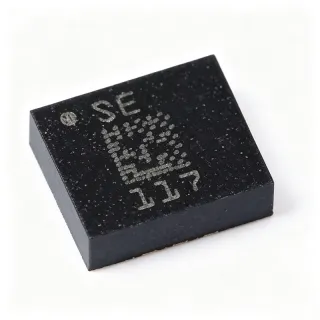
STM32MP151AAD3 - Cortex-A7 650MHz MPU | STMicroelectronics
MPN: STM32MP151AAD3 ✓ Active| Qty | Unit Price | Extended |
|---|---|---|
| 1 | $8.74 | $8.74 |
| 10 | $8.3 | $83.00 |
| 100 | $7.9 | $790.00 |
| 500 | $7.6 | $3,800.00 |
| 1,000 | $7.42 | $7,420.00 |
STM32MP151AAD3 Overview
An MPU (microprocessing unit) sits above the microcontroller (MCU) in the embedded-system hierarchy: while an MCU executes bare-metal or RTOS code on a single core, an MPU such as the STM32MP151 runs a full embedded Linux distribution on its Cortex-A7 application core while delegating hard real-time tasks to the companion Cortex-M4 core. This heterogeneous asymmetric-processing architecture lets a single chip replace an application processor plus a separate MCU, reducing BOM cost and board area in industrial and HMI designs.
Key features include the dual-core Arm architecture (Cortex-A7 at 650 MHz for Linux-class workloads plus Cortex-M4 at 209 MHz for deterministic real-time control), a rich peripheral set of 35 communication interfaces covering UART, SPI, I2C, CAN, Ethernet, and more, 25 timers for PWM, motor control, and timing-critical functions, and an integrated TFT display controller that can drive color GUI panels without an external display bridge. Per the official ST product page, STM32MP151 family members are offered with or without hardware crypto and secure boot; engineers must confirm the exact security configuration for this ordering code in the datasheet.
Technically, the device leverages ST's proven STM32 peripheral IP, so developers familiar with STM32 MCUs can reuse drivers and the Cortex-M4 firmware model while the Cortex-A7 side runs standard Linux. Typical applications include industrial HMI panels with TFT touchscreens, gateways and IoT edge nodes combining Linux connectivity with real-time control, and motor-drive or power-conversion systems requiring deterministic PWM from the M4 core.
A key design consideration is power-supply sequencing and the required external DDR memory: like most application-class MPUs, the STM32MP151 relies on external DDR3/LPDDR memory and a PMIC (such as the STPMIC1) for controlled rail sequencing. Budget board area and cost accordingly.
This page synthesizes distributor pricing from LCSC, DigiKey and Mouser, same-family drop-in alternatives, and practical design notes not found in the ST datasheet alone.
Drop-in alternatives for STM32MP151AAD3 — same package, pin-to-pin compatible. Different-package parts requiring PCB rework are excluded.
Variants in this series
Same-series models that are drop-in compatible with STM32MP151AAD3 (same form factor and footprint) — differing in RoHS Status, Series, Architecture, Core Processor, Display Controller.
Quick Comparison Tool — Select alternative parts for side-by-side comparison:
STM32MP157CAD3
✅ Drop-In📋 Reference alternative (not in catalog)
STM32MP151AAC3
✅ Drop-In✓ In Stock
$6.3 / Unit
View Datasheet →STM32MP151AAB3
✅ Drop-In📋 Reference alternative (not in catalog)
STM32MP133CAG3
✅ Drop-In📋 Reference alternative (not in catalog)
STM32MP151AAD3 Maximum Ratings & Electrical Characteristics
| Core | ARM Cortex-A7 (1 core) + ARM Cortex-M4 coprocessor |
| Core Size | 32-Bit |
| Cortex-A7 Maximum Frequency | 650 MHz |
| Cortex-M4 Frequency | 209 MHz |
| Series | STM32MP1 |
| Communication Interfaces | 35 interfaces |
| Timers | 25 |
| Display Controller | TFT display controller |
| Security | Family offered with or without HW crypto and secure boot (confirm for this ordering code) |
| Package | 257-TFBGA (10x10 mm) |
| Mounting Type | Surface Mount |
| RoHS Status | RoHS3 Compliant |
| Lead Free Status | Lead Free |
STM32MP151AAD3 257-tfbga (10x10 mm) Pin Configuration Guide
Pin configuration for STM32MP151AAD3 (257-tfbga (10x10 mm) package). This digital IC includes GPIO, communication interfaces (UART, SPI, I2C), and power pins. Refer to the manufacturer datasheet for alternate pin functions and configuration options. Essential for embedded system design and PCB layout.

No detailed pinout data available for STM32MP151AAD3.
Refer to the datasheet for full pin configuration.
Typical Applications
STM32MP151AAD3 is suitable for 6 applications: Industrial HMI Panels with TFT Touchscreen, Industrial IoT Gateways and Edge Nodes, Motor Control and Power Conversion, Smart Metering and Building Automation, Medical and Diagnostic Instrument Interfaces, Embedded Linux Development and Education.
Industrial HMI Panels with TFT Touchscreen
The STM32MP151AAD3 fits industrial human-machine-interface panels because its on-chip TFT display controller drives color touchscreens directly, while the 650 MHz Cortex-A7 runs an embedded Linux GUI framework (Qt or similar) with networking and file-system support. The Cortex-M4 coprocessor at 209 MHz simultaneously samples touch controllers, manages backlight PWM, and executes watchdog logic with deterministic timing that Linux cannot guarantee. Typical designs pair the TFT controller with 800x480 or 1024x600 panels and use the LTDC interface with external DDR memory for frame buffering. The trade-off versus an all-MCU design is a more complex power tree (external DDR and PMIC sequencing), but the payoff is a single-chip HMI with modern UI capability and long industrial lifecycle support from ST's STM32 roadmap.
Recommended
Industrial IoT Gateways and Edge Nodes
The STM32MP151AAD3 is well matched to edge-gateway designs where Linux-class connectivity (Ethernet, multiple UART/SPI/I2C buses - 35 interfaces in total) must coexist with hard real-time fieldbus handling. The Cortex-A7 core at 650 MHz runs OpenSTLinux with protocol stacks (MQTT, OPC UA, Modbus TCP), local data logging, and TLS encryption, while the Cortex-M4 at 209 MHz services CAN, RS-485, or proprietary industrial links with microsecond-level determinism. Because 25 timers are available, precise pulse capture and PWM generation coexist with Linux without latency spikes. Compared with a Linux SoM plus a separate MCU, this single 257-TFBGA device reduces BOM count, board area, and inter-processor interface complexity, using OpenAMP for communication between the two cores.
Recommended
Motor Control and Power Conversion
The STM32MP151AAD3 serves smart motor-drive and power-conversion systems where advanced control algorithms run on the Cortex-A7 (parameter tuning, fieldbus communication, condition monitoring) while the Cortex-M4 executes deterministic FOC loops using the family's advanced motor-control timers. With 25 timers available, complementary PWM outputs with dead-time insertion, brake inputs, and encoder interfaces are all handled by the M4 core at 209 MHz without Linux jitter. The 35 communication interfaces allow simultaneous CANopen, EtherCAT-adjacent, and diagnostic links. The key design consideration is that the MPU itself does not integrate gate drivers - pair it with a dedicated gate-driver IC and current-sensing front end, and allocate the external DDR bus layout carefully to keep switching-noise coupling away from memory routing.
Recommended
Smart Metering and Building Automation
The STM32MP151AAD3 suits smart energy meters, building controllers, and HVAC head units that need a Linux application layer plus certified real-time metering front-end control. The Cortex-A7 at 650 MHz handles DLMS/COSEM protocol stacks, web dashboards served over Ethernet, and remote firmware update infrastructure, while the Cortex-M4 coprocessor at 209 MHz continuously samples energy-front-end ADCs and drives the metrology state machine with deterministic timing. The TFT display controller can locally show consumption data on a small color panel. Designers should verify the security configuration of this ordering code, since ST offers STM32MP151 family members with or without hardware crypto and secure boot - a critical distinction for tamper-resistant metering platforms.
Recommended
Medical and Diagnostic Instrument Interfaces
The STM32MP151AAD3 fits benchtop and portable medical instruments that require a Linux-based user interface, data logging, and connectivity alongside hard real-time signal acquisition. The Cortex-A7 core at 650 MHz runs the GUI, USB mass-storage export, and network reporting, while the Cortex-M4 core at 209 MHz manages sensor front ends, ADC triggering, and safety interlocks with deterministic latency. The TFT display controller directly drives the instrument's color screen, and 35 communication interfaces connect to printers, barcode scanners, and laboratory peripherals. Longevity matters in medical equipment: ST's industrial-grade STM32 roadmap provides long-term supply, and the 10x10 mm TFBGA supports compact designs. Verify temperature-grade and security options for this ordering code against the product's regulatory requirements.
Recommended
Embedded Linux Development and Education
The STM32MP151AAD3 is an excellent vehicle for learning heterogeneous embedded Linux development because ST provides a complete, free ecosystem: OpenSTLinux (Yocto-based), STM32CubeIDE for the Cortex-M4 side, STM32CubeMX for peripheral configuration, and the OpenAMP framework for inter-core communication. The 650 MHz Cortex-A7 is fast enough for a responsive root filesystem on eMMC or SD, while the 209 MHz Cortex-M4 demonstrates real-time firmware patterns familiar to STM32 MCU users. Because 35 communication interfaces and 25 timers are exposed, students can prototype almost any peripheral combination. Compared with generic ARM SoM boards, the shared STM32 peripheral IP means drivers and HAL knowledge transfer directly from STM32 MCU experience, shortening the learning curve significantly.
Recommended
Recommended Products Summary
Engineering reference data for STM32MP151AAD3 — comparison, design guidance, and compliance information.
Selection Guide
Comparison with Alternatives
| Parameter | This Product | STM32MP157CAD3 | STM32MP151AAC3 | STM32MP151AAB3 | STM32MP133CAG3 |
|---|---|---|---|---|---|
| Package | 257-TFBGA (10x10 mm) | 257-TFBGA (10x10 mm) - same footprint | 257-TFBGA (10x10 mm) - same footprint | 257-TFBGA (10x10 mm) - same footprint | 257-TFBGA (10x10 mm) - same footprint |
| Brand | STMicroelectronics | STMicroelectronics | STMicroelectronics | STMicroelectronics | STMicroelectronics |
| CPU Core | 1x Arm Cortex-A7 + Cortex-M4 | 1x Arm Cortex-A7 + Cortex-M4 + GPU | 1x Arm Cortex-A7 + Cortex-M4 | 1x Arm Cortex-A7 + Cortex-M4 | 1x Arm Cortex-A7 + Cortex-M4 |
| Cortex-A7 Max Frequency | 650 MHz | 650 MHz | 650 MHz | 650 MHz | 650 MHz |
| Cortex-M4 Coprocessor | 209 MHz | 209 MHz | 209 MHz | 209 MHz | 209 MHz |
| GPU (3D Graphics) | No | Yes | No | No | No |
Key Differentiators
- Pure MPU focus without GPU cost overhead (vs STM32MP157CAD3)
- Largest internal memory option within same footprint (vs STM32MP151AAB3)
- Full interface richness vs cost-reduced sibling (vs STM32MP133CAG3)
Design Notes
The STM32MP151AAD3 requires multiple sequenced supply rails for the Cortex-A7 core, DDR memory, and I/O banks. ST's reference designs pair the MPU with the STPMIC1 power-management IC, which provides the required power-up and power-down sequencing controlled over I2C. Estimated: a typical Linux-running configuration at 650 MHz draws on the order of hundreds of milliwatts (confirm exact figures in the datasheet power-consumption tables for your operating points). Do not power the DDR rails independently of the core rails - incorrect sequencing is the most common cause of non-boot prototypes.
The 257-TFBGA (10x10 mm, 0.8 mm ball pitch class) requires at least 4 PCB layers with dedicated power and ground planes. Route the external DDR memory bus with length-matched, daisy-chained or fly-by topology per ST's layout application notes, keeping DDR traces on inner layers referenced to a solid ground plane. Decouple each VDD/VDDQ ball with 100 nF ceramics placed within 1-2 mm of the via fanout. Use the ST reference design (STM32MP15x-EV1 schematics) as the baseline for ballout fanout and DDR routing to avoid first-spin layout errors.
The STM32MP151 family is offered with or without hardware crypto and secure boot depending on the ordering code - do not assume security features exist on STM32MP151AAD3 without checking the datasheet ordering table. Another frequent pitfall is treating this part like an MCU: it has no internal memory sufficient for Linux and must boot from external media (eMMC/SD/NAND/NOR). Plan the boot chain (ROM -> FSBL in internal RAM -> bootloader -> kernel) and reserve boot pins accordingly. Also verify the Cortex-A7 operating frequency point (650 MHz here vs up to 800 MHz for some family members) against your thermal and power budget.
Compliance Information
Listed as ROHS3 Compliant and Lead Free per ics-100.com distributor data. REACH, halogen-free, and conflict-minerals declarations should be obtained from official ST material declaration documents.