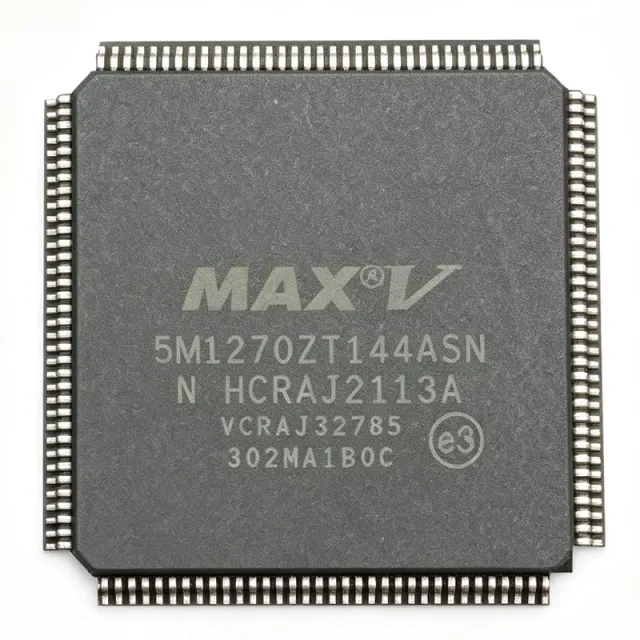
5M1270ZT144A5N - 980-Macro Cell MAX V CPLD, TQFP-144 | Intel
부품 번호: 5M1270ZT144A5N ✓ 활성| 수량 | 단가 | 합계 |
|---|---|---|
| 1 | $38.5 | $38.50 |
| 10 | $34.2 | $342.00 |
| 100 | $28.75 | $2,875.00 |
| 250 | $25.1 | $6,275.00 |
| 500 | $22.4 | $11,200.00 |
| 1,000 | $19.85 | $19,850.00 |
5M1270ZT144A5N 개요
A CPLD (Complex Programmable Logic Device) is a non-volatile programmable logic device that combines the instant-on behavior of a small PAL/GAL array with the logic density of an FPGA, typically used for glue logic, bus interfacing, power-up sequencing, and state-machine control. The MAX V family sits between discrete logic and high-density FPGAs in the programmable logic taxonomy: CPLD -> programmable logic -> logic IC -> integrated circuit -> semiconductor. Each macro cell includes a programmable AND/OR array plus a flip-flop, which the Quartus II / Quartus Prime toolset synthesizes from VHDL or Verilog.
Key features include 980 macro cells (equivalent to ~2120 logic elements), 8 Kbits of user flash memory, a MultiVolt I/O interface, an on-chip oscillator, and IEEE 1149.1 JTAG boundary-scan support. The 5N speed grade combined with the 144-pin TQFP package targets designs that need medium-density logic, abundant I/O, and hand-solderable or socketed assembly rather than fine-pitch BGA mounting. Internal pull-up resistors and bus-hold circuitry simplify board design by eliminating external termination on many signal lines.
The architecture is based on a non-volatile flash look-up table with CMOS process technology, providing instant-on capability and removing the need for an external boot PROM. The device supports in-system programmability via JTAG and is compatible with the Quartus II design software, which enables integration with both legacy schematic entry and modern HDL-based flows. AEC-Q100 qualification supports automotive deployments where the broader MAX V family is used.
Typical applications include I/O expansion and bus bridging for microcontrollers and SoCs, power-up and power-down sequencing for multi-rail systems, glue logic replacement for discrete 74-series gates, LED display driving, and protocol conversion (for example, SPI to parallel or UART to SPI). The TQFP-144 footprint also makes it suitable for educational platforms and rapid-prototyping boards where a socketed part is preferred over a BGA.
When designing with this part, place 0.1 uF and 10 uF decoupling capacitors close to every VCCINT and VCCIO pin, and observe the multi-voltage I/O bank rules so that 5 V-tolerant inputs do not exceed absolute maximum ratings. Designers migrating from legacy MAX 7000 or MAX II parts should note that MAX V delivers up to 2x higher logic density per macro cell and adds user flash, but uses the same JTAG programming chain and pinout philosophy for backward-compatible boards.
This page synthesizes verified distributor inventory, drop-in same-package alternatives drawn from the MAX V family, and practical design notes that go beyond the manufacturer datasheet table. Pricing is shown as of 2026-10-06 from DigiKey, Mouser, and Octopart.
드롭인 대체품: 5M1270ZT144A5N — 동일 패키지, 핀 호환. PCB 재작업이 필요한 다른 패키지 부품은 제외됩니다.
이 시리즈의 변형
다음과 드롭인 호환되는 동일 시리즈 모델: 5M1270ZT144A5N (동일 폼 팩터 및 풋프린트) — 차이점: Operating Temperature, Package, Programming Interface, Configuration Memory, Logic Array Blocks (LABs).
빠른 비교 도구 — 나란히 비교할 대체 부품을 선택하십시오:
5M1270ZT144C5N
✅ 드롭인✓ 재고 있음
$12.45 / 개
데이터시트 보기 →5M1270ZT144I5N
✅ 드롭인✓ 재고 있음
$17.9 / 개
데이터시트 보기 →5M2210ZT144A5N
✅ 드롭인 ⚠️ 사양 미검증📋 참조 대체품 (카탈로그에 없음)
5M1270ZF256A5N
✅ 드롭인✓ 재고 있음
$24.1 / 개
데이터시트 보기 →5M1270ZT144A5N 최대 정격 & 전기적 특성
| Family | MAX V |
| Device Type | CPLD (Complex Programmable Logic Device) |
| Macro Cells | 980 |
| User I/Os | 114 |
| Logic Elements | 2120 (approx.) |
| User Flash Memory | 8 Kbits |
| Maximum Operating Frequency | 201.1 MHz |
| Speed Grade | 5N |
| Core Supply Voltage | 1.8 V |
| I/O Bank Voltage Support | 1.8 V / 2.5 V / 3.3 V / 5.0 V (MultiVolt) |
| 패키지 | TQFP-144 (T144) |
| 실장 유형 | Surface Mount |
| Process Technology | Non-volatile flash CMOS |
| Programming Interface | JTAG (IEEE 1149.1) |
| Design Software | Quartus II / Quartus Prime |
| 동작 온도 | -40C to +125C (automotive) |
| Automotive Qualification | AEC-Q100 |
| RoHS 상태 | Compliant |
| Internal Features | Pull-up resistors, bus-hold, on-chip oscillator |
5M1270ZT144A5N tqfp-144 (t144) 핀 구성 가이드
5M1270ZT144A5N(tqfp-144 (t144) 패키지)의 핀 구성입니다. 이 디지털 IC에는 GPIO, 통신 인터페이스(UART, SPI, I2C), 전원 핀이 포함되어 있습니다. 대체 핀 기능과 구성 옵션은 제조사 데이터시트를 참조하십시오. 임베디드 시스템 설계와 PCB 레이아웃에 필수적입니다.

다음에 대한 상세 핀아웃 데이터 없음: 5M1270ZT144A5N.
다음을 참조하십시오: 데이터시트 전체 핀 구성은 다음을 참조하십시오.
일반적인 애플리케이션
5M1270ZT144A5N 적합 용도: 6 애플리케이션s: Automotive Body Electronics and Gateway Modules, Microcontroller and SoC I/O Expansion, Power-Up and Power-Down Sequencing, Glue Logic Replacement for 74-Series Gates, Protocol Conversion and Bus Bridging, Industrial Control and Test Instrumentation.
Automotive Body Electronics and Gateway Modules
The 5M1270ZT144A5N's AEC-Q100 qualification and -40C to +125C operating range make it well suited for automotive body control modules and CAN/LIN gateway designs. With 980 macro cells and 114 user I/Os in the TQFP-144 footprint, it can host CAN/LIN message routing, lighting and seat-control glue logic, and wake-up sequencing without needing an external boot PROM. Its 8 Kbits of user flash store diagnostic counters and calibration tables that survive key-off battery disconnects, and JTAG in-system programmability supports late-stage firmware updates on the assembly line.
추천
Microcontroller and SoC I/O Expansion
Designers using small microcontrollers or SoCs that lack enough pins use the 5M1270ZT144A5N as an I/O expander and bus translator. The MAX V's MultiVolt I/O banks interface directly to 1.8 V, 3.3 V, and 5.0 V peripherals without level shifters, while 980 macro cells are enough to implement PWM generators, quadrature decoders, or display multiplexers. The non-volatile flash boot eliminates external boot memory and the JTAG chain allows the SoC firmware team to update CPLD logic alongside the MCU image.
추천
Power-Up and Power-Down Sequencing
Power-sequencing for multi-rail systems is a textbook use case for the 5M1270ZT144A5N. The CPLD's deterministic instant-on boot lets it assert enable signals in a precise order across DC-DC converters, ASICs, and FPGAs, avoiding latch-up and in-rush faults. The 980 macro cells comfortably handle 8 to 16 sequenced rails with margin for fault monitoring and watchdog logic, and the 114 user I/Os provide plenty of dedicated enable, power-good, and fault lines. JTAG lets engineers iterate the sequencing chain in-circuit without rework.
추천
Glue Logic Replacement for 74-Series Gates
Boards originally built with dozens of 74HC/74LVC discrete gates can be consolidated onto a single 5M1270ZT144A5N, reducing board area and BOM cost. Each macro cell replaces several discrete gates, and Quartus Prime synthesis maps legacy schematic-capture designs directly onto MAX V. The TQFP-144 footprint is hand-solderable and socketable, simplifying rework and field replacement. Designers retain JTAG visibility into internal logic nodes for debug, which is impossible with discrete gates.
추천
Protocol Conversion and Bus Bridging
The 5M1270ZT144A5N commonly bridges between legacy and modern buses such as SPI to parallel, UART to SPI, or I2C to GPIO. The MultiVolt I/O banks handle mixed-voltage buses without external translators, and 980 macro cells are sufficient for full-duplex state machines plus FIFO buffers. JTAG-based in-system programmability means firmware engineers can fix bridging bugs in the field without board respins, which is especially valuable for industrial and medical equipment.
추천
Industrial Control and Test Instrumentation
Industrial PLCs, motor controllers, and test instruments benefit from the 5M1270ZT144A5N's deterministic boot, 114 user I/Os, and wide -40C to +125C operating range. The CPLD drives front-panel LEDs and seven-segment displays, decoders quadrature encoders, and handles emergency-stop logic with deterministic latency. The TQFP-144 package is socketable for ruggedized or repairable industrial assemblies, and 8 Kbits of user flash stores calibration data and serial numbers.
추천
추천 제품 요약
엔지니어링 참조 데이터: 5M1270ZT144A5N — 비교, 설계 지침 및 규정 준수 정보.
선택 가이드
대체품과의 비교
| 파라미터 | 이 제품 | 5M1270ZT144C5N | 5M1270ZT144I5N | 5M2210ZT144A5N | 5M1270ZF256A5N |
|---|---|---|---|---|---|
| Package | TQFP-144 | TQFP-144 - same | TQFP-144 - same | TQFP-144 - same | FBGA-256 - different |
| Brand | Intel (formerly Altera) | Intel - same | Intel - same | Intel - same | Intel - same |
| Macro Cells | 980 | 980 | 980 | 2210 | 980 |
| User I/Os | 114 | 114 | 114 | 114 | 212 |
| Maximum Frequency | 201.1 MHz | 201.1 MHz | 201.1 MHz | 201.1 MHz | 201.1 MHz |
| Temperature Grade | -40C to +125C (AEC-Q100) | 0C to +85C | -40C to +85C | -40C to +125C (AEC-Q100) | -40C to +125C (AEC-Q100) |
| Core Voltage | 1.8 V | 1.8 V | 1.8 V | 1.8 V | 1.8 V |
| Programming Interface | JTAG (IEEE 1149.1) | JTAG - same | JTAG - same | JTAG - same | JTAG - same |
주요 차별점
- AEC-Q100 automotive qualification with extended temperature range (vs 5M1270ZT144C5N)
- Higher logic density than the C-grade sibling for the same footprint (vs 5M1270ZT144C5N)
- TQFP-144 footprint allows hand-soldering and socketed assembly (vs 5M1270ZF256A5N (FBGA-256))
설계 노트
Place a 0.1 uF decoupling capacitor within 5 mm of every VCCINT and VCCIO pin, and bulk 10 uF ceramic capacitors near each supply rail. The MAX V CPLD has separate core (1.8 V) and I/O bank supplies; tying all VCCIO banks to the same rail is allowed but mixing 1.8 V, 3.3 V, and 5.0 V across banks enables direct multi-voltage interfacing. Estimate inrush at ~50 mA per bank at power-up, so the upstream regulator must supply that transient without sagging.
The TQFP-144 has a 0.5 mm pitch and exposed thermal pad (EP) on most MAX V packages; flood the EP with a continuous ground copper pour and stitch it with 0.3 mm thermal vias on a 1.2 mm grid. Route all JTAG signals (TCK, TMS, TDI, TDO) as a daisy chain with 4.7 kohm pull-ups on TCK/TMS/TDI to prevent floating during programming. Keep JTAG traces short (under 100 mm) and away from switching power nodes to avoid programming errors.
Do not apply 5 V to MAX V I/O pins when VCCIO is set to 1.8 V - although the inputs are 5 V-tolerant relative to VCCIO bank voltage, absolute maximum ratings are violated if the bank itself is below the input. Also avoid driving JTAG lines while VCCINT is ramping; the recommended power-on sequence is VCCINT first, then VCCIO, to prevent latch-up. Designers migrating from MAX 7000 must update their .pof files since MAX V uses the newer JIC format for JTAG programming.
Although the 5M1270ZT144A5N is a slow CMOS device (sub-200 MHz), the TQFP-144 lead inductance (~2 nH per pin) can still cause ringing on fast edges. Add 22-33 ohm series resistors on clock inputs and high-speed outputs when driving traces longer than 50 mm. Internal pull-ups are weak (~25 kohm); for bus-hold or strong pull-up requirements, add external 10 kohm resistors.
규정 준수 정보
AEC-Q100 qualified per the Z suffix in the part number; RoHS and lead-free per Intel MAX V product family datasheet. Halogen-free and conflict-minerals compliance stated on Intel/Altera material declaration.





