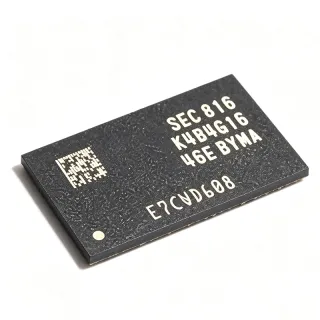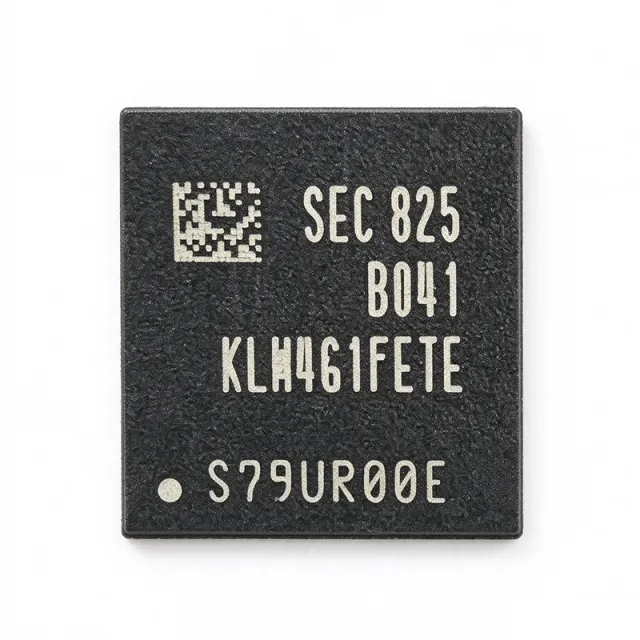
KLM4G1FETE-B041 - 4GB eMMC 5.1 FBGA-153 | Samsung | Embedded Storage
부품 번호: KLM4G1FETE-B041 ✓ 활성| 수량 | 단가 | 합계 |
|---|---|---|
| 1 | $11.25 | $11.25 |
| 10 | $8.125 | $81.25 |
| 100 | $7.1875 | $718.75 |
| 500 | $6.875 | $3,437.50 |
| 1,000 | $6.5625 | $6,562.50 |
KLM4G1FETE-B041 개요
An eMMC (embedded MultiMediaCard) is a managed NAND flash memory standard defined by JEDEC that pairs raw NAND flash with an integrated memory controller. In the storage hierarchy it sits above raw NAND and below SSDs, exposing a simple MMC protocol (v5.1 here) instead of requiring the host processor to manage erase, wear-leveling, and error correction. This makes eMMC the standard embedded storage choice for cost- and space-sensitive systems.
Key features of the KLM4G1FETE-B041 include the eMMC 5.1 feature set with HS400 mode, Enhanced Strobe support, and a 32 Gbit (4 GByte) NAND density organized 32 x 8. The device requires 3V supply for the NAND core area (VDDF/VCC) and supports 1.8V or 3V for the interface supply (VDD/VCCQ), simplifying integration with both legacy and low-voltage SoCs.
Architecturally, the internal controller manages flash translation, bad-block management, ECC, and wear leveling transparently to the host. The JEDEC-standardized ballout and register set mean bootloaders and drivers written for eMMC 5.1 operate without device-specific code, while Extended CSD registers expose configuration for caching, partitioning, and boot partitions.
Typical applications include IoT gateways and smart-home hubs, industrial HMI and data loggers, and Android-based embedded boards such as ARM SoM designs, where 4 GB is sufficient for OS images and application storage.
Design consideration: keep VCCQ at 1.8V for HS400 operation and follow the datasheet power-ramp sequence; verify your bootloader accepts the Extended CSD register settings of replacement parts when second-sourcing.
This page synthesizes distributor pricing, drop-in alternatives, and practical design notes not found in the manufacturer datasheet.
드롭인 대체품: KLM4G1FETE-B041 — 동일 패키지, 핀 호환. PCB 재작업이 필요한 다른 패키지 부품은 제외됩니다.
이 시리즈의 변형
다음과 드롭인 호환되는 동일 시리즈 모델: KLM4G1FETE-B041 (동일 폼 팩터 및 풋프린트) — 차이점: Interface Standard, Max Interface Mode, Mounting Type, Package.
빠른 비교 도구 — 나란히 비교할 대체 부품을 선택하십시오:
KLM8G1GETF-B041
✓ 재고 있음
$22.02 / 개
데이터시트 보기 →KLM8G1FET
📋 참조 대체품 (카탈로그에 없음)
KLMAG1JETD
📋 참조 대체품 (카탈로그에 없음)
ASFC4G31M-51BIN
📋 참조 대체품 (카탈로그에 없음)
MTFC4GACAE
📋 참조 대체품 (카탈로그에 없음)
KLM4G1FETE-B041 최대 정격 & 전기적 특성
| 메모리 유형 | eMMC (embedded MultiMediaCard) |
| Interface Standard | eMMC 5.1 (MMC protocol v5.1) |
| Density | 4 GByte (32 Gbit NAND) |
| Memory Organization | 32 x 8 |
| Memory Technology | NAND Flash |
| Max Interface Mode | HS400 |
| VCC (VDDF) Supply Voltage | 3 V (NAND area) |
| VCCQ (VDD) Supply Voltage | 1.8 V or 3 V dual supply |
| 패키지 | FBGA-153 |
| 실장 유형 | Surface Mount (BGA) |
| Enhanced Strobe | Supported (eMMC 5.1) |
| Controller | Integrated MMC controller with flash management |
| Width (Data Bus) | 8-bit |
| Manufacturer | Samsung Semiconductor, Inc. |
KLM4G1FETE-B041 fbga-153 핀 구성 가이드
KLM4G1FETE-B041(fbga-153 패키지)의 핀 구성입니다. 이 디지털 IC에는 GPIO, 통신 인터페이스(UART, SPI, I2C), 전원 핀이 포함되어 있습니다. 대체 핀 기능과 구성 옵션은 제조사 데이터시트를 참조하십시오. 임베디드 시스템 설계와 PCB 레이아웃에 필수적입니다.

다음에 대한 상세 핀아웃 데이터 없음: KLM4G1FETE-B041.
다음을 참조하십시오: 데이터시트 전체 핀 구성은 다음을 참조하십시오.
일반적인 애플리케이션
KLM4G1FETE-B041 적합 용도: 6 애플리케이션s: IoT Gateways and Smart Home Hubs, Industrial HMI and Data Loggers, Android / ARM Embedded Boards and SoMs, Networking Equipment Firmware Storage, Automotive Infotainment and Telematics (Non-Safety), Medical and Diagnostic Peripheral Devices.
IoT Gateways and Smart Home Hubs
IoT gateways and smart-home hubs need non-volatile storage for the OS image, middleware, and local data buffering, and the KLM4G1FETE-B041 fits this role precisely: its 4 GB capacity comfortably hosts a trimmed Linux build while its eMMC 5.1 HS400 interface (up to 400 MB/s bus class) keeps boot times short. The integrated Samsung controller handles wear leveling and ECC internally, so the host SoC only issues standard MMC v5.1 commands. Because the 153-ball FBGA is soldered, it tolerates vibration and tampering better than SD media. Power designers should hold VCCQ at 1.8V for low-power HS400 operation and use 10 uF bulk decoupling on both rails.
추천
Industrial HMI and Data Loggers
Industrial human-machine interface panels and data loggers demand storage that survives vibration, wide temperature exposure, and years of continuous small-block writes. The KLM4G1FETE-B041 addresses these needs with a soldered 153-ball FBGA package, an internal controller performing wear leveling and bad-block management, and a JEDEC-standard eMMC 5.1 interface that mainstream SoCs boot directly. Its 4 GB density is typically ample for an HMI firmware image plus rotating log files; the dual 1.8V/3V VCCQ support lets it integrate into both legacy 3V and modern low-voltage control boards. For extreme endurance requirements, validate write endurance against your logging duty cycle and consider partition-level Enhanced CSD configuration.
추천
Android / ARM Embedded Boards and SoMs
ARM system-on-modules and Android single-board computers standardize on eMMC for rootfs storage, and the KLM4G1FETE-B041 is a mainstream 4 GB choice: Android 9-13 images fit within 4 GB, and the eMMC 5.1 HS400 mode minimizes app-launch and boot latency on the 8-bit bus. Boot ROMs on common SoCs (i.MX, Rockchip, Allwinner) boot directly from eMMC boot partitions managed by the Samsung internal controller, removing external boot-flash cost. Because pin-compatible Samsung family parts scale from 4 GB to 16 GB on the same PCB pad, one carrier-board design serves multiple storage SKUs. Designers should reserve VCCQ rail sequencing per the Samsung datasheet power-ramp requirements.
추천
Networking Equipment Firmware Storage
Routers, switches, and wireless access points store firmware and configuration in onboard flash, and the KLM4G1FETE-B041 provides a managed, boot-capable solution: its eMMC boot partitions hold the bootloader, while the 4 GB main area stores dual firmware images for fail-safe OTA updates. HS400 mode shortens firmware load and config-reload times versus SPI NOR. The integrated Samsung controller abstracts NAND management from the network SoC, and the JEDEC eMMC 5.1 interface is supported natively by mainstream embedded Linux SDKs. Use 1.8V VCCQ for interface compatibility with modern SoCs, and validate Extended CSD register behavior if second-sourcing to Alliance or Micron equivalents.
추천
Automotive Infotainment and Telematics (Non-Safety)
In-vehicle head units, telematics boxes, and cluster accessories use eMMC for map data, media, and firmware in non-safety-critical partitions. The KLM4G1FETE-B041's soldered FBGA package resists vibration far better than card media, and its integrated controller keeps flash management invisible to the infotainment SoC. The 4 GB density suits map caches and application stores in entry-tier units, while the pin-compatible Samsung family allows a 16 GB (KLMAG1JETD) upscale on the identical footprint for premium SKUs. Automotive deployments must confirm the temperature grade in the current Samsung datasheet and consider AEC-qualified eMMC variants where the safety plan requires them.
추천
Medical and Diagnostic Peripheral Devices
Connected medical peripherals such as patient monitors, portable diagnostic analyzers, and infusion controllers require dependable local storage for calibration tables, patient session logs, and firmware. The KLM4G1FETE-B041 provides this with a managed eMMC 5.1 design: Samsung's internal controller performs ECC and wear leveling, so log-write cycles do not require host-side flash knowledge. The soldered 153-ball FBGA eliminates connector contact failures that plague removable cards in clinical environments, and 4 GB is generally sufficient for application firmware plus weeks of session records. Validate the operating temperature range and apply conservative derating in designs near thermal limits, and follow the datasheet power-ramp sequence for deterministic boot.
추천
추천 제품 요약
엔지니어링 참조 데이터: KLM4G1FETE-B041 — 비교, 설계 지침 및 규정 준수 정보.
선택 가이드
대체품과의 비교
| 파라미터 | 이 제품 | KLM8G1GETF-B041 | KLM8G1FET | KLMAG1JETD | ASFC4G31M-51BIN | MTFC4GACAE |
|---|---|---|---|---|---|---|
| Package | FBGA-153 | FBGA-153 - same | FBGA-153 - same | FBGA-153 - same | FBGA-153 - same | FBGA-153 - same |
| Brand | Samsung Electronics | Samsung Electronics | Samsung Electronics | Samsung Electronics | Alliance Memory | Micron Technology |
| Density | 4 GB | 8 GB | 8 GB | 16 GB | 4 GB | 4 GB |
| Interface | eMMC 5.1, HS400 | eMMC 5.1, HS400 | eMMC 5.x | eMMC 5.1 | eMMC 5.1 | eMMC 5.x |
| Pin Compatibility | Samsung eMMC family reference | Drop-in, same pad | Pin-to-pin (family) | Pin-to-pin (family) | Drop-in per Alliance comparison doc | JEDEC 153-ball footprint match |
| Second-Source Risk | n/a (reference) | None (same brand) | None (same brand) | None (same brand) | Verify Extended CSD registers | Verify Extended CSD + boot behavior |
| Typical Use | 4 GB embedded storage | Capacity upgrade | 8 GB SKU scaling | 16 GB premium SKU | Identical 4 GB second source | 4 GB cross-brand second source |
주요 차별점
- Native 4 GB density at lowest system cost (vs KLM8G1GETF-B041)
- Guaranteed same-brand footprint family (vs MTFC4GACAE)
- Full eMMC 5.1 / HS400 feature set (vs KLM8G1FET)
설계 노트
Design the power tree for two rails: 3V on VCC (VDDF, NAND core area) and 1.8V or 3V on VCCQ (VDD, interface). For HS400 operation use 1.8V VCCQ. Follow the Samsung datasheet power-ramp sequence - VCC and VCCQ must ramp within the specified order and timing windows or the internal controller may fail to initialize. Place 10 uF bulk plus 0.1 uF high-frequency decoupling capacitors directly at each supply ball group.
FBGA-153 requires a mechanically reliable land pattern per the Samsung package drawing; use solder-mask-defined or non-solder-mask-defined pads consistently and inspect with X-ray on first articles. Route the 8-bit DAT[7:0], CMD, and CLK as a length-matched group; for HS400 keep CLK-to-DAT skews tight and reference the CLKDS strobe. Reserve a solder mask dam under the BGA for rework access.
Bootloader sensitivity is the most common second-sourcing failure: even pin-compatible eMMC parts may expose different Extended CSD register settings, causing a 'picky' bootloader to reject the device, as noted in eMMC cross-reference guides. Always re-validate boot, partition configuration, and Enhanced Strobe settings when swapping Samsung for Alliance Memory (ASFC4G31M-51BIN) or Micron (MTFC4GACAE) equivalents. Keep the datasheet power-sequence requirements in your test plan.
규정 준수 정보
Compliance status not stated in the provided web data; Samsung consumer eMMC parts are typically RoHS compliant - verify on the official Samsung product page before claiming compliance.