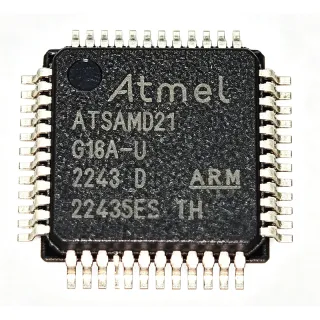
27C256T-15/SO - 256K 32Kx8 CMOS EPROM 150ns | Microchip Technology
MPN: 27C256T-15/SO ✗ End of Life| Qty | Unit Price | Extended |
|---|---|---|
| 1 | $2.95 | $2.95 |
| 10 | $2.65 | $26.50 |
| 100 | $2.35 | $235.00 |
| 500 | $2.1 | $1,050.00 |
| 1,000 | $1.9 | $1,900.00 |
Drop-in alternatives for 27C256T-15/SO — same package, pin-to-pin compatible. Different-package parts requiring PCB rework are excluded.
Quick Comparison Tool — Select alternative parts for side-by-side comparison:
27C256-15/SO
✅ Drop-In📋 Reference alternative (not in catalog)
27C256T-15E/SO
✅ Drop-In📋 Reference alternative (not in catalog)
27C256T-15I/SO
✅ Drop-In📋 Reference alternative (not in catalog)
W27E257-15
✅ Drop-In📋 Reference alternative (not in catalog)
AT27C256
✅ Drop-In📋 Reference alternative (not in catalog)
27C256T-15/SO Maximum Ratings & Electrical Characteristics
| Memory Type | CMOS EPROM (non-volatile) |
| Memory Organization | 32K x 8 (256 Kbit) |
| Total Density | 262,144 bits |
| Maximum Access Time | 150 ns |
| Supply Voltage (VCC) | 4.5 V to 5.5 V |
| Interface | Parallel, asynchronous |
| Output Type | 3-state outputs |
| Active Current | 20 mA |
| Standby Current | 100 uA |
| Technology | CMOS |
| Operation Mode | Asynchronous |
| Auto ID | Yes (automated programming identification) |
| Package | 28-lead SOIC (SO), surface mount |
| Mounting Type | Surface Mount |
27C256T-15/SO Pin Configuration
| Pin 1 | VPP — Programming supply voltage |
| Pin 2 | A12 — Address input 12 (MSB) |
| Pin 3 | A7 — Address input 7 |
| Pin 4 | A6 — Address input 6 |
| Pin 5 | A5 — Address input 5 |
| Pin 6 | A4 — Address input 4 |
| Pin 7 | A3 — Address input 3 |
| Pin 8 | A2 — Address input 2 |
| Pin 9 | A1 — Address input 1 |
| Pin 10 | A0 — Address input 0 (LSB) |
| Pin 11 | O0 — Data output 0 (LSB) |
| Pin 12 | O1 — Data output 1 |
| Pin 13 | O2 — Data output 2 |
| Pin 14 | GND — Ground |
| Pin 15 | O3 — Data output 3 |
| Pin 16 | O4 — Data output 4 |
| Pin 17 | O5 — Data output 5 |
| Pin 18 | O6 — Data output 6 |
| Pin 19 | O7 — Data output 7 (MSB) |
| Pin 20 | /CE — Chip enable (active low) |
| Pin 21 | A10 — Address input 10 |
| Pin 22 | /OE — Output enable (active low) |
| Pin 23 | A11 — Address input 11 |
| Pin 24 | A9 — Address input 9 |
| Pin 25 | A8 — Address input 8 |
| Pin 26 | A13 — Address input 13 |
| Pin 27 | PGM — Program enable (active low) |
| Pin 28 | VCC — Power supply, 4.5V to 5.5V |
Safe Operating Area (SOA) & Thermal Characteristics
No official SOA curve available for this digital IC. Always operate within absolute maximum ratings specified in the datasheet. Ensure adequate cooling and derate as needed.
Typical Applications
27C256T-15/SO is suitable for 6 applications: Legacy Industrial Controller Firmware, Automotive ECU ROM Replacement, Retro-Computing and Arcade Board Repair, Telecommunications Equipment Firmware, Test and Measurement Instrument ROM, Embedded Security and Fixed-Code Storage.
Legacy Industrial Controller Firmware
The 27C256T-15/SO stores boot firmware and fixed lookup tables in legacy PLC and industrial controllers that still use 27C256 sockets. Its 150 ns access time is compatible with 8-bit and 16-bit microprocessor buses from the 1980s and 1990s, and the 100 uA CMOS standby current suits equipment that must retain code through power cycles without a battery. Because the 28-lead SOIC footprint matches the original design, failing through-hole or socketed parts can be replaced with a surface-mount device on an adapter or a matching SOIC footprint. Content programmed in production cannot be altered in the field, which is an advantage where firmware integrity and tamper-resistance are required, but demands rigorous pre-programming verification.
Recommended
Automotive ECU ROM Replacement
Engine-control units of the 1990s era commonly used 27C256 EPROMs for fuel and ignition maps. The 27C256T-15/SO provides the same 32K x 8 organization and 150 ns access timing required by these ECUs, with 4.5V to 5.5V operation matching the automotive 5V regulator rail and 3-state outputs interfacing directly to the MCU bus. For repair and remapping work, choose the industrial (27C256T-15I/SO) or extended (27C256T-15E/SO) temperature grades when the underhood environment exceeds commercial limits. As a one-time-programmable device, each calibration revision requires a new part, so electrically erasable substitutes such as the W27E257-15 are popular during development, with the OTP EPROM used for the final production fit.
Recommended
Retro-Computing and Arcade Board Repair
Vintage PC, console, and arcade motherboards rely on 27C256 EPROMs for BIOS and game code, and replacement parts are the primary repair path as originals fail or are lost. The 27C256T-15/SO matches the original 150 ns speed grade, and the minuszerodegrees replacement guide confirms that 150 ns devices are suitable for IBM 5155/5160/5162/5170 motherboards, where access time acts as a maximum rating. The 28-lead SOIC package suits boards converted to surface mount or fitted with SOIC sockets. Programmers with Auto ID support automatically identify the device, simplifying batch programming of replacement ROMs for collectors and repair shops restoring large quantities of boards.
Recommended
Telecommunications Equipment Firmware
Older telecom line cards, modems, and PBX modules used 27C256 EPROMs for code storage, and field-service organizations still need replacements to keep installed bases running. The device's asynchronous parallel interface, 3-state outputs, and 20 mA active current fit directly into these 5V bus-based designs without glue-logic changes. The SOIC surface-mount package supports automated rework on modern assembly lines repairing surface-mount cards, and tape-and-reel packaging (the T suffix) supports pick-and-place placement during volume refurbishment. Because telecom deployments often run for decades, stocking a lifecycle-stable replacement such as this EOL-class EPROM or its pin-compatible industrial variant protects long-term serviceability of the installed base.
Recommended
Test and Measurement Instrument ROM
Older oscilloscopes, logic analyzers, and bench instruments from the 1990s store self-test and operating firmware in 27C256 EPROMs, and instrument repair often requires replacement parts with exact timing. The 27C256T-15/SO delivers the 150 ns maximum access time expected by these designs, and its 100 uA standby current keeps battery-backed memory subsystems within budget. In repair workflows, the instrument firmware image is recovered from a donor unit or archived dump, programmed into the EPROM with verification, and soldered or socketed in place of the failed device. Since the plastic SOIC cannot be erased, service centers typically program spares in batches and store them as serialized inventory for field swap-outs.
Recommended
Embedded Security and Fixed-Code Storage
Applications that must store fixed identifiers, encryption keys, or boot constants benefit from the inherently immutable nature of a programmed EPROM: unlike flash or EEPROM, a soldered-in 27C256T-15/SO cannot be electrically rewritten, providing a simple hardware-level tamper barrier without extra security circuitry. The 32K x 8 capacity holds code plus fixed tables comfortably, the 4.5V to 5.5V supply matches standard industrial 5V rails, and the 150 ns access time meets typical 8-bit MCU bus timing. Designers should treat program content as permanent - any revision means a new programmed device - and should protect pin 1 (VPP) and the /PGM line on the PCB so that in-system programming attempts are physically prevented.
Recommended
Recommended Products Summary
Engineering reference data for 27C256T-15/SO — comparison, design guidance, and compliance information.
Selection Guide
Comparison with Alternatives
| Parameter | This Product | 27C256-15/SO | 27C256T-15I/SO | W27E257-15 | AT27C256 |
|---|---|---|---|---|---|
| Package | 28-lead SOIC | 28-lead SOIC - same | 28-lead SOIC - same | 28-pin (SOIC/DIP) - same footprint | 28-pin (SOIC/DIP/PLCC) - SOIC same footprint |
| Brand | Microchip Technology (Fairchild legacy listing) | Microchip Technology | Microchip Technology | Winbond | Microchip Technology (Atmel) |
| Memory Organization | 32K x 8 (256 Kbit) | 32K x 8 | 32K x 8 | 32K x 8 | 32K x 8 |
| Maximum Access Time | 150 ns | 150 ns | 150 ns | 150 ns | Faster grades available (55-150 ns) |
| Supply Voltage | 4.5 V to 5.5 V | 4.5 V to 5.5 V | 4.5 V to 5.5 V | 4.5 V to 5.5 V | 4.5 V to 5.5 V |
| Erase Method | UV erase / OTP in plastic SOIC | UV erase / OTP in plastic SOIC | UV erase / OTP in plastic SOIC | Electrical erase (EEPROM) | OTP or windowed UV erase |
| Temperature Grade | Commercial (standard T grade) | Commercial | Industrial (-40C to +85C) | [DATA_NEEDED] | Commercial and industrial grades |
| Standby Current | 100 uA | 100 uA | 100 uA | [DATA_NEEDED] | [DATA_NEEDED] |
| Lifecycle Status | EOL (secondary market) | EOL (secondary market) | EOL (secondary market) | EOL (secondary market) | EOL (secondary market) |
Key Differentiators
- Surface-mount 28-lead SOIC packaging for legacy sockets (vs 27C256-15/SO)
- Standard commercial temperature grade at lowest cost (vs 27C256T-15I/SO)
- Immutable UV/OTP EPROM behavior versus electrically erasable substitutes (vs W27E257-15)
- Exact original speed grade match (vs AT27C256)
Design Notes
The 27C256T-15/SO in a plastic SOIC package is one-time programmable - there is no quartz window for UV erasure. Program and fully verify the firmware image in an external programmer (which can use Auto ID to identify the device) BEFORE assembly; a single bit error after reflow means scrapping the board or hot-air rework. Keep pin 1 (VPP) and pin 27 (PGM) routed to non-user-accessible points in security-sensitive designs so in-system programming is impossible.
Connect every VCC (pin 28) and GND (pin 14) with a 0.1 uF ceramic decoupling capacitor placed within a few millimeters of the package. Tie unused control lines properly: /CE (pin 20) and /OE (pin 22) must be actively driven or pulled up; leaving them floating can place outputs in undefined high-impedance states or increase active current beyond the 20 mA datasheet figure. Keep address lines short and equalized where bus timing approaches the 150 ns access budget.
The 150 ns maximum access time is a worst-case figure; the CPU address-to-data setup must satisfy t_ACC plus output-enable delays. When retrofitting this part into designs that originally used a faster grade, verify the timing margin: per the minuszerodegrees replacement guide, access time is a maximum rating, so a faster 27C256 always works where a 150 ns part was designed - but a 150 ns part in a faster socket is not guaranteed. If in doubt, qualify the faster 27C256 variants as second sources.
Compliance Information
This is a legacy EOL part; RoHS status is not clearly stated in verified distributor data (some broker listings reference RoHS stock). Obtain a certificate of conformance from the seller if compliance is mandatory.