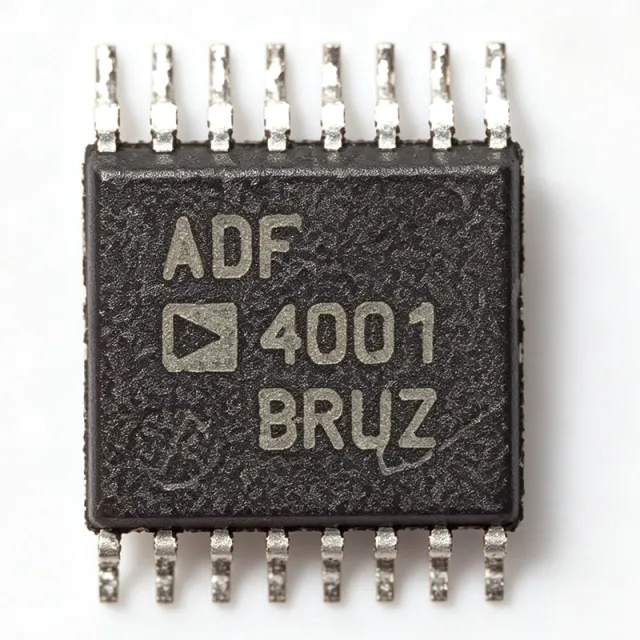
AD4001BRUZ - 16-Bit 2MSPS Differential SAR ADC | Analog Devices
MPN: AD4001BRUZ ✓ Active| Qty | Unit Price | Extended |
|---|---|---|
| 1 | $11.4545 | $11.45 |
| 10 | $8.2727 | $82.73 |
| 100 | $7.3182 | $731.82 |
| 500 | $7 | $3,500.00 |
| 1,000 | $6.6818 | $6,681.80 |
AD4001BRUZ Overview
An ADC (analog-to-digital converter) is an electronic component that converts continuous analog signals into discrete digital values. The AD4001BRUZ is a SAR ADC, which uses a binary search algorithm to determine the digital output. SAR ADCs are known for their high speed, low power, and excellent accuracy, making them ideal for applications such as industrial process control, medical instrumentation, and test and measurement equipment. The AD4001BRUZ is part of the precision ADC family, which includes other high-performance converters from Analog Devices.
Key features of the AD4001BRUZ include a 2 MSPS throughput, 16-bit resolution, and a differential input range that can be configured via the reference voltage. The device offers a high signal-to-noise ratio (SNR) and low power consumption, typically 15 mW at 2 MSPS. It also includes an input overvoltage clamp that protects the ADC inputs from overvoltage events, minimizing disturbances on the reference pin and eliminating the need for external protection diodes. The serial interface is SPI-compatible and supports daisy-chaining for multiple ADCs.
The AD4001BRUZ uses a precision capacitive DAC architecture with a track-and-hold circuit, ensuring accurate conversion of fast-changing signals. The device operates from a 1.8 V analog supply and a separate digital supply, allowing flexible interfacing with different logic levels. The reference input accepts a wide range of voltages, enabling the user to scale the input span to match the application requirements. The device also features a busy indicator and a conversion result readback that can be synchronized with an external clock.
Typical applications for the AD4001BRUZ include industrial automation, data acquisition systems, medical imaging, and portable instrumentation. Its high speed and precision make it suitable for applications that require accurate measurement of dynamic signals, such as vibration analysis and motor control. The small TSSOP package and low power consumption make it ideal for battery-powered devices.
When designing with the AD4001BRUZ, it is important to provide a clean, low-noise reference voltage and adequate decoupling on the power supply pins. The input signal should be driven by a low-impedance source, such as an operational amplifier, to ensure accurate conversion. The SPI interface should be configured for the correct clock polarity and phase to match the device's timing requirements.
Drop-in alternatives for AD4001BRUZ — same package, pin-to-pin compatible. Different-package parts requiring PCB rework are excluded.
Variants in this series
Same-series models that are drop-in compatible with AD4001BRUZ (same form factor and footprint) — differing in Interface, Resolution, Supply Voltage, Input Type, Package.
Quick Comparison Tool — Select alternative parts for side-by-side comparison:
AD7980BRMZ
✓ In Stock
$16.8636 / Unit
View Datasheet →AD7690BRMZ-RL7
✓ In Stock
$17.6 / Unit
View Datasheet →AD4001BRUZ-RL7
📋 Reference alternative (not in catalog)
AD4001BCPZ
📋 Reference alternative (not in catalog)
AD4001BRMZ
📋 Reference alternative (not in catalog)
AD4001BRUZ Maximum Ratings & Electrical Characteristics
| Resolution | 16-bit |
| Sampling Rate | 2 MSPS |
| Input Type | Differential |
| Supply Voltage | 1.8 V |
| Power Consumption | 15 mW at 2 MSPS |
| Interface | SPI-compatible |
| Package | 16-lead TSSOP |
| Input Overvoltage Clamp | Yes |
| Daisy-Chain Support | Yes |
| RoHS Status | Compliant |
AD4001BRUZ Pin Configuration
| Pin 1 | REF — Reference voltage input |
| Pin 2 | IN+ — Positive differential input |
| Pin 3 | IN- — Negative differential input |
| Pin 4 | GND — Ground |
| Pin 5 | VDD — Analog supply (1.8V) |
| Pin 6 | VIO — Digital interface supply |
| Pin 7 | SCK — Serial clock input |
| Pin 8 | SDI — Serial data input |
| Pin 9 | SDO — Serial data output |
| Pin 10 | CNV — Conversion start input |
| Pin 11 | BUSY — Busy indicator output |
| Pin 12 | GND — Ground |
Typical Applications
AD4001BRUZ is suitable for 6 applications: Industrial Automation, Medical Instrumentation, Data Acquisition Systems, Portable Instrumentation, Test and Measurement, Vibration Analysis.
Industrial Automation
The AD4001BRUZ's 16-bit resolution and 2 MSPS sampling rate enable precise measurement of dynamic signals in motor control and vibration analysis. Its differential input rejects common-mode noise, ensuring accurate data acquisition in noisy industrial environments. The SPI interface allows easy integration with microcontrollers, and the low power consumption supports distributed sensing nodes.
Recommended
Medical Instrumentation
In medical imaging and patient monitoring, the AD4001BRUZ provides high accuracy and low noise essential for diagnostic quality. Its 16-bit resolution captures fine details in biological signals, while the 2 MSPS throughput supports real-time processing. The small TSSOP package and low power consumption are ideal for portable devices. The input overvoltage clamp protects against patient-related transients.
Recommended
Data Acquisition Systems
The AD4001BRUZ is a core component in high-speed data acquisition systems, offering 2 MSPS sampling with 16-bit precision. Its SPI interface and daisy-chain capability simplify multi-channel designs, reducing wiring and component count. The differential input allows direct connection to sensors and transducers, while the low power consumption enables dense channel arrays. The device's accuracy ensures reliable data for analysis and control.
Recommended
Portable Instrumentation
For battery-powered test equipment and handheld analyzers, the AD4001BRUZ offers an optimal balance of speed, precision, and power efficiency. Its 15 mW power consumption at 2 MSPS extends battery life, while the 1.8 V supply simplifies power management. The small TSSOP package fits compact designs, and the SPI interface reduces pin count. The device's accuracy supports reliable field measurements.
Recommended
Test and Measurement
The AD4001BRUZ excels in test and measurement equipment requiring high-speed, high-resolution signal capture. Its 2 MSPS sampling rate captures transient events, while 16-bit resolution ensures measurement accuracy. The differential input and overvoltage clamp provide robustness in bench-top instruments. The SPI interface allows seamless integration with FPGAs and DSPs for real-time analysis.
Recommended
Vibration Analysis
The AD4001BRUZ is well-suited for vibration monitoring systems, where high-speed sampling and precision are critical. Its 2 MSPS rate captures high-frequency vibration components, and 16-bit resolution provides fine amplitude resolution. The differential input rejects common-mode interference from motors and machinery. The device's low power consumption allows deployment in remote sensors.
Recommended
Recommended Products Summary
Engineering reference data for AD4001BRUZ — comparison, design guidance, and compliance information.
Selection Guide
Comparison with Alternatives
| Parameter | This Product | AD4001BRUZ-RL7 | AD4001BCPZ | AD4001BRMZ |
|---|---|---|---|---|
| Package | 16-lead TSSOP | 16-lead TSSOP | 16-lead LFCSP | 10-lead MSOP |
| Brand | Analog Devices | Analog Devices | Analog Devices | Analog Devices |
| Resolution | 16-bit | 16-bit | 16-bit | 16-bit |
| Sampling Rate | 2 MSPS | 2 MSPS | 2 MSPS | 2 MSPS |
| Input Type | Differential | Differential | Differential | Differential |
| Supply Voltage | 1.8 V | 1.8 V | 1.8 V | 1.8 V |
| Power Consumption | 15 mW at 2 MSPS | 15 mW at 2 MSPS | 15 mW at 2 MSPS | 15 mW at 2 MSPS |
| Interface | SPI | SPI | SPI | SPI |
Key Differentiators
- 2 MSPS sampling rate with 16-bit resolution (vs AD7980BRMZ)
- Differential input with overvoltage clamp (vs AD7690BRMZ)
- Low power consumption of 15 mW at 2 MSPS (vs AD7980BRMZ)
Design Notes
Provide a clean, low-noise reference voltage to the REF pin. Use a precision reference such as the ADR4520 or ADR4550 for optimal performance. Bypass the REF pin with a 10uF ceramic capacitor to reduce noise and improve settling time.
Place decoupling capacitors (0.1uF and 10uF) close to the VDD and VIO pins. Use a solid ground plane and minimize trace lengths for the analog inputs. Keep digital signals away from analog input traces to reduce coupling.
Ensure the input signal is driven by a low-impedance source, such as an op-amp, to avoid sampling errors. Configure the SPI interface with correct clock polarity and phase (CPOL=0, CPHA=1) as per the datasheet. Do not exceed the absolute maximum ratings on any pin.
Compliance Information
RoHS compliance inferred from Analog Devices standard compliance. Other compliance data not specified in provided sources.


