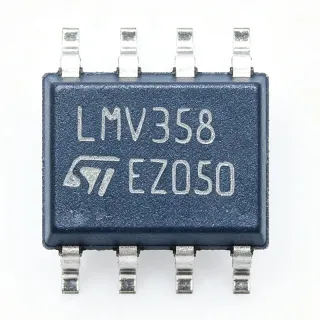
ADA4895-1ARZ-RL7 - 1nV/√Hz, G≥10 Stable Op Amp | Analog Devices
MPN: ADA4895-1ARZ-RL7 ✓ Active| Qty | Unit Price | Extended |
|---|---|---|
| 1 | $3.42 | $3.42 |
| 10 | $3.08 | $30.80 |
| 100 | $2.74 | $274.00 |
| 500 | $2.47 | $1,235.00 |
| 1,000 | $2.19 | $2,190.00 |
ADA4895-1ARZ-RL7 Overview
An operational amplifier (op amp) is a high-gain voltage amplifier with differential inputs and a single-ended output, used in signal conditioning, filtering, and mathematical operations. The ADA4895-1 belongs to the class of high-speed voltage feedback amplifiers, which are optimized for wide bandwidth and fast slew rate, making them suitable for applications requiring large dynamic range and precision. Within the hierarchy of analog ICs, it sits under linear amplifiers, which are fundamental building blocks in electronic systems.
Key features include a small signal bandwidth of 236 MHz at a gain of +10, a slew rate of 943 V/μs, and a settling time of 22 ns to 0.1%. The spurious-free dynamic range (SFDR) is -72 dBc at 2 MHz, ensuring low distortion in high-frequency signal paths. The device is available in an 8-lead SOIC package (ARZ suffix), with tape and reel packaging (RL7) for automated assembly.
The ADA4895-1 utilizes a voltage feedback architecture with complementary bipolar transistors, achieving low noise and high speed simultaneously. The rail-to-rail output stage maximizes dynamic range, while the wide supply voltage range supports both 5 V and 10 V systems. The amplifier is stable for gains of 10 or greater, which simplifies compensation in non-inverting and inverting configurations.
Typical applications include ultrasound imaging front-ends, low-noise preamplifiers for sensors, and high-speed signal conditioning in test and measurement equipment. Its low noise and high bandwidth make it ideal for amplifying small signals from photodiodes, microphones, and other transducers.
When designing with this amplifier, ensure that the gain is set to at least 10 to maintain stability. Use proper power supply decoupling with 0.1 μF ceramic capacitors close to the supply pins, and consider the thermal performance of the SOIC package in high-power applications.
Drop-in alternatives for ADA4895-1ARZ-RL7 — same package, pin-to-pin compatible. Different-package parts requiring PCB rework are excluded.
Variants in this series
Same-series models that are drop-in compatible with ADA4895-1ARZ-RL7 (same form factor and footprint) — differing in Package, Gain Bandwidth Product, Slew Rate.
Quick Comparison Tool — Select alternative parts for side-by-side comparison:
ADA4895-1ARZ-RL
✅ Drop-In📋 Reference alternative (not in catalog)
ADA4895-1ARZ
✅ Drop-In✓ In Stock
$2.19 / Unit
View Datasheet →AD8099ARDZ
✅ Drop-In ⚠️ Specs Unverified📋 Reference alternative (not in catalog)
OPA847IDR
✅ Drop-In ⚠️ Specs Unverified📋 Reference alternative (not in catalog)
ADA4895-1ARZ-RL7 Maximum Ratings & Electrical Characteristics
| Number of Channels | 1 |
| Amplifier Type | Voltage Feedback |
| Gain Bandwidth Product | 236 MHz (at G=+10) |
| Slew Rate | 943 V/μs |
| Input Voltage Noise Density | 1 nV/√Hz (typical) |
| 1/f Noise at 10 Hz | 2 nV/√Hz |
| Supply Voltage Range | 3 V to 10 V |
| Quiescent Current per Amplifier | 3 mA |
| Rail-to-Rail Output | Yes |
| Settling Time to 0.1% | 22 ns |
| Spurious-Free Dynamic Range (SFDR) | -72 dBc at 2 MHz |
| Minimum Stable Gain | 10 |
| Operating Temperature Range | -40°C to +125°C |
| Package | 8-Lead SOIC (ARZ) |
| Mounting Type | Surface Mount |
| RoHS Status | Compliant |
ADA4895-1ARZ-RL7 Pin Configuration
| Pin 1 | OUT — Amplifier output |
| Pin 2 | -IN — Inverting input |
| Pin 3 | +IN — Non-inverting input |
| Pin 4 | V- — Negative supply |
| Pin 5 | NC — No connect |
| Pin 6 | NC — No connect |
| Pin 7 | V+ — Positive supply |
| Pin 8 | NC — No connect |
Typical Applications
ADA4895-1ARZ-RL7 is suitable for 6 applications: Ultrasound Imaging Front-End, Low-Noise Preamplifier, High-Speed Signal Conditioning, Test and Measurement Equipment, RF and IF Signal Processing, Portable Medical Devices.
Ultrasound Imaging Front-End
The ADA4895-1's low input noise (1 nV/√Hz) and high bandwidth (236 MHz) make it ideal for amplifying the small echo signals in ultrasound systems. Its high slew rate (943 V/μs) ensures fast response to pulsed signals, while the rail-to-rail output maximizes dynamic range. The wide supply range (3 V to 10 V) supports various system voltages, and the low quiescent current (3 mA) is beneficial for portable ultrasound devices.
Recommended
Low-Noise Preamplifier
With 1 nV/√Hz input noise and 2 nV/√Hz at 10 Hz, the ADA4895-1 is perfect for low-noise preamplifiers in sensor interfaces, microphone preamps, and instrumentation. Its high gain stability (≥10) allows precise amplification of weak signals, and the rail-to-rail output ensures full-scale swing. The low quiescent current (3 mA) makes it suitable for battery-powered equipment.
Recommended
High-Speed Signal Conditioning
The ADA4895-1's 236 MHz bandwidth and 943 V/μs slew rate enable high-speed signal conditioning in data acquisition, video, and communication systems. Its fast settling time (22 ns to 0.1%) ensures accurate sampling, and the low distortion (-72 dBc SFDR) preserves signal integrity. The wide supply range supports both 5 V and 10 V rails.
Recommended
Test and Measurement Equipment
In oscilloscopes, spectrum analyzers, and signal generators, the ADA4895-1 provides low-noise, high-bandwidth amplification for accurate signal reproduction. Its high slew rate and fast settling time are critical for pulse measurements, while the low noise floor ensures precise small-signal analysis. The SOIC package is easy to integrate into PCB designs.
Recommended
RF and IF Signal Processing
The ADA4895-1's high bandwidth and low distortion make it suitable for IF amplification in radio receivers and transmitters. Its low noise improves receiver sensitivity, and the rail-to-rail output allows direct interface to ADCs. The wide supply range accommodates various RF system voltages, and the low quiescent current is advantageous for portable RF devices.
Recommended
Portable Medical Devices
The ADA4895-1's low power (3 mA) and wide supply range (3 V to 10 V) make it ideal for battery-powered medical devices such as portable ECG monitors and hearing aids. Its low noise ensures accurate biopotential signal acquisition, and the small SOIC package saves board space. The high bandwidth supports fast signal processing for real-time monitoring.
Recommended
Recommended Products Summary
Engineering reference data for ADA4895-1ARZ-RL7 — comparison, design guidance, and compliance information.
Selection Guide
Comparison with Alternatives
| Parameter | This Product | ADA4895-1ARZ-RL | ADA4895-1ARZ | AD8099ARDZ | OPA847IDR |
|---|---|---|---|---|---|
| Package | 8-Lead SOIC | 8-Lead SOIC | 8-Lead SOIC | 8-Lead SOIC | 8-Lead SOIC |
| Brand | Analog Devices | Analog Devices | Analog Devices | Analog Devices | Texas Instruments |
| Input Voltage Noise | 1 nV/√Hz | 1 nV/√Hz | 1 nV/√Hz | 0.95 nV/√Hz | 0.85 nV/√Hz |
| Bandwidth (G=+10) | 236 MHz | 236 MHz | 236 MHz | 3.8 GHz (GBW) | 3.9 GHz (GBW) |
| Slew Rate | 943 V/μs | 943 V/μs | 943 V/μs | 1350 V/μs | 950 V/μs |
| Quiescent Current | 3 mA | 3 mA | 3 mA | 15 mA | 18 mA |
| Supply Voltage Range | 3 V to 10 V | 3 V to 10 V | 3 V to 10 V | 5 V to 12 V | 5 V to 12 V |
| Minimum Stable Gain | 10 | 10 | 10 | 1 (unity) | 1 (unity) |
Key Differentiators
- Ultra-low input noise of 1 nV/√Hz (vs AD8099ARDZ)
- Low quiescent current of 3 mA (vs OPA847IDR)
- Wide supply range of 3 V to 10 V (vs AD8099ARDZ)
Design Notes
Place 0.1 μF ceramic capacitors close to the V+ and V- pins to decouple the power supply. Use a ground plane to minimize noise pickup. Keep feedback resistors and input traces short to reduce parasitic capacitance and maintain stability.
The ADA4895-1 is not unity-gain stable; it requires a gain of at least 10. Operating at lower gains can cause oscillation. Ensure the feedback network sets the gain to ≥10. Also, avoid excessive capacitive loading on the output, which can degrade stability.
The SOIC package has a thermal resistance of approximately 158°C/W (theta_JA). At a supply voltage of 10 V and quiescent current of 3 mA, power dissipation is 30 mW, resulting in a temperature rise of about 5°C. This is acceptable, but for higher output currents, consider the thermal impact.
Compliance Information
RoHS compliant per Analog Devices datasheet. AEC-Q100 not applicable for this commercial-grade part.