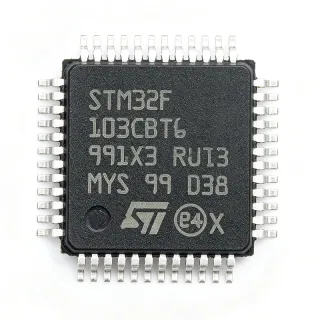
ATMEGA48PA-MUR - 8-bit AVR MCU 4KB 20MHz VQFN-32 | Microchip
MPN: ATMEGA48PA-MUR ✓ Active| Qty | Unit Price | Extended |
|---|---|---|
| 1 | $1.62 | $1.62 |
| 10 | $1.46 | $14.60 |
| 100 | $1.28 | $128.00 |
| 500 | $1.13 | $565.00 |
| 1,000 | $0.98 | $980.00 |
ATMEGA48PA-MUR Overview
An 8-bit AVR microcontroller is a Harvard-architecture RISC processor that executes most of its 131 instructions in a single clock cycle, making it a foundational building block within the broader embedded systems hierarchy: MCU -> microcontroller -> semiconductor. The ATmega family pairs the CPU with on-chip Flash program memory, SRAM data memory, EEPROM for non-volatile storage, and a rich peripheral set on a single die.
Key features include an advanced RISC core with 32 general-purpose working registers, three flexible timer/counters with compare modes, a 10-bit 6-channel ADC, a programmable serial USART, an SPI interface, a two-wire (I2C-compatible) interface, and five software-selectable power-saving modes. The picoPower technology delivers sub-uA current draw in power-down mode, critical for battery-operated designs.
The ATMEGA48PA architecture supports both in-system programming (ISP) and in-application programming, plus debugWIRE on-chip debugging through the RESET pin, reducing development cost by eliminating socketed parts. Internal calibrated RC oscillator options (8 MHz and 128 kHz) allow operation without an external crystal for cost-sensitive designs.
Typical applications include consumer appliance control, industrial sensor nodes, battery-powered metering, LED lighting control, and hobby/education platforms. The 23 I/O lines and rich timers suit motor control and UI handling.
Design consideration: at 5V the device can run at the full 20 MHz, but at 1.8V the maximum safe clock drops (per the ATmega48PA datasheet frequency-versus-voltage curve), so derate f_MAX at low supply voltages.
This page synthesizes distributor pricing, drop-in alternatives including the ATmega48PB, and practical design notes not found in the manufacturer datasheet.
Drop-in alternatives for ATMEGA48PA-MUR — same package, pin-to-pin compatible. Different-package parts requiring PCB rework are excluded.
Variants in this series
Same-series models that are drop-in compatible with ATMEGA48PA-MUR (same form factor and footprint) — differing in Package, EEPROM, Operating Temperature, SRAM, Flash Memory.
Quick Comparison Tool — Select alternative parts for side-by-side comparison:
ATMEGA48PB-MUR
✅ Drop-In✓ In Stock
$0.88 / Unit
View Datasheet →ATMEGA88PA-MUR
✅ Drop-In ⚠️ 参数待验证📋 Reference alternative (not in catalog)
ATMEGA168PA-MUR
✅ Drop-In ⚠️ 参数待验证✓ In Stock
$1.75 / Unit
View Datasheet →ATMEGA328P-MUR
✅ Drop-In ⚠️ 参数待验证📋 Reference alternative (not in catalog)
ATMEGA328PB-MUR
✅ Drop-In ⚠️ 参数待验证✓ In Stock
$1.68 / Unit
View Datasheet →ATMEGA48PA-MUR Maximum Ratings & Electrical Characteristics
| Core Processor | AVR |
| Core Size | 8-bit |
| Speed | 20 MHz |
| Flash Memory | 4 KB (2K x 16) |
| EEPROM | 256 B |
| SRAM | 512 B |
| Supply Voltage Range | 1.8 V to 5.5 V |
| Number of I/O | 23 |
| ADC Resolution | 10-bit, 6 channels |
| Timers | Two 8-bit, one 16-bit |
| Communication Interfaces | USART, SPI, I2C (TWI) |
| Operating Temperature | -40C to +85C |
| Package | 32-VQFN (5x5 mm) 32M1 |
| Mounting Type | Surface Mount |
| Package Height / Pitch | 1 mm height, 0.45 mm pitch (per datasheet package drawing) |
| Programming Features | ISP, IAP, debugWIRE |
| Power-Saving Modes | 5 modes incl. picoPower power-down |
| RoHS Status | Compliant (GREEN package) |
ATMEGA48PA-MUR Pin Configuration
| Pin 1 | PD3 (INT1/OC2B/PCINT19) — Port D bit 3, external interrupt 1, Timer2 output compare B |
| Pin 2 | PD4 (XCK/T0/PCINT20) — Port D bit 4, USART external clock, Timer0 clock input |
| Pin 3 | GND — Ground |
| Pin 4 | VCC — Digital supply voltage |
| Pin 5 | GND — Ground |
| Pin 6 | VCC — Digital supply voltage |
| Pin 7 | PB6 (XTAL1/TOSC1/PCINT6) — Port B bit 6, crystal oscillator input / Timer oscillator |
| Pin 8 | PB7 (XTAL2/TOSC2/PCINT7) — Port B bit 7, crystal oscillator output |
| Pin 9 | PD5 (T1/OC0B/PCINT21) — Port D bit 5, Timer1 clock input, Timer0 output compare B |
| Pin 10 | PD6 (AIN0/OC0A/PCINT22) — Port D bit 6, analog comparator positive input, Timer0 output compare A |
| Pin 11 | PD7 (AIN1/PCINT23) — Port D bit 7, analog comparator negative input |
| Pin 12 | PB0 (ICP1/CLKO/PCINT0) — Port B bit 0, Timer1 input capture, clock output |
| Pin 13 | PB1 (OC1A/PCINT1) — Port B bit 1, Timer1 output compare A (PWM) |
| Pin 14 | PB2 (SS/OC1B/PCINT2) — Port B bit 2, SPI slave select, Timer1 output compare B |
| Pin 15 | PB3 (MOSI/OC2A/PCINT3) — Port B bit 3, SPI master out, Timer2 output compare A |
| Pin 16 | PB4 (MISO/PCINT4) — Port B bit 4, SPI master in |
| Pin 17 | PB5 (SCK/PCINT5) — Port B bit 5, SPI clock |
| Pin 18 | AVCC — ADC supply voltage |
| Pin 19 | ADC6 — Analog input channel 6 |
| Pin 20 | AREF — ADC analog reference |
| Pin 21 | GND — Ground |
| Pin 22 | ADC7 — Analog input channel 7 |
| Pin 23 | PC0 (ADC8/PCINT8) — Port C bit 0, analog input channel 8 |
| Pin 24 | PC1 (ADC9/PCINT9) — Port C bit 1, analog input channel 9 |
| Pin 25 | PC2 (ADC10/PCINT10) — Port C bit 2, analog input channel 10 |
| Pin 26 | PC3 (ADC11/PCINT11) — Port C bit 3, analog input channel 11 |
| Pin 27 | PC4 (ADC12/SDA/PCINT12) — Port C bit 4, ADC12, TWI data line |
| Pin 28 | PC5 (ADC13/SCL/PCINT13) — Port C bit 5, ADC13, TWI clock line |
| Pin 29 | PC6 (RESET/PCINT14) — Reset input (active low), debugWIRE interface |
| Pin 30 | PD0 (RXD/PCINT16) — Port D bit 0, USART receive |
| Pin 31 | PD1 (TXD/PCINT17) — Port D bit 1, USART transmit |
| Pin 32 | PD2 (INT0/PCINT18) — Port D bit 2, external interrupt 0 |
Typical Applications
ATMEGA48PA-MUR is suitable for 6 applications: Battery-Powered Sensor Nodes, Consumer Appliance Control, Industrial Sensor and Actuator Modules, LED Lighting and Dimming Control, Education and Hobbyist Embedded Platforms, Motor Control in Small Appliances and Toys.
Battery-Powered Sensor Nodes
The ATMEGA48PA-MUR's picoPower technology makes it a strong fit for battery-powered sensor nodes: power-down current is approximately 0.1 uA at 3V with the watchdog disabled, and the device wakes through pin-change or watchdog interrupts in microseconds. The internal 128 kHz RC oscillator can drive low-duty-cycle polling loops without a crystal, while the 10-bit ADC reads analog sensors such as temperature or humidity channels directly. Operating from 1.8V allows running down to a nearly depleted coin cell or single alkaline cell through a boost converter. Designers typically budget the 512B SRAM for a lightweight sensor-protocol stack such as a simplified RF link or wired sensor bus, keeping the 4KB Flash footprint small and update-friendly via ISP.
Recommended
Consumer Appliance Control
In appliances such as coffee makers, fans, and small cooktops, the ATMEGA48PA-MUR provides 23 I/O lines to drive touch keys, LEDs, relays, and a buzzer from a single controller. Two 8-bit timers and one 16-bit timer deliver PWM for heater or motor control, while the TWI interface reads an external EEPROM or user-interface expander. The GREEN, RoHS-compliant VQFN package supports lead-free reflow assembly required by consumer appliance supply chains. The 20 MHz core at 5V executes the 131-instruction AVR set mostly in single cycles, keeping button debounce, display refresh, and safety interlock checks in one 10 ms superloop with margin. Internal 8 MHz RC option removes the crystal from cost-sensitive BOMs.
Recommended
Industrial Sensor and Actuator Modules
For industrial modules in the -40C to +85C range, the ATMEGA48PA-MUR's industrial temperature rating and 1.8V to 5.5V tolerance simplify integration on 5V or 3.3V rails. The USART handles Modbus-RTU framing at 9600-115200 baud, SPI connects to ADCs or flash logging, and the 10-bit ADC monitors supply and diagnostic voltages. Brown-out detection and a watchdog timer support the fail-safe behavior expected in factory equipment, while debugWIRE allows in-target debugging without removing the MCU. The 32-pad VQFN with exposed configuration tolerates the vibration profiles of panel-mounted modules better than DIP parts, and the same footprint upgrades to 8KB/16KB Flash parts (ATMEGA88PA/168PA-MUR) without a PCB respin.
Recommended
LED Lighting and Dimming Control
The ATMEGA48PA-MUR suits LED drivers needing flexible PWM: the 8-bit Timer/Counter2 offers phase-correct PWM with output-compare on OC2B, and the 16-bit Timer/Counter1 provides high-resolution dimming curves for flicker-sensitive fixtures. The 20 MHz clock yields 8-bit PWM at roughly 78 kHz, above audibility for flicker-free dimming. PicoPower sleep modes keep standby draw near 0.1 uA in occupancy-sensored luminaires. The 10-bit ADC reads NTC thermistors for thermal fold-back protection of the LED string, and the analog comparator (ACO) can implement hardware over-current cut-off. Supply tolerance of 1.8V to 5.5V lets the MCU share a 3.3V or 5V rail with the LED driver controller.
Recommended
Education and Hobbyist Embedded Platforms
The ATmega48/88/168/328 family is the standard teaching platform for 8-bit embedded systems, and the ATMEGA48PA-MUR is the entry-level member: 4KB Flash is large enough for timer, ADC, UART, and I2C lab exercises while forcing efficient C coding. AVR-GCC and Microchip Studio are free, Arduino-as-ISP provides a zero-cost programmer, and debugWIRE gives single-step debugging through the RESET pin. The 32-VQFN teaches proper SMD hand-soldering with drag-soldering or hot-plate techniques on a 0.45 mm pitch. Because the pinout is identical to the ATMEGA168PA and ATMEGA328P in the same package, students can drop in larger-memory parts as projects grow without changing the board.
Recommended
Motor Control in Small Appliances and Toys
For brushed-DC and small BLDC fans, the ATMEGA48PA-MUR combines three timer/counters with compare outputs for one- to three-phase drive, and its analog comparator with the internal bandgap reference detects zero-cross events for sensorless commutation. Pin-change interrupts on any of the 23 I/O lines capture hall-sensor or encoder feedback with minimal CPU load. At 5V and 20 MHz, the AVR core executes PI-loop updates in tens of microseconds, adequate for low-cost speed regulation. The 1.8V floor supports two-NiMH-cell toy applications, while the -40C to +85C industrial rating covers outdoor garden equipment. EEPROM stores calibration constants such as trim curves and commutation tables across power cycles.
Recommended
Recommended Products Summary
Engineering reference data for ATMEGA48PA-MUR — comparison, design guidance, and compliance information.
Selection Guide
Comparison with Alternatives
| Parameter | This Product | ATMEGA48PB-MUR | ATMEGA88PA-MUR | ATMEGA168PA-MUR | ATMEGA328P-MUR | ATMEGA328PB-MUR |
|---|---|---|---|---|---|---|
| Package | 32-VQFN (5x5 mm, 32M1) | 32-VQFN (5x5 mm, 32M1) - same | 32-VQFN (5x5 mm, 32M1) - same | 32-VQFN (5x5 mm, 32M1) - same | 32-VQFN (5x5 mm, 32M1) - same | 32-VQFN (5x5 mm, 32M1) - same |
| Brand | Microchip Technology (Atmel) | Microchip Technology | Microchip Technology | Microchip Technology | Microchip Technology | Microchip Technology |
| Flash Memory | 4 KB | 4 KB | 8 KB | 16 KB | 32 KB | 32 KB |
| SRAM | 512 B | 512 B | 1 KB | 1 KB | 2 KB | 2 KB |
| EEPROM | 256 B | 256 B | 512 B | 512 B | 1 KB | 1 KB |
| Max Clock Speed | 20 MHz | 20 MHz | 20 MHz | 20 MHz | 20 MHz | 20 MHz |
| Supply Voltage | 1.8 V to 5.5 V | 1.7 V to 5.5 V | 1.8 V to 5.5 V | 1.8 V to 5.5 V | 1.8 V to 5.5 V | 1.8 V to 5.5 V |
| ADC Channels | 6 channels, 10-bit | 8 channels, 10-bit | 6 channels, 10-bit | 6 channels, 10-bit | 6 channels, 10-bit | 7 channels, 10-bit |
| Drop-in Caveats | N/A (reference part) | Pin 3 (GND) / pin 6 (VCC) must not be actively driven if connected (Microchip migration note) | None - same pinout, more memory | None - same pinout, more memory | None - same pinout, more memory | Some peripheral pin multiplexing differs |
| Lifecycle Status | Active | Active (recommended for new designs) | Active | Active | Active | Active |
Key Differentiators
- Lowest cost entry point of the ATmega48/88/168/328 family (vs ATMEGA328P-MUR)
- Proven picoPower platform with documented migration path (vs ATMEGA48PB-MUR)
- Pin-compatible memory upgrade path (vs ATMEGA168PA-MUR)
Design Notes
Respect the frequency-versus-voltage derating curve in the ATmega48PA datasheet: 20 MHz is only guaranteed at 4.5V to 5.5V, while at 1.8V the maximum safe clock is around 4 MHz (estimated from the datasheet curve). Running 20 MHz at 3.3V violates the safe operating envelope and causes erratic execution. If your design must run fast on a 3.3V rail, either scale the clock to 13-14 MHz or use a regulated 5V supply. Add 100 nF decoupling on both VCC pins (4 and 6) plus AVCC with an LC filter to the ADC supply.
The 32M1 VQFN exposes its ground via the center pad (which connects to the die pad). Solder the exposed pad to a grounded copper pour with an array of thermal vias; relying on perimeter pins alone for ground gives poor ADC noise performance and weak thermal relief. Use a 0.45 mm pitch stencil with reduced aperture (approximately 80%) for the center pad to avoid voids. Pin 1 is at the top-left dot marker; verify silkscreen orientation against the datasheet package drawing before panelization.
When migrating to the ATMEGA48PB drop-in replacement, Microchip's migration note imposes two conditions: pin 3 must not be actively driven if connected to GND, and pin 6 must not be actively driven if connected to VCC (the analog-comparator output ACO feature on the PB uses these pins differently). Audit your schematic for these connections before qualifying the PB. Also, debugWIRE shares pin 29 (RESET) with ISP programming - disable debugWIRE fuse and cycle power before attempting ISP if you previously enabled DWEN.
Estimated: at 5V, 20 MHz, and 20 mA total I/O plus core current of roughly 25 mA, power dissipation is about 125 mW. With a typical VQFN-32 theta_JA of 40-50 C/W on a standard 4-layer board, junction rise is only 5-6 C - thermal design is not a concern for this MCU except in enclosed high-ambient (+85C) products, where total on-board dissipation, not the MCU, drives derating.
Compliance Information
Verified web data describes the part as GREEN package (halogen-free, RoHS-compliant per Microchip GREEN definition). Industrial temperature grade; not automotive qualified.