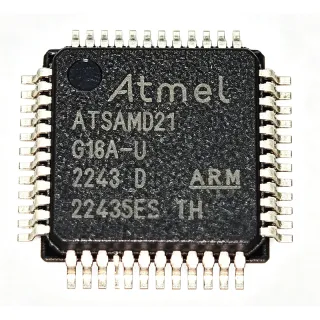
ATMXT1536E-S-CUR - maXTouch Capacitive Touch Sensor | Microchip
MPN: ATMXT1536E-S-CUR ✓ Active| Qty | Unit Price | Extended |
|---|---|---|
| 1 | $0 | $0.00 |
| 10 | $0 | $0.00 |
| 100 | $0 | $0.00 |
| 500 | $0 | $0.00 |
| 1,000 | $0 | $0.00 |
ATMXT1536E-S-CUR Overview
A capacitive touch controller is a specialized sensor-interface device that measures tiny capacitance changes on electrode arrays when a finger or stylus approaches the panel. Within the system hierarchy, it sits at the sensor-interface layer of human-machine interface (HMI) design: below the host MCU or application processor and above the raw ITO electrode pattern. Modern capacitive touch ICs combine analog front-end (AFE) charge-transfer or self/mutual-capacitance measurement engines with DSP-based filtering to reject display and charger noise.
The maXTouch E-series family is engineered for coexistence with active displays, offering water rejection, gloved-touch handling, and robust signal-to-noise performance in cluttered electrical environments. Devices in the family support self- and mutual-capacitance scanning, automatic calibration, and configurable touch thresholds, allowing tuning to different stack-ups and cover lenses.
Architecturally, the MXT1536E Slave Chip variant is intended to operate as a subordinate touch-processing device in a multi-chip touch architecture, communicating with a host or master touch controller over a serial bus. This slave configuration enables larger touch systems to distribute scanning load across multiple devices.
Typical applications include automotive touchpads and touchscreen systems, industrial HMI panels, and large-format capacitive touch surfaces where a slave touch-processing channel supplements a primary maXTouch controller.
A key design consideration is firmware/configuration memory: maXTouch devices require a calibrated configuration object set matched to the panel stack-up; designers should plan for in-system configuration updates over the communication bus.
This page synthesizes distributor availability data, family context, and practical design notes not found together on standard distributor catalog pages. Pricing is quote-based; contact XAIPART for current stock and lead time as of 2026-09-19.
Drop-in alternatives for ATMXT1536E-S-CUR — same package, pin-to-pin compatible. Different-package parts requiring PCB rework are excluded.
Quick Comparison Tool — Select alternative parts for side-by-side comparison:
ATMXT1536T-S-CUR
✅ Drop-In ⚠️ 参数待验证📋 Reference alternative (not in catalog)
ATMXT1536T-CUR
✅ Drop-In ⚠️ 参数待验证📋 Reference alternative (not in catalog)
ATMXT1664S-CCU
✅ Drop-In ⚠️ 参数待验证📋 Reference alternative (not in catalog)
ATMXT1440-CCU
✅ Drop-In ⚠️ 参数待验证📋 Reference alternative (not in catalog)
ATMXT1536E-S-CUR Maximum Ratings & Electrical Characteristics
| Product Type | Capacitive Touch Sensor Controller (maXTouch E-series) |
| Family | maXTouch (MXT1536E) |
| Configuration | Slave Chip |
| Sensing Technology | Projected capacitive (self/mutual capacitance) |
| Manufacturer Part Number | ATMXT1536E-S-CUR |
| Brand | Microchip Technology |
| Category | Interface - Sensor, Capacitive Touch |
| Mounting Type | Surface Mount |
| Water Rejection | Supported (maXTouch E-series feature) |
| Gloved Touch Support | Supported (maXTouch E-series feature) |
ATMXT1536E-S-CUR standard Pin Configuration Guide
Pin configuration for ATMXT1536E-S-CUR (standard package). Pin numbering, functions, and connection diagrams are defined in the manufacturer datasheet. Refer to it for the exact footprint and soldering guidelines.

No detailed pinout data available for ATMXT1536E-S-CUR.
Refer to the datasheet for full pin configuration.
Typical Applications
ATMXT1536E-S-CUR is suitable for 6 applications: Automotive Touchscreen HMI, Industrial HMI Touch Panels, Large-Format Touch Surfaces, Touchpad and ClickPad Modules, Multi-Zone Appliance Controls, Test and Measurement Front Panels.
Automotive Touchscreen HMI
In automotive center-stack and cluster touchscreen systems, the ATMXT1536E-S-CUR serves as a slave touch-processing device under a maXTouch master controller, extending the sensing capacity of large touchscreens. Microchip's maXTouch E-series is specifically engineered for automotive EMI environments, where display refresh noise, charger common-mode noise, and RF transmitters corrupt capacitive measurements. The E-series water-rejection and gloved-touch algorithms allow reliable operation with rain droplets on the lens or drivers wearing gloves, which standalone controllers often handle poorly. Placed on the touch sensor flex PCB, the slave chip scans its assigned electrode region and streams processed touch reports to the master over the serial bus, keeping host CPU load near zero. Design trade-off: the multi-chip architecture requires careful bus topology and a matched configuration object set, adding tuning effort compared with a single-chip design.
Recommended
Industrial HMI Touch Panels
Industrial operator terminals and machine-control panels use the ATMXT1536E-S-CUR where a distributed maXTouch architecture needs additional sensing regions under one master controller. Factory environments impose severe electrical noise from variable-frequency drives, contactors, and switched-mode power supplies; the maXTouch E-series automatic noise filtering and configurable thresholds maintain touch integrity where cheaper controllers produce phantom touches. The slave-chip configuration lets panel designers scale touch area by adding devices without changing host firmware, since the master aggregates all touch reports. Surface-mount construction supports standard reflow assembly on the sensor PCB. Performance consideration: industrial panels often use thick glass cover lenses with air gaps, so the mutual-capacitance sensitivity must be tuned via the configuration object set, and gloved-touch operation should be validated with the actual operator gloves used on the factory floor.
Recommended
Large-Format Touch Surfaces
Large capacitive touch surfaces - oversized control consoles, interactive kiosks, and multi-zone touchpads - exceed the channel count of any single touch controller. The ATMXT1536E-S-CUR addresses this as the MXT1536E Slave Chip: one or more slave devices each scan a section of the electrode matrix while a maXTouch master coordinates scanning, calibration, and host communication. This distributed topology maintains frame rates on high-channel-count panels because scan load is shared, and all zones report through one unified touch-data protocol to the host. The E-series noise immunity also helps on large panels, whose long electrode traces act as antennas picking up display and mains noise. Key design consideration: electrode routing length mismatch between zones can unbalance sensitivity, so per-zone gain settings in the configuration must be tuned individually during bring-up.
Recommended
Touchpad and ClickPad Modules
Notebook-style touchpads and automotive console touchpads use the ATMXT1536E-S-CUR to implement precise finger tracking, palm rejection, and button-zone emulation within a maXTouch multi-device system. As the slave device, it scans the touchpad electrode pattern and reports coordinates and gesture states to the master controller, which fuses them with other touch inputs. The E-series algorithms support gloved-hand operation, valuable in vehicles where drivers interact with touchpads without removing gloves, and water rejection prevents rain-induced false cursor jumps in open cockpit designs. Self-capacitance scanning provides strong single-finger sensitivity while mutual-capacitance passes deliver multi-finger tracking. Trade-off note: clickpad mechanical integration requires keeping the sensor flex clear of the switch dome so actuation force does not shift capacitance baselines, triggering unintended recalibration.
Recommended
Multi-Zone Appliance Controls
Premium home appliances - ovens, cooktops, refrigerators - increasingly use multi-zone capacitive interfaces combining a main touchscreen with auxiliary slider or button zones. The ATMXT1536E-S-CUR fits as the slave scanner for secondary zones under a maXTouch master, letting one touch ecosystem cover the entire front panel. Appliance fronts are grounded-metal or glass constructions near induction-heater and motor-drive noise sources; the E-series noise filtering sustains reliable detection in this cluttered spectrum, and water rejection handles spills and condensation that routinely reach appliance surfaces. The serial slave bus means the appliance main controller talks only to the maXTouch master, keeping firmware simple. Design consideration: wet-finger and boiling-pot conditions must be validated with the final lens material, since high-permittivity liquids strongly couple into the electrode array.
Recommended
Test and Measurement Front Panels
Bench instruments and rack-mounted test equipment embed touch front panels whose sensors sit directly beside high-speed digital and analog circuitry - a worst-case noise environment for capacitive sensing. Using the ATMXT1536E-S-CUR as a slave scanning device under a maXTouch master lets instrument designers partition the front panel into a touchscreen region and dedicated soft-key zones while keeping a single touch driver stack in the instrument firmware. The E-series display-noise rejection compensates for coupling from the instrument's own LCD backlight and switching regulators, which commonly desensitize generic touch chips. The device's serial report stream integrates cleanly with embedded Linux or RTOS front-end software on the instrument mainboard. Practical note: ground the sensor shield plane to instrument chassis ground, not digital ground, to avoid injecting switching noise into the AFE reference.
Recommended
Recommended Products Summary
Engineering reference data for ATMXT1536E-S-CUR — comparison, design guidance, and compliance information.
Selection Guide
Comparison with Alternatives
| Parameter | This Product | ATMXT1536T-S-CUR | ATMXT1536T-CUR | ATMXT1664S-CCU | ATMXT1440-CCU |
|---|---|---|---|---|---|
| Brand | Microchip Technology | Microchip Technology | Microchip Technology | Microchip Technology | Microchip Technology |
| Family | maXTouch E-series (MXT1536E) | maXTouch 1536 (non-E) | maXTouch 1536 (non-E, standalone) | maXTouch E-series (MXT1664S) | maXTouch E-series (MXT1440) |
| E-series Noise Features (water/glove) | Yes | No (non-E variant) | No (non-E variant) | Yes (E-series) | Yes (E-series) |
| Substitution Effort | - | Low (same core, feature loss) | Medium (architecture change) | Medium (config retune) | Medium (matrix resize) |
Key Differentiators
- Slave-chip architecture for scalable touch systems (vs ATMXT1536T-CUR)
- E-series noise immunity (vs ATMXT1536T-S-CUR)
- Balanced channel count within E-series (vs ATMXT1664S-CCU)
Design Notes
Because the ATMXT1536E-S-CUR is a slave scanning device, place it on the touch sensor flex or PCB as close as possible to the electrode connector to minimize trace length; long sensing traces increase parasitic capacitance and pickup of display and charger noise, degrading signal-to-noise ratio. Keep the touch AFE ground return separate from high-current digital grounds and join at a single point. Route the serial bus to the maXTouch master differentially if it crosses noisy regions of the board.
maXTouch devices do not function correctly without a panel-matched configuration object set. The most common bring-up failure is running with default or borrowed configuration from a different stack-up, producing phantom touches or dead zones. Always regenerate and validate the configuration for your exact lens thickness, sensor pitch, and adhesive stack, store it in non-volatile memory, and plan an in-system configuration-update path over the serial bus for field tuning.
The E-series noise-immunity features (water rejection, gloved touch, display-noise filtering) only deliver rated performance when the analog front end is protected externally as well. Add a ground shield plane between the touch sensor and any nearby switching regulator or display backlight driver, and use a solid, low-impedance ground under the IC. Estimated: a 5 cm unterminated sense trace can pick up millivolts of coupled switching noise, which is on the order of a touch signal, so keep sense routing short and shielded.
Compliance Information
Compliance status not explicitly stated in verified data sources as of 2026-09-19. Confirm via Microchip environmental documentation or material declaration request. AEC-Q100 status marked not_applicable pending confirmation since no automotive qualification data was provided.