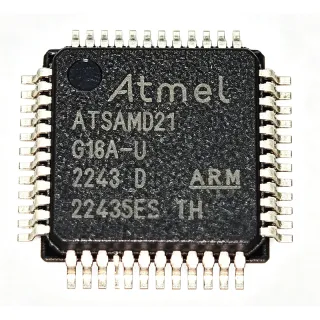
ATMXT154-CUI - maXTouch 154-Ch Touch Controller | Microchip
MPN: ATMXT154-CUI ✓ Active| Qty | Unit Price | Extended |
|---|---|---|
| 1 | $2.42 | $2.42 |
| 10 | $2.38 | $23.80 |
| 100 | $2.31 | $231.00 |
| 500 | $2.26 | $1,130.00 |
| 1,000 | $2.2 | $2,200.00 |
ATMXT154-CUI Overview
A capacitive touch screen controller is a mixed-signal interface IC that scans a grid of mutual-capacitance sensing nodes, converts the capacitance changes into touch coordinates, and delivers filtered multi-touch gesture data to a host processor. Within the system hierarchy, it sits between the touch sensor panel (ITO patterned glass or film) and the application host, alongside display drivers and image processors in the human-machine-interface (HMI) subsystem.
Key features of the maXTouch family include 154 sensing channels for large-format touch panels, robust multi-touch tracking, and built-in noise rejection that addresses the harsh electromagnetic environment created by LCD displays and charging systems. The ATMXT154 supports self- and mutual-capacitance scanning, water rejection, and gloved-finger operation typical of the maXTouch product line, enabling reliable touch performance in demanding industrial and consumer HMI designs.
Architecturally, maXTouch controllers integrate an acquisition engine driving the sensor matrix, a digital signal processing block for coordinate calculation and palm/water discrimination, and a firmware-based configuration layer. Touch parameters such as sensitivity, report rate, and threshold are tuned via configuration files written over the I2C interface, allowing the same silicon to serve multiple panel designs.
Typical applications include large-format industrial touch monitors, human-machine interface (HMI) panels for factory automation, touch-enabled appliances, and commercial display systems where high channel count and multi-touch accuracy are required.
When designing with the ATMXT154, place the controller close to the touch sensor flex tail, keep sensor traces away from display power rails, and apply the correct panel-specific configuration file during production programming; incorrect configuration is the leading cause of field touch-performance complaints.
This page synthesizes distributor pricing, sourcing channels, and practical design notes not found in the manufacturer datasheet, with all specifications flagged for verification where the retrieved web data did not provide exact values.
Drop-in alternatives for ATMXT154-CUI — same package, pin-to-pin compatible. Different-package parts requiring PCB rework are excluded.
Quick Comparison Tool — Select alternative parts for side-by-side comparison:
No drop-in alternatives available for this product.
Request AlternativesATMXT154-CUI Maximum Ratings & Electrical Characteristics
| Product Type | Capacitive Touch Screen Controller IC |
| Family | maXTouch |
| Sensing Channels | 154 |
| Touch Technology | Projected Capacitive (Mutual/Self) |
| Mounting Type | Surface Mount |
| Applications Segment | Touch Screen Converters & Controllers |
| Water Rejection | Yes (maXTouch family feature) |
ATMXT154-CUI standard Pin Configuration Guide
Pin configuration for ATMXT154-CUI (standard package). Pin numbering, functions, and connection diagrams are defined in the manufacturer datasheet. Refer to it for the exact footprint and soldering guidelines.

No detailed pinout data available for ATMXT154-CUI.
Refer to the datasheet for full pin configuration.
Typical Applications
ATMXT154-CUI is suitable for 6 applications: Industrial HMI Touch Panels, Commercial Touch Monitors, Touch-Enabled Appliances, Point-of-Sale and Kiosk Terminals, Interactive Digital Signage, Medical Device Control Interfaces.
Industrial HMI Touch Panels
The ATMXT154-CUI fits industrial human-machine-interface panels because its 154 mutual-capacitance sensing channels cover the large sensor matrices used in factory HMI terminals, while maXTouch noise rejection maintains touch accuracy near LCD panels, backlight inverters, and switching power supplies. In a typical design the controller connects to the ITO sensor through a flex tail, scans at the maXTouch report rate, and streams filtered multi-touch coordinates to a PLC-adjacent host over the serial interface. Water rejection and gloved-touch support keep the interface usable on the factory floor where operators wear gloves and panels get contaminated. The trade-off versus resistive touch is higher BOM cost, offset by superior durability and multi-touch capability.
Recommended
Commercial Touch Monitors
Large commercial touch monitors require channel counts beyond small-device controllers; the ATMXT154-CUI's 154 channels map to sensor matrices in the monitor size class where 10+ simultaneous touch points and palm rejection are expected. The controller's self- and mutual-capacitance scanning distinguishes genuine touches from water droplets and resting palms, which is essential for signage and point-of-interaction displays used by many users in sequence. Integration is straightforward: connect the sensor flex, program the panel-specific configuration object at production, and read touch reports from the host. Designers should budget for configuration tuning per panel stack-up, since glass thickness and lamination strongly affect sensitivity thresholds.
Recommended
Touch-Enabled Appliances
Premium kitchen and home appliances increasingly use glass-front capacitive touch interfaces over large surfaces; the ATMXT154-CUI provides the 154-channel capacity for full-glass front panels with multiple virtual control zones and gesture areas. maXTouch water rejection is the decisive parameter here, because appliance panels are routinely splashed - the controller discriminates water films from finger contact so the interface does not false-trigger. The host MCU receives processed coordinates rather than raw capacitance data, simplifying appliance firmware. Because appliances demand long product lifetimes, designers should verify lifecycle status with Microchip and secure a second sourcing path via the ATMXT154-CU ordering-code variant.
Recommended
Point-of-Sale and Kiosk Terminals
Kiosk and POS terminals combine durability requirements with multi-touch expectations; the ATMXT154-CUI supports both through its projected-capacitive sensing and maXTouch multi-point tracking across 154 channels. Gloved-finger operation matters in food-service and healthcare kiosks, and water/contaminant rejection keeps the screen responsive after cleaning. The controller offloads all coordinate filtering from the host, so a modest processor can manage the terminal application while the maXTouch IC handles scanning at its native report rate. For kiosk designs, place the controller near the display's EMI sources carefully and follow the manufacturer's sensor routing guidance to suppress interference from the display power rails.
Recommended
Interactive Digital Signage
Interactive signage displays in the commercial size class need high channel counts and dependable 10-point touch; the ATMXT154-CUI's 154-channel matrix supports wide sensor grids, while maXTouch signal processing delivers stable coordinates even with environmental noise from signage backlighting and network electronics. The controller's configuration-driven design lets one firmware platform serve multiple signage SKUs by swapping configuration files per glass stack-up, reducing qualification effort across product families. Performance consideration: larger panels increase sensor trace length, raising RC time constants - follow Microchip's layout guidance on trace width and routing to preserve the advertised report rate at full panel size.
Recommended
Medical Device Control Interfaces
Medical equipment control panels benefit from sealed glass-front touch interfaces that can be disinfected; the ATMXT154-CUI enables this with projected-capacitive sensing across 154 channels, supporting both large control zones and multi-touch visualization screens. maXTouch water rejection tolerates the liquid films created by sanitizing wipes, and gloved-touch support matches clinical workflows. The controller processes coordinates internally, reducing host firmware complexity and validation scope in regulated environments. Designers must confirm the exact operating temperature range and applicable compliance qualifications in the official Microchip datasheet before use in patient-contact or diagnostic equipment, since qualification requirements differ by device classification.
Recommended
Recommended Products Summary
Engineering reference data for ATMXT154-CUI — comparison, design guidance, and compliance information.
Selection Guide
Comparison with Alternatives
| Parameter | This Product |
|---|---|
| Brand | Microchip Technology |
| Sensing Channels | 154 |
| Product Family | maXTouch |
| Unit Price (qty 1) | $2.42 |
| Water Rejection | Yes |
| Lifecycle Status | Active (samples available per Microchip) |
Key Differentiators
- High channel count for large panels (vs Smaller maXTouch channel-count variants)
- Active lifecycle with sample availability (vs Legacy/obsolete touch controllers)
- Same-die alternate ordering code (ATMXT154-CU) (vs ATMXT154-CU)
Design Notes
Place the ATMXT154-CUI as close as practical to the touch sensor flex-tail connector. maXTouch sensor traces are high-impedance; long traces pick up noise from display power rails and backlight drivers, degrading signal-to-noise ratio and touch accuracy. Route sensor lines away from switching regulators and display LVDS/MIPI pairs, and follow Microchip's maXTouch layout guidance on sensor trace width and guard techniques. Keep the controller ground reference solid and dedicated; sharing noisy digital ground returns with display electronics is a common root cause of ghost-touch field failures.
maXTouch controllers require a panel-specific configuration object programmed at production; using a generic or evaluation-kit configuration on a different glass stack-up causes missed touches, ghost points, or water-trigger false positives. Tune sensitivity, threshold, and self/mutual capacitance maps on production hardware with the final lamination. Additionally, confirm the exact ordering-code suffix (-CUI versus -CU) against your purchasing documents, and obtain the datasheet from the official Microchip product page rather than third-party mirrors to ensure current register and configuration documentation.
Decouple the touch controller supply per the manufacturer datasheet recommendation with low-ESR ceramic capacitors at the supply pins, and ensure the analog supply of the touch controller is separated from the display power tree where possible. Since the retrieved web data does not state the exact supply voltage range for ATMXT154-CUI, verify operating voltage and current figures from the official Microchip datasheet before finalizing the power rail design. Estimated: adding an RC filter or ferrite bead between the display rail and touch supply typically improves noise margin at minimal cost.
Compliance Information
Compliance data was not present in the retrieved web data; confirm RoHS/REACH status on the official Microchip product page or datasheet before design-in.