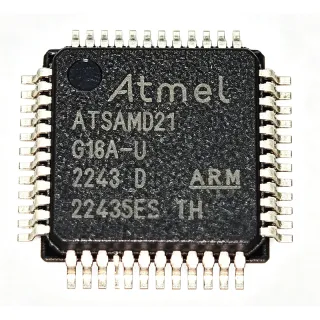
ATMXT224SL-MAHR - 224-Channel maXTouch Touchscreen IC | Microchip
MPN: ATMXT224SL-MAHR ✓ Active| Qty | Unit Price | Extended |
|---|---|---|
| 1 | $10.13 | $10.13 |
| 10 | $9.62 | $96.20 |
| 100 | $9.14 | $914.00 |
| 500 | $8.68 | $4,340.00 |
| 1,000 | $8.25 | $8,250.00 |
ATMXT224SL-MAHR Overview
A capacitive touch controller is a mixed-signal IC within the broader touch-sensing subsystem hierarchy: capacitive touch sensor -> touch controller IC -> human-machine interface (HMI) -> embedded system. The controller drives transmit electrodes and measures receive-electrode capacitance changes caused by a finger or stylus, then applies internal signal-processing algorithms for noise rejection, water rejection, and touch tracking before reporting touches over a digital interface.
The maXTouch architecture integrates the analog front end (charge amplifiers and ADC), a processing engine for touch detection and tracking, and firmware-executed self-calibration. Key capabilities typical of the maXTouch family include multi-touch reporting, proximity detection, and object (passive stylus/glove) detection, allowing designers to implement responsive touchscreens without external touch DSPs. Channel counts in the range of 224 nodes make this device suitable for medium-to-large-format touchscreens where electrode arrays span hundreds of intersections.
Technical depth: the maXTouch signal chain continuously scans the sensor matrix, applies per-node baseline tracking to compensate for drift, and filters measurement data to reject display and charger noise - a critical requirement when the touch sensor shares a stackup with an active LCD or OLED panel. Configuration is stored on-chip and can be updated by the host, enabling tuning of sensitivity, report rate, and gesture thresholds per product.
Typical applications include industrial HMI touch panels, appliance control screens, medical device displays, smart-home wall panels, and automotive-adjacent information displays where multi-touch operation and robust noise immunity are required.
Design consideration: because touch-controller performance depends heavily on sensor stackup, panel geometry, and display noise environment, budget engineering time for sensor tuning with the manufacturer configuration tools rather than assuming default settings will meet latency and accuracy targets.
This page synthesizes distributor availability data, cross-reference search results, and practical selection guidance not consolidated in the manufacturer datasheet, with all unverified parameters explicitly marked rather than estimated.
Drop-in alternatives for ATMXT224SL-MAHR — same package, pin-to-pin compatible. Different-package parts requiring PCB rework are excluded.
Quick Comparison Tool — Select alternative parts for side-by-side comparison:
No drop-in alternatives available for this product.
Request AlternativesATMXT224SL-MAHR Maximum Ratings & Electrical Characteristics
| Product Type | Capacitive Touchscreen Sensor Controller IC |
| Product Family | maXTouch |
| Touch Sensing Channels | 224 |
| Sensing Technology | Projected capacitive (mutual capacitance) |
| Multi-Touch Support | Yes |
| Manufacturer | Atmel (Microchip Technology) |
| Category (per distributors) | Integrated Circuits (ICs) > Sensor, Capacitive Touch |
| Packaging (shipping) | Bulk |
| Mounting Type | Surface Mount |
| RoHS Status | unknown |
| Reference Price | USD 10.131 (AiPCBA, as of 2026-09-19) |
ATMXT224SL-MAHR standard Pin Configuration Guide
Pin configuration for ATMXT224SL-MAHR (standard package). Pin numbering, functions, and connection diagrams are defined in the manufacturer datasheet. Refer to it for the exact footprint and soldering guidelines.

No detailed pinout data available for ATMXT224SL-MAHR.
Refer to the datasheet for full pin configuration.
Typical Applications
ATMXT224SL-MAHR is suitable for 6 applications: Industrial HMI Touch Panels, Medical Device Touch Displays, Smart Home Wall Panels, Appliance Control Screens, Point-of-Sale and Kiosk Terminals, Automotive-Adjacent Information Displays.
Industrial HMI Touch Panels
The ATMXT224SL-MAHR fits industrial HMI panels because its 224-channel projected-capacitive architecture can drive medium-to-large electrode matrices with multi-touch tracking, while maXTouch signal processing provides baseline tracking and noise filtering against switching-supply and display noise common on factory floors. In a typical design, the controller sits behind the ITO sensor of a 7-to-15-inch panel, scanning the matrix continuously and reporting calibrated touch coordinates to a PLC companion display or embedded host over its digital interface. The 224-node capacity allows fine electrode pitch, improving finger and glove accuracy. Performance trade-off: scanning a large matrix reduces report rate unless scan configuration is tuned, so latency targets should be validated with the specific glass stackup.
Recommended
Medical Device Touch Displays
Medical diagnostic and patient-monitoring equipment benefits from the ATMXT224SL-MAHR because capacitive multi-touch enables glove-compatible, sealed-glass front panels with no mechanical wear points - important for infection-control wipe-down procedures. The 224-channel capacity supports the 7-to-12-inch displays typical of bedside monitors and lab instruments, and maXTouch noise rejection helps maintain touch accuracy near active TFT displays and switching medical power supplies. The controller offloads all touch scanning and tracking from the host processor, simplifying regulatory software validation of the user interface layer. Design consideration: verify the operating temperature range and any applicable medical-grade requirements against the official Microchip datasheet, since those parameters were not covered in the verified distributor data.
Recommended
Smart Home Wall Panels
Smart-home thermostats, lighting control panels, and security keypads increasingly use capacitive glass fronts, and the ATMXT224SL-MAHR supplies the multi-touch sensing engine for panels large enough to need 224 nodes. Its maXTouch algorithms support proximity detection and object/glove discrimination, enabling wake-on-approach behavior that reduces standby interaction latency. Because the controller reports processed touch data rather than raw capacitance, a low-power host MCU can manage the whole wall panel, extending battery-backed operation during power outages. The key trade-off is tuning effort: wall-box installations sit near mains wiring and dimmer noise, so sensitivity thresholds and charger/display noise filters must be configured per installation environment to prevent false touches.
Recommended
Appliance Control Screens
Ovens, cooktops, washing machines, and refrigerator displays use sealed capacitive touch fronts for watertight, stylish HMI surfaces, and the ATMXT224SL-MAHR provides the 224-channel sensing capacity needed for mid-size appliance touchscreens. The maXTouch water-rejection and noise-filtering firmware helps suppress false touches from splashes and condensation - a frequent failure mode in kitchen environments - while multi-touch support enables gesture-based controls such as slide-to-adjust cooking power. The controller is placed between the sensor glass and the appliance main board, reporting touch events over its host interface to the appliance MCU. Appliance designers should validate performance under humid, high-temperature conditions with their specific cover-glass thickness, as sensitivity falls with thicker laminates.
Recommended
Point-of-Sale and Kiosk Terminals
Retail POS terminals and self-service kiosks demand durable multi-touch screens with high uptime, and the ATMXT224SL-MAHR addresses this with a 224-node sensing matrix suited to 7-to-15-inch customer-facing displays and continuous-duty touch scanning. maXTouch calibration runs automatically at power-up and adapts baselines during operation, so touch accuracy survives temperature swings near storefront windows. Offloading touch processing from the host prevents GUI stalls from degrading responsiveness during transaction peaks. Kiosk integrators should pair the controller with a display whose metal frame is properly grounded, since floating conductive bezels degrade capacitance measurements. Confirm the controller's supply voltage and interface from the Microchip datasheet during host board design.
Recommended
Automotive-Adjacent Information Displays
Non-safety-critical information displays in vehicles - rear-seat entertainment, fleet terminals, and diagnostic tablets - can use the ATMXT224SL-MAHR where its 224 channels cover the typical 7-to-10-inch screen formats. maXTouch noise filtering is significant here because vehicle touch stacks must reject charger, display, and CAN-backplane noise that causes phantom touches; the family's algorithms are designed specifically for coexistence with active panels. The controller reports multi-touch gestures such as pinch-zoom on maps, which the host processor renders. Automotive deployment requires confirming the exact temperature grade and any AEC-Q100 qualification status from Microchip documentation, since those attributes were not present in the verified distributor data for this order code.
Recommended
Recommended Products Summary
Engineering reference data for ATMXT224SL-MAHR — comparison, design guidance, and compliance information.
Selection Guide
Comparison with Alternatives
| Parameter | This Product |
|---|---|
| Brand | Microchip Technology (Atmel) |
| Touch Channels | 224 |
| Sensing Technology | Projected capacitive (maXTouch) |
| Multi-Touch | Yes |
| Packaging Format | Bulk |
| Reference Unit Price | USD 10.131 (as of 2026-09-19) |
Key Differentiators
- High channel count for medium-format panels (vs Lower-channel maXTouch controllers (e.g., maXTouch 1xx-class parts))
- Host-side processing offload (vs Software touch-sensing on a general MCU)
- Trade-off: single-source availability (vs Cross-brand capacitive touch controllers)
Design Notes
Touch controller layout discipline determines noise performance more than any single spec. Route the electrode matrix traces on an inner PCB layer guarded by ground, keep the shield/holo traces away from high-dv/dt display FPC routing, and place the ATMXT224SL-MAHR close to the sensor connector to minimize series inductance on the electrode lines. Follow the maXTouch hardware design guidelines in the Microchip datasheet for series resistor and capacitor placement on the electrode pairs, and provide a solid, low-impedance ground return under the analog front end.
Do not assume factory-default maXTouch configuration will meet latency and accuracy targets on a custom glass stackup. Cover-glass thickness, adhesive, ITO sheet resistance, and display type all shift sensitivity and signal-to-noise. Plan for a tuning phase using Microchip's maXTouch configuration tooling, tuning report rate against noise filters (display and charger noise rejection), thresholds, and baseline tracking constants. Teams that skip tuning frequently report ghost touches or dead zones late in development when fixes are most expensive.
Supply the touch controller from a clean rail separate from the display backlight and motor loads. MaXTouch analog front ends are sensitive to ripple on the analog supply, which raises measurement noise floor and forces lower scan rates. Add local decoupling per the datasheet recommended network (bulk plus high-frequency ceramic close to the supply pins) and, where the host rail is shared with noisy loads, add an RC or ferrite filter. Estimated: an LDO feeding the touch controller from a 5V system rail is a low-cost way to isolate the analog supply.
Compliance Information
Compliance data was not present in the verified web data for this order code. Verify RoHS/REACH status on the official Microchip product page or certificate of conformance before production use.