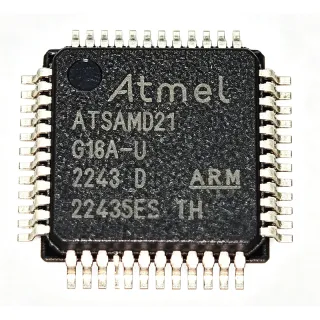
ATMXT154-CUIR - 154-Channel maXTouch Controller | Microchip
MPN: ATMXT154-CUIR ✓ Active| Qty | Unit Price | Extended |
|---|---|---|
| 1 | $4.12 | $4.12 |
| 10 | $3.78 | $37.80 |
| 100 | $3.35 | $335.00 |
| 500 | $3.02 | $1,510.00 |
| 1,000 | $2.71 | $2,710.00 |
ATMXT154-CUIR Overview
A projected-capacitive touch controller is a specialized mixed-signal IC that drives excitation signals onto transmit electrodes and measures mutual capacitance changes on receive electrodes to locate finger or stylus contact. Within the signal-chain hierarchy, it sits between the ITO sensor pattern on the display cover glass and the host processor, typically communicating over an I2C-compatible interface, making it a key element of human-machine interface (HMI) subsystems.
Key features of the ATMXT154 family include 154 sensing channels that support dense electrode arrays, self-capacitance and mutual-capacitance measurement for gloved-hand and proximity detection, and Microchip maXTouch acquisition technology with noise filtering for use near LCD and OLED displays. The integrated microcontroller runs Microchip-supplied firmware and object-based configuration, allowing tuning via configuration files rather than firmware redesign.
Technically, the device combines an analog front end with charge-integrating receive channels, a high-resolution acquisition engine, and digital signal processing for palm rejection and water rejection. Object-based configuration enables OEMs to adjust thresholds, electrode geometry maps, and touch report rates to match panel stack-up and display noise conditions.
Typical applications include industrial HMI touch panels, home-appliance control surfaces, smart-home wall controllers, and automotive center-stack or climate-control touchscreens where robust noise immunity near displays is required.
A key design consideration is the host interface configuration: the controller must be configured with the correct object set for the specific sensor pattern, and display-noise synchronization (to the display refresh) should be enabled to avoid jitter in high-noise environments.
This page synthesizes distributor availability, drop-in family alternatives, and practical design notes not found in the manufacturer datasheet.
Drop-in alternatives for ATMXT154-CUIR — same package, pin-to-pin compatible. Different-package parts requiring PCB rework are excluded.
Quick Comparison Tool — Select alternative parts for side-by-side comparison:
ATMXT144-CUIR
✅ Drop-In ⚠️ 参数待验证📋 Reference alternative (not in catalog)
ATMXT644-CUIR
✅ Drop-In ⚠️ 参数待验证📋 Reference alternative (not in catalog)
ATMXT1664-CUIR
✅ Drop-In ⚠️ 参数待验证📋 Reference alternative (not in catalog)
ATMXT154-CUIR Maximum Ratings & Electrical Characteristics
| Sensor Type | Capacitive Touch / Proximity |
| Touch Channels | 154 |
| Family | maXTouch |
| Sensing Technology | Projected capacitive (mutual and self capacitance) |
| Proximity Sensing | Yes |
| Mounting Type | Surface Mount |
| RoHS Status | Compliant |
| Lifecycle Status | Active, samples available |
ATMXT154-CUIR standard Pin Configuration Guide
Pin configuration for ATMXT154-CUIR (standard package). Pin numbering, functions, and connection diagrams are defined in the manufacturer datasheet. Refer to it for the exact footprint and soldering guidelines.

No detailed pinout data available for ATMXT154-CUIR.
Refer to the datasheet for full pin configuration.
Typical Applications
ATMXT154-CUIR is suitable for 6 applications: Industrial HMI Touch Panels, Home Appliance Control Surfaces, Smart-Home Wall Controllers and Keypads, Automotive Center-Stack and Climate Touchscreens, Medical Device User Interfaces, Fitness Equipment and Gaming Consoles.
Industrial HMI Touch Panels
The ATMXT154-CUIR fits industrial human-machine interface panels where 154 sensing channels support large, dense electrode arrays behind thick or gloved-glass stacks. Its maXTouch acquisition engine applies noise filtering that keeps touch accuracy stable near switching power supplies, inverters, and industrial displays - environments where simpler controllers lose tracking. Placed between the ITO sensor pattern and the host PLC or MPU over the serial interface, the controller reports filtered touch coordinates at a configurable rate. Its proximity capability enables wake-on-approach for screen dimming in always-on factory terminals, reducing display power and extending backlight life.
Recommended
Home Appliance Control Surfaces
Modern ovens, cooktops, washing machines, and refrigerators replace mechanical buttons with capacitive glass front panels, and the ATMXT154-CUIR supports these surfaces with up to 154 channels plus self-capacitance proximity detection. Water rejection and palm rejection algorithms from the maXTouch signal-processing chain prevent false triggers from spilled liquids or cleaning wipes - a critical reliability requirement in kitchen environments. The controller sits behind the decorative glass, driving the electrode pattern and communicating touch events to the appliance main board. Its object-based configuration lets appliance OEMs tune thresholds for their specific glass thickness and stack-up without firmware changes.
Recommended
Smart-Home Wall Controllers and Keypads
Smart-home wall panels, scene controllers, and touchscreen thermostats use the ATMXT154-CUIR for flush glass touch surfaces with proximity wake-up. The proximity sensing mode lets a panel illuminate and become touch-responsive as a user approaches, then dim to low power afterward, reducing standby energy. With 154 channels, designers can combine a modest display touch area with additional off-display gesture or slider zones on the same electrode array. The controller's noise filtering maintains accuracy adjacent to Wi-Fi, Zigbee, and power-line modules typical in wall-box installations, and object-based configuration enables a single PCB reused across product families with different glass artwork.
Recommended
Automotive Center-Stack and Climate Touchscreens
Automotive cockpit designs require touch controllers tolerant of high display noise, wide temperature ranges, and gloved operation. The ATMXT154-CUIR's maXTouch acquisition technology with display-noise synchronization addresses LCD/OLED coupling noise, while mutual-capacitance sensing maintains gloved-finger tracking. Its 154 channels cover center-stack displays and adjacent capacitive sliders or haptic zones on one controller, reducing BOM complexity versus multiple small controllers. Note: for production automotive programs, verify the specific AEC-Q100 qualification status of the exact MPN grade with Microchip, as qualification varies by grade suffix within Microchip families. Configuration tuning must be validated against the vehicle display's refresh characteristics.
Recommended
Medical Device User Interfaces
Medical monitors, infusion pumps, and diagnostic instruments benefit from sealed glass front panels enabled by the ATMXT154-CUIR. Capacitive sensing removes crevices where contaminants collect, supporting wipe-down disinfection protocols required in clinical settings. The controller's proximity detection can wake the display when a clinician approaches and lock touch input during automated procedures to prevent accidental interaction. With 154 channels, larger touch arrays for alarm controls and on-screen keyboards are supported on one IC. The maXTouch configuration framework lets OEMs calibrate sensitivity per product to account for protective cover lenses of varying thickness, and noise filtering preserves accuracy near switching power converters inside the enclosure.
Recommended
Fitness Equipment and Gaming Consoles
Treadmill consoles, exercise bikes, arcade machines, and gaming peripherals use the ATMXT154-CUIR for robust touch operation under sweaty or gloved hands. Mutual-capacitance tracking with the maXTouch signal-processing chain resists the conductivity variations that defeat simple self-capacitance controllers, while palm rejection prevents accidental inputs from resting hands on large console surfaces. The 154-channel budget supports wide console strips, rotary capacitive dials, and the main display touch array on one controller. High report-rate configuration gives responsive feedback in fast-paced interaction, and the object-based configuration allows one electronics board to serve multiple console sizes by re-mapping electrodes in software.
Recommended
Recommended Products Summary
Engineering reference data for ATMXT154-CUIR — comparison, design guidance, and compliance information.
Selection Guide
Comparison with Alternatives
| Parameter | This Product | ATMXT144-CUIR | ATMXT644-CUIR | ATMXT1664-CUIR |
|---|---|---|---|---|
| Brand | Microchip Technology | Microchip Technology | Microchip Technology | Microchip Technology |
| Proximity Sensing | Yes | Yes | Yes | Yes |
| Architecture | maXTouch, object-based configuration | maXTouch, object-based configuration | maXTouch, object-based configuration | maXTouch, object-based configuration |
| RoHS Compliance | Compliant (-CUIR suffix) | Compliant (-CUIR suffix) | Compliant (-CUIR suffix) | Compliant (-CUIR suffix) |
| Lifecycle Status | Active | Active | Active | Active |
| Best Fit Panel Size | Medium-to-large touch panels | Medium panels | Small-to-medium panels | Large-format panels |
Key Differentiators
- Higher channel budget than ATMXT144 (vs ATMXT144-CUIR)
- Cost-optimized channel count for mid-size panels (vs ATMXT1664-CUIR)
- Sufficient channels for display plus gesture zones (vs ATMXT644-CUIR)
Design Notes
Place the ATMXT154-CUIR close to the sensor FPC connector to minimize the length of driven transmit traces; long TX lines increase parasitic capacitance and radiated noise, degrading signal-to-noise ratio. Route RX traces away from switching regulator inductors and high-current motor lines, and provide a solid ground plane under the controller region. Follow the sensor pattern's shield/hguard routing guidelines from Microchip maXTouch design documentation to prevent fringe-field interference between neighboring electrode zones.
Capacitive touch front ends are highly sensitive to display coupling noise. Enable display-noise synchronization in the maXTouch configuration so the acquisition engine's integration window tracks the panel refresh timing. Keep the controller's charge-pump and boost circuitry (if used) physically separated from RX lines, and verify noise immunity with the actual display powered across its brightness range. Include the noise-filter object settings in your configuration validation plan rather than relying on default values.
The most frequent bring-up failure is powering the controller before the host loads the correct configuration object set, leaving touch non-functional. Ensure the host firmware (or an external EEPROM scheme) delivers configuration for the exact sensor pattern. Second, do not assume pinout equivalence between maXTouch family members: channel-to-pin mapping differs with channel count, so always re-verify against the current Microchip datasheet before swapping devices on an existing PCB.
Compliance Information
RoHS compliant and lead-free inferred from the standard Microchip -CUIR suffix convention (lead-free, matte-tin packaging). REACH, halogen-free, and conflict-minerals declarations should be confirmed via official Microchip environmental documentation for the exact MPN.