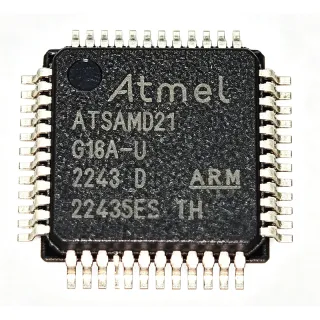
ATMXT1664S-CU - maXTouch 1664-Channel Touch Controller | Microchip
MPN: ATMXT1664S-CU ✗ End of Life| Qty | Unit Price | Extended |
|---|---|---|
| 1 | $6.9 | $6.90 |
| 10 | $6.35 | $63.50 |
| 100 | $5.8 | $580.00 |
| 500 | $5.4 | $2,700.00 |
| 1,000 | $5.05 | $5,050.00 |
ATMXT1664S-CU Overview
A capacitive touch controller is a mixed-signal power management and human-interface IC that drives transmit electrodes, measures mutual capacitance changes on receive electrodes, and applies signal-processing algorithms to report finger or passive-stylus positions. It sits within the human-machine interface (HMI) hierarchy: capacitive touch controller -> sensor interface IC -> mixed-signal IC -> semiconductor. In larger touchscreen systems it replaces discrete MCU-based scanning solutions, offloading touch acquisition from the main application processor.
Key features of the mXT1664S include its 1664-channel sensing matrix, which supports large-format touchscreens with high electrode counts; the S Series architecture with on-chip 32-bit AVR processing for real-time touch decision-making; support for Multi-Touch All Points (MTAP) reporting; and water-rejection and noise-immunity processing designed for challenging electrical environments. Microchip's maXTouch firmware ecosystem provides object-based configuration, so touch tuning is performed via firmware objects rather than hardware redesign.
Technically, the device integrates an analog front end (AFE) with programmable charge amplifiers and a digital back end running Microchip's maXTouch algorithms. The 32-bit AVR core executes acquisition sequencing, noise filtering, and gesture detection, reducing host CPU load. Configuration is stored in an EEPROM-like object space, enabling field updates and multiple panel profiles.
Typical applications include large touchscreens for industrial HMI panels, automotive-grade infotainment displays, point-of-sale terminals, and smart-appliance interfaces, where high electrode counts and robust noise immunity are essential.
Design consideration: maXTouch S Series devices require panel-specific tuning of the acquisition and noise-suppression object settings; plan firmware tuning time into the schedule and confirm the exact package and pinout from the manufacturer datasheet before layout.
This page synthesizes distributor availability, the manufacturer-recommended replacement, and drop-in alternative guidance not consolidated in any single datasheet.
Drop-in alternatives for ATMXT1664S-CU — same package, pin-to-pin compatible. Different-package parts requiring PCB rework are excluded.
Quick Comparison Tool — Select alternative parts for side-by-side comparison:
ATMXT1664T3
✅ Drop-In📋 Reference alternative (not in catalog)
ATMXT1664T
✅ Drop-In ⚠️ 参数待验证📋 Reference alternative (not in catalog)
ATMXT1664S-CU Maximum Ratings & Electrical Characteristics
| Product Series | maXTouch S Series (mXT1664S) |
| Touch Sensing Channels | 1664 |
| Touch Technology | Projected capacitive (mutual capacitance) |
| Core Processor | 32-bit AVR |
| Host Interface | I2C-compatible serial interface |
| Multi-Touch Reporting | Multi-Touch All Points (MTAP) |
| Device Type | Capacitive touchscreen controller IC |
| Water Rejection | Yes (S Series noise/water-rejection processing) |
| Mounting Type | Surface Mount |
| Lifecycle Status | Not recommended for new designs; recommended alternative ATMXT1664T3 per Microchip product page |
ATMXT1664S-CU standard Pin Configuration Guide
Pin configuration for ATMXT1664S-CU (standard package). Pin numbering, functions, and connection diagrams are defined in the manufacturer datasheet. Refer to it for the exact footprint and soldering guidelines.

No detailed pinout data available for ATMXT1664S-CU.
Refer to the datasheet for full pin configuration.
Typical Applications
ATMXT1664S-CU is suitable for 6 applications: Industrial HMI Touch Panels, Automotive Infotainment Touchscreens, Point-of-Sale Terminals, Smart Appliance Control Panels, Medical Device Touch Interfaces, Large Format Display Modules.
Industrial HMI Touch Panels
Large industrial human-machine interface panels use dense electrode matrices that the mXT1664S's 1664 channels can address without host-side scanning. The on-chip 32-bit AVR runs maXTouch acquisition and noise-suppression algorithms continuously, maintaining touch accuracy near variable-frequency drives and switched-mode power supplies common on factory floors. The controller reports validated coordinates over I2C, so the PLC-facing processor spends no cycles on raw signal processing. In this role the IC sits between the bonded sensor stack and the industrial display module, with configuration objects tuned to the panel's specific electrode geometry. For legacy industrial panels already tuned on the S Series, the mXT1664S remains the lowest-risk sourcing option; new industrial designs should start on the recommended ATMXT1664T3 to secure long-term supply.
Recommended
Automotive Infotainment Touchscreens
Center-stack and cluster touchscreens in vehicles demand high electrode counts, aggressive electrical-noise immunity against alternator ripple, and water-rejection behavior when screens are wiped. The mXT1664S's S Series processing addresses these needs: 1664 channels cover large panels, and its noise-suppression objects filter conducted interference picked up by the sensor. The controller's on-chip AVR performs gesture detection locally, reducing CAN/LIN bus traffic and host SoC load in infotainment systems. Designers must tune the noise objects against the vehicle's actual EMC environment, a task the maXTouch tooling supports through configurable firmware objects rather than hardware changes. For new automotive programs, qualify the ATMXT1664T3 recommended by Microchip, retaining the S Series part only for carry-over service of validated, already-tuned designs.
Recommended
Point-of-Sale Terminals
Retail point-of-sale terminals use medium-to-large touchscreens that benefit from the mXT1664S's high channel count and multi-touch all-points reporting, enabling pinch-zoom on receipts, signatures, and promotional interfaces. The controller's water-rejection processing keeps the screen responsive when cleaning fluids or spilled liquids cover the glass - a frequent retail condition. Its I2C host interface integrates directly with the terminal's payment SoC, and the on-chip 32-bit AVR handles gesture recognition so the application processor remains available for transaction security tasks. Integration effort centers on panel tuning with maXTouch configuration objects. Because the S Series is not recommended for new designs, POS makers should adopt the ATMXT1664T3 for new hardware and use the mXT1664S to sustain legacy terminal fleets.
Recommended
Smart Appliance Control Panels
Premium kitchen and laundry appliances increasingly use glass-front touch interfaces spanning large display areas, exactly the scale the mXT1664S's 1664 channels address. Appliance environments combine motor-driven vibration, mains-borne EMI from induction heaters, and condensation from cooking - all conditions targeted by S Series noise-suppression and water-rejection processing. The controller decouples touch acquisition from the main appliance MCU: it scans, filters, and reports gestures over I2C, simplifying certification of the control electronics. Touch tuning via firmware objects allows the same PCB to serve multiple panel sizes across a product family. Given the end-of-development status of the S Series, appliance platforms should migrate to Microchip's recommended ATMXT1664T3 at the next board spin, reusing tuning data as a starting point.
Recommended
Medical Device Touch Interfaces
Diagnostic and monitoring equipment uses large touchscreens that must respond reliably through gloved operation and repeated disinfectant wiping. The mXT1664S provides the electrode capacity for these panels, while its water-rejection object set prevents false touches from cleaning fluids on the display surface. Its local 32-bit AVR processing reports stable, debounced touch coordinates to the medical host, supporting UI responsiveness requirements without burdening the safety-relevant main processor. Because design cycles in medical equipment are long, many in-production devices were qualified on the S Series; for these, the mXT1664S remains the drop-in continuity choice, while new medical designs should baseline the ATMXT1664T3 recommended by Microchip and re-run touch tuning during the regulatory requalification window.
Recommended
Large Format Display Modules
Commercial display modules - digital signage, kiosk monitors, and interactive whiteboards - require capacitive controllers with high channel counts to cover wide sensor matrices. The mXT1664S's 1664 channels and multi-touch all-points output support these formats, and its on-chip processing delivers low-latency touch response across the full panel. The S Series architecture keeps noise suppression adaptive, which matters in signage deployments sharing power with LED backlights and switching supplies. Integration involves connecting the sensor matrix, configuring the object set to the electrode layout, and tuning acquisition parameters for glass thickness and cover-lens materials. Display makers with S Series-qualified modules can continue with the mXT1664S; new module platforms should adopt the ATMXT1664T3 to align with Microchip's current roadmap.
Recommended
Recommended Products Summary
Engineering reference data for ATMXT1664S-CU — comparison, design guidance, and compliance information.
Selection Guide
Comparison with Alternatives
| Parameter | This Product | ATMXT1664T3 | ATMXT1664T |
|---|---|---|---|
| Brand | Microchip Technology | Microchip Technology | Microchip Technology |
| Sensing Channels | 1664 | 1664-class (maXTouch large-panel) | 1664-class (maXTouch large-panel) |
| Series Architecture | S Series | T Series (newer generation) | T Series |
| Core | 32-bit AVR | maXTouch on-chip processing core | maXTouch on-chip processing core |
Key Differentiators
- Highest channel count in its maXTouch generation (vs ATMXT1664T)
- On-chip 32-bit AVR touch processing (vs Discrete MCU touch-scan solutions)
- Honest lifecycle trade-off (vs ATMXT1664T3)
Design Notes
The mXT1664S is not recommended for new designs: Microchip's own product page names ATMXT1664T3 as the recommended alternative. Starting a new PCB on the S Series creates immediate obsolescence risk. For legacy S Series designs, secure residual distributor stock (Octopart reported about 8400 pcs in April 2026) and plan the S-to-T migration, including firmware object re-tuning, into the next board revision.
Capacitive touch controller layout demands careful sensor routing: keep drive (X) and sense (Y) traces separated with ground guard traces where the datasheet requires, minimize trace length mismatches across the matrix, and place the controller as close as practical to the sensor connector. Follow the maXTouch S Series datasheet layout guidelines for ground plane cutouts under the sensor area - a solid plane beneath electrodes adds parasitic capacitance that reduces sensitivity.
maXTouch S Series performance depends heavily on firmware configuration objects (acquisition, noise suppression, water rejection) tuned to the specific panel. Budget engineering time for touch tuning on real hardware: electrode geometry, cover-lens thickness, and ground coupling all shift optimal settings. Microchip tuning tools and the touch sensor vendor's joint tuning support should be engaged early; untreated default settings rarely meet latency and linearity targets on large 1664-channel panels.
Compliance Information
Compliance data not present in verified web data; confirm from Microchip environmental documentation.