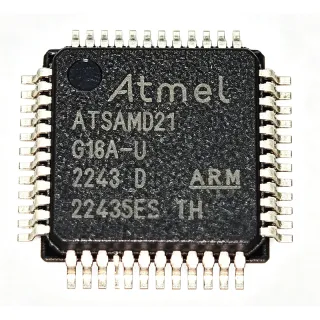
ATMXT224SL-CCUR - maXTouch 224-Channel Touch Controller | Microchip
MPN: ATMXT224SL-CCUR ✓ Active| Qty | Unit Price | Extended |
|---|---|---|
| 1 | $0 | $0.00 |
| 10 | $0 | $0.00 |
| 100 | $0 | $0.00 |
| 500 | $0 | $0.00 |
| 1,000 | $0 | $0.00 |
ATMXT224SL-CCUR Overview
A capacitive touchscreen controller is a specialized mixed-signal interface IC that measures tiny capacitance changes across an electrode grid when a finger or stylus approaches the panel surface. Within the touch-sensing hierarchy, it sits between the passive sensor glass (ITO electrode pattern) and the host processor: the controller drives excitation signals into the sense lines, digitizes the resulting capacitance matrix, performs touch detection and finger tracking in firmware, and reports interpreted touch coordinates to the host over a digital interface. In this role it belongs to the broader family of human-machine interface (HMI) semiconductors alongside button controllers and gesture ICs.
The defining feature of the maXTouch platform, and of this 224-channel part specifically, is its highly scalable sensing architecture: a large node count enables smart processing of capacitive images, supporting multi-touch tracking, stylus operation, and noise immunity on medium-to-large touch panels. Microchip documents that the maXTouch architecture enables intelligent processing of capacitive sensor arrays, which is critical for high signal-to-noise touch performance on displays susceptible to charger and display noise.
Devices in this family integrate the analog front end (charge amplifiers and ADC), the digital signal processing engine for touch detection, and configuration memory in a single chip, reducing bill-of-material complexity versus discrete solutions. Configuration is typically applied through firmware objects that set channel mapping, touch thresholds, and noise filtering parameters.
Typical applications include medium-to-large capacitive touch panels in industrial HMI panels, appliances, smart home controls, and commercial equipment displays where robust multi-touch performance is required.
A key design consideration is sensor layout: electrode routing, trace length matching, and panel stack-up strongly influence sensitivity and noise immunity, so Microchip provides board design files and configuration tools for the maXTouch family that should be used during bring-up.
This page consolidates verified distributor listings, series identification, packaging data, and sourcing guidance for the ATMXT224SL-CCUR, including lifecycle and alternative-part analysis not found on distributor product pages.
Drop-in alternatives for ATMXT224SL-CCUR — same package, pin-to-pin compatible. Different-package parts requiring PCB rework are excluded.
Quick Comparison Tool — Select alternative parts for side-by-side comparison:
ATMXT224SL-CCUT
✅ Drop-In ⚠️ 参数待验证📋 Reference alternative (not in catalog)
ATMXT224SLT-CCUR
✅ Drop-In ⚠️ 参数待验证📋 Reference alternative (not in catalog)
ATMXT224T-CCUR
✅ Drop-In ⚠️ 参数待验证📋 Reference alternative (not in catalog)
ATMXT224SL-CCUR Maximum Ratings & Electrical Characteristics
| Product Type | Capacitive Touchscreen Controller IC |
| Series | maXTouch |
| Number of Sensor Channels | 224 |
| Sensing Technology | Projected Capacitive (PCAP) |
| Touch Sensing Method | Mutual capacitance |
| Mounting Type | Surface Mount |
| Packaging | Tape & Reel |
ATMXT224SL-CCUR standard Pin Configuration Guide
Pin configuration for ATMXT224SL-CCUR (standard package). Pin numbering, functions, and connection diagrams are defined in the manufacturer datasheet. Refer to it for the exact footprint and soldering guidelines.

No detailed pinout data available for ATMXT224SL-CCUR.
Refer to the datasheet for full pin configuration.
Typical Applications
ATMXT224SL-CCUR is suitable for 6 applications: Industrial HMI Touch Panels, Home Appliance Displays, Smart Home Control Panels, Commercial and POS Equipment, Medical Device User Interfaces, Automotive and Transportation Cabin Displays.
Industrial HMI Touch Panels
Industrial human-machine interface panels demand touch controllers that survive electrically noisy factory environments while delivering accurate multi-touch response on medium-to-large displays. The ATMXT224SL-CCUR fits this application because its 224 sensing channels provide a dense capacitive image that Microchip's maXTouch smart processing uses to reject charger noise, display interference, and gloved-finger ambiguity. In a typical topology, the controller connects directly to the ITO electrode matrix of the projected-capacitive panel through short, shielded traces, and reports touch coordinates to the host MCU or SoC over its serial interface. Performance depends heavily on following Microchip's board design files for trace routing and panel stack-up; when configured correctly, the maXTouch architecture maintains touch accuracy even with switching power supplies and backlights operating nearby, which is the primary reason industrial designers specify 224-class maXTouch parts over lower-channel alternatives.
Recommended
Home Appliance Displays
Modern refrigerators, ovens, washing machines, and coffee machines use glass-front projected-capacitive touch panels instead of mechanical keys, requiring a controller that works reliably through thick cover glass and with wet or gloved hands. The ATMXT224SL-CCUR suits this use because 224 channels allow fine-grained electrode matrices that maintain sensitivity through thick overlays, while maXTouch noise-immunity processing copes with the strong EMI generated by inverter compressors and motor drives inside appliances. In the signal chain, the touch IC sits behind the display module and communicates with the appliance main controller; configuration objects tune thresholds for water rejection and glove detection. Designers should validate the panel with wet-hand testing per their product requirements, using Microchip's maXTouch configuration tools to iterate gain and filter settings until reliable activation is achieved with the final production cover lens and adhesive stack.
Recommended
Smart Home Control Panels
Wall-mounted smart home thermostats, lighting controllers, and security keypads increasingly use capacitive touch displays in the 4-inch to 10-inch class, which is the typical electrode-count range served by a 224-channel controller. The ATMXT224SL-CCUR provides the sensing resolution needed for precise, responsive touch zones and gesture support while its maXTouch signal processing suppresses noise from Wi-Fi modules, dimmed LED drivers, and AC mains coupling common in wall boxes. Integration follows the standard pattern: the sensor glass electrode tails bond to the controller board, and the IC reports touch data to the panel's wireless SoC or MCU. Because these products run continuously, designers should verify the controller's supply current and power-management features in the Microchip datasheet and implement sleep/active cycling through the firmware configuration to meet energy budgets without sacrificing wake-up responsiveness.
Recommended
Commercial and POS Equipment
Point-of-sale terminals, self-service kiosks, and retail payment terminals require touch input that remains accurate under continuous public use, including stylus signatures and multi-touch gestures on 7-inch to 15-inch displays. The ATMXT224SL-CCUR is appropriate for the mid-size end of this range because its 224 mutual-capacitance nodes deliver the spatial resolution needed for signature capture and the capacitive-image processing needed to ignore water droplets and resting palms. In a POS design, the controller typically interfaces to the terminal's main compute module while the display is driven separately; keeping the touch and display grounds star-connected prevents LCD noise from degrading signal-to-noise ratio. Microchip's maXTouch firmware objects allow vendor-specific tuning for stylus size and palm rejection, so plan a calibration pass with production units before release, and source the tape-and-reel packaging for automated assembly of high-volume retail hardware.
Recommended
Medical Device User Interfaces
Medical monitors, infusion pump panels, and diagnostic equipment interfaces use projected-capacitive touch because it allows sealed, disinfectant-wipeable glass fronts with no mechanical crevices. The ATMXT224SL-CCUR supports this application's requirements: a 224-channel matrix gives dependable touch detection through the thick, chemically hardened cover glass used in medical enclosures, and maXTouch noise filtering maintains accuracy near the switching supplies and RF circuitry present in patient-connected devices. Electrical integration follows the standard maXTouch topology with the controller mounted on the display assembly and communicating with the device's safety MCU; designers must validate performance under the device's actual EMC test plan and verify the operating temperature and supply specifications in the Microchip datasheet. Firmware configuration enables glove-mode operation for clinical staff, and the tape-and-reel format supports the traceability requirements of medical contract manufacturing.
Recommended
Automotive and Transportation Cabin Displays
Center-stack touchscreens, climate control panels, and rear-seat entertainment displays in vehicles and commercial transport demand touch controllers certified for wide temperature ranges and hostile EMC environments. The ATMXT224SL-CCUR's 224-channel maXTouch architecture is applicable to mid-size cabin panels where high node density is needed for accurate touch through thick, optically bonded cover lenses, and its noise-immunity processing addresses the severe radiated and conducted interference from inverters, radios, and engine electronics. In-vehicle integration places the controller near the display with guarded sense routing and typically an SPI or I2C link to the body-domain controller. Designers must confirm the exact automotive qualification status of this ordering code before design-in, since suffixes within the maXTouch family differentiate commercial and automotive grades; consult the Microchip product page and datasheet for the qualified variant and its AEC qualification level.
Recommended
Recommended Products Summary
Engineering reference data for ATMXT224SL-CCUR — comparison, design guidance, and compliance information.
Selection Guide
Comparison with Alternatives
| Parameter | This Product | ATMXT224SL-CCUT | ATMXT224SLT-CCUR | ATMXT224T-CCUR |
|---|---|---|---|---|
| Brand | Microchip Technology | Microchip Technology | Microchip Technology | Microchip Technology |
| Sensor Channels | 224 | 224 | 224 | 224 |
| Series | maXTouch | maXTouch | maXTouch | maXTouch |
| Sensing Technology | Projected capacitive, mutual | Projected capacitive, mutual | Projected capacitive, mutual | Projected capacitive, mutual |
| Packaging | Tape & Reel | Tray | Tape & Reel | Tape & Reel |
| Lifecycle Status | Active (verify) | Active (verify) | Active (verify) | Family under migration guidance - see ATMXT336U note |
Key Differentiators
- High channel density for larger panels (vs ATMXT224T-CCUR)
- Tape-and-reel assembly support (vs ATMXT224SL-CCUT)
- Migration path documented by manufacturer (vs ATMXT336U)
Design Notes
Touch controller performance is dominated by sensor routing: keep the traces from the maXTouch IC to the ITO electrode tails as short and uniform as possible, route them on inner layers guarded by ground, and avoid running them parallel to display flex or backlight power lines. Microchip provides maXTouch board design files and reference designs through the ATMXT224SL product page; reuse these layouts during bring-up rather than creating a first-pass custom sensor board, and only deviate after bench-validating signal-to-noise ratio with the production panel.
maXTouch controllers are firmware-configured: touch behavior (thresholds, channel mapping, glove/water rejection, stylus settings) lives in configuration objects, not just hardware. A common failure is migrating to an apparently equivalent part number and assuming the existing configuration file will apply unchanged. Always re-verify the configuration compatibility for the exact ordering code, and keep versioned configuration binaries in your build system. Also confirm suffix meanings (-CCUR grading/packing) from the Microchip ordering information before purchase, since broker listings sometimes conflate suffixes.
Decouple the touch controller's analog supply close to the pin with low-ESR ceramic capacitors and provide a clean, low-noise rail separate from display and backlight supplies. Switching regulators feeding the display can couple into the sense lines through shared ground returns, degrading signal-to-noise ratio; a star ground with a dedicated touch ground plane is best practice. Verify the exact supply voltage range and quiescent current from the official Microchip datasheet before finalizing the power tree, since these values are not captured in the data verified here.
Compliance Information
One broker listing shows an unreadable RoHS status field for this part; compliance must be confirmed from the official Microchip product page or certificate of conformance.