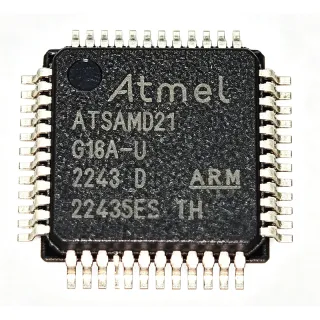
ATMXT154E-CCU - maXTouch 154-Ch Touch Controller | Microchip
MPN: ATMXT154E-CCU ✓ Active| Qty | Unit Price | Extended |
|---|---|---|
| 1 | $6.2 | $6.20 |
| 10 | $5.62 | $56.20 |
| 100 | $4.95 | $495.00 |
| 500 | $4.45 | $2,225.00 |
| 1,000 | $3.98 | $3,980.00 |
ATMXT154E-CCU Overview
A capacitive touch controller (also called a touch screen sensor IC or touch screen converter) is a mixed-signal device that excites rows and columns of a transparent ITO electrode pattern, measures mutual-capacitance changes caused by a finger or stylus, and processes those measurements on-chip to output touch coordinates over a digital host interface. Within the system hierarchy, it sits above the raw touch sensor stack and below the host application processor, forming part of the human-machine interface (HMI) subsystem.
Key differentiators of the ATMXT154E family include its high sensor channel count of 154 lines, support for multi-touch reporting, integrated touch-processing firmware that offloads the host CPU, and Microchip's maXTouch signal-processing algorithms for moisture tolerance and noise immunity in demanding environments. The BGA49 package keeps the footprint compact behind the display module.
Architecturally, the maXTouch devices integrate an analog front end (AFE) with charge amplifiers and ADC, a digital signal-processing engine executing touch detection and tracking, and a serial interface to the host. Configuration objects stored in the device's non-volatile memory allow tuning of thresholds, report rates, and sensor geometry without external components.
Typical applications include automotive center-stack and climate-control touch displays, industrial HMI panels, large-format human-machine interfaces in appliances, and commercial touch monitors where 100+ channel panels require high signal-to-noise-ratio sensing.
When designing with the ATMXT154E-CCU, the touch panel stack-up, ITO pattern geometry, and grounding of adjacent display electronics must match the family design guidelines; sensor tuning through the maXTouch configuration files is normally required and should be validated with the actual panel and display assembly.
This page synthesizes distributor pricing and availability, drop-in family alternatives, and practical design guidance not consolidated in the manufacturer datasheet, with all uncertain values explicitly flagged rather than estimated.
Drop-in alternatives for ATMXT154E-CCU — same package, pin-to-pin compatible. Different-package parts requiring PCB rework are excluded.
Quick Comparison Tool — Select alternative parts for side-by-side comparison:
ATMXT154E-CCUR
✅ Drop-In📋 Reference alternative (not in catalog)
ATMXT154E-CCUI
✅ Drop-In📋 Reference alternative (not in catalog)
ATMXT154E-CCU-ES-X
✅ Drop-In📋 Reference alternative (not in catalog)
ATMXT154E-MAH
✅ Drop-In📋 Reference alternative (not in catalog)
ATMXT154CU-520
✅ Drop-In📋 Reference alternative (not in catalog)
ATMXT154E-CCU Maximum Ratings & Electrical Characteristics
| Product Type | Capacitive Touch Screen Controller |
| Sensor Channels | 154 |
| Touch Technology | Projected Capacitive (maXTouch) |
| Package | BGA-49 (CCU) |
| Mounting Type | Surface Mount |
| RoHS Status | ROHS3 Compliant |
| Packaging | Tray |
| Manufacturer Series | maXTouch |
ATMXT154E-CCU bga-49 (ccu) Pin Configuration Guide
Pin configuration for ATMXT154E-CCU (bga-49 (ccu) package). Pin numbering, functions, and connection diagrams are defined in the manufacturer datasheet. Refer to it for the exact footprint and soldering guidelines.

No detailed pinout data available for ATMXT154E-CCU.
Refer to the datasheet for full pin configuration.
Typical Applications
ATMXT154E-CCU is suitable for 6 applications: Automotive Center-Stack Touch Display, Industrial HMI Touch Panels, Appliance and White-Goods Touch User Interfaces, Commercial Touch Monitors and Kiosks, Medical Device Touch Interfaces, Smart Home and Building Automation Panels.
Automotive Center-Stack Touch Display
The ATMXT154E-CCU fits automotive center-stack HMI panels because its 154 sensing channels cover the dense mutual-capacitance matrix typical of 8-to-12-inch resistive-noise-prone in-vehicle touchscreens. maXTouch signal processing suppresses display-induced noise from LCD and OLED backlight inverters and tolerates water droplets, a common false-touch source in cabin environments. The controller sits between the ITO sensor stack and the head-unit SoC, reporting processed multi-touch coordinates over a serial link, which offloads touch tracking from the main processor. Tuning via Microchip configuration objects should be validated against the actual display module to meet automotive EMC and braid-noise requirements.
Recommended
Industrial HMI Touch Panels
Industrial operator panels benefit from the ATMXT154E-CCU's high channel count and noise immunity, since factory floors combine motors, variable-frequency drives, and switching supplies that inject common-mode noise into capacitive sensors. With 154 lines, the controller supports large-format glass-film-film or glass-glass stacks used in machine interfaces, and its on-chip processing maintains stable touch tracking while the PLC or embedded host focuses on control logic. Glove-touch performance can be tuned through sensitivity configuration objects. The BGA49 package integrates behind the display module, keeping the HMI stack thin. Grounding of the sensor shield and chassis should follow maXTouch design guidelines for reliable ESD and EMI behavior.
Recommended
Appliance and White-Goods Touch User Interfaces
Modern ovens, refrigerators, washing machines, and cooktops use glass-over-sensor capacitive UIs where the 154-channel ATMXT154E-CCU drives wide touch matrices spanning slider bars, rotary-emulating rings, and button arrays. maXTouch moisture tolerance is critical because condensation and water spills on glass routinely cause false touches with lesser controllers; on-chip algorithms discriminate water from finger contact. The controller's integrated configuration memory allows field-variant UI geometry without hardware changes, and the compact BGA49 package fits behind curved glass. Host communication uses a serial interface to the appliance MCU, and report-rate configuration balances responsiveness against power in always-on standby modes.
Recommended
Commercial Touch Monitors and Kiosks
Interactive kiosks, point-of-sale terminals, and commercial touch monitors employ large projected-capacitive panels whose line counts exceed the budgets of mainstream touch ICs; the ATMXT154E-CCU's 154 channels support these bigger matrices with high signal-to-noise ratio. Continuous-duty kiosk operation demands stable performance across temperature and against interference from power supplies and nearby displays, which maXTouch noise filtering addresses. The controller reports multi-touch gestures to the host over a digital interface, and its integrated tracking frees host resources for the kiosk application. Panel geometry and thresholds are tuned via Microchip configuration files, and final validation should use the assembled monitor with its display and cover glass installed.
Recommended
Medical Device Touch Interfaces
Patient monitors, infusion pumps, and diagnostic equipment increasingly rely on capacitive touchscreens for sealed, easy-to-disinfect front panels, and the ATMXT154E-CCU supports these designs with 154 channels for medium-to-large displays and reliable sensing through thick cover glass. Because medical devices must not false-trigger from cleaning fluids or gloved hands, maXTouch moisture handling and tunable sensitivity thresholds are decisive advantages. The controller's deterministic touch reporting and on-chip processing reduce host-side latency, important for alarm interactions. Configurations can be locked in the device's memory, supporting design control and validation documentation. EMC behavior near medical-grade switching supplies should be verified during system-level testing.
Recommended
Smart Home and Building Automation Panels
Wall-mounted smart home thermostats, security keypads, and room controllers use sleek glass touch surfaces; the ATMXT154E-CCU serves larger or high-resolution versions of these panels where the electrode matrix exceeds 100 lines. Its 154-channel capacity covers button arrays combined with slider and wheel widgets on a single sensor, while integrated noise filtering keeps operation stable near Wi-Fi modules and lighting dimmers that inject interference. The controller's low host burden suits always-on panels powered by constrained supplies, and configurable report rates allow power saving when the panel is idle. The BGA49 footprint integrates behind flat or curved glass, enabling flush, bezel-free industrial designs common in premium building automation products.
Recommended
Recommended Products Summary
Engineering reference data for ATMXT154E-CCU — comparison, design guidance, and compliance information.
Selection Guide
Comparison with Alternatives
| Parameter | This Product | ATMXT154E-CCUR | ATMXT154E-CCUI | ATMXT154E-CCU-ES-X | ATMXT154E-MAH | ATMXT154CU-520 |
|---|---|---|---|---|---|---|
| Package | BGA-49 (CCU) | BGA-49 (CCU) - same | BGA-49 (CCU) - same | BGA-49 (CCU) - same | BGA-49 (CCU) - same | BGA-49 (CCU) - same |
| Brand | Microchip Technology | Microchip Technology | Microchip Technology | Microchip (Atmel legacy) | Microchip Technology | Microchip Technology |
| Sensor Channels | 154 | 154 | 154 | 154 (ES grade) | 154 | 154 |
| Multi-Touch / Family | maXTouch 154-channel | maXTouch 154-channel | maXTouch 154-channel | maXTouch 154-channel | maXTouch 154-channel | maXTouch 154-channel |
Key Differentiators
- Production-grade silicon (vs ATMXT154E-CCU-ES-X)
- Tray packaging for in-circuit programming flows (vs ATMXT154E-CCUR)
- 154-channel capacity in compact BGA49 (vs Lower-channel maXTouch controllers)
Design Notes
Place the ATMXT154E-CCU as close as possible to the touch sensor flex or PCB connector, keeping sensor line routing short and away from display flex cables. The 49-ball BGA requires a defined land pattern per the datasheet package section; follow Microchip maXTouch layout guidelines for via-in-pad or dog-bone fanout. Dedicate a solid ground plane under the controller region and route sensor traces on layers shielded from switching converter nodes to protect the measured mutual-capacitance signal from coupled noise.
Power the touch controller from a clean, low-noise rail separated from the display backlight and DC-DC converter supplies. Add local decoupling at the supply balls per the datasheet recommendations, and star-route the ground return to the analog ground plane. Because touch measurement accuracy depends directly on supply noise, an LC filter or dedicated LDO for the maXTouch analog domain measurably improves signal-to-noise ratio versus sharing a noisy digital rail.
The most frequent maXTouch integration failure is skipping panel-specific configuration tuning: default configuration objects rarely match the production sensor geometry, causing ghost touches or missed touches. Always generate a configuration file from the actual panel stack-up, write it to device non-volatile memory, and validate with the final display powered on. Also beware substituting ES-grade parts (e.g., ATMXT154E-CCU-ES-X) into production builds - engineering samples lack production qualification.
Compliance Information
ROHS3 Compliant per distributor listing (ics-embedded.com). REACH, lead-free, halogen-free, and conflict-minerals status must be confirmed from Microchip official compliance documentation for this ordering code.