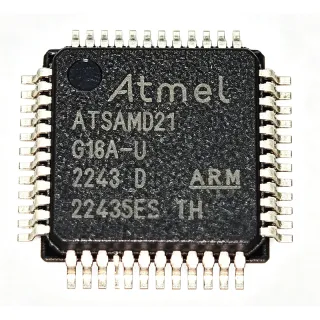
ATSAM4LC2AA-AUR - 48MHz Cortex-M4 MCU, 128KB Flash | Microchip
MPN: ATSAM4LC2AA-AUR ✓ Active| Qty | Unit Price | Extended |
|---|---|---|
| 1 | $5.12 | $5.12 |
| 10 | $4.63 | $46.30 |
| 100 | $4.08 | $408.00 |
| 500 | $3.72 | $1,860.00 |
| 1,000 | $3.35 | $3,350.00 |
ATSAM4LC2AA-AUR Overview
A microcontroller unit (MCU) is a single integrated circuit that combines a processor core, memory, and programmable peripherals into one chip, sitting at the heart of embedded systems as part of the wider hierarchy of semiconductor devices: MCU -> 32-bit MCU -> ARM Cortex-M MCU -> flash microcontroller. The SAM4L family positions itself at the low-power end of the 32-bit MCU spectrum, targeting battery-powered and energy-harvesting designs.
Key differentiating features include the hardware-based Peripheral Event System that lets peripherals communicate without CPU intervention, a built-in LCD controller for segment and dot-matrix glass, AES/DES hardware cryptography, and a flexible, low-leakage power architecture with multiple sleep modes and a Backup mode drawing under 1 uA. Peripherals include USB (device/host), TWI/I2C, SPI, UART/USART, an ADC, and multiple timers.
Architecturally, the Cortex-M4 core with integrated NVIC and single-cycle multiply executes from flash with a prefetch buffer, while the PDCA (Peripheral DMA Controller) offloads data movement from the CPU, directly enabling the 90 uA/MHz figure by shortening active periods. The SCIF (System Control Interface) manages oscillators, PLLs, and the DFLL for flexible clocking at minimal power.
Typical applications include battery-powered metering, wearable and handheld devices with LCD glass, sensor nodes, and low-power industrial control. The LCD controller plus cryptography make it especially strong for smart meters and secure portable products.
Design consideration: exploit the Peripheral Event System and sleep modes aggressively; keeping the CPU asleep between events is the primary path to the datasheet power figures.
This page synthesizes distributor pricing, drop-in alternatives, and practical design notes not found in the manufacturer datasheet.
Drop-in alternatives for ATSAM4LC2AA-AUR — same package, pin-to-pin compatible. Different-package parts requiring PCB rework are excluded.
Variants in this series
Same-series models that are drop-in compatible with ATSAM4LC2AA-AUR (same form factor and footprint) — differing in Flash Memory, Operating Temperature, Core Size, Peripherals, Supply Voltage.
Quick Comparison Tool — Select alternative parts for side-by-side comparison:
ATSAM4LC4AA-AUR
✅ Drop-In📋 Reference alternative (not in catalog)
ATSAM4LS2AA-AUR
✅ Drop-In ⚠️ 参数待验证✓ In Stock
$1.58 / Unit
View Datasheet →ATSAM4LS4AA-AUR
✅ Drop-In ⚠️ 参数待验证✓ In Stock
$3.98 / Unit
View Datasheet →ATSAM4LC8AA-AUR
✅ Drop-In ⚠️ 参数待验证📋 Reference alternative (not in catalog)
ATSAM4N8AA-AUR
✅ Drop-In📋 Reference alternative (not in catalog)
ATSAM4LC2AA-AUR Maximum Ratings & Electrical Characteristics
| Core Processor | ARM Cortex-M4 |
| Core Size | 32-bit |
| Maximum Clock Frequency | 48 MHz |
| Flash Memory | 128 KB (128K x 8) |
| SRAM | 32 KB |
| Supply Voltage | 1.62 V to 3.6 V (1.8 V / 2.5 V / 3.3 V) |
| Active Mode Current | 90 uA/MHz |
| Sleep Mode Current | 1.5 uA |
| Wake-up Time | down to 1.5 us |
| Package | 48-TQFP (7x7 mm) |
| Mounting Type | Surface Mount |
| Operating Temperature | -40C to +85C (industrial) |
| Peripherals | LCD controller, USB device/host, hardware cryptography (AES/DES), DMA (PDCA), Peripheral Event System |
| Communication Interfaces | I2C (TWI), SPI, UART/USART, USB |
| Connectivity | USB |
| Packaging | Tape & Reel (R suffix) |
| RoHS Status | Compliant (GREEN, MRL A) |
ATSAM4LC2AA-AUR Pin Configuration
| Pin 1 | GND — Digital ground |
| Pin 2 | VDDCORE — Core logic supply |
| Pin 3 | VDDIN — Main supply input to on-chip regulator |
| Pin 4 | PA00 — GPIO port A / peripheral function |
| Pin 5 | PA01 — GPIO port A / peripheral function |
| Pin 6 | PA02 — GPIO port A / peripheral function |
| Pin 7 | PA03 — GPIO port A / peripheral function |
| Pin 8 | PA04 — GPIO port A / peripheral function |
| Pin 9 | PA05 — GPIO port A / peripheral function |
| Pin 10 | PA06 — GPIO port A / peripheral function |
| Pin 11 | PA07 — GPIO port A / peripheral function |
| Pin 12 | PA08 — GPIO port A / peripheral function |
| Pin 13 | PA09 — GPIO port A / peripheral function |
| Pin 14 | PA10 — GPIO port A / peripheral function |
| Pin 15 | PA11 — GPIO port A / peripheral function |
| Pin 16 | PA12 — GPIO port A / peripheral function |
| Pin 17 | PA13 — GPIO port A / peripheral function |
| Pin 18 | PA14 — GPIO port A / peripheral function |
| Pin 19 | PA15 — GPIO port A / peripheral function |
| Pin 20 | PA16 — GPIO port A / peripheral function |
| Pin 21 | PA17 — GPIO port A / peripheral function |
| Pin 22 | PA18 — GPIO port A / peripheral function |
| Pin 23 | PA19 — GPIO port A / peripheral function |
| Pin 24 | GND — Digital ground |
| Pin 25 | VDDIO — I/O supply |
| Pin 26 | PA20 — GPIO port A / peripheral function |
| Pin 27 | PA21 — GPIO port A / peripheral function |
| Pin 28 | PA22 — GPIO port A / peripheral function |
| Pin 29 | PA23 — GPIO port A / peripheral function |
| Pin 30 | PA24 — GPIO port A / peripheral function |
| Pin 31 | PA25 — GPIO port A / peripheral function |
| Pin 32 | PA26 — GPIO port A / peripheral function |
| Pin 33 | PA27 — GPIO port A / peripheral function |
| Pin 34 | PA28 — GPIO port A / peripheral function |
| Pin 35 | XIN32 — 32.768 kHz crystal input (RTC/oscillator) |
| Pin 36 | XOUT32 — 32.768 kHz crystal output |
| Pin 37 | VDDA — Analog supply (ADC/oscillators) |
| Pin 38 | GNDA — Analog ground |
| Pin 39 | XIN0 — Main crystal oscillator input |
| Pin 40 | XOUT0 — Main crystal oscillator output |
| Pin 41 | PA29 — GPIO port A / peripheral function |
| Pin 42 | PA30 — GPIO port A / peripheral function |
| Pin 43 | PA31 — GPIO port A / peripheral function |
| Pin 44 | PB00 — GPIO port B / peripheral function |
| Pin 45 | PB01 — GPIO port B / peripheral function |
| Pin 46 | PB02 — GPIO port B / peripheral function |
| Pin 47 | VDDIO — I/O supply |
| Pin 48 | VDDIO — I/O supply |
Typical Applications
ATSAM4LC2AA-AUR is suitable for 6 applications: Battery-Powered Smart Metering, Wearable and Handheld Devices, Industrial Sensor Nodes and IoT Endpoints, Secure Portable Access and Authentication Devices, Medical Monitoring and Diagnostic Portables, Consumer Appliance User Interfaces.
Battery-Powered Smart Metering
Smart water, gas, and energy meters benefit directly from the ATSAM4LC2AA-AUR's power profile: at 90 uA/MHz active and 1.5 uA sleep, the device can wake on a flow-pulse Peripheral Event, run an ADC sampling burst, update the segment LCD, and return to sleep within milliseconds, keeping the average current in the low-uA range and enabling 10+ year battery life from a lithium cell. The integrated LCD controller drives the meter glass without a companion driver IC, cutting BOM cost, while on-chip AES/DES cryptography secures consumption data and tamper flags for utility-grade security compliance. The Peripheral DMA Controller moves ADC and communication data without CPU involvement, further shortening active windows and protecting the energy budget.
Recommended
Wearable and Handheld Devices
Wearables and handheld instruments require a Cortex-M4-class CPU with minimal energy draw and an integrated display interface - exactly the ATSAM4LC2AA-AUR's combination. The 1.5 us wake-up time lets the device respond instantly to a button press or accelerometer interrupt while spending the vast majority of time in 1.5 uA sleep, and the LCD controller drives segment or simple dot-matrix glass directly at low voltage. Operating from 1.62 V to 3.6 V allows a direct coin-cell or single-cell LiSOCl2 connection without a boost converter, reducing quiescent losses. The 128 KB flash accommodates BLE module host code and UI logic, while the 48 MHz core headroom handles signal-processing tasks such as PPG filtering that a Cortex-M0+ wearable MCU would struggle to complete efficiently.
Recommended
Industrial Sensor Nodes and IoT Endpoints
In industrial sensor nodes the ATSAM4LC2AA-AUR bridges acquisition and communication: the 12-bit ADC samples process variables, the PDCA streams data to memory, and a USART/SPI link transfers readings to a radio module, all while the Peripheral Event System triggers conversions from timer events without waking the CPU unnecessarily. Industrial -40C to +85C temperature grading and RoHS GREEN, MRL-A construction suit factory and outdoor deployments. The AES hardware engine encrypts payloads for secure MQTT or LoRaWAN uplinks at negligible CPU cost, and the 48 MHz Cortex-M4 executes calibration and compensation math (FFT filtering, linearization) locally. The 32 KB SRAM provides adequate buffering for burst acquisition between radio transmissions.
Recommended
Secure Portable Access and Authentication Devices
Portable authentication tokens, secure keypads, and access-control readers leverage the ATSAM4LC2AA-AUR's hardware cryptography: AES and DES engines perform encryption in silicon rather than software, protecting keys against timing side-channel extraction and freeing CPU cycles. The LCD controller displays status on low-cost segment glass, the USB device port supports direct connectivity to hosts for credential provisioning, and sleep-mode consumption of 1.5 uA keeps the token alive for years on a coin cell. The industrial temperature range covers outdoor reader installations, and the 48 MHz Cortex-M4 with single-cycle multiply handles elliptic-curve helper math in firmware on top of the symmetric hardware engines, giving designers a balanced secure-embedded platform.
Recommended
Medical Monitoring and Diagnostic Portables
Portable medical monitors - pulse oximeters, glucose loggers, and vital-sign recorders - fit the ATSAM4LC2AA-AUR well. The low-noise, wide-supply ADC digitizes biosignals, the Cortex-M4 DSP instructions execute filtering algorithms, and the LCD controller renders readings without a display driver, reducing leakage paths on patient-adjacent hardware. The 90 uA/MHz efficiency and 1.5 uA sleep current extend battery replacement intervals, an important usability factor in home-care devices, while wake-up within 1.5 us supports event-driven logging triggered by patient activity. The on-chip AES engine helps protect patient data in transit over USB, aligning with health-data privacy expectations. Single 3 V coin-cell operation is possible thanks to the 1.62 V minimum supply.
Recommended
Consumer Appliance User Interfaces
Appliance control panels and remote controls use the ATSAM4LC2AA-AUR to combine touch input, LCD feedback, and communication in one chip. GPIO and timer peripherals scan capacitive or membrane keys, the LCD controller drives the panel display, and a USART or TWI interface reports commands to the main appliance controller - eliminating a separate display driver and keyboard encoder. The 48 MHz core leaves ample margin for gesture decoding and UI state machines, and the 128 KB flash holds localization assets for multi-language products. RoHS GREEN, MRL-A manufacturing status simplifies global regulatory clearance for consumer shipments, while 1.62 V operation supports single-cell remote designs and the 1.5 uA sleep figure ensures remote-control batteries meet multi-year shelf-life expectations.
Recommended
Recommended Products Summary
Engineering reference data for ATSAM4LC2AA-AUR — comparison, design guidance, and compliance information.
Selection Guide
Comparison with Alternatives
| Parameter | This Product | ATSAM4LC4AA-AUR | ATSAM4LS2AA-AUR | ATSAM4N8AA-AUR |
|---|---|---|---|---|
| Package | 48-TQFP (7x7 mm) | 48-TQFP (7x7 mm) - same | 48-TQFP (7x7 mm) - same | 48-TQFP (7x7 mm) - same |
| Brand | Microchip Technology | Microchip Technology | Microchip Technology | Microchip Technology |
| Core / Frequency | ARM Cortex-M4 @ 48 MHz | ARM Cortex-M4 @ 48 MHz | ARM Cortex-M4 @ 48 MHz | ARM Cortex-M4 @ 120 MHz |
| Flash Memory | 128 KB | 256 KB | 128 KB | 512 KB |
| SRAM | 32 KB | 32 KB | 32 KB | 80 KB |
| LCD Controller | Yes | Yes | Yes | No |
| Hardware Crypto (AES/DES) | Yes | Yes | Yes | No |
| Operating Temperature | -40C to +85C | -40C to +85C | -40C to +85C | -40C to +85C |
Key Differentiators
- Integrated segment LCD controller (vs ATSAM4N8AA-AUR)
- On-chip AES/DES cryptography (vs ATSAM4N8AA-AUR)
- Class-leading low-power figures for Cortex-M4 (vs ATSAM4N8AA-AUR)
- Pin-compatible flash scalability within family (vs ATSAM4LC4AA-AUR)
Design Notes
The SAM4L uses separate VDDCORE (regulated internally from VDDIN), VDDIO, and VDDA domains. Place 100 nF ceramic decoupling capacitors directly at each supply pin pair plus one 4.7 uF bulk capacitor per rail. Connect VDDA to a clean analog supply or an RC/LC filter from VDDIO; ADC accuracy degrades noticeably when digital switching noise couples into VDDA. Keep GNDA as a quiet island joined to digital ground at a single point under the device.
Route the 32.768 kHz crystal (XIN32/XOUT32) with short traces, guard it with ground, and keep load capacitors close to the pins; this clock feeds the RTC and low-power sleep timing, so poor layout directly worsens sleep current. Similarly, keep the main oscillator (XIN0/XOUT0) loop compact. The TQFP48 0.5 mm pitch requires solder-mask-defined pads per Microchip landing pattern recommendations; verify with IPC-compliant footprint data before panelizing.
To actually achieve 90 uA/MHz and 1.5 uA sleep, you must configure unused GPIOs as inputs with pull-downs disabled or outputs driven to defined levels, disable unused peripheral clocks via the PM/SCIF clock mask registers, and select the correct sleep mode - deep sleep modes require the appropriate wake source (EIC, AST, or TC) to be pre-configured. Firmware that leaves the DFLL or unused oscillators running after boot is the most common cause of measured current being 10x the datasheet figure.
Compliance Information
Listed as GREEN, IND TEMP, MRL A by Mouser, indicating RoHS-compliant, halogen-free green packaging with industrial moisture sensitivity level. REACH and conflict-minerals status not stated in provided data.