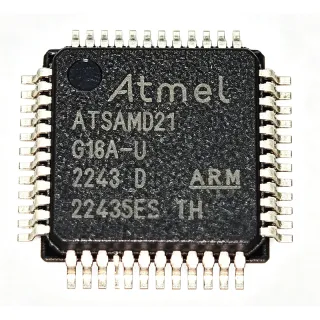
ATSAM4LS4AA-AUR - 48MHz Cortex-M4 MCU, 256KB Flash | Microchip
MPN: ATSAM4LS4AA-AUR ✓ Active| Qty | Unit Price | Extended |
|---|---|---|
| 1 | $5.8 | $5.80 |
| 10 | $5.28 | $52.80 |
| 100 | $4.79 | $479.00 |
| 500 | $4.35 | $2,175.00 |
| 1,000 | $3.98 | $3,980.00 |
ATSAM4LS4AA-AUR Overview
A microcontroller (MCU) is a single-chip computer that integrates a processor core, non-volatile Flash program memory, SRAM data memory, and a rich set of peripherals such as timers, serial interfaces, and analog converters. Within the power-management hierarchy of embedded systems, an MCU is the central control element that orchestrates sensors, communication, and user interfaces. The ATSAM4LS4AA-AUR belongs to Microchip's (formerly Atmel) SAM4L family, a line of ultra-low-power ARM Cortex-M4 Flash microcontrollers positioned above the SAM D20 Cortex-M0+ series and alongside Cortex-M4 competitors from other vendors.
The defining feature of the ATSAM4LS4AA-AUR is class-leading power efficiency: 90 uA/MHz in active mode, 1.5 uA in sleep mode, and wake-up times down to 1.5 us - the shortest in a Cortex-M4 device according to the manufacturer. This combination of low active power and instant wake-up makes it possible to duty-cycle demanding DSP workloads from coin cells or energy-harvesting supplies. The device also integrates a USB device controller, a peripheral event system that routes signals between peripherals without CPU intervention, and the innovative SleepWalking feature, which lets peripherals wake the core only when preprogrammed conditions are met.
The crypto-capable variant designated by the MRL/CRYPTO suffix adds hardware security acceleration, offloading symmetric and hash operations from software. Operating from a 1.8V to 3.3V supply (per FindIC specification data), the industrial-temperature-grade part suits -40C to +85C environments.
Typical applications include battery-powered sensor nodes, portable medical devices, industrial control panels, and USB-connected data loggers - all scenarios where both 32-bit compute (single-cycle MAC, hardware divide for Cortex-M4 DSP instructions) and microamp sleep currents are mandatory.
For design, exploit the SleepWalking and peripheral event system to keep the CPU asleep; the wake-up penalty of only 1.5 us means aggressive power gating rarely impacts responsiveness. Size the decoupling network per the SAM4L datasheet recommendations for the 48-TQFP power pins.
This page synthesizes distributor pricing, drop-in family alternatives, and practical low-power design guidance not consolidated in the manufacturer datasheet, giving engineers a single citable reference for the ATSAM4LS4AA-AUR.
Drop-in alternatives for ATSAM4LS4AA-AUR — same package, pin-to-pin compatible. Different-package parts requiring PCB rework are excluded.
Variants in this series
Same-series models that are drop-in compatible with ATSAM4LS4AA-AUR (same form factor and footprint) — differing in Package, RoHS Status, Operating Temperature, Packaging, Series.
Quick Comparison Tool — Select alternative parts for side-by-side comparison:
No drop-in alternatives available for this product.
Request AlternativesATSAM4LS4AA-AUR Maximum Ratings & Electrical Characteristics
| Core Processor | ARM Cortex-M4 |
| Core Size | 32-bit |
| Maximum Clock Frequency | 48 MHz |
| Flash Memory | 256KB (256K x 8) |
| Program Memory Type | Flash |
| Supply Voltage | 1.8V / 3.3V |
| Number of Pins | 48 |
| Package | 48-TQFP (7x7 mm) |
| Mounting Type | Surface Mount |
| Operating Temperature | Industrial (-40C to +85C) |
| Active Mode Current | 90 uA/MHz |
| Sleep Mode Current | 1.5 uA |
| Wake-up Time | Down to 1.5 us |
| USB | USB device controller |
| Special Features | Crypto acceleration, Peripheral Event System, SleepWalking |
| Packaging | Tape & Reel (R suffix) |
ATSAM4LS4AA-AUR 48-tqfp (7x7 mm) Pin Configuration Guide
Pin configuration for ATSAM4LS4AA-AUR (48-tqfp (7x7 mm) package). This digital IC includes GPIO, communication interfaces (UART, SPI, I2C), and power pins. Refer to the manufacturer datasheet for alternate pin functions and configuration options. Essential for embedded system design and PCB layout.

No detailed pinout data available for ATSAM4LS4AA-AUR.
Refer to the datasheet for full pin configuration.
Typical Applications
ATSAM4LS4AA-AUR is suitable for 6 applications: Battery-Powered IoT Sensor Nodes, Portable Medical Monitoring Devices, USB Data Loggers and Field Instruments, Industrial Control and HMI Panels, Secure Embedded Systems and Firmware Protection, Energy Harvesting and Coin-Cell Systems.
Battery-Powered IoT Sensor Nodes
The ATSAM4LS4AA-AUR fits battery-powered sensor nodes because its 90 uA/MHz active current, 1.5 uA sleep current, and 1.5 us wake-up minimize the dominant energy cost of duty-cycled sensing: repeated sleep-wake transitions. A node that samples every few seconds can remain asleep more than 99% of the time, while the Cortex-M4's DSP instructions process filter or FFT workloads quickly enough to return to sleep almost immediately. The SleepWalking feature lets a timer or analog comparator wake the core only when a threshold is crossed, and the peripheral event system chains ADC-to-DMA transfers without CPU involvement. At 1.8V operation the MCU can run directly from a discharged lithium coin cell rail with proper supervision.
Recommended
Portable Medical Monitoring Devices
Wearable and portable medical instruments such as pulse oximeters, ECG patches, and glucose monitors benefit from the ATSAM4LS4AA-AUR's combination of 32-bit compute and microamp standby. The Cortex-M4 single-cycle MAC accelerates digital filtering of physiological signals without an external DSP, while 256KB Flash holds protocol stacks and calibration tables on one chip. The industrial temperature grade (-40C to +85C) covers autoclave-adjacent storage and transport conditions, and the crypto hardware supports patient-data protection at the device level. With 1.5 us wake-up, an interrupt from a vital-sign front end is serviced with negligible latency, and the USB device port enables direct data offload to clinical hardware without a separate USB bridge IC.
Recommended
USB Data Loggers and Field Instruments
The integrated USB device controller of the ATSAM4LS4AA-AUR removes the need for an external USB interface chip in data loggers, handheld meters, and field instruments. Firmware can implement USB CDC/MSD classes while the Cortex-M4 core concurrently processes sensor data; 256KB Flash accommodates both the USB stack and the application. SleepWalking permits logging tasks to continue at low power while USB remains available only when a host connects. The 1.8V/3.3V supply range allows operation from a single Li-ion cell through a small LDO. Designers should budget USB VBUS detection per the SAM4L datasheet and place the 48-TQFP decoupling capacitors close to the supply pins for signal integrity on the 48 MHz domain.
Recommended
Industrial Control and HMI Panels
Factory panels, motor-control supervisory nodes, and human-machine interfaces operate for years in -40C to +85C environments, which the industrial-grade ATSAM4LS4AA-AUR addresses directly. The 48 MHz Cortex-M4 with hardware divide executes PID loops and Modbus/CAN gateway code comfortably, and hardware crypto supports secure firmware updates in the field - increasingly mandatory in industrial networks. The peripheral event system reduces interrupt latency and jitter by routing timer and ADC events without the CPU. At 3.3V, GPIOs drive optocouplers and level shifters for 24V industrial signaling. Tape-and-reel packaging (R suffix) supports automated pick-and-place for panel volume production.
Recommended
Secure Embedded Systems and Firmware Protection
Products that must authenticate accessories, encrypt stored data, or protect firmware IP can use the ATSAM4LS4AA-AUR's integrated crypto acceleration rather than adding a separate secure element for symmetric operations. The Cortex-M4 core offloads hash and cipher workloads to hardware, reducing both execution time and side-channel exposure compared with pure software implementations. In connected devices, the same crypto block supports signed-boot verification at power-up, with the 1.5 us wake-up ensuring verification adds no perceptible start-up delay. Combined with 256KB Flash for application plus key-handling code, this makes the part a compact choice for secure sensors, licensed peripherals, and anti-counterfeiting nodes in consumer and industrial ecosystems.
Recommended
Energy Harvesting and Coin-Cell Systems
Systems powered by photovoltaic, thermoelectric, or RF energy harvesting demand ultra-low average current, and the ATSAM4LS4AA-AUR's 1.5 uA sleep current fits within typical harvester budgets. Because wake-up takes only 1.5 us, the MCU can execute burst computations and return to sleep so quickly that transient load events stay short enough for small storage capacitors. The peripheral event system and SleepWalking allow sensor front ends to pre-process data autonomously, waking the core only for decisions. Running at 1.8V matches the output range of many boost converters used with harvesters. Engineers should verify BOD thresholds against the harvester's cold-start voltage per the SAM4L family datasheet to guarantee reliable brown-out behavior.
Recommended
Recommended Products Summary
Engineering reference data for ATSAM4LS4AA-AUR — comparison, design guidance, and compliance information.
Selection Guide
Comparison with Alternatives
| Parameter | This Product | ATSAM4LC4AA-AUR | ATSAM4LC4BA-AUR | ATSAM4LS4BA-AUR | ATSAM4LS4CA-AUR | ATSAM4LS8AA-AUR |
|---|---|---|---|---|---|---|
| Package | 48-TQFP (7x7 mm) | 48-TQFP (7x7 mm) - same | 48-TQFP (7x7 mm) - same | 48-TQFP (7x7 mm) - same | 48-TQFP (7x7 mm) - same | 48-TQFP (7x7 mm) - same |
| Brand | Microchip Technology (Atmel) | Microchip Technology (Atmel) | Microchip Technology (Atmel) | Microchip Technology (Atmel) | Microchip Technology (Atmel) | Microchip Technology (Atmel) |
| Core | ARM Cortex-M4, 32-bit | ARM Cortex-M4, 32-bit | ARM Cortex-M4, 32-bit | ARM Cortex-M4, 32-bit | ARM Cortex-M4, 32-bit | ARM Cortex-M4, 32-bit |
| Max Clock Frequency | 48 MHz | 48 MHz | 48 MHz | 48 MHz | 48 MHz | 48 MHz |
| Flash Memory | 256KB | 256KB | 256KB | 256KB | 256KB | 512KB |
| Temperature Grade | Industrial (-40C to +85C) | Industrial | Industrial | Industrial | Industrial | Industrial |
Key Differentiators
- Shortest wake-up time in a Cortex-M4 device (vs ATSAMD21G18A-AU)
- Integrated hardware crypto in the MCU (vs ATSAMD21G18A-AU)
- Memory upgrade without PCB change (vs ATSAM4LS8AA-AUR)
Design Notes
To achieve the advertised 1.5 uA sleep current, all unused GPIOs must be configured as inputs with pull-downs disabled or grounded outputs per the SAM4L datasheet low-power checklist; a single floating input can dominate the entire sleep budget. Clock the device from the internal RC oscillator during sleep-critical phases and shut down the PLL and external crystal. Use the BOD in monitoring (not reset-generating) mode in battery products if the brown-out threshold current would exceed the sleep budget. Estimated: at 1.5 uA sleep, a 220 mAh CR2032 supports roughly 16 years of standby before self-discharge limits dominate.
For the 48-TQFP (7x7 mm) package, place one 100 nF ceramic capacitor within 2 mm of each VDD/VDDCORE pair and one bulk 4.7-10 uF capacitor per power domain, per the SAM4L datasheet layout guidance. Use a solid ground plane and keep the VDDCORE decoupling loop minimal - the core supply has the highest transient di/dt at 48 MHz. NC pins must be left unconnected exactly as the pin-multiplexing table specifies; tying them can enable internal test modes.
SAM4L variants (LS vs LC, A/B/C suffixes) differ in peripheral sets and register maps despite identical pinouts, so firmware written for one variant can silently mis-configure another. Confirm the exact device ID register at startup and gate peripheral drivers accordingly. The 'R' suffix means tape-and-reel: if hand assembly or small reflow runs are planned, order the tray (-AU) suffix instead, since reel moisture-bake and MSL handling apply. Verify USB VBUS presence detection wiring before first board bring-up - it is a common first-boot failure.
Route the 48 MHz system clock domain traces short and keep switching GPIOs away from the crystal and SWD debug lines. For USB D+/D- traces, maintain 90-ohm differential impedance and length-match within 1 mm when the connector is more than 30 mm from the MCU. The peripheral event system routes internal signals, but external interrupt lines should still avoid crossing power-domain boundaries on two-layer boards, which typically lack the ground stitching needed for clean edge rates at Cortex-M4 GPIO speeds.
Compliance Information
Mouser lists the part as 'TQFP, Green' - Microchip's Green designation denotes lead-free, halogen-free RoHS-compliant packaging. REACH and conflict-minerals declarations not stated in the provided data.