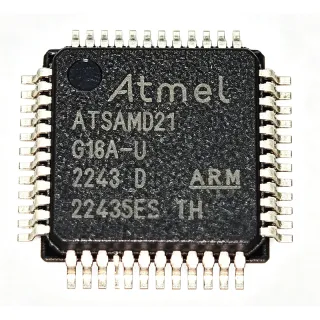
ATSAM4LS2AA-AUR - 48MHz Cortex-M4 MCU 128KB Flash | Microchip
MPN: ATSAM4LS2AA-AUR ✓ Active| Qty | Unit Price | Extended |
|---|---|---|
| 1 | $2.28 | $2.28 |
| 10 | $2.17 | $21.70 |
| 100 | $1.95 | $195.00 |
| 500 | $1.76 | $880.00 |
| 1,000 | $1.58 | $1,580.00 |
ATSAM4LS2AA-AUR Overview
A microcontroller (MCU) is a single-chip embedded computer that integrates a processor core, memory, and peripherals on one die, sitting at the device level of the embedded systems hierarchy (MCU -> microcontroller -> embedded processor -> semiconductor). The SAM4L family belongs to the ARM Cortex-M class of 32-bit RISC MCUs, widely used in low-power embedded design.
The headline feature of the ATSAM4LS2A is class-leading energy efficiency: 90 uA/MHz in active mode, 1.5 uA in sleep mode, and wake-up times down to 1.5 us, the shortest wake-up time among Cortex-M4 devices per Microchip's product page. It integrates a USB device controller, a peripheral event system allowing peripherals to interact without CPU intervention, and the SleepWalking capability that lets peripherals operate and wake the core only when needed. Hardware crypto support and MRL A status are listed by Mouser for this industrial-temperature, green TQFP part.
Typical applications include battery-powered IoT sensor nodes, portable medical devices, industrial sensor interfaces, and consumer products requiring USB connectivity with long battery life. The Cortex-M4 core with DSP instructions handles signal processing locally, while the event system keeps dynamic power low.
Design-wise, exploit SleepWalking and the peripheral event system to keep the CPU in sleep states; wake-up latency of 1.5 us makes aggressive duty-cycling practical even for event-driven tasks.
This page adds distributor pricing comparison, drop-in alternatives, design notes, and FAQ content synthesized beyond the manufacturer datasheet.
Drop-in alternatives for ATSAM4LS2AA-AUR — same package, pin-to-pin compatible. Different-package parts requiring PCB rework are excluded.
Variants in this series
Same-series models that are drop-in compatible with ATSAM4LS2AA-AUR (same form factor and footprint) — differing in Flash Memory, Operating Temperature, Core Size, Peripherals, Supply Voltage.
Quick Comparison Tool — Select alternative parts for side-by-side comparison:
ATSAM4LS2AA-AU
✅ Drop-In✓ In Stock
$5.39 / Unit
View Datasheet →ATSAM4LS4AA-AUR
✅ Drop-In ⚠️ 参数待验证✓ In Stock
$3.98 / Unit
View Datasheet →ATSAM4LC2AA-AUR
✅ Drop-In✓ In Stock
$3.35 / Unit
View Datasheet →ATSAM4LC4AA-AUR
✅ Drop-In ⚠️ 参数待验证📋 Reference alternative (not in catalog)
ATSAM3S2AA-MUR
✅ Drop-In✓ In Stock
$3.49 / Unit
View Datasheet →ATSAM4LS2AA-AUR Maximum Ratings & Electrical Characteristics
| Core Processor | ARM Cortex-M4 |
| Core Size | 32-Bit Single-Core |
| Max Clock Frequency | 48 MHz |
| Flash Memory | 128KB (128K x 8) |
| Product Family | SAM4L |
| Active Mode Current | 90 uA/MHz |
| Sleep Mode Current | 1.5 uA |
| Wake-Up Time | down to 1.5 us |
| USB | USB device |
| Peripherals | Peripheral event system, SleepWalking |
| Security Feature | Crypto |
| Package | 48-TQFP (7x7 mm) |
| Mounting Type | Surface Mount |
| Operating Temperature | Industrial temperature range (-40C to +85C) |
| Packing | Tape & Reel (R suffix) |
| RoHS / Green Status | Green (per Mouser listing) |
ATSAM4LS2AA-AUR 48-tqfp (7x7 mm) Pin Configuration Guide
Pin configuration for ATSAM4LS2AA-AUR (48-tqfp (7x7 mm) package). This digital IC includes GPIO, communication interfaces (UART, SPI, I2C), and power pins. Refer to the manufacturer datasheet for alternate pin functions and configuration options. Essential for embedded system design and PCB layout.

No detailed pinout data available for ATSAM4LS2AA-AUR.
Refer to the datasheet for full pin configuration.
Typical Applications
ATSAM4LS2AA-AUR is suitable for 6 applications: Battery-Powered IoT Sensor Nodes, Portable Medical Devices, USB Peripherals and Accessories, Industrial Sensor Interfaces, Consumer Electronics and Wearables, Smart Metering and Data Loggers.
Battery-Powered IoT Sensor Nodes
The ATSAM4LS2AA-AUR fits battery-powered IoT nodes because its 90 uA/MHz active current and 1.5 uA sleep current minimize average draw in duty-cycled designs. The 1.5 us wake-up time allows the Cortex-M4 core to sleep between sensor reads and respond instantly to radio or timer events, while SleepWalking lets the RTC or USART wake the system only when data is ready. In a typical node, the MCU reads a sensor via TWI/SPI, processes data locally with Cortex-M4 DSP instructions, and transmits via an external radio over USART. Placing 100 nF decoupling caps at each VDD pin and exploiting the peripheral event system keeps dynamic power low; a coin cell can then run the node for years depending on the radio budget.
Recommended
Portable Medical Devices
Wearable and portable medical instruments benefit from the ATSAM4LS2AA-AUR's combination of low sleep current (1.5 uA) and local signal processing. The Cortex-M4 core executes filtering and feature extraction on physiological signals (ECG, SpO2, glucose) without offloading to a host, and the hardware crypto engine supports patient-data protection required by connected medical accessories. With a 48 MHz clock and 128KB Flash, a full acquisition-plus-logging firmware fits on-chip, and USB device connectivity enables charging-and-data cradles. The industrial temperature rating and green TQFP package suit clinical handhelds. Designers should budget the analog front-end supply separately and use the event system to sequence sampling so the CPU wakes only for compute bursts, extending battery service intervals between recharges.
Recommended
USB Peripherals and Accessories
The integrated USB device controller makes the ATSAM4LS2AA-AUR a natural fit for USB-connected accessories such as sensors dongles, HID devices, and industrial configuration tools. Unlike MCUs requiring an external USB PHY or bridge chip, the SAM4L integrates the device peripheral on-die, reducing BOM count and board area in the 7x7 mm TQFP-48 footprint. The 1.5 us wake-up lets the part sleep between USB transactions and still meet response timing, and the peripheral event system routes USB-triggered events to other peripherals without core involvement. Firmware typically implements CDC, HID, or MSC classes on the 128KB Flash. Designers should place a 1.5 kOhm pull-up per the USB spec where required and validate compliance with a USB electrical test for host interoperability.
Recommended
Industrial Sensor Interfaces
In industrial environments, the ATSAM4LS2AA-AUR conditions and digitizes sensor outputs (4-20 mA loops, RTDs, bridge sensors) using its SPI/TWI/USART peripherals and Cortex-M4 arithmetic for linearization and compensation. The 90 uA/MHz active efficiency suits loop-powered and energy-harvesting transmitters where every microamp counts, while the industrial temperature grade and crypto feature support secure field instruments. SleepWalking allows a watchdog or comparator event to wake processing only on alarms. The 48-TQFP 7x7 mm package offers enough GPIO for muxing multiple sensor channels without port expanders. Design guidance: isolate field wiring, protect GPIO with TVS diodes, and use the event system so ADC conversions trigger autonomously, letting the CPU remain in sleep between samples for minimum system current.
Recommended
Consumer Electronics and Wearables
Consumer products - fitness bands, smart remotes, toys, appliance controls - leverage the ATSAM4LS2AA-AUR's low standby draw (1.5 uA) to meet long shelf-life and standby-time requirements, while the 48 MHz Cortex-M4 provides headroom for UI rendering, touch handling, and BLE stack co-processing. The 128KB Flash holds firmware plus OTA update buffers for many product classes, and hardware crypto supports secure boot and accessory authentication schemes used in consumer ecosystems. The 7x7 mm TQFP is hand-assemblable for prototyping yet reflow-compatible for mass production in green, RoHS-type packaging. Battery life modeling should combine the 90 uA/MHz active figure with realistic duty cycles; aggressive use of sleep states and the 1.5 us wake-up typically dominates the energy budget over radio or display loads.
Recommended
Smart Metering and Data Loggers
Energy and utility metering endpoints require years of operation from primary batteries - exactly the profile the ATSAM4LS2AA-AUR targets with 1.5 uA sleep and SleepWalking peripherals. The device can periodically wake via RTC, sample a metering front-end over SPI, compute consumption with fixed/DSP-style arithmetic, and log to external Flash, waking only for minutes per day. The peripheral event system chains timer-to-ADC triggers without CPU cycles, and the crypto engine protects metering data and firmware images in tamper-sensitive deployments. With 128KB Flash, both the application and a redundant bootloader fit on-chip for field firmware updates over UART or USB. Designers should size a bulk storage device (e.g., serial Flash) for log capacity and validate sleep-state current on the final PCB, as leakage often exceeds silicon sleep current.
Recommended
Recommended Products Summary
Engineering reference data for ATSAM4LS2AA-AUR — comparison, design guidance, and compliance information.
Selection Guide
Comparison with Alternatives
| Parameter | This Product | ATSAM4LS2AA-AU | ATSAM4LS4AA-AUR | ATSAM4LC2AA-AUR | ATSAM3S2AA-MUR |
|---|---|---|---|---|---|
| Package | 48-TQFP (7x7 mm) | 48-TQFP (7x7 mm) - same | 48-TQFP (7x7 mm) - same | 48-TQFP (7x7 mm) - same | 48-TQFP (7x7 mm) - same |
| Brand | Microchip Technology | Microchip Technology | Microchip Technology | Microchip Technology | Microchip Technology |
| Core | ARM Cortex-M4 @ 48 MHz | ARM Cortex-M4 @ 48 MHz | ARM Cortex-M4 @ 48 MHz | ARM Cortex-M4 @ 48 MHz | ARM Cortex-M3 @ 64 MHz |
| Flash Memory | 128KB | 128KB | 256KB | 128KB | 128KB |
| Special Features | USB device, event system, SleepWalking, crypto | Identical feature set | Identical + more Flash | Adds segment LCD controller | USB device, no DSP/FPU core |
| Packing | Tape & Reel | Tray | Tape & Reel | Tape & Reel | Tape & Reel |
Key Differentiators
- Lowest wake-up time in Cortex-M4 class (vs ATSAM3S2AA-MUR)
- More Flash headroom in the same footprint (vs ATSAM4LS4AA-AUR)
- General-purpose low-power I/O focus (vs ATSAM4LC2AA-AUR)
Design Notes
Estimated: a duty-cycled design running 10 ms of active code at 48 MHz (90 uA/MHz x 48 MHz = 4.3 mA) once per second, sleeping at 1.5 uA otherwise, averages roughly 44 uA plus sleep leakage - well within coin-cell budgets. Model your actual firmware duty cycle before finalizing the battery; radio and external sensor currents usually dominate over the MCU itself.
Place a 100 nF ceramic decoupling capacitor at each VDD/VDDIO pin pair, as close to the pins as possible, plus one bulk 4.7-10 uF capacitor near the supply entry. Keep the USB D+/D- traces as a 90-ohm differential pair with length matching if the USB port is populated. Provide SWD (SWCLK/SWDIO) test points for programming and debug - in-circuit reprogramming avoids socketing the TQFP-48.
Do not assume the wake-up current equals the datasheet sleep figure - verify total board sleep current on the finished PCB, since pull-ups, external Flash leakage, and regulator quiescent current often exceed the MCU's 1.5 uA. Also confirm the exact SRAM size and supply voltage range from the current SAM4L datasheet revision before finalizing memory maps and power-tree design, and use 1% resistor dividers on reset/brown-out related pins where applicable.
Compliance Information
Mouser lists this part as 'TQFP, Green, IND TEMP, CRYPTO, MRL A' - green package indicates RoHS-compliant lead-free construction. Formal REACH/conflict minerals certificates should be requested from Microchip.