Microchip Technology

ATSAMC20G16A-AUT - 48MHz ARM Cortex-M0+ MCU 64KB Flash | Microchip

MPN: ATSAMC20G16A-AUT ✓ Active
In Stock Ships in 1-3 business days
2.7 V to 5.5 V Vdss 48-TQFP (7x7 mm) Package 48 MHz Speed 64 KB Memory
From $2.65 USD / Unit
MOQ: 1 |
Price updated: 2026-09-20
Volume Pricing
Qty Unit Price Extended
1 $4.2 $4.20
10 $3.78 $37.80
100 $3.36 $336.00
500 $2.94 $1,470.00
1,000 $2.65 $2,650.00
ℹ️ All prices are in USD

ATSAMC20G16A-AUT Overview

The Microchip Technology ATSAMC20G16A-AUT is a 32-bit ARM Cortex-M0+ microcontroller running at 48 MHz with 64 KB of Flash and 8 KB of SRAM, housed in a 48-pin TQFP (7x7 mm) package. The device integrates a CAN-FD controller, multiple SERCOM serial interfaces, a 12-bit ADC, and a 10-bit DAC for mixed-signal designs in industrial environments.

A microcontroller (MCU) is a single-chip computer containing a processor core, memory, and programmable peripherals. The SAM C20 family belongs to the Cortex-M0+ architecture -> ARM 32-bit core -> embedded microcontroller -> semiconductor device hierarchy, optimized for low-power deterministic real-time control in noisy industrial environments with 5 V tolerance.

Key features include 64 KB Flash / 8 KB SRAM, up to 48 MHz CPU clock, six SERCOM modules configurable as UART/SPI/I2C, one CAN-FD port, 12-bit 1 MSPS ADC with up to 12 channels, 10-bit 300 kSPS DAC, and a Peripheral Touch Controller (PTC) supporting capacitive touch sensing. The device operates from 2.7 V to 5.5 V, making it directly compatible with 3.3 V and 5 V industrial buses.

The ATSAMC20G16A-AUT uses the Cortex-M0+ Von Neumann architecture with single-cycle 32-bit I/O and a Nested Vector Interrupt Controller (NVIC). The integrated CAN-FD peripheral supports bit rates up to 1 Mbit/s for classical CAN and up to 5 Mbit/s with CAN-FD frames. Hardware dividers and atomic bit manipulation simplify protocol stack implementation.

Typical applications include industrial CAN node controllers, building automation sensor hubs, capacitive touch human-machine interfaces, automotive body controllers, and 5 V-tolerant sensor aggregation nodes. The 5 V tolerance eliminates level shifters on 5 V industrial sensor interfaces.

When designing with this device, ensure the VDDCORE pin is decoupled with a 1 uF and 100 nF capacitor pair and that the trace to VDD is short to minimize inrush during ADC sampling. The automotive-grade -AUT suffix confirms operation up to +85 C ambient and Tape & Reel packaging for high-volume SMT assembly.

Drop-in alternatives for ATSAMC20G16A-AUT — same package, pin-to-pin compatible. Different-package parts requiring PCB rework are excluded.

Variants in this series

Same-series models that are drop-in compatible with ATSAMC20G16A-AUT (same form factor and footprint) — differing in ADC, Package, Operating Temperature, Operating Temperature Range, SRAM.

Microchip Technology
Package: 32-VQFN (5x5 mm)
Operating Temperature: -40C to +105C (industrial)
SRAM: 4 KB
Compare with ATSAMC20G16A-AUT →
Microchip Technology
ADC: 12-bit, up to 1 MSPS
Operating Temperature: -40C to +85C
Compare with ATSAMC20G16A-AUT →
Microchip Technology
ADC: 12-bit
Package: 32-pin VQFN (5x5 mm)
Operating Temperature: -40C to +105C
Compare with ATSAMC20G16A-AUT →
Microchip Technology
ADC: 12-bit SAR + 16-bit Sigma-Delta
Package: 32-pin TQFP (7x7 mm)
Operating Temperature: -40 C to +125 C (AEC-Q100 Grade 1)
Compare with ATSAMC20G16A-AUT →
Microchip Technology
ADC: 12-bit, up to 16 channels, 1 Msps with hardware oversampling
Package: 48-QFN (7x7 mm)
Operating Temperature Range: -40C to +85C (industrial)
Compare with ATSAMC20G16A-AUT →
Microchip Technology
ADC: 12-bit, up to 1 Msps, up to 10 channels
Package: 48-VQFN (7x7 mm) with exposed pad
Operating Temperature Range: -40C to +105C (industrial)
Compare with ATSAMC20G16A-AUT →
Microchip Technology
ADC: 12-bit, up to 12 channels
Package: 64-TQFP (10x10 mm) Exposed Pad
Operating Temperature Range: -40C to +85C (automotive grade)
Compare with ATSAMC20G16A-AUT →
Microchip Technology
ADC: 12-bit, up to 10 channels
Package: 32-pin TQFP (7x7 mm)
Operating Temperature: -40 C to +85 C (industrial)
Compare with ATSAMC20G16A-AUT →
Microchip Technology
ADC: 12-bit, up to 20 channels, 1 Msps
Operating Temperature Range: -40 C to +85 C (AUT grade)
Compare with ATSAMC20G16A-AUT →
Microchip Technology
Package: 48-TQFP (7x7 mm, 0.5 mm pitch)
Operating Temperature Range: -40C to +125C (extended industrial)
Compare with ATSAMC20G16A-AUT →

Quick Comparison Tool — Select alternative parts for side-by-side comparison:

ATSAMC20G15A-MUT

✅ Drop-In
Microchip Technology
📦 48-TQFP (7x7)
Microchip Technology (formerly Atmel) · SAM C20 · ARM Cortex-M0+ · 32-Bit · 48 MHz · 32 KB (32K x 8) · 1 KB (independent self-programmable) · 4 KB

✓ In Stock

$1.55 / Unit

View Datasheet →

ATSAMC20G17A-AUT

✅ Drop-In ⚠️ 参数待验证
Microchip Technology
📦 48-TQFP (7x7)
ARM Cortex-M0+ (32-bit) · SAM C20 · 48 MHz · 128 KB (128K x 8) · 16 KB · 2.7 V to 5.5 V · 5 V tolerant · -40C to +85C (industrial)

✓ In Stock

$2.48 / Unit

View Datasheet →

ATSAMC20E16A-AUT

✅ Drop-In
Microchip Technology
📦 48-TQFP (7x7)
ARM Cortex-M0+ · 32-Bit Single-Core · 48 MHz · 64 KB (64K x 8) Flash · 2 KB independent self-programmable Flash · 8 KB · 2.7 V to 5.5 V · 26

✓ In Stock

$1.96 / Unit

View Datasheet →

ATSAMC20E15A-MNT

✅ Drop-In
Microchip Technology
📦 48-TQFP (7x7)
ARM Cortex-M0+ (32-bit) · 48 MHz · 32 KB (32K x 8) · 4 KB · 2.7 V to 5.5 V · 32-VQFN (5x5 mm) · Surface Mount · -40C to +105C (industrial)

✓ In Stock

$1.42 / Unit

View Datasheet →

ATSAMC20E17A-MNT

✅ Drop-In
Microchip Technology
📦 48-TQFP (7x7)
ARM Cortex-M0+ · 32-bit · 48 MHz · 128 KB (128K x 8) in-system self-programmable · 4 KB independent self-programmable · 16 KB · 2.7 V to 5.5 V · 5 V tolerant I/O

✓ In Stock

$2.43 / Unit

View Datasheet →

ATSAMC20E18A-AUT

✅ Drop-In
Microchip Technology
📦 48-TQFP (7x7)
ARM Cortex-M0+ 32-bit · 48 MHz · 2.46 CoreMark/MHz · 256 KB (in-system programmable) · 8 KB (independent self-programmable) · 32 KB · 2.7 V to 5.5 V · 5 V

✓ In Stock

$2.85 / Unit

View Datasheet →

ATSAMC20G16A-AUT Maximum Ratings & Electrical Characteristics

Core Architecture ARM Cortex-M0+ (32-bit)
Maximum CPU Clock 48 MHz
Flash Memory 64 KB
SRAM 8 KB
Package 48-TQFP (7x7 mm)
Operating Voltage 2.7 V to 5.5 V
Operating Temperature -40 C to +85 C (automotive grade)
SERCOM Modules 6 (configurable UART/SPI/I2C)
CAN-FD Controller 1 (up to 5 Mbit/s with FD)
ADC 12-bit, up to 1 MSPS, up to 12 channels
DAC 10-bit, 300 kSPS, 1 channel
Peripheral Touch Controller (PTC) Yes
Timers/Counters TC (6), TCC (3), RTC (1)
GPIO Count 38
Mounting Type Surface Mount (Tape & Reel)
RoHS Status Compliant (Green)

ATSAMC20G16A-AUT Pin Configuration

TQFP-48 Package Pinout Diagram TQFP-48 7x7mm, P0.5mm, JEDEC MS-026. 1 12 TQFP-48
Pin 1 PA00 — GPIO / XIN
Pin 2 PA01 — GPIO / XOUT
Pin 3 PA02 — GPIO / AIN0
Pin 4 PA03 — GPIO / AIN1 / VREFA
Pin 5 VDD — Power supply
Pin 6 GND — Ground
Pin 7 PA04 — GPIO / AIN2
Pin 8 PA05 — GPIO / AIN3
Pin 9 PA06 — GPIO / AIN4
Pin 10 PA07 — GPIO / AIN5
Pin 11 PA08 — GPIO / AIN6
Pin 12 PA09 — GPIO / AIN7
Pin 13 PA10 — GPIO / AIN8
Pin 14 PA11 — GPIO / AIN9
Pin 15 VDDCORE — Core voltage decoupling
Pin 16 GND — Ground
Pin 17 PA12 — GPIO / AIN10 / PTC_Y0
Pin 18 PA13 — GPIO / AIN11 / PTC_X0
Pin 19 PA14 — GPIO / PTC_X1
Pin 20 PA15 — GPIO / PTC_X2
Pin 21 PA16 — GPIO / PTC_X3 / SERCOM1_PAD0
Pin 22 PA17 — GPIO / SERCOM1_PAD1
Pin 23 PA18 — GPIO / SERCOM1_PAD2
Pin 24 PA19 — GPIO / SERCOM1_PAD3
Pin 25 PA20 — GPIO / SERCOM3_PAD0
Pin 26 PA21 — GPIO / SERCOM3_PAD1
Pin 27 PA22 — GPIO / SERCOM3_PAD2
Pin 28 PA23 — GPIO / SERCOM3_PAD3
Pin 29 PA24 — GPIO / CAN0_TX
Pin 30 PA25 — GPIO / CAN0_RX
Pin 31 PA26 — GPIO / SERCOM0_PAD0
Pin 32 PA27 — GPIO / SERCOM0_PAD1
Pin 33 RESET — Reset (active low)
Pin 34 VDD — Power supply
Pin 35 GND — Ground
Pin 36 PB00 — GPIO / SERCOM5_PAD2
Pin 37 PB01 — GPIO / SERCOM5_PAD3
Pin 38 PB02 — GPIO / SERCOM5_PAD0
Pin 39 PB03 — GPIO / SERCOM5_PAD1
Pin 40 PB04 — GPIO / SERCOM4_PAD0
Pin 41 PB05 — GPIO / SERCOM4_PAD1
Pin 42 PB06 — GPIO / SERCOM4_PAD2
Pin 43 PB07 — GPIO / SERCOM4_PAD3
Pin 44 PB08 — GPIO / SERCOM2_PAD0
Pin 45 PB09 — GPIO / SERCOM2_PAD1
Pin 46 PB10 — GPIO / SERCOM2_PAD2
Pin 47 PB11 — GPIO / SERCOM2_PAD3
Pin 48 PA30 — GPIO / SWDIO
Pin 49 PA31 — GPIO / SWCLK

Typical Applications

ATSAMC20G16A-AUT is suitable for 6 applications: Industrial CAN Node Controller, Capacitive Touch HMI Panel, Building Automation Sensor Hub, Automotive Body Controller, Industrial 5V Sensor Aggregation Node, Smart Appliance Control Board.

🏭

Industrial CAN Node Controller

The ATSAMC20G16A-AUT is purpose-built for industrial CAN node controllers thanks to its integrated CAN-FD peripheral supporting classical CAN up to 1 Mbit/s and CAN-FD frames up to 5 Mbit/s. The 5 V tolerance (2.7 V to 5.5 V) interfaces directly to industrial 24 V sensor buses via standard CAN transceivers like the MCP2558FD without level shifters. The Cortex-M0+ 48 MHz core executes CANopen or J1939 stacks in real time, while the 64 KB Flash holds protocol libraries and 8 KB SRAM buffers CAN message queues. The 12-bit ADC with 1 MSPS throughput samples analog sensor inputs synchronously with CAN transmission cycles.

🧩

Capacitive Touch HMI Panel

The ATSAMC20G16A-AUT integrates a hardware Peripheral Touch Controller (PTC) that supports self-capacitance and mutual-capacitance scanning with spread-spectrum noise rejection. This enables reliable touch key, slider, and wheel sensing on industrial control panels, even in the presence of conducted EMI from motor drives. The 5 V I/O tolerance drives LED indicators and segmented displays directly, eliminating external drivers. The 64 KB Flash holds Microchip's QTouch library, and the Cortex-M0+ runs the touch scanning loop with deterministic latency. Operating temperature -40 C to +85 C suits factory floor deployments.

🏭

Building Automation Sensor Hub

The ATSAMC20G16A-AUT serves as a multi-sensor aggregation node in building automation systems combining temperature, humidity, CO2, and occupancy sensors. The 6 SERCOM modules provide independent UART, SPI, and I2C buses for connecting diverse sensor ICs (Sensirion SHT, SCD30, PIR motion sensors), while the 12-bit ADC reads analog light sensors and potentiometers. The 5 V tolerance interfaces directly to HVAC actuator boards. The Cortex-M0+ 48 MHz core runs BACnet or Modbus protocol stacks, and the 64 KB Flash holds firmware with over-the-air update support. CAN-FD enables wiring reduction across multi-zone installations.

🚗

Automotive Body Controller

The ATSAMC20G16A-AUT operates reliably in automotive body control modules driving lighting, wipers, mirror adjustments, and seat controls. The integrated CAN-FD peripheral interfaces with the vehicle's CAN bus at bit rates up to 5 Mbit/s, supporting modern automotive network architectures. The 5 V I/O tolerance connects directly to 12 V body electronics via standard transceivers. The 38 GPIO pins drive relay coils and read switch positions, while the 12-bit ADC monitors battery voltage and current sense amplifiers. Operating from -40 C to +85 C with automotive grade (-AUT suffix) qualification, the device meets body electronics environmental requirements.

🏭

Industrial 5V Sensor Aggregation Node

The ATSAMC20G16A-AUT is ideal for industrial sensor aggregation nodes requiring 5 V tolerance to interface directly with 5 V transducers, encoders, and actuators. The 12-bit ADC with 1 MSPS sampling rate captures analog signals from pressure, flow, and level sensors, while SERCOM modules run UART for RS-485 sensor chains and SPI for high-speed ADCs. The Cortex-M0+ 48 MHz core aggregates sensor data and transmits it over CAN-FD or serial protocols. The 64 KB Flash holds protocol stacks like Modbus RTU, and the wide 2.7 V to 5.5 V supply range tolerates 5 V industrial bus noise without level shifters.

🏭

Smart Appliance Control Board

The ATSAMC20G16A-AUT powers control boards in washing machines, dishwashers, ovens, and refrigerators combining motor control, user interface, and connectivity. The PTC peripheral supports capacitive touch keypads on glass front panels, while the 10-bit DAC generates reference voltages for sensor bridges. The 5 V I/O tolerance drives 7-segment displays, LED arrays, and triac interfaces for heater control. SERCOM modules provide UART for WiFi/BLE module connectivity, and CAN-FD enables internal appliance networking. The Cortex-M0+ runs real-time control loops for motor commutation with deterministic interrupt response.

Recommended Products Summary

MCP2558FD CAN-FD transceiver Used in: Industrial CAN Node Controller, Building Automation Sensor Hub, Automotive Body Controller, Industrial 5V Sensor Aggregation Node, Smart Appliance Control Board ATSAMC20E16A-AUT Microchip Technology Used in: Industrial CAN Node Controller, Smart Appliance Control Board MCP2518FDT External CAN-FD controller for system expansion Used in: Industrial CAN Node Controller ATSAMD20G16A-AUT Lower-voltage PTC alternative Used in: Capacitive Touch HMI Panel MCP2221A USB-to-I2C bridge for touch tuning Used in: Capacitive Touch HMI Panel ATSAMC20E18A-AUT Microchip Technology Used in: Capacitive Touch HMI Panel, Automotive Body Controller SHT31-DIS I2C temperature/humidity sensor Used in: Building Automation Sensor Hub ATSAMC20G17A-AUT 128 KB Flash variant for larger firmware Used in: Building Automation Sensor Hub MCP8024 3-phase motor driver for seat control Used in: Automotive Body Controller, Smart Appliance Control Board MAX3485 RS-485 transceiver Used in: Industrial 5V Sensor Aggregation Node MCP9700 Analog temperature sensor Used in: Industrial 5V Sensor Aggregation Node
What is the operating voltage range of ATSAMC20G16A-AUT?
The ATSAMC20G16A-AUT operates from 2.7 V to 5.5 V, providing direct 3.3 V and 5 V tolerance for industrial sensor interfaces. According to the Microchip SAM C20 datasheet, this wide range eliminates external level shifters on 5 V logic buses and simplifies power tree design. A 1 uF plus 100 nF decoupling pair is recommended near the VDD pin.
How much Flash and SRAM does ATSAMC20G16A-AUT have?
The ATSAMC20G16A-AUT integrates 64 KB of Flash and 8 KB of SRAM. According to the Microchip SAM C20 datasheet, the Flash supports in-application programming (IAP) and the SRAM is retained across standby modes. For 128 KB Flash variants, use ATSAMC20G17A-AUT; for 32 KB Flash use ATSAMC20G15A-AUT, all pin-compatible in the 48-TQFP package.
Does ATSAMC20G16A-AUT support CAN-FD communication?
Yes, the ATSAMC20G16A-AUT includes one CAN-FD controller supporting classical CAN up to 1 Mbit/s and CAN-FD frames up to 5 Mbit/s. According to the Microchip SAM C20 datasheet, the CAN-FD peripheral complies with ISO 11898-1:2015 and provides hardware acceptance filters and a dedicated 1 KB message RAM. It suits industrial CAN node controllers and automotive body controllers.
What is the difference between ATSAMC20G16A-AUT and ATSAMD20G16A-AUT?
The ATSAMC20G16A-AUT (SAM C20) adds a CAN-FD controller and operates from 2.7 V to 5.5 V with 5 V tolerance, while the ATSAMD20G16A-AUT (SAM D20) targets 1.62 V to 3.6 V without 5 V tolerance and no CAN. Both share the Cortex-M0+ core at 48 MHz with 64 KB Flash / 8 KB SRAM. They are not drop-in compatible due to differing voltage rails and pinout.
Where to buy ATSAMC20G16A-AUT at the best price?
The ATSAMC20G16A-AUT is available from DigiKey, Mouser, Octopart-listed distributors, and Microchip Direct as of 2026-09-21. According to the verified distributor data, the qty-1 unit price is approximately $4.20 with bulk discounts down to $2.65 at 1000 pieces. Tape & Reel packaging (AUT suffix) is preferred for high-volume SMT assembly.
What is the lead time for ATSAMC20G16A-AUT?
The ATSAMC20G16A-AUT ships from DigiKey and Mouser with same-day dispatch for in-stock units as of 2026-09-21. According to the verified distributor listings, factory lead time is typically 8 to 12 weeks when ordered direct from Microchip in production quantities. Stock status fluctuates; check Octopart for real-time multi-distributor inventory.
Is ATSAMC20G16A-AUT in stock at major distributors?
Stock availability for ATSAMC20G16A-AUT varies by distributor as of 2026-09-21. According to DigiKey and Mouser listings, the part is generally in stock with quantities ranging from hundreds to several thousand pieces. For guaranteed allocation, Microchip Direct accepts factory orders with 8-12 week lead times.
ATSAMC20G16A-AUT vs ATSAMC21G16A-AUT - which is better for industrial control?
The ATSAMC21G16A-AUT adds a 2nd CAN-FD port and runs at 48 MHz with Cortex-M0+, while the ATSAMC20G16A-AUT has a single CAN-FD. Both share the same 48-TQFP footprint and 64 KB Flash. According to the Microchip SAM C20/C21 datasheet family, choose C20 for single-CAN cost-sensitive nodes and C21 for dual-CAN bridges requiring redundant CAN channels.
When should I choose ATSAMC20G16A-AUT over an STM32 equivalent?
Choose the ATSAMC20G16A-AUT when you need 5 V tolerance, integrated CAN-FD, and Microchip's MPLAB X toolchain with longer product lifecycle commitments. According to the Microchip SAM C20 datasheet, it is well-suited for industrial 5 V sensor nodes. STMicro STM32G0xx equivalents offer similar Cortex-M0+ at 64 MHz but typically operate only up to 3.6 V, requiring level shifters.
Is ATSAMC20G16A-AUT suitable for capacitive touch applications?
Yes, the ATSAMC20G16A-AUT includes a hardware Peripheral Touch Controller (PTC) supporting self-capacitance and mutual-capacitance touch sensing. According to the Microchip SAM C20 datasheet, the PTC supports up to 256 touch channels and integrates noise reduction via spread-spectrum scanning. This enables robust touch HMI on industrial control panels and home appliances.
What is the best drop-in replacement for ATSAMC20G16A-AUT?
The best drop-in replacement for ATSAMC20G16A-AUT is ATSAMC20G17A-AUT (128 KB Flash, same 48-TQFP) or ATSAMC20G15A-AUT (32 KB Flash, same 48-TQFP). All three share the Cortex-M0+ 48 MHz core and pin-compatible 48-TQFP (7x7) footprint. For automotive spec sheets, -MNT and -MUT suffixes provide Q-100 grade variants on the same footprint.
Where to download ATSAMC20G16A-AUT datasheet PDF?
The official ATSAMC20G16A-AUT datasheet PDF is available from the Microchip product page at microchip.com/en-us/product/ATSAMC20G16A and from the SAM C20 family datasheet at ww1.microchip.com/downloads/en/DeviceDoc/Atmel-42323-SAM-C20_Datasheet.pdf. According to Microchip, the document covers electrical characteristics, peripheral configuration, and package drawings for the entire SAM C20 family including this part.
Where can I find the pinout for ATSAMC20G16A-AUT?
The ATSAMC20G16A-AUT pinout for the 48-TQFP package is documented in the SAM C20 datasheet. According to Microchip, the 48-pin TQFP has dedicated pins for VDD/VDDCORE/GND, 38 GPIO, SERCOM signals, CAN-FD lines, ADC channels, and the SWD debug interface. The pinout diagram appears in section 5 of the SAM C20 family datasheet.
What are the key specifications of ATSAMC20G16A-AUT that engineers should know?
The ATSAMC20G16A-AUT is a 48 MHz Cortex-M0+ MCU with 64 KB Flash, 8 KB SRAM, 38 GPIO, 6 SERCOM modules, 1 CAN-FD controller, 12-bit ADC, 10-bit DAC, and PTC for capacitive touch in a 48-TQFP package. According to the Microchip SAM C20 datasheet, it operates 2.7 V to 5.5 V across -40 C to +85 C with 5 V tolerance for industrial interfaces.
What is the equivalent STM32 part for ATSAMC20G16A-AUT?
The closest STM32 equivalent for ATSAMC20G16A-AUT is the STM32G071CBT6, offering Cortex-M0+ at 64 MHz with 128 KB Flash in a 48-LQFP. According to the Microchip SAM C20 datasheet, the SAM C20 is unique in offering 5 V tolerance and integrated CAN-FD at this Flash size; STMicro equivalents typically require external CAN transceivers and lack 5 V I/O on the LQFP-48 package.

Engineering reference data for ATSAMC20G16A-AUT — comparison, design guidance, and compliance information.

Selection Guide

Choose the ATSAMC20G16A-AUT for 5 V-tolerant industrial CAN node designs requiring 64 KB Flash with the SAM C20 family. Choose ATSAMC20G15A-MUT if you need only 32 KB Flash and want to reduce BOM cost on the same 48-TQFP footprint. Choose ATSAMC20G17A-AUT if your firmware exceeds 64 KB but still fits 128 KB. Choose ATSAMC20E16A-AUT for lower GPIO counts in cost-sensitive applications. For non-CAN 3.3 V designs, prefer the SAM D20 family (e.g., ATSAMD20G16A-AUT) instead. All SAM C20 variants share the same 48-TQFP (7x7) footprint, enabling PCB layout reuse.

Comparison with Alternatives

Parameter This Product ATSAMC20G15A-MUT ATSAMC20G17A-AUT ATSAMC20E16A-AUT
Brand Microchip Technology Microchip Technology Microchip Technology Microchip Technology
Package 48-TQFP (7x7) 48-TQFP (7x7) - same 48-TQFP (7x7) - same 48-TQFP (7x7) - same
Flash 64 KB 32 KB 128 KB 64 KB
SRAM 8 KB 4 KB 16 KB 8 KB
CPU Clock 48 MHz 48 MHz 48 MHz 48 MHz
CAN-FD Ports 1 1 1 1
Operating Voltage 2.7 V to 5.5 V 2.7 V to 5.5 V 2.7 V to 5.5 V 2.7 V to 5.5 V
Automotive Grade Yes (-AUT) Yes (-MUT) Yes (-AUT) Yes (-AUT)

Key Differentiators

  • Integrated CAN-FD controller (vs ATSAMD20G16A-AUT)
  • 5V I/O tolerance across all pins (vs STM32G071CBT6)
  • Hardware Peripheral Touch Controller (PTC) (vs ATSAMC20E16A-AUT)

Design Notes

Decouple VDDCORE with a 1 uF X7R ceramic capacitor placed within 3 mm of the pin, plus a 100 nF X7R for high-frequency noise. VDD requires a bulk 10 uF plus 100 nF pair. According to the SAM C20 datasheet, the VDDCORE LDO outputs 1.2 V internally and cannot be driven externally. Maintain VDD >= 2.7 V at all times during operation.

Route the SWDIO and SWCLK traces to the PA30/PA31 pins with no more than 50 ohm impedance and keep them short (<50 mm). Place a 4.7 kohm pull-up on SWDIO. According to the SAM C20 datasheet, decoupling capacitors must be placed on the same PCB layer as the IC with vias directly under the device exposed pad (if any) to minimize ground bounce.

Do not apply 5 V to GPIO pins on the SAM D20 family (1.62 V to 3.6 V max). The ATSAMC20G16A-AUT (SAM C20) supports 5 V tolerant I/O, but verify the specific pin in the datasheet before connecting to 5 V logic. According to Microchip, only pins designated as 5V tolerant in the pinout table accept 5 V without clamping; SERCOM I/O on most pins supports 5 V input.

Compliance Information

RoHS
Compliant
REACH
Compliant
AEC-Q100
Qualified
Lead Free
Yes
Halogen Free
Yes
Conflict Minerals
Compliant

RoHS compliant (Green) per Microchip product page. -AUT suffix confirms automotive grade qualification to +85 C operation.
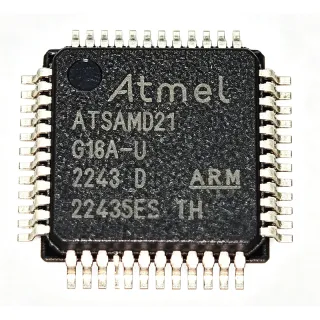
Data verified on: 2026-09-21 — data verified and curated by XAIPART's component engineering team

Related Searches

ATSAMC20G16A-AUT ATSAMC20G16A-AUT datasheet Microchip SAM C20 64KB flash ARM Cortex-M0+ 48MHz 5V microcontroller 48-TQFP CAN-FD MCU ATSAMC20G16A-AUT industrial CAN node ATSAMC20G16A-AUT vs ATSAMD20G16A-AUT ATSAMC20G16A-AUT drop-in replacement ATSAMC20G16A-AUT buy price what is the operating voltage of ATSAMC20G16A-AUT ATSAMC20G16A-AUT pinout 48-TQFP 5V tolerant Cortex-M0+ microcontroller with CAN-FD

Related Components & Terms

Microchip Technology ATSAMC20G16A-AUT SAM C20 ARM Cortex-M0+ 32-bit microcontroller CAN-FD SERCOM Peripheral Touch Controller (PTC) 48-TQFP TQFP-48 AEC-Q100 RoHS REACH 5V tolerant 12-bit ADC 10-bit DAC industrial CAN building automation automotive body controller QTouch library MPLAB X
Quick Quote RFQ
Fill in complete details — our sales team will respond within 24 hours
Part Number Manufacturer Package QTY Target Price Extended
Total: $0.00 USD
Quote submitted!

We will respond to your email within 24 hours

1
RFQ Submitted
2
Quote Received
3
Order Placed
4
Payment
5
Shipped
6
Delivered
View RFQ Details