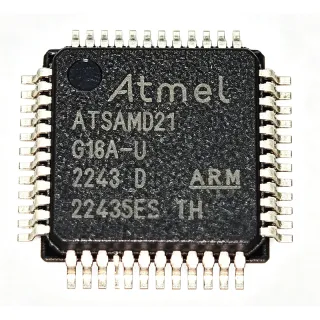
ATSAMC21G15A-AUT - 48MHz Cortex-M0+ MCU 32KB Flash | Microchip
MPN: ATSAMC21G15A-AUT ✓ Active| Qty | Unit Price | Extended |
|---|---|---|
| 1 | $3.45 | $3.45 |
| 10 | $3.1 | $31.00 |
| 100 | $2.78 | $278.00 |
| 500 | $2.45 | $1,225.00 |
| 1,000 | $2.15 | $2,150.00 |
ATSAMC21G15A-AUT Overview
An ARM Cortex-M0+ microcontroller is a 32-bit RISC processor core designed by Arm for low-power embedded applications, balancing performance, energy efficiency, and code density. Within the broader taxonomy, the Cortex-M0+ belongs to the Cortex-M family (cortex microcontroller family), which itself is part of the Arm architecture family; the M0+ is positioned as the most energy-efficient member. Microcontrollers (MCUs) integrate CPU core, memory, and peripherals on a single IC and serve as the core processing element in billions of embedded devices from IoT nodes to automotive ECUs. The SAM C21 family adds 5V tolerance and CAN-FD on top of the standard M0+ feature set, targeting industrial and automotive environments.
Key features of the ATSAMC21G15A-AUT include 32KB Flash, 4KB SRAM, up to 48MHz CPU clock, 5V-tolerant I/O with 1.62V-5.5V supply range, a 12-bit 1Msps ADC with up to 20 channels, a 10-bit 350ksps DAC, six SERCOM (serial communication) interfaces configurable as UART/SPI/I2C, one CAN-FD controller, and a built-in Peripheral Touch Controller. The integrated PTC enables capacitive-touch button, slider, and wheel interfaces without external components. A 16-bit event system, six DMA channels, and a Real-Time Clock round out the on-chip peripheral set. The 48-pin TQFP package provides 38 usable I/O lines, which is generous for the package size.
The SAM C21 architecture pairs the Cortex-M0+ core with Microchip's SmartEE peripheral bus and an optimized interrupt controller (NVIC). The 5V-tolerant I/O makes the ATSAMC21G15A-AUT particularly attractive for industrial control designs where 3.3V signals must coexist with legacy 5V sensors and actuators. AEC-Q100 qualification (AUT suffix denotes automotive grade) makes it suitable for non-safety-critical body electronics, HMI, and HVAC modules. The integrated CAN-FD controller supports the higher data rates required by modern automotive networks without requiring an external transceiver logic.
Typical applications include industrial sensor interfaces, capacitive-touch HMI panels, automotive body and HVAC control, IoT edge nodes with CAN-FD connectivity, home appliance control boards, and low-cost motor control sub-systems. The 5V tolerance also makes it a direct upgrade path for designs that previously required 8-bit PIC microcontrollers. A typical circuit places the ATSAMC21G15A-AUT as the master controller on a 3.3V rail, with a CAN-FD transceiver (such as the MCP2562FD) on the bus side and a 12-bit ADC front-end for analog sensor inputs.
When designing with this device, plan the supply rail carefully - the SAM C21 supports both 3.3V and 5V operation, but the ADC reference voltage and VDDCORE must follow specific sequencing rules. Decoupling requires a 100nF ceramic on each VDD pin plus a bulk capacitor, and unused I/O pins should be configured as outputs low to minimize leakage.
This page synthesizes distributor pricing, drop-in alternatives within the same TQFP-48 footprint, and practical design notes not found in the manufacturer datasheet.
Drop-in alternatives for ATSAMC21G15A-AUT — same package, pin-to-pin compatible. Different-package parts requiring PCB rework are excluded.
Variants in this series
Same-series models that are drop-in compatible with ATSAMC21G15A-AUT (same form factor and footprint) — differing in Package, ADC, DAC, SERCOM Modules, Operating Temperature.
Quick Comparison Tool — Select alternative parts for side-by-side comparison:
ATSAMC21G16A-AUT
✅ Drop-In✓ In Stock
$2.35 / Unit
View Datasheet →ATSAMC21E17A-AUT
✅ Drop-In ⚠️ 参数待验证✓ In Stock
$2.45 / Unit
View Datasheet →ATSAMC21E16A-AUT
✅ Drop-In ⚠️ 参数待验证✓ In Stock
$2.78 / Unit
View Datasheet →ATSAMD21G15A-AUT
✅ Drop-In📋 Reference alternative (not in catalog)
ATSAMC20G16A-AUT
✅ Drop-In ⚠️ 参数待验证✓ In Stock
$2.65 / Unit
View Datasheet →ATSAMC20G15A-MUT
✅ Drop-In ⚠️ 参数待验证✓ In Stock
$1.55 / Unit
View Datasheet →ATSAMC20J18A-AUT
✅ Drop-In ⚠️ 参数待验证✓ In Stock
$3.1 / Unit
View Datasheet →ATSAMC20N18A-ANT
✅ Drop-In ⚠️ 参数待验证✓ In Stock
$4.1 / Unit
View Datasheet →ATSAMC21G15A-AUT Maximum Ratings & Electrical Characteristics
| Manufacturer | Microchip Technology |
| Series | SAM C21 |
| Core Processor | ARM Cortex-M0+ |
| Core Size | 32-Bit |
| Maximum Clock Speed | 48 MHz |
| Program Memory Size (Flash) | 32 KB (32K x 8) |
| RAM Size | 4 KB |
| Supply Voltage Range | 1.62 V to 5.5 V (5V tolerant I/O) |
| Operating Temperature Range | -40 C to +85 C (AUT grade) |
| Package | 48-TQFP (7x7 mm) |
| Mounting Type | Surface Mount |
| ADC | 12-bit, up to 20 channels, 1 Msps |
| DAC | 10-bit, 350 ksps |
| Communication Interfaces | 6x SERCOM (UART/SPI/I2C), CAN-FD |
| Peripheral Touch Controller (PTC) | Yes (capacitive touch) |
| Functional Safety | Class B (IEC 60730) capable |
| DMA Channels | 6 |
| I/O Pins | 38 (max) |
| RoHS Status | Compliant |
| AEC-Q100 Qualified | Yes (AUT automotive grade) |
ATSAMC21G15A-AUT Pin Configuration
| Pin 1 | PA00 — GPIO / ADC AIN0 / PTC X0 (TAMP) |
| Pin 2 | PA01 — GPIO / ADC AIN1 / PTC Y0 |
| Pin 3 | PA02 — GPIO / ADC AIN2 / PTC X1 |
| Pin 4 | PA03 — GPIO / ADC AIN3 / PTC Y1 / REF |
| Pin 5 | VDD — Digital supply voltage (1.62V-5.5V) |
| Pin 6 | VSS — Ground |
| Pin 7 | PA04 — GPIO / ADC AIN4 / VDIV |
| Pin 8 | PA05 — GPIO / ADC AIN5 |
| Pin 9 | PA06 — GPIO / ADC AIN6 |
| Pin 10 | PA07 — GPIO / ADC AIN7 |
| Pin 11 | PA08 — GPIO / NMI / SERCOM0 PAD0 |
| Pin 12 | PA09 — GPIO / SERCOM0 PAD1 |
| Pin 13 | PA10 — GPIO / SERCOM0 PAD2 |
| Pin 14 | PA11 — GPIO / SERCOM0 PAD3 |
| Pin 15 | VDD — Digital supply voltage |
| Pin 16 | VSS — Ground |
| Pin 17 | PB08 — GPIO / SERCOM4 PAD0 / TC4 WO0 |
| Pin 18 | PB09 — GPIO / SERCOM4 PAD1 / TC4 WO1 |
| Pin 19 | PB10 — GPIO / SERCOM4 PAD2 / TC5 WO0 |
| Pin 20 | PB11 — GPIO / SERCOM4 PAD3 / TC5 WO1 |
| Pin 21 | PA12 — GPIO / SERCOM2 PAD0 / CAN0 TX |
| Pin 22 | PA13 — GPIO / SERCOM2 PAD1 / CAN0 RX |
| Pin 23 | PA14 — GPIO / SERCOM2 PAD2 / XCLK |
| Pin 24 | PA15 — GPIO / SERCOM2 PAD3 |
| Pin 25 | PA16 — GPIO / SERCOM1 PAD0 / I2S FS0 |
| Pin 26 | PA17 — GPIO / SERCOM1 PAD1 / I2S MCK0 |
| Pin 27 | PA18 — GPIO / SERCOM3 PAD0 |
| Pin 28 | PA19 — GPIO / SERCOM3 PAD1 |
| Pin 29 | PB12 — GPIO / SERCOM5 PAD0 / TC0 WO0 |
| Pin 30 | PB13 — GPIO / SERCOM5 PAD1 / TC0 WO1 |
| Pin 31 | PB14 — GPIO / SERCOM5 PAD2 / TC1 WO0 |
| Pin 32 | PB15 — GPIO / SERCOM5 PAD3 / TC1 WO1 |
| Pin 33 | PA20 — GPIO / SERCOM5 PAD2 / TC2 WO0 |
| Pin 34 | PA21 — GPIO / SERCOM5 PAD3 / TC2 WO1 |
| Pin 35 | PA22 — GPIO / SERCOM3 PAD2 / TC3 WO0 |
| Pin 36 | PA23 — GPIO / SERCOM3 PAD3 / TC3 WO1 |
| Pin 37 | PA24 — GPIO / SERCOM5 PAD2 / USB DM (alternate) |
| Pin 38 | PA25 — GPIO / SERCOM5 PAD3 / USB DP (alternate) |
| Pin 39 | PB16 — GPIO / SERCOM5 PAD0 / TC6 WO0 |
| Pin 40 | PB17 — GPIO / SERCOM5 PAD1 / TC6 WO1 |
| Pin 41 | PA27 — GPIO / SERCOM3 PAD3 |
| Pin 42 | PA28 — GPIO / Reset input (bidirectional) |
| Pin 43 | VDD — Digital supply voltage |
| Pin 44 | VSS — Ground |
| Pin 45 | PA30 — GPIO / SWDIO (programming/debug) |
| Pin 46 | PA31 — GPIO / SWCLK (programming/debug) |
| Pin 47 | PB00 — GPIO / ADC AIN8 |
| Pin 48 | PB01 — GPIO / ADC AIN9 / DAC VOUT |
Typical Applications
ATSAMC21G15A-AUT is suitable for 7 applications: Industrial Sensor Interface with CAN-FD, Capacitive Touch HMI Panel, Automotive Body Electronics (HVAC, Lighting), IoT Edge Node with CAN-FD Connectivity, Home Appliance Control Board, Low-Cost Motor Control Sub-System, Smart Energy Metering Module.
Industrial Sensor Interface with CAN-FD
The ATSAMC21G15A-AUT is ideal for industrial sensor interfaces requiring CAN-FD connectivity. Its integrated CAN-FD controller supports up to 5 Mbps in the data phase, well beyond classic CAN's 1 Mbps, enabling high-throughput sensor data aggregation on factory automation networks. The 5V-tolerant I/O accepts legacy 5V sensor signals directly without level shifters. With 12-bit 1Msps ADC, up to 20 analog input channels, and 38 GPIO pins, the device reads multiple sensor types simultaneously while running control loops at 48MHz. The AEC-Q100 qualification and -40C to +85C operating range suit harsh factory environments. Companion components: MCP2562FD CAN-FD transceiver (bus-side driver) and ATSAM-I2C temperature sensor for monitoring.
Recommended
Capacitive Touch HMI Panel
The ATSAMC21G15A-AUT excels in capacitive touch HMI panels thanks to its integrated Peripheral Touch Controller (PTC), which supports up to 256 touch buttons, sliders, and wheels without external touch ICs. The PTC handles acquisition, baseline tracking, and water-tolerant algorithms in hardware, freeing the Cortex-M0+ core for HMI logic. The 48MHz processing speed is sufficient for responsive UI rendering and debouncing. The 5V tolerance allows direct interface with industrial HMI backlights and indicator LEDs. With 32KB Flash for HMI firmware and 4KB SRAM for buffer memory, this MCU powers cost-sensitive HMI modules in appliance and industrial control panels.
Recommended
Automotive Body Electronics (HVAC, Lighting)
Recommended
IoT Edge Node with CAN-FD Connectivity
The ATSAMC21G15A-AUT fits IoT edge nodes in industrial IoT deployments that aggregate sensor data over CAN-FD backbones. The low-power Cortex-M0+ core with Sleep/Idle/Standby modes reduces active current to under 10uA/MHz, suiting battery-backed edge devices. 32KB Flash accommodates TLS stacks, sensor drivers, and edge analytics; 4KB SRAM handles packet buffers and protocol state. The integrated ADC and SERCOM interfaces connect directly to environmental sensors (temperature, humidity, vibration) without external glue logic. Combined with a CAN-FD transceiver, this MCU bridges legacy industrial sensors to modern edge gateways.
Recommended
Home Appliance Control Board
The ATSAMC21G15A-AUT replaces legacy 8-bit PIC microcontrollers in home appliances such as washing machines, dishwashers, and refrigerators. Its 5V tolerance interfaces directly with triac-driven AC loads and 5V sensor signals, while the 48MHz Cortex-M0+ adds the computational headroom needed for modern UI features (segment displays, capacitive buttons, motor control). The 12-bit ADC delivers precise temperature and pressure readings, and SERCOM ports support UART for inverter communication. AEC-Q100 and 5V capability reduce qualification burden for appliance makers targeting both residential and light-commercial markets.
Recommended
Low-Cost Motor Control Sub-System
The ATSAMC21G15A-AUT serves as a sub-system controller in BLDC and stepper motor applications, handling user interface, sensor feedback, and supervisory control while a dedicated motor-control IC handles gate driving. The 12-bit ADC with 1Msps rate reads back-EMF signals and current shunts for sensorless control loops. PWM channels drive status LEDs and signal interface ICs. SERCOM interfaces support UART communication with the motor driver for torque/speed commands. The 32KB Flash is sufficient for FOC firmware with state machines, while 4KB SRAM handles data logging and parameter storage.
Recommended
Smart Energy Metering Module
The ATSAMC21G15A-AUT fits into smart energy metering sub-modules that require 5V interface to legacy metering front-ends and CAN-FD connectivity to building automation networks. The 12-bit ADC at 1Msps samples voltage and current channels for power calculation algorithms, while the Cortex-M0+ core runs metering math and calibration routines. The Functional Safety (FuSa) capability per IEC 60730 Class B supports safety-critical appliance designs. SERCOM ports interface with metrology AFE chips, and CAN-FD transports aggregated metering data to concentrators.
Recommended
Recommended Products Summary
Engineering reference data for ATSAMC21G15A-AUT — comparison, design guidance, and compliance information.
Selection Guide
Comparison with Alternatives
| Parameter | This Product | ATSAMC21G16A-AUT | ATSAMC21E17A-AUT | ATSAMD21G15A-AUT | ATSAMC20G16A-AUT |
|---|---|---|---|---|---|
| Brand | Microchip Technology | Microchip Technology | Microchip Technology | Microchip Technology | Microchip Technology |
| Package | 48-TQFP (7x7) | 48-TQFP (7x7) - same | 48-TQFP (7x7) - same | 48-TQFP (7x7) - same | 48-TQFP (7x7) - same |
| Core | ARM Cortex-M0+ 48MHz | ARM Cortex-M0+ 48MHz | ARM Cortex-M0+ 48MHz | ARM Cortex-M0+ 48MHz | ARM Cortex-M0+ 48MHz |
| Flash | 32 KB | 48 KB (+50%) | 64 KB (+100%) | 32 KB (same) | 48 KB (+50%) |
| SRAM | 4 KB | 4 KB (same) | 8 KB (+100%) | 4 KB (same) | 4 KB (same) |
| Supply Voltage | 1.62V-5.5V (5V tolerant) | 1.62V-5.5V (5V tolerant) | 1.62V-5.5V (5V tolerant) | 1.62V-3.6V (no 5V) | 1.62V-5.5V (5V tolerant) |
| CAN-FD | Yes (1x) | Yes (1x) | Yes (1x) | No (USB instead) | No |
| ADC | 12-bit 1Msps (20 ch) | 12-bit 1Msps (20 ch) | 12-bit 1Msps (20 ch) | 12-bit 1Msps (20 ch) | 12-bit 1Msps (20 ch) |
| Peripheral Touch Controller | Yes | Yes | Yes | Yes | Yes |
| Automotive Grade | Yes (AUT, -40C to +85C) | Yes (AUT) | Yes (AUT) | Yes (AUT) | Yes (AUT) |
Key Differentiators
- 5V-tolerant I/O with integrated CAN-FD (vs ATSAMD21G15A-AUT)
- AEC-Q100 automotive qualification at Cortex-M0+ price point (vs ATSAMC20G15A-MUT)
- Integrated Peripheral Touch Controller eliminates external touch IC (vs Discrete capacitive-touch designs)
- Functional Safety (FuSa) capability per IEC 60730 Class B (vs Non-FuSA Cortex-M0+ competitors)
Design Notes
Estimated: At 48MHz active mode, the ATSAMC21G15A-AUT draws approximately 7mA (per datasheet typical). At 3.3V supply, that is about 23mW of core consumption. Add 100nF ceramic decoupling on each VDD pin (5 pins total on 48-TQFP) plus a single 4.7uF bulk capacitor near the MCU. Place the bulk capacitor within 10mm of the package to minimize inductance. The 5V-tolerant I/O pins must still respect the VDD supply ramp - do not drive I/O above VDD before VDD reaches 0.9V.
At -40C to +85C automotive operating range, no special thermal management is needed for the 48-TQFP package at typical MCU power levels (under 100mW). However, in enclosed housings (e.g., sealed HMI panels), ambient temperature may exceed 85C locally. Verify with theta_JA of approximately 64 C/W for 48-TQFP-7x7 with standard JEDEC test PCB. For extended industrial operation above 85C, consider the 48-TQFP -MNT (industrial) variant instead of -AUT.
Keep the SWD/SWCK pins (PA30/PA31) accessible for in-circuit programming and debugging. Route the RESET line (PA28) with a 10k pull-up and 100nF capacitor for clean reset behavior. Place a ground pour under the MCU package connected to all VSS pins to minimize ground bounce. Analog inputs (PA04-PA07, PB00-PB01) should be routed away from digital signals to reduce ADC noise coupling.
Critical: The CAN-FD peripheral requires the CAN transceiver's TXD pin to drive the MCU's CAN RX input low when the bus is dominant. Verify your CAN transceiver (e.g., MCP2562FD) is in Normal mode, not Standby, after power-up. The 5V tolerance applies only to I/O pins - the VDD supply itself must be within 1.62V-5.5V. Do not exceed 5.5V on VDD even with 5V-tolerant I/O, or the internal voltage regulator will be damaged.
When using the 12-bit ADC at 1Msps, the source impedance should be below 1kOhm to achieve full conversion accuracy. Add a 100nF ceramic bypass capacitor directly at the ADC input pin (within 5mm). The Peripheral Touch Controller operates best when the sensor traces are guarded (grounded shield traces) to reduce noise pickup from adjacent signals. PTC clock frequency should be tuned per Microchip's QTouch Library configuration guide for the specific PCB layout.
Compliance Information
AUT suffix indicates AEC-Q100 Grade 3 qualification. RoHS/REACH compliant per Microchip product declaration. FuSa Class B capable per IEC 60730.