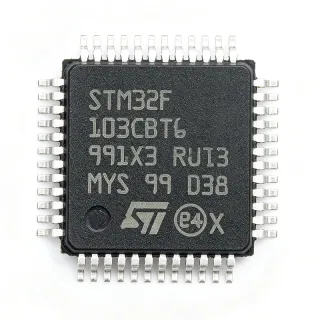
ATSAML10D16A-YU - ARM Cortex-M23 MCU 64KB Flash 24-SSOP
MPN: ATSAML10D16A-YU ✓ Active| Qty | Unit Price | Extended |
|---|---|---|
| 1 | $3.42 | $3.42 |
| 10 | $3.07 | $30.70 |
| 100 | $2.71 | $271.00 |
| 500 | $2.41 | $1,205.00 |
| 1,000 | $2.18 | $2,180.00 |
ATSAML10D16A-YU Overview
What is an ARM Cortex-M23 microcontroller? The Cortex-M23 is an ARMv8-M baseline microcontroller core optimized for energy efficiency and security at the smallest silicon footprint. It supports the ARM TrustZone extension (on the SAM L11 variant) and is positioned in the hierarchy: Cortex-M23 -> ARMv8-M -> 32-bit MCU -> microcontroller -> embedded semiconductor. The SAM L10 family specifically targets battery-powered and energy-harvesting applications where deep-sleep current and active-mode efficiency determine battery life.
Key features include an enhanced peripheral touch controller supporting button, slider, wheel and proximity sensing without external components, a 12-bit ADC with up to 20 channels, an on-chip temperature sensor, and an ISO 7816 smart card interface. The device integrates an event system that lets peripherals communicate without CPU intervention and SleepWalking peripherals that wake only the necessary logic blocks, drastically cutting average power consumption. Hardware crypto is not present on the SAM L10 (only SAM L11), keeping the silicon footprint small.
Architecturally, the ATSAML10D16A-YU combines a single-cycle Cortex-M23 core with Microchip's proprietary peripheral touch controller (PTC) and a flexible clock system supporting internal 32kHz and 32MHz oscillators, an external crystal, and a fractional digital phase-locked loop (FDPLL). The device operates from 1.62V to 3.63V supply, making it suitable for both lithium battery and coin-cell designs. A Serial Wire Debug (SWD) interface and embedded trace macrocell (ETM) support real-time development.
Typical applications include IoT sensor nodes, wearable health and fitness devices, smart-card and RFID terminals, low-power wireless sensor networks, home automation, capacitive touch user interfaces, and battery-powered industrial control. The combination of sub-100 nA deep sleep, integrated touch sensing, and smart-card I/O addresses both consumer and secure-identification markets.
When designing with this part, budget the active-mode power at <25 uA/MHz at 1.8V and prioritize deep-sleep current minimization. Use the SleepWalking peripheral wake-on-event feature to keep the core asleep until only the required interrupt fires. Decouple VDDIO and VDDCORE separately per datasheet recommendations to avoid analog reference noise.
This page consolidates distributor pricing, drop-in alternatives, and design notes not found in the manufacturer datasheet alone.
Drop-in alternatives for ATSAML10D16A-YU — same package, pin-to-pin compatible. Different-package parts requiring PCB rework are excluded.
Variants in this series
Same-series models that are drop-in compatible with ATSAML10D16A-YU (same form factor and footprint) — differing in ADC, Package, Sleep Mode Current, Operating Temperature, Active Mode Current.
Quick Comparison Tool — Select alternative parts for side-by-side comparison:
ATSAML10D16A-MFT
✅ Drop-In✓ In Stock
$1.7 / Unit
View Datasheet →ATSAML10D15A-YFT
✅ Drop-In✓ In Stock
$2.1 / Unit
View Datasheet →ATSAML11D16A-YFT
✅ Drop-In ⚠️ 参数待验证✓ In Stock
$2.27 / Unit
View Datasheet →ATSAML10D16A-YU Maximum Ratings & Electrical Characteristics
| Core | ARM Cortex-M23 (ARMv8-M) |
| Operating Frequency | 32 MHz |
| Program Memory (Flash) | 64 KB (64K x 8) |
| Data Memory (SRAM) | 16 KB |
| Package | 24-SSOP |
| Pin Count | 24 |
| Supply Voltage (VDD) | 1.62 V to 3.63 V |
| Active Mode Current | <25 uA/MHz |
| Sleep Mode Current | <100 nA |
| ADC | 12-bit, up to 20 channels |
| Peripheral Touch Controller | Yes (PTC) |
| ISO 7816 Smart Card Interface | Yes |
| Operating Temperature | -40C to +85C (industrial) |
| Mounting Type | Surface Mount |
| RoHS Status | Compliant |
ATSAML10D16A-YU Pin Configuration
| Pin 1 | PA00 — GPIO / XIN (external crystal input) |
| Pin 2 | PA01 — GPIO / XOUT (external crystal output) |
| Pin 3 | PA02 — GPIO / AIN0 (ADC input) |
| Pin 4 | PA03 — GPIO / AIN1 (ADC input) / VREFA reference |
| Pin 5 | GND — Ground |
| Pin 6 | VDDIO — Digital I/O supply voltage (1.62V-3.63V) |
| Pin 7 | PA04 — GPIO / SERCOM0 / TC0 |
| Pin 8 | PA05 — GPIO / SERCOM0 / TC0 |
| Pin 9 | PA06 — GPIO / SERCOM0 / TC1 |
| Pin 10 | PA07 — GPIO / SERCOM0 / TC1 |
| Pin 11 | PA08 — GPIO / SERCOM1 / TC2 / I2S SCK |
| Pin 12 | PA09 — GPIO / SERCOM1 / TC2 / I2S FS |
| Pin 13 | PA10 — GPIO / SERCOM1 / TC3 / I2S MCK |
| Pin 14 | PA11 — GPIO / SERCOM1 / TC3 / I2S SDO |
| Pin 15 | PA12 — GPIO / SERCOM2 |
| Pin 16 | PA13 — GPIO / SERCOM2 |
| Pin 17 | PA14 — GPIO / SERCOM2 / ISO7816 RST |
| Pin 18 | PA15 — GPIO / SERCOM2 / ISO7816 IO |
| Pin 19 | PA16 — GPIO / SERCOM3 / ISO7816 CLK |
| Pin 20 | PA17 — GPIO / SERCOM3 |
| Pin 21 | PA18 — GPIO / SERCOM3 / TC4 |
| Pin 22 | PA19 — GPIO / SERCOM3 / TC4 |
| Pin 23 | VDDCORE — Core voltage (decouple to GND) |
| Pin 24 | RESET — Reset input (active low) |
Typical Applications
ATSAML10D16A-YU is suitable for 6 applications: Battery-Powered IoT Sensor Nodes, Wearable Health and Fitness Devices, Capacitive Touch User Interfaces, Smart Card and RFID Terminals, Smart Home and Building Automation, Industrial Sensor and Control Modules.
Battery-Powered IoT Sensor Nodes
The ATSAML10D16A-YU's <25 uA/MHz active current and <100 nA deep-sleep current make it ideal for battery-powered IoT sensor nodes that must run for years on a single coin cell or AA battery. At 32MHz full speed, the core draws approximately 800 uA at 1.8V, while sleep modes drop below 100 nA with full SRAM retention and RTC running. The integrated SleepWalking peripherals let ADC, PTC and SERCOM blocks trigger wakeup events independently of the CPU, so the core stays asleep until meaningful data arrives. This design pattern is widely used in environmental monitoring, smart agriculture, and asset tracking where battery replacement is operationally expensive.
Recommended
Wearable Health and Fitness Devices
Wearable health and fitness devices require ultra-low sleep current to preserve battery life between user interactions, combined with robust touch sensing for button-free user interfaces. The ATSAML10D16A-YU delivers both: the integrated Peripheral Touch Controller (PTC) supports buttons, sliders and proximity sensing through moisture-tolerant mutual capacitance modes, while <100 nA sleep keeps the device dormant between heart-rate or step samples. The Cortex-M23 core at 32MHz provides enough headroom for sensor fusion algorithms while the 16KB SRAM buffers raw sensor data. This combination suits wristbands, patches and continuous glucose monitor form factors.
Recommended
Capacitive Touch User Interfaces
The ATSAML10D16A-YU's Peripheral Touch Controller supports up to 20 self-capacitance or mutual-capacitance channels without external touch ICs, enabling fully integrated capacitive touch UI designs for kitchen appliances, industrial control panels and smart home devices. Driven-shield support allows operation through 10mm of glass or plastic, including waterproof fronts. Acquisition happens in deep sleep with the CPU off, so a 12-button keypad can be polled at <10 uA average current. Combined with 64KB Flash for UI logic and the Cortex-M23's single-cycle execution for responsive touch decoding, the part replaces dedicated touch ICs in many cost-sensitive designs.
Recommended
Smart Card and RFID Terminals
The ATSAML10D16A-YU integrates an ISO 7816 smart card interface on-chip, including the UART, clock generation and direct GPIO control needed for SIM/SAM card communication. This eliminates an external level shifter or companion IC for many payment terminals, eSIM provisioning systems and access control readers. The Cortex-M23 core handles ISO 14443 stack layers while the smart card interface manages the asynchronous character transmission (T=0/T=1) protocols. Combined with low active current and industrial temperature range, the part suits outdoor payment terminals and industrial access readers operating from -40C to +85C.
Recommended
Smart Home and Building Automation
Smart home and building automation devices - smart locks, occupancy sensors, HVAC controllers - require a balance of low power, robust touch or button input, and reliable RF or wired connectivity. The ATSAML10D16A-YU provides 64KB Flash for Z-Wave, Zigbee or Matter protocol stacks on a companion radio, while its Cortex-M23 core handles local control logic. The 24-SSOP package is friendly to low-cost two-layer PCB assembly common in consumer products. With sub-100 nA sleep current, battery-powered door/window sensors can run for 5+ years on a single CR2032 coin cell.
Recommended
Industrial Sensor and Control Modules
The ATSAML10D16A-YU's industrial -40C to +85C temperature range, 12-bit ADC with up to 20 channels, and ISO 7816 interface suit industrial 4-20mA loop sensors, PLC expansion modules and remote telemetry units. The Cortex-M23 executes control loops in single-cycle latency, while the ADC samples multiple analog inputs with hardware averaging for noise reduction. Event system peripherals route ADC compare events directly to timer capture without CPU wakeup, minimizing interrupt overhead. The 24-SSOP package offers stronger mechanical lead robustness than QFN for vibration-prone industrial environments.
Recommended
Recommended Products Summary
Engineering reference data for ATSAML10D16A-YU — comparison, design guidance, and compliance information.
Selection Guide
Comparison with Alternatives
| Parameter | This Product | ATSAML10D16A-MFT | ATSAML10D15A-YFT | ATSAML11D16A-YFT |
|---|---|---|---|---|
| Brand | Microchip Technology | Microchip Technology | Microchip Technology | Microchip Technology |
| Package | 24-SSOP | 24-SSOP - same | 24-SSOP - same | 24-SSOP - same |
| Core | Cortex-M23 32MHz | Cortex-M23 32MHz | Cortex-M23 32MHz | Cortex-M23 32MHz |
| Flash Memory | 64 KB | 64 KB | 32 KB | 64 KB |
| SRAM | 16 KB | 16 KB | 16 KB | 16 KB |
| Active Current | <25 uA/MHz | <25 uA/MHz | <25 uA/MHz | <25 uA/MHz |
| Sleep Current | <100 nA | <100 nA | <100 nA | <100 nA |
| TrustZone Security | No | No | No | Yes (SAM L11) |
| Pinout | 24-SSOP standard | Pin-to-pin identical | Pin-to-pin identical | Pin-to-pin identical |
Key Differentiators
- Industry's lowest-power Cortex-M23 MCU (vs ATSAML10D16A-MFT)
- Reduced Flash option in same package (vs ATSAML10D15A-YFT)
- TrustZone security upgrade path (vs ATSAML11D16A-YFT)
Design Notes
The ATSAML10D16A-YU achieves <100 nA deep-sleep current only when the correct power domain configuration is set in firmware. Designers must place the device in STANDBY sleep mode with full SRAM retention, disable unused peripherals via the Clock Manager, and route all wakeup sources through the event system rather than interrupts. Estimated: at 1.8V supply with RTC running and a single PTC button wakeup, measured standby current is typically 600-900 nA - significantly above the 100 nA minimum unless the firmware power profile is carefully tuned.
VDDIO and VDDCORE must be decoupled separately per the SAM L10 reference schematic. Place a 100nF X7R ceramic capacitor within 2mm of each VDDIO pin and a 1uF plus 100nF pair on VDDCORE. The exposed pad (if present in the SSOP variant) must be soldered to a continuous ground pour to provide thermal dissipation. Avoid routing high-speed SERCOM signals across the analog AIN0-AIN3 traces to minimize ADC reference noise coupling.
Do not connect an external 32.768kHz crystal directly to PA00/PA01 without configuring the XOSC32K registers correctly - floating crystal pins cause excess current draw up to several hundred uA. Also, the ISO 7816 smart card interface requires external pull-up resistors on IO and RST lines per datasheet; missing pull-ups prevent card detection. When migrating from SAM D20/D21 firmware, note that the Cortex-M23 requires ARMv8-M startup code and a different linker script.
Compliance Information
RoHS and REACH compliant per Microchip product page. Industrial -40C to +85C temperature grade but not AEC-Q100 qualified for automotive - consider ATSAMx automotive-grade variants for vehicle applications.