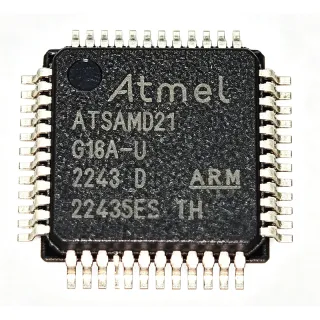
DSPIC33CK128MP503T-I/M5 - 100MHz 16-bit DSC 128KB Flash | Microchip
MPN: DSPIC33CK128MP503T-I/M5 ✓ Active| Qty | Unit Price | Extended |
|---|---|---|
| 1 | $3.35 | $3.35 |
| 10 | $3.02 | $30.20 |
| 100 | $2.65 | $265.00 |
| 500 | $2.3 | $1,150.00 |
| 1,000 | $2.04 | $2,040.00 |
DSPIC33CK128MP503T-I/M5 Overview
A digital signal controller combines the computational throughput of a DSP with the peripheral integration and deterministic behavior of a microcontroller. Within the power-management hierarchy of embedded processors, the dsPIC33CK sits above general-purpose MCUs for control-loop tasks and below application processors, targeting closed-loop systems where fast, mathematically intensive feedback is required.
Key features include a 16-bit pipelined core with DSP engine running at 100 MHz, three integrated operational amplifiers, three analog comparators, CAN-FD connectivity, and a Programmable Switching Regulator (PTG) hardware sequencer. DigiKey also lists the part as Functional Safety (FuSa) supported, simplifying ISO 26262 and IEC 61508 design workflows.
The dsPIC33CK architecture pairs the 16-bit CPU with a 24-bit instruction word, hardware multiply-accumulate, and single-cycle MAC operations, which shortens control-loop execution for current shaping and power-conversion algorithms. High-resolution PWM peripherals support fine duty-cycle resolution essential for digitally controlled power supplies.
Typical applications include digital power supplies, motor control (BLDC, PMSM, ACIM), advanced sensing and control, and industrial CAN-FD networking nodes. The three on-chip op-amps reduce external component count in current-sense front ends for motor inverters.
Design consideration: the M5 UQFN package has an exposed thermal pad that must be soldered to a grounded copper pour for both heat dissipation and signal-integrity; follow Microchip layout guidance for decoupling each VDD pin.
This page synthesizes distributor pricing, same-family drop-in alternatives, and practical design notes not found in the manufacturer datasheet.
Drop-in alternatives for DSPIC33CK128MP503T-I/M5 — same package, pin-to-pin compatible. Different-package parts requiring PCB rework are excluded.
Variants in this series
Same-series models that are drop-in compatible with DSPIC33CK128MP503T-I/M5 (same form factor and footprint) — differing in Package, Core, Program Memory Size, RAM Size, CAN.
Quick Comparison Tool — Select alternative parts for side-by-side comparison:
DSPIC33CK128MP503T-E/M5
✅ Drop-In📋 Reference alternative (not in catalog)
DSPIC33CK128MP503T-H/M5
✅ Drop-In📋 Reference alternative (not in catalog)
DSPIC33CK128MP503-I/M5
✅ Drop-In ⚠️ Specs Unverified📋 Reference alternative (not in catalog)
DSPIC33CK64MP503-I/M5
✅ Drop-In ⚠️ Specs Unverified✓ In Stock
$2.12 / Unit
View Datasheet →DSPIC33CK128MC503T-I/M5
✅ Drop-In ⚠️ Specs Unverified✓ In Stock
$3 / Unit
View Datasheet →DSPIC33CK128MP503T-I/M5 Maximum Ratings & Electrical Characteristics
| Core | dsPIC33CK 16-bit DSC core with DSP engine |
| Maximum Clock Frequency | 100 MHz |
| Program Memory Size | 128KB (128K x 8) Flash |
| RAM Size | 16KB |
| Supply Voltage | 3.3 V |
| Package | 36-UQFN (5x5 mm), exposed pad (M5) |
| Number of Pins | 36 |
| On-chip Operational Amplifiers | 3 |
| Analog Comparators | 3 |
| CAN | CAN-FD |
| Special Peripherals | PTG (Programmable Time Generator / hardware sequencer) |
| Functional Safety Support | Yes (FuSa package per DigiKey listing) |
| Operating Temperature Range | -40C to +85C (I grade) |
| Mounting Type | Surface Mount |
| Packaging | Tape & Reel (T suffix) |
| Product Family | dsPIC33CK (digital power, motor control, advanced sensing) |
| RoHS Status | Compliant |
DSPIC33CK128MP503T-I/M5 36-uqfn (5x5 mm), exposed pad (m5) Pin Configuration Guide
Pin configuration for DSPIC33CK128MP503T-I/M5 (36-uqfn (5x5 mm), exposed pad (m5) package). This digital IC includes GPIO, communication interfaces (UART, SPI, I2C), and power pins. Refer to the manufacturer datasheet for alternate pin functions and configuration options. Essential for embedded system design and PCB layout.

No detailed pinout data available for DSPIC33CK128MP503T-I/M5.
Refer to the datasheet for full pin configuration.
Typical Applications
DSPIC33CK128MP503T-I/M5 is suitable for 6 applications: Digital Power Supplies, Brushless Motor Control, CAN-FD Industrial Networking Nodes, Advanced Sensing and Control, USB-PD and Wireless Charging Power Stages, Test and Measurement Instrumentation.
Digital Power Supplies
The DSPIC33CK128MP503T-I/M5 is purpose-built for digitally controlled power converters such as LLC resonant, buck, boost, and totem-pole PFC stages. Its 100 MHz DSP-accelerated core closes current and voltage loops fast enough for switching frequencies in the several-hundred-kHz range, while three on-chip comparators provide cycle-by-cycle overcurrent protection with no CPU latency. The three integrated op-amps amplify shunt-current signals directly on-chip, cutting BOM cost and board area versus external amplifiers. In a typical design the DSC sits between the feedback dividers and the power stage gate drivers, running PI or predictive control firmware. Unlike analog controllers, firmware enables soft-start profiles, adaptive dead-time, and CAN-FD telemetry in telecom rectifiers and server PSUs.
Recommended
Brushless Motor Control
For BLDC, PMSM, and ACIM motor drives, the DSPIC33CK128MP503T-I/M5 combines field-oriented-control (FOC) execution throughput with an analog front end tailored to current sensing. The 100 MHz core with hardware MAC accelerates the Clarke/Park transforms and PI current loops, while the three op-amps condition low-side or in-line shunt signals and the three comparators gate PWM outputs on overcurrent events within one switching cycle. High-resolution PWM peripherals generate center-aligned six-channel drive with adjustable dead time. In a typical FOC inverter the DSC reads shunt amplifiers through its ADC, executes the control loop each PWM period, and handles CAN-FD commands for industrial automation or e-mobility auxiliary drives, all within the 5x5 mm UQFN footprint.
Recommended
CAN-FD Industrial Networking Nodes
The integrated CAN-FD controller of the DSPIC33CK128MP503T-I/M5 makes it a compact networking node for industrial automation, building control, and vehicle auxiliary systems. CAN-FD raises payload capacity to 64 bytes per frame and supports faster data phases than classical CAN, which the 100 MHz core can service without dropping control-loop deadlines. Combined with the PTG hardware sequencer that automates timed peripheral actions independently of software, the device sustains deterministic behavior in multi-node networks. Typical deployments pair the DSC with an external CAN-FD transceiver on the 36-pin UQFN board, using the on-chip comparators and op-amps for local sensing while firmware handles protocol stacks, diagnostics, and OTA parameter updates across the network.
Recommended
Advanced Sensing and Control
Sensor aggregation and closed-loop control tasks benefit directly from the analog integration of the DSPIC33CK128MP503T-I/M5. The three op-amps can be used as programmable-gain front ends for bridge, thermocouple, or current-shunt signals, and the three comparators create threshold alarms in hardware, offloading the CPU. The 100 MHz 16-bit core with DSP instructions filters and decimates sampled data quickly enough for vibration, pressure, and power-quality monitoring loops. Because the entire signal chain - amplification, comparison, conversion, and control - lives inside one 5x5 mm UQFN package, designers shrink sensing PCB area for compact industrial instruments. Functional Safety (FuSa) package support from Microchip further assists developers building certified monitoring equipment.
Recommended
USB-PD and Wireless Charging Power Stages
Compact power-conversion accessories such as USB-PD adapters and Qi wireless chargers demand fast digital loops in minimal board area - exactly the profile of the DSPIC33CK128MP503T-I/M5. The 100 MHz core executes the control law for quasi-resonant or active-clamp flyback topologies, while the on-chip op-amps read primary current and the comparators provide sub-cycle protection against short-circuit and overload conditions. The PTG hardware sequencer automates startup and burst-mode timing without CPU intervention, improving light-load efficiency. The 36-pin UQFN 5x5 mm footprint fits tight adapter housings, and tape-and-reel packaging supports high-volume automated assembly. Firmware-based control also allows a single hardware platform to cover multiple power ratings and regional standards.
Recommended
Test and Measurement Instrumentation
Bench and embedded instruments - electronic loads, programmable supplies, sensor calibrators - leverage the DSPIC33CK128MP503T-I/M5 for real-time feedback and communication. The 100 MHz DSP core implements averaging, RMS computation, and control-loop regulation with deterministic timing, while 128KB Flash accommodates protocol stacks, calibration tables, and command interpreters alongside the control firmware. The three op-amps buffer measurement inputs and the comparators generate hardware limits that protect the device under test faster than software could react. CAN-FD or UART links report readings to a host controller. Functional Safety documentation support and the industrial -40C to +85C rating allow deployment in factory-floor test stations with wide ambient swings.
Recommended
Recommended Products Summary
Engineering reference data for DSPIC33CK128MP503T-I/M5 — comparison, design guidance, and compliance information.
Selection Guide
Comparison with Alternatives
| Parameter | This Product | DSPIC33CK128MP503T-E/M5 | DSPIC33CK128MP503T-H/M5 | DSPIC33CK64MP503-I/M5 | DSPIC33CK128MC503T-I/M5 |
|---|---|---|---|---|---|
| Package | 36-UQFN (5x5 mm) M5 | 36-UQFN (5x5 mm) M5 - same | 36-UQFN (5x5 mm) M5 - same | 36-UQFN (5x5 mm) M5 - same | 36-UQFN (5x5 mm) M5 - same |
| Brand | Microchip Technology | Microchip Technology | Microchip Technology | Microchip Technology | Microchip Technology |
| Max Clock Frequency | 100 MHz | 100 MHz | 64 MHz | 100 MHz | 100 MHz |
| Flash Memory | 128KB | 128KB | 128KB | 64KB | 128KB |
| RAM | 16KB | 16KB | 16KB | 16KB | 16KB |
| Operating Temperature | -40C to +85C (I) | -40C to +125C (E) | -40C to +125C (H) | -40C to +85C (I) | -40C to +85C (I) |
| Packaging | Tape & Reel (T) | Tape & Reel (T) | Tape & Reel (T) | Tray/Tube (non-T) | Tape & Reel (T) |
Key Differentiators
- Full 100 MHz execution speed (vs DSPIC33CK128MP503T-H/M5)
- Extended-temperature pin-compatible upgrade path (vs DSPIC33CK128MP503T-E/M5)
- Three integrated op-amps for sensorless current sensing (vs DSPIC33CK128MC503T-I/M5)
Design Notes
The M5 36-UQFN package includes an exposed thermal pad that must be connected to ground through an array of vias to the ground plane. This pad is not only the primary heat-removal path but also the return reference that keeps ADC noise low; skipping it degrades analog accuracy and thermal margin simultaneously. Use a solder-mask-defined opening per Microchip's UQFN landing-pattern recommendation and print sufficient paste to avoid voiding under the pad during reflow.
Decouple every VDD pin pair with 100 nF ceramic capacitors placed within 2 mm of the pin, plus at least one bulk 10 uF capacitor near the device. Separate AVDD from digital VDD with an RC or ferrite filter so the on-chip op-amps, comparators, and ADC see a quiet rail; noise on AVDD directly shifts conversion results. Verify VCAP stability - the internal regulator capacitor must be a low-ESR type of the value specified in the datasheet for reliable core operation.
Confirm the temperature grade suffix before assembly: -I/M5 parts are rated -40C to +85C, while -E and -H grades extend to +125C. Designs sealed in enclosures with power stages can exceed 85C ambient even when room temperature is modest; if in doubt, select the -E grade, which is pin-compatible. Also reserve the PGEC/PGED programming pins with test points or a Tag-Connect footprint so field firmware updates remain possible on the assembled 36-UQFN board.
Compliance Information
RoHS compliance and lead-free status per distributor listings (DigiKey/LCSC). REACH, halogen-free, and conflict-minerals declarations should be requested from Microchip via certificate of conformance.