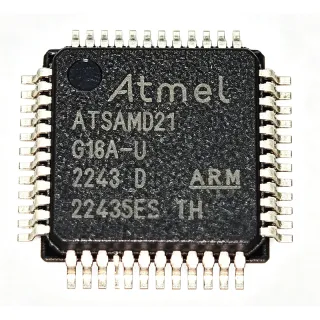
DSPIC33EV32GM102-I/SO - 16-bit 70 MIPS 5V DSC | Microchip
MPN: DSPIC33EV32GM102-I/SO ✓ Active| Qty | Unit Price | Extended |
|---|---|---|
| 1 | $3.62 | $3.62 |
| 10 | $3.26 | $32.60 |
| 100 | $2.9 | $290.00 |
| 500 | $2.61 | $1,305.00 |
| 1,000 | $2.35 | $2,350.00 |
DSPIC33EV32GM102-I/SO Overview
A digital signal controller combines the computational architecture of a digital signal processor (DSP) with the peripheral set and ease of use of a microcontroller (MCU). Within the embedded hierarchy, the dsPIC33EV sits in the 16-bit DSC family under Microchip's broader dsPIC33/PIC24 product line, targeting real-time control loops where math-intensive processing and robust analog integration are required on a single chip.
Key features include operation at up to 70 MIPS from an internal PLL, a true 5V supply range that eliminates the need for level shifting in industrial and automotive environments, an on-chip CAN 2.0B module for vehicle and industrial networking, high-resolution PWM outputs for motor control and power conversion, SENT peripheral support for automotive sensor interfaces, and integrated op amps plus advanced analog features that reduce external component count.
Architecturally, the device implements a modified Harvard 16-bit core with DSP instruction extensions (MAC, dual operand fetch), 9 timers, 4 DMA channels, and multiple internal bus architectures for parallel peripheral access. CMOS process technology supports the wide 5V operating range with enhanced latch-up and ESD robustness suited to harsh environments such as appliances, industrial drives, and automotive subsystems.
Typical applications include BLDC and PMSM motor control, switch-mode power supplies and digital lighting, automotive body and sensor nodes using CAN or SENT, and industrial appliances requiring sensorless control algorithms. The DSP engine and high-speed PWM make it a natural fit for field-oriented control implementations.
A key design consideration: at 70 MIPS the core runs from the internal FRC PLL, so designers should verify clock accuracy requirements against the internal oscillator tolerance or budget an external crystal for CAN networks.
This page synthesizes distributor availability data, drop-in family alternatives, and practical design notes not found in the manufacturer datasheet.
Drop-in alternatives for DSPIC33EV32GM102-I/SO — same package, pin-to-pin compatible. Different-package parts requiring PCB rework are excluded.
Variants in this series
Same-series models that are drop-in compatible with DSPIC33EV32GM102-I/SO (same form factor and footprint) — differing in Package, Operating Temperature, Supply Voltage, Core Architecture, RAM.
Quick Comparison Tool — Select alternative parts for side-by-side comparison:
DSPIC33EV32GM002-E/SO
✅ Drop-In📋 Reference alternative (not in catalog)
DSPIC33EV64GM102-I/SO
✅ Drop-In ⚠️ Specs Unverified✓ In Stock
$3.55 / Unit
View Datasheet →DSPIC33EV16GM102-I/SO
✅ Drop-In ⚠️ Specs Unverified📋 Reference alternative (not in catalog)
DSPIC33EV64GM002-I/SO
✅ Drop-In ⚠️ Specs Unverified📋 Reference alternative (not in catalog)
DSPIC33EV128GM102-I/SO
✅ Drop-In ⚠️ Specs Unverified📋 Reference alternative (not in catalog)
DSPIC33EV32GM102-I/SO Maximum Ratings & Electrical Characteristics
| Core Architecture | 16-bit dsPIC DSC (modified Harvard, DSP-enhanced) |
| Maximum CPU Speed | 70 MIPS |
| Supply Voltage | 5 V |
| Flash Program Memory | 32 KB |
| RAM | 4 KB |
| Package | 28-pin SOIC |
| Operating Temperature Range | -40C to +85C (I grade) |
| CAN Module | Yes (CAN 2.0B) |
| PWM | Yes (motor-control PWM) |
| SENT Interface | Yes |
| On-chip Op Amps | Yes |
| Timers | 9 |
| DMA Channels | 4 |
| Mounting Type | Surface Mount |
| Description Class | 16-Bit, 5V Digital Signal Controllers with PWM, SENT, Op Amps and Advanced Analog Features |
DSPIC33EV32GM102-I/SO 28-pin soic Pin Configuration Guide
Pin configuration for DSPIC33EV32GM102-I/SO (28-pin soic package). This digital IC includes GPIO, communication interfaces (UART, SPI, I2C), and power pins. Refer to the manufacturer datasheet for alternate pin functions and configuration options. Essential for embedded system design and PCB layout.

No detailed pinout data available for DSPIC33EV32GM102-I/SO.
Refer to the datasheet for full pin configuration.
Typical Applications
DSPIC33EV32GM102-I/SO is suitable for 6 applications: BLDC/PMSM Motor Control, Automotive Body and Sensor Nodes, Digital Power Conversion (SMPS/LED Drivers), Industrial Appliances (Washers, Cookers, Fans), Sensor Conditioning and Data Acquisition, Embedded Safety and Supervisory Control.
BLDC/PMSM Motor Control
The DSPIC33EV32GM102-I/SO fits motor control because its 70 MIPS DSP core executes field-oriented control (FOC) loops fast enough for high-speed motors, while the motor-control PWM peripheral provides complementary outputs with dead-time insertion and the on-chip op amps amplify shunt current-sense signals without external amplifiers. The 4 DMA channels move ADC results to RAM without CPU intervention, keeping the control-loop jitter low. Typical usage: ADC-triggered FOC current loop at 10-20 kHz PWM frequency, with the DSP MAC instructions accelerating Park/Clarke transforms. The trade-off versus a dedicated gate driver plus MCU is that one chip handles sensing, control and PWM, but 32KB Flash requires compact fixed-point control code.
Recommended
Automotive Body and Sensor Nodes
This DSC suits automotive nodes because it combines a CAN 2.0B controller for network communication with a SENT peripheral for direct connection of SENT-compatible sensors (throttle position, pressure, level), both standard automotive interfaces. The 5V supply matches legacy automotive sensor rails, and the -40C to +85C Industrial grade covers most in-cabin and body applications; choose the -E grade (+125C) for under-hood positions. In a typical body node, the CAN module handles ECU messaging while SENT reads a sensor without software timing criticality, and the 9 timers offload pulse measurement. The 28-pin SOIC footprint keeps node PCB area small for cost-sensitive volume production.
Recommended
Digital Power Conversion (SMPS/LED Drivers)
For switch-mode power supplies and digital LED drivers, the DSPIC33EV32GM102-I/SO offers high-resolution PWM with fast comparators and a 5V-tolerant analog front end in one 28-pin package. The 70 MIPS core closes voltage- or current-mode feedback loops at the 100-500 kHz switching frequencies common in offline and DC-DC converters, while on-chip op amps condition shunt or divider feedback directly. The ADC-to-PWM trigger path supports peak current-mode control with minimal latency. Designers should budget firmware space carefully - at 32KB Flash, one converter algorithm plus compensation tables fit comfortably, but adding communication stacks alongside requires moving to the 64KB variant.
Recommended
Industrial Appliances (Washers, Cookers, Fans)
Harsh-environment appliance control is a headline application for the dsPIC33EV family: Microchip explicitly positions the 5V, 70 MIPS core for appliances and industrial equipment. The 5V I/O connects directly to legacy appliance sensors, buttons and triac-driving circuitry without level shifters, improving robustness against noisy 230V environments. The DSP core runs sensorless motor algorithms for washing-machine drums and fans, while the CAN module links to display boards or higher-level controllers in larger appliances. The -40C to +85C rating covers unheated utility rooms. Using internal oscillators reduces BOM cost, but verify clock tolerance if CAN is used between boards.
Recommended
Sensor Conditioning and Data Acquisition
The integrated op amps, comparators and fast ADC make this DSC a compact analog front-end for industrial sensor conditioning: bridge, thermocouple or pressure signals can be amplified on-chip, converted, and digitally filtered using the DSP MAC instructions, then transmitted over CAN or UART. The 4 DMA channels stream ADC samples continuously to 4KB RAM, supporting burst-capture analysis without CPU loading. At 70 MIPS, a 1 kHz-sample digital filter chain consumes only a fraction of core throughput, leaving headroom for application logic. For multi-channel systems needing more RAM or larger filter coefficient sets, the same-package 64KB/128KB Flash variants provide a zero-PCB-change upgrade path.
Recommended
Embedded Safety and Supervisory Control
The dsPIC33EV family's safety-oriented feature set (described by Microchip as "CAN, Safety, Motor Control") suits supervisory controllers in machinery: watchdog supervision, windowed watchdog, and configurable Brown-out reset protect against fault conditions, while the 16-bit core deterministically executes state machines for safety interlocks. The 5V noise margin improves immunity in electrically noisy industrial cabinets compared with 3.3V controllers, and CRC-capable flash self-test routines fit within 32KB. Typical topology: the DSC monitors sensors via its op amp/ADC front end, drives relays or PWM outputs, and reports status over CAN to the main PLC or vehicle controller with deterministic 70 MIPS timing.
Recommended
Recommended Products Summary
Engineering reference data for DSPIC33EV32GM102-I/SO — comparison, design guidance, and compliance information.
Selection Guide
Comparison with Alternatives
| Parameter | This Product | DSPIC33EV32GM002-E/SO | DSPIC33EV64GM102-I/SO | DSPIC33EV16GM102-I/SO | DSPIC33EV64GM002-I/SO | DSPIC33EV128GM102-I/SO |
|---|---|---|---|---|---|---|
| Package | 28-pin SOIC | 28-pin SOIC - same | 28-pin SOIC - same | 28-pin SOIC - same | 28-pin SOIC - same | 28-pin SOIC - same |
| Brand | Microchip Technology | Microchip Technology | Microchip Technology | Microchip Technology | Microchip Technology | Microchip Technology |
| Flash Program Memory | 32 KB | 32 KB | 64 KB | 16 KB | 64 KB | 128 KB |
| RAM | 4 KB | 4 KB | 8 KB | 2 KB | 8 KB | 16 KB |
| CAN 2.0B Module | Yes | No | Yes | Yes | No | Yes |
| CPU Speed | 70 MIPS | 70 MIPS | 70 MIPS | 70 MIPS | 70 MIPS | 70 MIPS |
| Operating Temperature | -40C to +85C (I grade) | -40C to +125C (E grade) | -40C to +85C (I grade) | -40C to +85C (I grade) | -40C to +85C (I grade) | -40C to +85C (I grade) |
| SENT / PWM / Op Amps | Yes / Yes / Yes | Yes / Yes / Yes | Yes / Yes / Yes | Yes / Yes / Yes | Yes / Yes / Yes | Yes / Yes / Yes |
Key Differentiators
- On-chip CAN 2.0B controller (vs DSPIC33EV32GM002-E/SO)
- 5V operation with integrated analog (vs DSPIC33EV16GM102-I/SO)
- Flash/RAM headroom in identical footprint (vs DSPIC33EV64GM102-I/SO)
Design Notes
Provide a clean 5V rail with 0.1uF ceramic decoupling on each VDD pin placed within 5 mm of the pin, plus 4.7-10uF bulk capacitance near the device. The dsPIC33EV core generates internal 1.8V/2.5V rails via on-chip regulators - follow the datasheet's required external regulator capacitor value and type exactly, as omitting or undersizing it is a common cause of erratic reset behavior. If the board carries motor or relay loads, star-route the DSC ground away from switching return currents.
The 70 MIPS clock is derived from the internal FRC oscillator and PLL. Internal oscillator tolerance is adequate for general firmware but NOT guaranteed for CAN bus bit-timing on long or heavily loaded networks - budget an external crystal (e.g., 8-16 MHz with PLL) if the CAN module connects to a shared automotive/industrial bus. Also verify configuration words (FBS, FGS, FOSC) on first programming; wrong oscillator configuration is the most frequent first-power-up failure on dsPIC33 designs.
Use the on-chip op amps for motor current sensing with short, kelvin-connected shunt traces to the amplifier inputs; keep the PWM output traces away from analog routing to prevent coupling into the ADC front end. For SENT inputs, add a series resistor (1-2k ohm) and check the SENT signal's slow edges against the input buffer thresholds. Route the CAN TX/RX to the transceiver with a ground guard trace when the bus runs through noisy cable harnesses.
The 28-pin SOIC has a 1.27 mm pitch and a wide (~7.5 mm body) footprint that is easy to hand-solder and probe. Expose a solid ground plane under the device; connect analog ground references to it at a single quiet point. If migrating later between GM002/GM102/GM302 Flash variants, no layout change is needed - design the footprint once and use family-level net names (e.g., RPn remappable pins) so firmware pin assignment stays portable across the family.
Compliance Information
Suffix-based Microchip parts with -I/-E temperature codes are standard lead-free RoHS productions; confirm current RoHS/REACH certificates on microchip.com, as the retrieved web data did not state compliance explicitly.