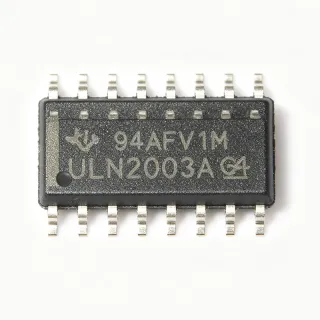
LDC3114-Q1 - 4-Ch Inductive Touch Sensor 16-TSSOP | TI
MPN: LDC3114-Q1 ✓ Active| Qty | Unit Price | Extended |
|---|---|---|
| 1 | $3.1 | $3.10 |
| 10 | $2.79 | $27.90 |
| 100 | $2.42 | $242.00 |
| 500 | $2.12 | $1,060.00 |
| 1,000 | $1.88 | $1,880.00 |
LDC3114-Q1 Overview
An inductance-to-digital converter (LDC) is a specialized sensor interface IC that measures the resonant frequency shift of an LC tank driven by a conductive target. Within the sensor signal chain hierarchy, it sits between the raw coil sensor and the host MCU, functioning as both an excitation source and a digitizer. LDCs belong to the broader family of capacitive/inductive position and touch sensing interfaces used across automotive and industrial human-machine interfaces.
Key features include four well-matched sensing channels that support differential and ratiometric measurements, allowing compensation of environmental and aging effects such as temperature drift and mechanical drift. The device communicates through an I2C interface for simple configuration, and an ultra-low power mode is specifically intended for power on/off buttons and position sensors in battery-powered applications. The device is AEC-Q1 qualified, making it suitable for automotive in-cabin and body electronics designs.
Technically, the LDC3114-Q1 drives external coils directly and reports proximity or touch state via I2C registers, offloading threshold computation from the host processor. The well-matched channel structure improves multi-button uniformity, while the single-ended sensing method simplifies sensor PCB layout compared to differential architectures.
Typical applications include automotive touch buttons on steering wheels and center consoles, contactless rotary/position sensing in knobs and dials, and industrial control panels where sealed, mechanical-free interfaces improve reliability in harsh environments.
Design consideration: keep the LC tank components close to the device and follow the TI sensor PCB layout guidelines to minimize parasitic capacitance; the single-ended architecture is more EMI-sensitive than differential predecessors such as the LDC1662, so shielding and ground plane practices matter.
Drop-in alternatives for LDC3114-Q1 — same package, pin-to-pin compatible. Different-package parts requiring PCB rework are excluded.
Variants in this series
Same-series models that are drop-in compatible with LDC3114-Q1 (same form factor and footprint) — differing in Configuration, Function, Package.
Quick Comparison Tool — Select alternative parts for side-by-side comparison:
LDC3114QPWR
✅ Drop-In✓ In Stock
$1.8 / Unit
View Datasheet →LDC3114QPWT
✅ Drop-In📋 Reference alternative (not in catalog)
LDC1314QPWRQ1
✅ Drop-In ⚠️ Specs Unverified📋 Reference alternative (not in catalog)
LDC1614QPWRQ1
✅ Drop-In ⚠️ Specs Unverified📋 Reference alternative (not in catalog)
LDC3114-Q1 Maximum Ratings & Electrical Characteristics
| Number of Channels | 4 |
| Function | 4-Channel Hybrid Inductive Touch and Inductance-to-Digital Converter |
| Interface | I2C |
| Resolution | 160 bits conversion engine (per DigiKey listing) |
| Package | 16-TSSOP (PW), 5.00 mm x 4.40 mm |
| Mounting Type | Surface Mount |
| Qualification | AEC-Q100 (automotive grade, Q1) |
| Ultra-Low Power Mode | Yes (for battery-powered buttons/position sensors) |
| Measurement Type | Single-ended inductance sensing |
| Channel Matching | Well-matched channels for differential/ratiometric measurement |
| Configuration | I2C registers |
| RoHS Status | Compliant |
| Marking Code | QDC3114 |
LDC3114-Q1 16-tssop (pw), 5.00 mm x 4.40 mm Pin Configuration Guide
Pin configuration for LDC3114-Q1 (16-tssop (pw), 5.00 mm x 4.40 mm package). Pin numbering, functions, and connection diagrams are defined in the manufacturer datasheet. Refer to it for the exact footprint and soldering guidelines.

No detailed pinout data available for LDC3114-Q1.
Refer to the datasheet for full pin configuration.
Typical Applications
LDC3114-Q1 is suitable for 6 applications: Automotive Touch Buttons, Battery-Powered Power Buttons, Contactless Rotary Position Sensing, Industrial Control Panels, Proximity Detection, Home Appliance User Interfaces.
Automotive Touch Buttons
The LDC3114-Q1 enables sealed, mechanical-free touch buttons on steering wheels, center consoles, and door panels. Its AEC-Q100 qualification and well-matched channels allow four buttons to share consistent thresholds on one PCB, while ratiometric measurement compensates temperature drift inside a hot vehicle cabin. Because sensing is inductive, metal overlays and moisture do not cause false triggers the way they can with capacitive sensing. Placed behind a decorative metal panel with external coils, the device reports button state over I2C with no moving parts to wear out, improving long-term reliability versus mechanical switches.
Recommended
Battery-Powered Power Buttons
The ultra-low power mode of the LDC3114-Q1 is specifically intended for power on/off buttons in battery-powered products. In this mode the device periodically samples the LC tank to detect a finger or target, waking the system via interrupt when a press is detected. Because sensing is contactless, a fully sealed waterproof button face can be used, ideal for outdoor and wearable products. Designers should size the coil for the target's proximity range and configure the low-power sampling interval to balance current draw against wake-up latency in the I2C register set.
Recommended
Contactless Rotary Position Sensing
TI's Inductive Touch and Magnetic Dial Contactless User Interface reference design uses the LDC3114-Q1 for rotary knobs and dials. A conductive target attached to the knob moves over fixed coils, and the four channels resolve angular or stepped position without optical encoders or potentiometers. The 160-step conversion resolution provides fine position granularity, and channel matching keeps readings linear across rotation. This architecture survives dust, moisture, and vibration that defeat mechanical encoders, making it attractive for appliance, automotive HVAC, and industrial control knobs where long service life is mandatory.
Recommended
Industrial Control Panels
In factory and process control panels, the LDC3114-Q1 provides four sealed touch inputs immune to dust, oil, and washdown conditions that degrade mechanical buttons. The single-ended inductive sensing works through stainless steel or aluminum overlays, enabling rugged IP-rated front panels. Well-matched channels permit one calibration routine across all four inputs, and the I2C interface connects directly to industrial MCUs. Ratiometric measurement compensates the wide ambient temperature swings typical of industrial cabinets, maintaining consistent touch thresholds without periodic recalibration or drift compensation in host firmware.
Recommended
Proximity Detection
The LDC3114-Q1 performs short-range proximity detection by measuring the shift in coil inductance as a conductive target approaches. This supports gesture-like wake-up, liquid level detection through container walls, and metal target presence checks in automation. Compared with the differential-method LDC1662, the single-ended architecture simplifies coil layout but is somewhat more sensitive to external EMI, so designers should add ground planes and follow TI layout guidelines. The ultra-low power mode allows always-on presence detection in battery nodes, reporting state changes through the interrupt pin to the host controller.
Recommended
Home Appliance User Interfaces
Washing machines, cooktops, and coffee makers benefit from the LDC3114-Q1's sealed inductive touch inputs, which operate reliably with wet hands and behind metal or glass fascias where capacitive touch struggles. Four channels cover common button clusters with a single IC, and ratiometric measurement rejects the large temperature gradients near heating elements. The I2C interface integrates with appliance main controllers, and the interrupt output allows the host to sleep until a touch occurs, lowering standby power. AEC-Q1 qualification also makes the same design reusable across automotive and appliance platforms.
Recommended
Recommended Products Summary
Engineering reference data for LDC3114-Q1 — comparison, design guidance, and compliance information.
Selection Guide
Comparison with Alternatives
| Parameter | This Product | LDC3114QPWR | LDC1314QPWRQ1 | LDC1614QPWRQ1 |
|---|---|---|---|---|
| Package | 16-TSSOP (PW) 5.00 mm x 4.40 mm | 16-TSSOP (PW) - same | 16-TSSOP (PW) - same | 16-TSSOP (PW) - same |
| Brand | Texas Instruments | Texas Instruments | Texas Instruments | Texas Instruments |
| Channels | 4 | 4 | 4 | 4 |
| Automotive Qualification | Yes (AEC-Q100 Q1) | No (commercial) | Yes (Q1) | Yes (Q1) |
| Sensing Method | Single-ended hybrid touch + inductance | Single-ended hybrid touch + inductance | Inductance-to-digital (no hybrid touch mode) | High-resolution inductance-to-digital |
| Interface | I2C | I2C | I2C | I2C |
Key Differentiators
- Hybrid inductive touch mode (vs LDC1314QPWRQ1)
- Automotive qualification at commercial-family cost (vs LDC1614QPWRQ1)
- Well-matched channels for drift compensation (vs LDC3114QPWR)
Design Notes
Place the LC tank inductors and capacitors as close as possible to the INxA/INxB channel pins, and keep the coil traces on a dedicated area of the PCB away from switching regulators and high-speed clocks. Follow the sensor coil design equations in TI datasheet (SNOSDA) to select the LC resonance; the single-ended architecture is more EMI-sensitive than differential predecessors such as the LDC1662, which included a dedicated input deglitch filter, so shielding and a solid ground plane under the coils are important.
Decouple VDD with a 100 nF ceramic capacitor placed within 2 mm of the supply pin, and provide a clean analog supply free of switching ripple. For battery-powered power-button designs, use the ultra-low power mode and configure the active sampling duty cycle via I2C registers to minimize average current; a noisy supply will appear as inductance-shift noise and raise touch thresholds.
The LDC3114-Q1 is functionally identical to the commercial LDC3114 but carries AEC-Q100 qualification - do not substitute the commercial part in automotive builds. When migrating from LDC1662, note the sensing method changes from differential to single-ended and register maps differ, so firmware and sensor coil design must be re-validated. Use well-matched channel layouts so ratiometric compensation of temperature and mechanical drift remains effective across all four channels.
Compliance Information
Automotive (Q1) qualified per TI product page. RoHS/lead-free status per standard TI automotive product offering; REACH and halogen details not stated in retrieved data.