MSPM0L1305-Q1 - Automotive 32MHz Cortex-M0+ MCU | Texas Instruments
MPN: MSPM0L1305-Q1 ✓ Active| Qty | Unit Price | Extended |
|---|---|---|
| 1 | $2.82 | $2.82 |
| 10 | $2.53 | $25.30 |
| 100 | $2.25 | $225.00 |
| 500 | $2.02 | $1,010.00 |
| 1,000 | $1.85 | $1,850.00 |
MSPM0L1305-Q1 Overview
What is an automotive mixed-signal microcontroller? A microcontroller (MCU) is a compact integrated circuit that combines a processor core, memory, and programmable input/output peripherals onto a single chip. The MSPM0 family belongs to the ultra-low-power, highly integrated 32-bit MSPM0 MCU series built around the enhanced Arm Cortex-M0+ core platform. These devices provide high-performance analog peripherals integration, enabling them to interface directly with sensors and actuators while reducing system component count and overall bill-of-materials cost.
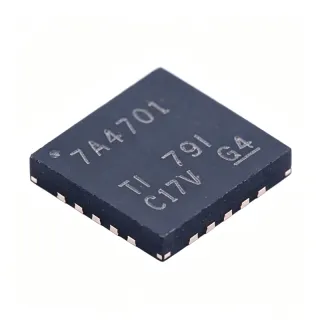
Key features of the MSPM0L1305-Q1 include a 12-bit analog-to-digital converter (ADC) with up to 1.68 Msps sampling rate, a zero-drift low-power operational amplifier, and a power-on reset/brown-out reset circuit for robust startup. The device also features a comprehensive clock system with an internal 32 MHz oscillator, capable of ±3% accuracy without external timing components. The MCU is offered in a 24-pin VQFN (RGE) package, measuring 4x4 mm, and an ultra-small 16-pin SOT-23-THIN package for space-constrained automotive applications.
The MSPM0L1305-Q1 supports a variety of low-power modes, allowing system designers to meet strict automotive power budgets. Its peripherals include multiple timers, a UART, SPI, I2C interfaces, and a LIN transceiver, enabling seamless connectivity in body control modules, sensor interfaces, and battery management systems.
For design considerations, it is crucial to decouple the VDD and VDDIO pins with ceramic capacitors to ensure stable operation. The device's internal voltage regulator requires an external bypass capacitor for reliable operation. With its high-temperature operation and robust ESD protection, the MSPM0L1305-Q1 delivers dependable performance in harsh automotive environments.
Drop-in alternatives for MSPM0L1305-Q1 — same package, pin-to-pin compatible. Different-package parts requiring PCB rework are excluded.
Quick Comparison Tool — Select alternative parts for side-by-side comparison:
MSPM0L1305SDYYR
✅ Drop-In📋 Reference alternative (not in catalog)
MSPM0L1305TRGER
✅ Drop-In📋 Reference alternative (not in catalog)
MSPM0L1306-Q1
✅ Drop-In ⚠️ Specs Unverified✓ In Stock
Contact for price
MSPM0L1305
✅ Drop-In📋 Reference alternative (not in catalog)
STM32F031K6U6
⚡ Same Package ⚠️ Specs Unverified✓ In Stock
$1.24 / Unit
View Datasheet →ATSAMD21G18A-AU
⚡ Same Package ⚠️ Specs Unverified✓ In Stock
$2.78 / Unit
View Datasheet →MSPM0L1305-Q1 Maximum Ratings & Electrical Characteristics
| Core Processor | ARM Cortex-M0+ |
| Core Size | 32-Bit |
| Speed | 32 MHz |
| Program Memory Size | 32 KB (32K x 8) |
| Program Memory Type | FLASH |
| RAM Size | 4 KB |
| ADC | 12-bit, 1.68 Msps |
| Operational Amplifier | 1x OPA (zero-drift) |
| Communication Interfaces | UART, SPI, I2C, LIN |
| Supply Voltage | 1.62 V to 3.6 V |
| Operating Temperature | -40°C to +125°C (Grade 1) |
| Package | 24-VQFN (4x4), 16-SOT-23-THIN |
| Mounting Type | Surface Mount |
| AEC-Q100 Qualified | Yes (Grade 1) |
| RoHS Status | Compliant |
MSPM0L1305-Q1 Pin Configuration
| Pin 1 | VDD — Power supply input |
| Pin 2 | VSS — Ground |
| Pin 3 | PA0 — General purpose I/O / ADC input |
| Pin 4 | PA1 — General purpose I/O / UART TX |
| Pin 5 | PA2 — General purpose I/O / SPI CLK |
| Pin 6 | PA3 — General purpose I/O / SPI MOSI |
| Pin 7 | PA4 — General purpose I/O / I2C SDA |
| Pin 8 | PA5 — General purpose I/O / I2C SCL |
| Pin 9 | PA6 — General purpose I/O / OPA input |
| Pin 10 | PA7 — General purpose I/O / OPA output |
| Pin 11 | PB0 — General purpose I/O / ADC input |
| Pin 12 | PB1 — General purpose I/O / LIN TX |
| Pin 13 | PB2 — General purpose I/O / LIN RX |
| Pin 14 | PB3 — General purpose I/O / PWM |
| Pin 15 | PB4 — General purpose I/O / PWM |
| Pin 16 | PB5 — General purpose I/O / Timer input |
| Pin 17 | PB6 — General purpose I/O / UART RX |
| Pin 18 | PB7 — General purpose I/O / SPI MISO |
| Pin 19 | NRST — Reset input (active low) |
| Pin 20 | VDDIO — I/O power supply |
| Pin 21 | SWCLK — Serial wire debug clock |
| Pin 22 | SWDIO — Serial wire debug data I/O |
| Pin 23 | VREF+ — ADC reference voltage positive input |
| Pin 24 | VREF- — ADC reference voltage negative input |
Typical Applications
MSPM0L1305-Q1 is suitable for 6 applications: Automotive Body Control Modules, Sensor Interface, Automotive Lighting and LED Control, Battery Management System Supervision, Industrial Sensor Nodes, Smart Body Access Systems.
Automotive Body Control Modules
The MSPM0L1305-Q1 is ideal for body control modules (BCM) due to its AEC-Q100 Grade 1 qualification, -40°C to +125°C operation, and LIN communication. Its 12-bit ADC enables direct interfacing with seat position sensors, door lock actuators, and lighting control. The MCU's 32 MHz core provides sufficient processing power for multi-rail diagnostics and control loops. The 1.62V-3.6V supply range allows direct connection to the automotive 3.3V rail, simplifying power design. With its integrated LIN transceiver, the device reduces BOM cost by eliminating external communication ICs.
Recommended
Sensor Interface
This MCU integrates a 12-bit ADC and zero-drift operational amplifier, making it a perfect fit for automotive sensor interfaces such as pressure, temperature, and position sensors. The OPA can amplify low-level sensor signals while the ADC digitizes them at up to 1.68 Msps. With its low-power modes, the MCU can sleep between sensor readings, meeting rigorous automotive power budgets. Additionally, the SPI and I2C interfaces allow connection to digital sensors, while the LIN interface can report sensor data to a central ECU. This reduces the need for companion ICs, cutting system cost and PCB area.
Recommended
Automotive Lighting and LED Control
The MSPM0L1305-Q1 can control automotive exterior and interior lighting systems. With its PWM-capable timers, it provides smooth dimming for LED tail lamps and ambient lighting. The MCU's LIN interface supports lighting commands from the body control module, enabling centralized management. Its noise-immune ADC can monitor LED current feedback via an external current sense resistor, facilitating closed-loop regulation. The compact VQFN or SOT-23 package fits into tight headlamp and interior lighting assemblies, while the AEC-Q100 qualification ensures reliable operation under hot and vibration-prone conditions.
Recommended
Battery Management System Supervision
For battery management systems (BMS), the MSPM0L1305-Q1 serves as a local supervisor that monitors cell voltages and temperatures. Its 12-bit ADC can measure voltage across a sense resistor with the OPA providing amplification for small differential signals. The MCU communicates with a main BMS controller via LIN or UART. Operating from 1.62V to 3.6V, it can be powered directly from a reference rail in the sensing circuit. Its low-power modes ensure minimal drain on the battery pack, which is critical for long-term storage and standby operation.
Recommended
Industrial Sensor Nodes
The MSPM0L1305-Q1 is well-suited for industrial sensor nodes requiring low power and mixed-signal integration. Its 32 MHz Cortex-M0+ core handles data acquisition and processing, while the integrated ADC and OPA interface directly with industrial sensors. The wide supply voltage range of 1.62V to 3.6V permits operation from 2-cell alkaline or Li-ion batteries. The UART and I2C interfaces enable compatibility with industrial gateways and PLCs. With its robust design and extended temperature range, this MCU delivers reliable performance in factory automation and process control environments.
Recommended
Smart Body Access Systems
In smart body access systems, the MSPM0L1305-Q1 controls keyless entry and immobilizer functions. Its LIN interface communicates with the central access controller, switching between drive and park modes. The MCU's low-power consumption allows extended battery operation for passive key fob detection. Additionally, the integrated ADC senses capacitive proximity signals for touchless entry. With AEC-Q100 qualification, it withstands the harsh automotive environment while enabling the precise timing needed for radio frequency (RF) wake-up and authentication protocols.
Recommended
Recommended Products Summary
Engineering reference data for MSPM0L1305-Q1 — comparison, design guidance, and compliance information.
Selection Guide
Comparison with Alternatives
| Parameter | This Product | MSPM0L1305SDYYR | MSPM0L1305TRGER | MSPM0L1306-Q1 | STM32F031K6U6 |
|---|---|---|---|---|---|
| Brand | Texas Instruments | Texas Instruments | Texas Instruments | Texas Instruments | STMicroelectronics |
| Package | 24-VQFN (4x4) / 16-SOT-23-THIN | 16-SOT-23-THIN | 24-VQFN (4x4) | 24-VQFN (4x4) | 24-VQFN (4x4) |
| Core Clock Speed | 32 MHz | 32 MHz | 32 MHz | 32 MHz | 48 MHz |
| Flash Memory | 32 KB | 32 KB | 32 KB | 64 KB | 32 KB |
| SRAM | 4 KB | 4 KB | 4 KB | 8 KB | 4 KB |
| ADC Resolution | 12-bit | 12-bit | 12-bit | 12-bit | 12-bit |
| Automotive Qualification | Yes (AEC-Q100 Grade 1) | Yes | Yes | Yes | No |
| LIN Interface | Yes | Yes | Yes | Yes | No |
Key Differentiators
- AEC-Q100 Grade 1 qualification with -40°C to 125°C operation (vs STM32F031K6U6)
- Integrated zero-drift OPA and LIN transceiver (vs MSPM0L1305SDYYR)
- Ultra-low-power modes for battery applications (vs ATSAMD21G18A-AU)
Design Notes
Ensure a 100 nF decoupling capacitor is placed close to the VDD pin and a 10 µF bulk capacitor on the supply rail. The internal voltage regulator requires an external bypass capacitor of at least 1 µF. A 100 nF capacitor should also be placed on VDDIO to prevent I/O switching noise from affecting the internal analog circuitry.
At 32 MHz with all peripherals active, the MSPM0L1305-Q1 can dissipate up to 50 mW. The VQFN package thermal resistance is approximately 45°C/W. Design the PCB with a thermal pad connected to a ground plane to help dissipate heat. For ambient temperatures above 105°C, reduce the clock frequency or use low-power modes to keep the junction temperature below 125°C.
Do not route high-frequency digital signals near the ADC reference input to avoid noise coupling. Use the internal reference for moderate accuracy or connect an external reference to VREF+ for precision. When using the LIN interface, ensure proper hardware handshake with the transceiver to avoid bus conflicts during multi-node communication. Always initialize the OPA before enabling the ADC to avoid false conversions.
Compliance Information
AEC-Q100 qualified for automotive applications, Grade 1. RoHS compliant per TI product page.