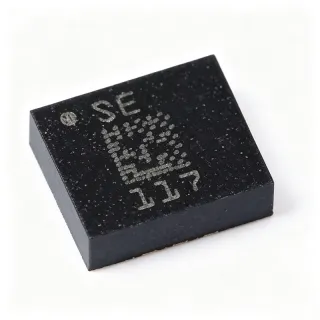
LSM303DTR - 3D Accelerometer + Magnetometer | STMicroelectronics
MPN: LSM303DTR ✓ Active| Qty | Unit Price | Extended |
|---|---|---|
| 1 | $3.42 | $3.42 |
| 10 | $3.08 | $30.80 |
| 100 | $2.74 | $274.00 |
| 500 | $2.47 | $1,235.00 |
| 1,000 | $2.19 | $2,190.00 |
LSM303DTR Overview
A 3D accelerometer is a sensor that measures linear acceleration along three perpendicular axes (X, Y, Z), typically used to detect motion, tilt, and vibration. A 3D magnetometer measures the strength and direction of the magnetic field, functioning as an electronic compass. When combined, they form an inertial measurement unit (IMU) capable of providing orientation and heading information. The LSM303DTR integrates both sensors in a single package, reducing board space and simplifying design compared to discrete solutions.
Key features include a full-scale acceleration range selectable from ±2g to ±16g, and a magnetic field full-scale range from ±2 gauss to ±12 gauss. The accelerometer offers a 16-bit data output with a noise density of 220 µg/√Hz, while the magnetometer provides 16-bit resolution with a sensitivity of 0.080 µT/LSB at ±4 gauss range. The device supports output data rates from 3.125 Hz to 1600 Hz for the accelerometer and 0.625 Hz to 100 Hz for the magnetometer, with an embedded FIFO buffer to reduce host processor load.
The LSM303DTR utilizes a MEMS (Micro-Electro-Mechanical Systems) capacitive sensing element for the accelerometer and a Hall-effect or magneto-resistive sensing element for the magnetometer. The integrated signal conditioning, ADC, and digital interface eliminate the need for external components, simplifying PCB design. The device operates over a temperature range of -40°C to +85°C, making it suitable for industrial and consumer applications.
Typical applications include orientation and motion sensing in smartphones, tablets, gaming controllers, and wearable devices. It is also used in robotics for tilt compensation, in navigation systems for dead reckoning, and in industrial equipment for vibration monitoring. The low power consumption, with a typical current of 2 mA in normal mode, extends battery life in portable devices.
When designing with the LSM303DTR, ensure proper decoupling with a 100 nF capacitor on the power supply pins and place the sensor away from magnetic interference sources such as speakers and motors. The I2C address is 0x1E (7-bit) and can be configured via the SA0 pin. For optimal performance, follow the layout guidelines in the datasheet to minimize mechanical stress on the package.
Drop-in alternatives for LSM303DTR — same package, pin-to-pin compatible. Different-package parts requiring PCB rework are excluded.
Quick Comparison Tool — Select alternative parts for side-by-side comparison:
LSM303DLHCTR
✅ Drop-In ⚠️ Specs Unverified📋 Reference alternative (not in catalog)
LSM303CTR
✅ Drop-In ⚠️ Specs Unverified📋 Reference alternative (not in catalog)
LSM303DTR Maximum Ratings & Electrical Characteristics
| Sensor Type | 3D Accelerometer + 3D Magnetometer |
| Interface | I2C / SPI |
| Supply Voltage | 2.16 V to 3.6 V |
| Accelerometer Full-Scale Range | ±2g, ±4g, ±6g, ±8g, ±16g |
| Magnetometer Full-Scale Range | ±2, ±4, ±8, ±12 gauss |
| Accelerometer Sensitivity | 0.061 mg/LSB at ±2g |
| Magnetometer Sensitivity | 0.080 µT/LSB at ±4 gauss |
| Accelerometer Noise Density | 220 µg/√Hz |
| Output Data Rate (Accelerometer) | 3.125 Hz to 1600 Hz |
| Output Data Rate (Magnetometer) | 0.625 Hz to 100 Hz |
| Resolution | 16-bit |
| FIFO Buffer | Yes (32 levels) |
| Operating Temperature | -40°C to +85°C |
| Package | LGA-16 (3x3x1 mm) |
| Mounting Type | Surface Mount |
| RoHS Status | Compliant |
LSM303DTR Pin Configuration
| Pin 1 | VDD_IO — Power supply for I/O pins |
| Pin 2 | SCL/SPC — I2C clock / SPI clock |
| Pin 3 | GND — Ground |
| Pin 4 | SDA/SDI — I2C data / SPI data in |
| Pin 5 | SA0/SDO — I2C address select / SPI data out |
| Pin 6 | CS — Chip select (SPI) |
| Pin 7 | INT1 — Interrupt 1 output |
| Pin 8 | INT2 — Interrupt 2 output |
| Pin 9 | NC — Not connected |
| Pin 10 | NC — Not connected |
| Pin 11 | NC — Not connected |
| Pin 12 | NC — Not connected |
| Pin 13 | NC — Not connected |
| Pin 14 | NC — Not connected |
| Pin 15 | VDD — Power supply |
| Pin 16 | GND — Ground |
Typical Applications
LSM303DTR is suitable for 6 applications: Wearable Devices, Smartphones and Tablets, Robotics and Drones, Industrial Vibration Monitoring, Navigation and Dead Reckoning, Gaming and Virtual Reality.
Wearable Devices
The LSM303DTR is ideal for wearables like fitness trackers and smartwatches, where its compact LGA-16 package and low power consumption (2 mA) enable continuous motion tracking. The accelerometer detects steps and activity, while the magnetometer provides heading for navigation. The 16-bit resolution and selectable full-scale ranges (±2g to ±16g) allow accurate measurement of both subtle movements and high-impact activities. The I2C/SPI interface simplifies connection to low-power MCUs, and the FIFO buffer reduces host wake-ups, extending battery life. The wide supply voltage (2.16V-3.6V) supports direct battery connection. The operating temperature range (-40°C to +85°C) ensures reliable operation in various environments. Compared to discrete sensors, the integrated solution reduces board space and design complexity, making it a preferred choice for compact wearables.
Recommended
Smartphones and Tablets
In smartphones and tablets, the LSM303DTR provides orientation detection for screen rotation, tilt compensation for GPS navigation, and motion-based gaming controls. The accelerometer's high ODR (up to 1600 Hz) enables responsive gesture recognition, while the magnetometer's ±12 gauss range allows accurate compass heading. The 16-bit resolution ensures smooth and precise motion tracking. The I2C interface at 400 kHz and SPI at 10 MHz provide fast data transfer to the application processor. The small LGA-16 package fits into the tight PCB layouts of modern devices. The device's low power consumption (2 mA) is critical for battery life, and the FIFO buffer offloads the host processor, reducing power consumption further. The device's robustness to vibration and shock, with full-scale up to ±16g, makes it suitable for drop detection and impact sensing.
Recommended
Robotics and Drones
The LSM303DTR is used in robotics and drones for attitude estimation, stabilization, and navigation. The accelerometer measures linear acceleration for tilt sensing, while the magnetometer provides heading reference for yaw. The 16-bit resolution and low noise (220 µg/√Hz) enable precise orientation estimation. The wide full-scale range (±16g) handles high dynamic movements. The SPI interface at 10 MHz allows fast data streaming to the flight controller. The compact package and low weight are advantageous for aerial vehicles. The device's operating temperature range (-40°C to +85°C) suits outdoor operation. In drones, the sensor data is fused with gyroscope data (from an external gyro) to provide a complete IMU. The FIFO buffer helps synchronize data with the control loop, reducing jitter. The low power consumption extends flight time.
Recommended
Industrial Vibration Monitoring
The LSM303DTR is suitable for industrial vibration monitoring in machinery and equipment. The accelerometer's wide full-scale range (±16g) and high ODR (up to 1600 Hz) capture high-frequency vibrations. The 16-bit resolution provides detailed vibration signatures for predictive maintenance. The device's industrial temperature range (-40°C to +85°C) ensures reliable operation in harsh environments. The SPI interface allows connection to industrial PLCs or MCUs. The small package can be mounted directly on equipment. The magnetometer can detect magnetic fields from motors, aiding in rotational speed measurement. The FIFO buffer enables efficient data collection for FFT analysis. The low power consumption is beneficial for battery-powered wireless sensor nodes. The device's robustness to shock and vibration ensures long-term reliability.
Recommended
Navigation and Dead Reckoning
The LSM303DTR is used in navigation systems for dead reckoning, where the accelerometer measures step length and the magnetometer provides heading. This is critical in GPS-denied environments such as indoor navigation. The accelerometer's low noise (220 µg/√Hz) and high resolution enable accurate step counting and stride length estimation. The magnetometer's ±12 gauss range and 0.080 µT/LSB sensitivity provide precise heading. The I2C interface simplifies integration with navigation processors. The device's low power consumption (2 mA) is essential for battery-powered portable navigation devices. The FIFO buffer reduces host processing, allowing continuous operation. The compact package fits into handheld devices. The operating temperature range supports outdoor use. The sensor fusion algorithms combine accelerometer and magnetometer data to estimate position and orientation, improving navigation accuracy.
Recommended
Gaming and Virtual Reality
The LSM303DTR is used in gaming controllers and VR headsets for motion tracking and gesture recognition. The accelerometer's high ODR (up to 1600 Hz) and wide full-scale range (±16g) capture fast movements and impacts. The magnetometer provides heading for orientation tracking. The 16-bit resolution ensures smooth and accurate motion. The I2C/SPI interface allows connection to gaming processors. The small package is ideal for compact controllers. The low latency, enabled by the FIFO buffer, is critical for real-time gaming. The device's low power consumption extends battery life in wireless controllers. The operating temperature range supports extended gaming sessions. The sensor fusion with gyroscope data (external) provides 9-axis tracking for immersive VR experiences. The device's robustness to shock ensures durability in gaming environments.
Recommended
Recommended Products Summary
Engineering reference data for LSM303DTR — comparison, design guidance, and compliance information.
Selection Guide
Comparison with Alternatives
| Parameter | This Product | LSM303DLHCTR | LSM303CTR | LSM9DS1TR | MPU-9250 | FXOS8700CQ |
|---|---|---|---|---|---|---|
| Package | LGA-16 (3x3x1 mm) | LGA-16 (3x3x1 mm) - same | LGA-16 (3x3x1 mm) - same | LGA-24 (3.5x3.5 mm) - different | QFN-24 (3x3x1 mm) - different | QFN-16 (3x3x1 mm) - different |
| Brand | STMicroelectronics | STMicroelectronics | STMicroelectronics | STMicroelectronics | TDK InvenSense | NXP Semiconductors |
| Accelerometer Full-Scale Range | ±2g to ±16g | ±2g to ±8g | ±2g to ±16g | ±2g to ±16g | ±2g to ±16g | ±2g to ±8g |
| Magnetometer Full-Scale Range | ±2 to ±12 gauss | ±1.3 to ±8.1 gauss | ±2 to ±16 gauss | ±4 to ±16 gauss | ±4.8 to ±48 mT (approx ±48 to ±480 gauss) | ±1.2 to ±12 gauss |
| Accelerometer ODR | 3.125 Hz to 1600 Hz | 1 Hz to 1000 Hz | 3.125 Hz to 1600 Hz | 10 Hz to 952 Hz | 4 Hz to 4000 Hz | 1.563 Hz to 800 Hz |
| FIFO Buffer | Yes (32 levels) | No | Yes (32 levels) | Yes (32 levels) | Yes (512 bytes) | Yes (32 samples) |
| Supply Current (Normal Mode) | 2 mA | 0.3 mA | 2 mA | 4.5 mA | 3.45 mA | 0.9 mA |
| Interface | I2C / SPI | I2C / SPI | I2C / SPI | I2C / SPI | I2C / SPI | I2C / SPI |
Key Differentiators
- Wider accelerometer full-scale range (±16g) compared to LSM303DLHC (±8g) (vs LSM303DLHCTR)
- Higher accelerometer ODR (1600 Hz vs 1000 Hz) (vs LSM303DLHCTR)
- Integrated FIFO buffer (32 levels) not present in LSM303DLHC (vs LSM303DLHCTR)
Design Notes
Place a 100 nF decoupling capacitor close to the VDD and VDD_IO pins. Use a 1 µF capacitor on VDD for additional filtering. Ensure the ground pins are connected to a solid ground plane. Avoid routing high-current traces near the sensor to minimize magnetic interference.
Mount the sensor away from sources of mechanical stress, such as mounting holes and connectors. Use a soft mounting technique (e.g., rubber grommets) if the device is subject to vibration. Keep the PCB area under the sensor free of copper to reduce stress-induced offset.
Do not exceed the supply voltage of 3.6V. Ensure the I2C address is correctly configured via the SA0 pin to avoid address conflicts. When using SPI, set the CS pin high when not communicating. Calibrate the magnetometer for hard-iron and soft-iron effects in the final assembly to ensure accurate heading.
Compliance Information
RoHS compliant per STMicroelectronics product page. Not AEC-Q100 qualified.