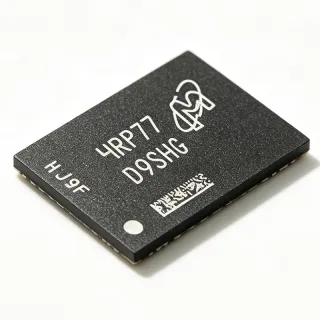
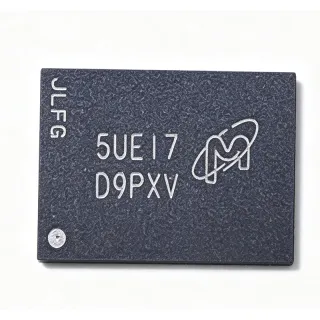
M29W128GL70N3F - 128Mbit Parallel NOR Flash 70ns | Micron
MPN: M29W128GL70N3F ✓ Active| Qty | Unit Price | Extended |
|---|---|---|
| 1 | $3.07 | $3.07 |
| 10 | $2.92 | $29.20 |
| 100 | $2.76 | $276.00 |
| 500 | $2.61 | $1,305.00 |
| 1,000 | $2.48 | $2,480.00 |
M29W128GL70N3F Overview
NOR Flash is a type of nonvolatile memory that allows random access to any address, unlike NAND Flash which accesses data in pages. In the memory hierarchy of an embedded system, NOR Flash typically serves as code storage (XIP, execute-in-place) for microprocessors, FPGAs, and network processors because of its fast random read times and high reliability, while NAND Flash is reserved for bulk data storage. A 70 ns access time means the processor can fetch code directly from the device without copying it to RAM first.
Key features of the M29W128GL family include a 2.7V to 3.6V supply range, uniform block architecture with boot-block sectoring, fast program and erase operations, and hardware-level data protection features. The GL suffix denotes the block organization variant (versus the GH variant of the same density), and the 70 suffix denotes the 70 ns speed grade. The N3F ordering code indicates the 56-lead TSOP package with lead-free finishing.
Architecturally, the device uses Micron's advanced NOR cell technology with an embedded program/erase state machine, status polling, and standard command-set compatibility that simplifies driver reuse across the M29W family. Block protection and temporary unprotect features guard boot code against accidental corruption.
Typical applications include boot code storage for network routers and switches, set-top boxes, industrial PLCs, FPGA configuration storage, and automotive/telecom line cards where code execute-in-place is required.
When designing with this device, verify block organization against your memory map before finalizing the footprint, since GL and GH variants differ in sector layout even though they share the package.
This page synthesizes distributor pricing, drop-in alternatives, and practical design notes not found in the manufacturer datasheet.
Drop-in alternatives for M29W128GL70N3F — same package, pin-to-pin compatible. Different-package parts requiring PCB rework are excluded.
Variants in this series
Same-series models that are drop-in compatible with M29W128GL70N3F (same form factor and footprint) — differing in Density, Memory Type, Organization, Package, Block Architecture.
Quick Comparison Tool — Select alternative parts for side-by-side comparison:
M29W128GH70N3F
✅ Drop-In ⚠️ Specs Unverified✓ In Stock
Contact for price
View Datasheet →M29W128GL70N6E
✅ Drop-In📋 Reference alternative (not in catalog)
M29W128GL70N3F Maximum Ratings & Electrical Characteristics
| Memory Type | NOR Flash |
| Memory Format | FLASH - NOR |
| Density | 128 Mbit |
| Organization | 8M x16 / 16M x8 |
| Interface | Parallel |
| Access Time | 70 ns |
| Package | 56-TSOP |
| Mounting Type | Surface Mount |
| Block Organization Variant | GL (boot-block) |
| Speed Grade Code | -70 |
| Package Finish Code | N3F (lead-free TSOP) |
| Programming Interface | Command-set parallel bus, embedded state machine |
M29W128GL70N3F n3f (lead-free tsop) Pin Configuration Guide
Pin configuration for M29W128GL70N3F (n3f (lead-free tsop) package). This digital IC includes GPIO, communication interfaces (UART, SPI, I2C), and power pins. Refer to the manufacturer datasheet for alternate pin functions and configuration options. Essential for embedded system design and PCB layout.

No detailed pinout data available for M29W128GL70N3F.
Refer to the datasheet for full pin configuration.
Typical Applications
M29W128GL70N3F is suitable for 6 applications: Networking Equipment Boot Code, FPGA Configuration Storage, Industrial PLC and Automation Controllers, Set-Top Box and Consumer Electronics Firmware, Automotive and Telecom Line Cards, Test and Measurement Instrument Firmware.
Networking Equipment Boot Code
Routers, switches, and telecom line cards need reliable code storage that supports execute-in-place. The M29W128GL70N3F's 70 ns random access time lets the network processor fetch boot code and firmware directly from the Flash without shadowing to DRAM, shortening boot time and removing a copy step from the startup path. Its 128Mbit (16 MB in x8 mode) capacity accommodates multiple firmware images plus a factory-default partition, enabling failsafe A/B firmware update schemes. The GL boot-block organization places small sectors at the boot end for the reset vector and early initialization code while large sectors hold application images. Placed on the processor's static memory controller bus with CE#/OE#/WE# handshake, the device behaves like slow SRAM; adding proper address-line buffering and pull-ups on RP#/RESET ensures clean reset behavior during hot board bring-up.
Recommended
FPGA Configuration Storage
Mid-range FPGAs frequently store their bitstream in parallel NOR Flash and load it at power-up through a configuration controller. The M29W128GL70N3F fits this role because 128Mbit provides ample room for several bitstream images, user data, and a golden fallback image, while the 70 ns access time keeps configuration latency low versus slower 90/120 ns parts. In x8 mode the full 16 MB is addressable with a single byte-wide bus, conserving FPGA I/O; in x16 mode the bus bandwidth doubles for faster multi-image loading. Designers should reserve protected boot sectors for the configuration loader and map application bitstreams to large erase blocks to minimize update time. Micron's embedded state machine with status polling allows the FPGA to self-manage remote field updates of its own configuration image over the network.
Recommended
Industrial PLC and Automation Controllers
Programmable logic controllers demand nonvolatile storage that survives years of power cycles, vibration, and field firmware updates. The M29W128GL70N3F's NOR architecture provides the random-access reliability and execute-in-place capability required for the PLC's resident runtime kernel, while the 128Mbit array stores the user application, recipes, and logging structures. The 3V-class supply integrates with modern low-voltage logic, and the embedded program/erase algorithms guarantee data integrity without external supervision. Block-protection features let OEMs lock the bootloader region so corrupted field updates can always be rolled back. In x16 mode, 8M-word addressing keeps the external memory map compact. Designers should budget erase cycles across wear-leveled partitions and hold RP#/RESET asserted during brownout events to prevent spurious writes.
Recommended
Set-Top Box and Consumer Electronics Firmware
Set-top boxes, smart TVs, and consumer gateways store their bootloader and firmware image in parallel NOR Flash for dependable cold boot. The M29W128GL70N3F's 16 MB (x8) capacity holds a boot ROM stage, a compressed Linux kernel, and a rescue image, while the 70 ns access time supports direct execution of the early boot code before the SoC switches to faster DDR-resident execution. The GL sector map allows the manufacturer to lock small boot sectors and leave large sectors for over-the-air update payloads, supporting robust dual-image update schemes. Because consumer designs are cost-sensitive, the device's distributor pricing - from $3.07 at LCSC as of 2026-09-05 - keeps the boot-storage BOM cost low. Surface-mount 56-TSOP assembly is fully compatible with standard reflow profiles used in high-volume consumer manufacturing.
Recommended
Automotive and Telecom Line Cards
Telecom line cards and vehicle control modules require code storage with deterministic read timing and strong data retention across wide temperature excursions. The M29W128GL70N3F provides a parallel 70 ns interface that plugs into legacy bus architectures common on line-card processors, and its 128Mbit array supports multiple firmware partitions for hot-swap card upgrades without service interruption. Sector locking protects the card's identity data and bootloader, while the RP#/RESET input gives the hot-swap controller a clean way to hold the Flash in reset during card insertion. Designers should confirm the device temperature grade and compliance data from the official Micron datasheet for their exact automotive or telecom qualification requirements, and should implement power-rail sequencing with the card's FPGA and CPU so the Flash never sees address activity while unpowered.
Recommended
Test and Measurement Instrument Firmware
Oscilloscopes, spectrum analyzers, and signal generators rely on NOR Flash for resident instrument firmware, calibration constants, and factory configuration. The M29W128GL70N3F's execute-in-place capability lets the instrument CPU boot directly from Flash, and its 16 MB capacity in x8 mode stores the application image plus a factory-restore partition. The 70 ns access time keeps boot-up responsive, an important user-experience factor for bench instruments. Calibration data benefits from small-sector granularity at the boot end of the GL map, letting calibration tables be rewritten without erasing the application image. Instruments that perform field firmware updates should implement a CRC-validated staging scheme: write the new image to large sectors, verify, then swap pointers at next boot, with the protected boot sector providing an always-recoverable fallback path.
Recommended
Recommended Products Summary
Engineering reference data for M29W128GL70N3F — comparison, design guidance, and compliance information.
Selection Guide
Comparison with Alternatives
| Parameter | This Product | M29W128GH70N3F | M29W128GL70N6E |
|---|---|---|---|
| Package | 56-TSOP | 56-TSOP - same | 56-TSOP - same |
| Brand | Micron Technology | Micron Technology | Micron Technology |
| Density | 128 Mbit | 128 Mbit | 128 Mbit |
| Access Time | 70 ns | 70 ns | 70 ns (N6 speed family) |
| Organization | 8M x16 / 16M x8 | 8M x16 / 16M x8 | 8M x16 / 16M x8 |
| Sector Organization | GL boot-block map | GH block map (different) | GL boot-block map - same |
| Interface | Parallel | Parallel | Parallel |
| Firmware Transparency | Baseline | Requires sector-map verification | Same GL map - firmware transparent |
Key Differentiators
- GL boot-block sector organization with firmware transparency (vs M29W128GH70N3F)
- Fast 70 ns random access for execute-in-place boot (vs M29W128GL70N6E)
- Low distributor pricing and multi-source availability (vs Cross-brand parallel NOR)
Design Notes
Verify the sector map before substituting GL and GH variants. Both M29W128GL70N3F and M29W128GH70N3F share the 56-TSOP footprint and electrical interface, but their block organizations differ. A firmware driver that hard-codes GL boot-block boundaries will corrupt data on a GH part during erase operations. Always derive erase-block tables from the datasheet of the exact suffix fitted, or query the device's identifier registers at boot to select the correct map.
For 70 ns parallel NOR operation, keep address and data bus traces under 100 mm where possible and match data-line lengths within the bus group to minimize skew. Place 0.1 uF decoupling capacitors on each VCC pin of the 56-TSOP as close to the package as possible. Pull RP#/RESET up through a dedicated RC-supervised supervisor circuit rather than a passive pull-up alone, so the device stays in reset during brownout and cannot be spuriously written while VCC is falling.
Estimated: erase and program operations draw peak currents well above read-mode current on parallel NOR devices. Budget the 3V rail for worst-case program/erase current from the official Micron datasheet rather than read-mode figures, and size the bulk decoupling (typically 10 uF local plus 47 uF bulk) to hold the rail during simultaneous erase bursts. Sharing the Flash rail with other inductive-switching loads risks VCC droop-induced write corruption.
Compliance Information
The N3F ordering suffix conventionally indicates lead-free TSOP finishing per Micron ordering nomenclature. Full RoHS/REACH compliance status should be confirmed from Micron's official product page or the datasheet.