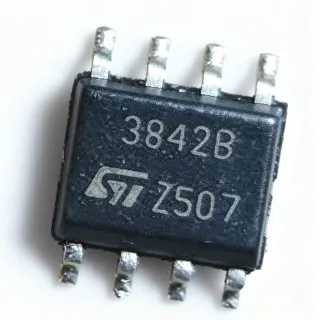
MP38876DL-LF-Z - 15A 28V Sync Buck Converter | MPS | QFN-20
MPN: MP38876DL-LF-Z ✓ Active| Qty | Unit Price | Extended |
|---|---|---|
| 1 | $3.92 | $3.92 |
| 10 | $3.52 | $35.20 |
| 100 | $3.13 | $313.00 |
| 500 | $2.81 | $1,405.00 |
| 1,000 | $2.49 | $2,490.00 |
MP38876DL-LF-Z Overview
What is a synchronous buck converter? A buck (step-down) switching converter is a type of DC-DC voltage regulator that efficiently converts a higher input voltage to a lower output voltage by rapidly switching an internal power MOSFET and storing energy in an external inductor. Synchronous buck converters replace the traditional Schottky rectifier with a second MOSFET (synchronous rectifier) to improve efficiency, especially at high output currents. The MP38876 sits within the broader hierarchy: synchronous buck regulator -> step-down DC-DC converter -> switching voltage regulator -> power management IC.
Key features include 15 A continuous output current, 4.5 V to 28 V wide operating input range, 0.8 V reference with adjustable output down to 0.6 V, internal soft-start, cycle-by-cycle over-current protection (OCP), and thermal shutdown. The device uses current-mode control that provides fast transient response and eases loop stabilization. A built-in synchronous gate driver eliminates the need for an external bootstrap circuit in many designs.
The MP38876DL-LF-Z uses constant-on-time (COT) / current-mode architecture optimized for fast transient response at high step ratios. Its high switching frequency (programmable up to 400 kHz) allows the use of small external LC components, shrinking the total solution footprint. Internal MOSFETs minimize parasitic losses, while the synchronous rectifier architecture achieves high efficiency at 15 A output. This makes the MP38876 particularly well-suited for distributed POL (point-of-load) applications where board space and thermal headroom are constrained.
Typical applications include distributed power systems, networking equipment, telecom base stations, industrial controllers, graphic cards, and high-current ASIC/DSP power rails. The wide VIN range also fits 12 V and 24 V industrial bus inputs commonly found in factory automation and telecom hardware.
When designing with the MP38876DL-LF-Z, ensure the input capacitor and bootstrap capacitor are placed as close as possible to the IC pins. Choose an inductor with low DCR to limit conduction losses at 15 A, and verify the output capacitors have sufficient ripple current rating. The exposed pad must be soldered to a sufficient copper pour for thermal dissipation.
This page synthesizes distributor pricing from Mouser and DigiKey, drop-in same-brand alternatives (MP38876DL-LF-P), and practical design notes not consolidated on the manufacturer datasheet alone.
Drop-in alternatives for MP38876DL-LF-Z — same package, pin-to-pin compatible. Different-package parts requiring PCB rework are excluded.
Quick Comparison Tool — Select alternative parts for side-by-side comparison:
MP38876DL-LF-P
✅ Drop-In📋 Reference alternative (not in catalog)
MP38876DL-LF
✅ Drop-In📋 Reference alternative (not in catalog)
MP38876DL-Z
✅ Drop-In📋 Reference alternative (not in catalog)
MP38876DL-LF-Z Maximum Ratings & Electrical Characteristics
| Topology | Synchronous Buck (Step-Down) |
| Input Voltage Range | 4.5 V to 28 V |
| Continuous Output Current | 15 A |
| Switching Frequency | Up to 400 kHz |
| Reference Voltage | 0.8 V |
| Output Type | Adjustable |
| Internal MOSFETs | Yes (high-side + low-side synchronous) |
| Control Mode | Current-mode |
| Synchronous Gate Driver | Integrated |
| Soft-Start | Internal |
| Protection Features | OCP, Thermal Shutdown |
| Operating Temperature | -40 C to 85 C |
| Package | QFN-20 (3 x 4 mm), 20-PowerVFQFN |
| Mounting Type | Surface Mount |
| RoHS Status | Compliant (LF suffix) |
| Lead-Free | Yes |
| Packaging | Tape & Reel (Z suffix, 5,000 per reel) |
MP38876DL-LF-Z Pin Configuration
| Pin 1 | BST — Bootstrap capacitor connection for high-side gate driver |
| Pin 2 | VDD — Internal regulator bypass / IC supply |
| Pin 3 | IN — Input voltage supply |
| Pin 4 | EN — Enable (active high) |
| Pin 5 | GND — Ground reference |
| Pin 6 | FB — Feedback (voltage sense for adjustable output) |
| Pin 7 | COMP — Loop compensation node |
| Pin 8 | SS — Soft-start programming |
| Pin 9 | FREQ — Frequency programming / RT resistor |
| Pin 10 | SW — Switch node (to external inductor) |
| Pin 11 | SW — Switch node (continued) |
| Pin 12 | NC — Not connected (per datasheet) |
| Pin 13 | NC — Not connected (per datasheet) |
| Pin 14 | NC — Not connected (per datasheet) |
| Pin 15 | NC — Not connected (per datasheet) |
| Pin 16 | NC — Not connected (per datasheet) |
| Pin 17 | NC — Not connected (per datasheet) |
| Pin 18 | PGND — Power ground |
| Pin 19 | PGND — Power ground |
| Pin 20 | PGND — Power ground |
Typical Applications
MP38876DL-LF-Z is suitable for 7 applications: Distributed POL for Networking Equipment, Telecom Base Station Power Rails, Industrial 24V Bus Voltage Regulation, FPGA Core and Auxiliary Voltage Rails, Graphics Card and High-End ASIC Power, Server and Datacenter Point-of-Load, Automotive Infotainment and ADAS.
Distributed POL for Networking Equipment
The MP38876DL-LF-Z is well-suited for networking switch and router point-of-load regulation. Its 4.5-28 V input range accepts 12 V or 24 V intermediate bus power commonly used in networking hardware, while the 15 A continuous output current supports high-current ASICs, network processors, and switching ICs. The 400 kHz switching frequency allows small LC filter components, critical for compact line-card designs where board space is at a premium. The integrated synchronous gate driver and internal MOSFETs eliminate 6-8 discrete parts versus a controller + external FET design, reducing BOM cost and assembly time. Built-in OCP and thermal shutdown protect downstream silicon during fault events typical of hot-swap and OR-ing topologies.
Recommended
Telecom Base Station Power Rails
In telecom base-station equipment the MP38876DL-LF-Z steps down a 24 V or 48 V (post-converter) bus to power DSP, FPGA, and baseband processor cores at 0.8-3.3 V. Its 28 V maximum input accommodates the transients typical of -48 V telecom systems after the front-end isolated converter. The 15 A output supports multiple parallel lower-current rails or a single high-current ASIC core. Current-mode control provides the fast transient response required when baseband processors transition between idle and active states during RF burst transmission. Cycle-by-cycle OCP protects the converter during load-step events characteristic of multi-carrier GSM/LTE amplifier power supplies.
Recommended
Industrial 24V Bus Voltage Regulation
Factory-automation controllers, PLCs, and motor-drive auxiliary rails often run from a 24 V industrial bus. The MP38876DL-LF-Z's 4.5-28 V input range directly accepts this bus without a pre-regulator, simplifying the power tree. Its 15 A continuous output current drives multiple sensor subsystems, isolated communication transceivers, and digital logic. The exposed thermal pad of the QFN-20 (3 x 4 mm) package allows direct soldering to a substantial copper pour, supporting reliable operation in the -40 C to 85 C industrial temperature range without forced-air cooling. Synchronous rectification maintains high efficiency at the moderate step-down ratios typical of 24 V to 5 V or 24 V to 3.3 V conversions.
Recommended
FPGA Core and Auxiliary Voltage Rails
Modern FPGAs and SoCs require multiple low-voltage rails at high current. The MP38876DL-LF-Z provides 15 A continuous output for FPGA core (0.85-1.0 V), auxiliary (1.2-1.8 V), or transceiver (2.5-3.3 V) rails from a 5 V or 12 V input. The internal soft-start minimizes inrush current at FPGA power-up, preventing voltage rail collisions in multi-rail sequencing. Current-mode control and 400 kHz switching combine fast load-step response with small output filter components, critical for FPGAs that transition between configuration and active states drawing 5-10x their average current. Multiple MP38876DL-LF-Z devices can be paralleled or sequenced for systems requiring more than 15 A per rail.
Recommended
Graphics Card and High-End ASIC Power
Graphics cards and high-end ASICs demand 15+ A at sub-1V core voltages with tight regulation. The MP38876DL-LF-Z delivers 15 A continuous from a 12 V PCIe slot input, ideal for GPU memory or auxiliary ASIC rails. Its high switching frequency (up to 400 kHz) shrinks output inductors, freeing board area for the dense via arrays required by graphics PCB stack-ups. Synchronous rectification maintains >90% efficiency even at heavy loads, limiting thermal dissipation in the cramped airflow paths typical of add-in cards. OCP and thermal shutdown provide critical short-circuit protection for these high-value silicon devices.
Recommended
Server and Datacenter Point-of-Load
In server and datacenter motherboards, the MP38876DL-LF-Z steps down 12 V intermediate bus voltage to power CPUs, memory, and chipset rails at high efficiency. The 15 A continuous output supports multi-phase configurations when paralleled with additional MP38876DL-LF-Z devices, scaling to 30 A or 45 A for CPU cores. Synchronous rectification and current-mode control minimize switching losses, helping achieve the >90% peak efficiency required by 80 PLUS and Energy Star server specifications. Internal soft-start and OCP simplify hot-swap controller integration. The QFN-20 (3 x 4 mm) footprint allows high-density POL placement near load devices, minimizing PCB trace losses.
Recommended
Automotive Infotainment and ADAS
Although not AEC-Q100 qualified per the standard part number, the MP38876DL-LF-Z can serve automotive infotainment and ADAS prototyping applications where 12 V battery rail regulation is required. Its 4.5-28 V input handles load-dump transients typical of automotive electrical systems (with external TVS protection). The 15 A continuous output supports multi-display head units, surround-view camera processors, and sensor fusion SoCs. The -40 C to 85 C operating range spans automotive temperature grades. Synchronous rectification and current-mode control deliver clean power rails critical for noise-sensitive camera and radar signal chains, where power-rail ripple directly impacts image and RF signal integrity.
Recommended
Recommended Products Summary
Engineering reference data for MP38876DL-LF-Z — comparison, design guidance, and compliance information.
Selection Guide
Comparison with Alternatives
| Parameter | This Product | MP38876DL-LF-P | MP38876DL-LF | MP38876DL-Z |
|---|---|---|---|---|
| Brand | Monolithic Power Systems | Monolithic Power Systems | Monolithic Power Systems | Monolithic Power Systems |
| Package | QFN-20 (3x4 mm) | QFN-20 (3x4 mm) - same | QFN-20 (3x4 mm) - same | QFN-20 (3x4 mm) - same |
| Input Voltage Range | 4.5 V to 28 V | 4.5 V to 28 V | 4.5 V to 28 V | 4.5 V to 28 V |
| Output Current (Continuous) | 15 A | 15 A | 15 A | 15 A |
| Switching Frequency (max) | 400 kHz | 400 kHz | 400 kHz | 400 kHz |
| Output Voltage Reference | 0.8 V | 0.8 V | 0.8 V | 0.8 V |
| Synchronous Gate Driver | Integrated | Integrated | Integrated | Integrated |
| Operating Temperature | -40 C to 85 C | -40 C to 85 C | -40 C to 85 C | -40 C to 85 C |
| RoHS / Lead-Free | Yes (LF suffix) | Yes (LF suffix) | Yes (LF suffix) | No RoHS suffix (non-LF) |
| Packaging Format | Tape & Reel (5,000/reel) | Tape & Reel (smaller qty) | Tray | Tape & Reel (5,000/reel, non-LF) |
Key Differentiators
- Highest current in MPS MP388xx family at 28V VIN (vs MP38874 (MPS, 12A variant))
- Integrated synchronous gate driver (vs MP38872 (MPS, non-synchronous controller))
- Wide 28V VIN supports industrial 24V bus (vs MP38875 (MPS, 18V variant))
Design Notes
The MP38876DL-LF-Z in QFN-20 (3 x 4 mm) requires the exposed thermal pad (EP) to be soldered directly to a PCB ground copper pour for effective heat dissipation. At 15 A output with a typical 12 V to 3.3 V step-down, internal power dissipation is around (12-3.3)*0.6*15 = 78 W minus efficiency losses; realistic dissipation at 90% efficiency is about 1.5 W. Estimated: at 1.5 W dissipation with a JEDEC-standard 4-layer 1 oz PCB, theta_JA is approximately 35 C/W, yielding a junction rise of about 53 C above ambient. Use a minimum 0.5 square inch of top-side copper pour; more copper reduces junction temperature and improves reliability. Do not rely on the package alone for thermal management.
Place the input ceramic capacitor (typically 22 uF X7R) as close as possible to the IN and PGND pins to minimize the high-frequency switching current loop. Use a 0.1 uF X7R bypass capacitor in parallel for high-frequency decoupling. Route the SW (switch node) trace as short and wide as possible to limit voltage spikes and EMI radiation. The bootstrap capacitor (BST to SW) must be placed within 2 mm of the BST pin; a 0.1 uF to 1 uF ceramic is typical. Keep the FB trace away from the SW node to avoid noise coupling into the feedback loop. Use a 4-layer PCB with a dedicated ground plane for best results.
Do not exceed the absolute maximum VIN of 28 V; add a TVS diode or input fuse for hot-plug protection. Ensure the chosen inductor has a saturation current rating at least 30% above the 15 A continuous rating to handle load transients. The output capacitors must have sufficient ripple current rating (typically 4-5 A RMS for a 15 A load); ceramic X7R 22 uF capacitors in parallel are common. Do not omit the compensation network on the COMP pin - follow the MPS datasheet reference design values to ensure loop stability. When using the adjustable version, use 1% or better resistors for the FB divider to maintain output voltage accuracy.
The MP38876DL-LF-Z high di/dt switching at 400 kHz generates significant EMI on the SW node. To minimize radiated emissions, minimize the SW node copper area and use a shielded inductor. A small RC snubber (typically 1-2 ohm and 1-2 nF) across the low-side FET can dampen ringing on the SW node. For CISPR 22 / CISPR 32 compliance in telecom and networking applications, add an input pi-filter (common-mode choke plus X/Y capacitors) at the VIN supply. The exposed pad and PGND pins must be solidly stitched to the ground plane with multiple vias to limit ground bounce.
Compliance Information
RoHS compliant per LF suffix in the part number. AEC-Q100 qualification status not specified in MPS datasheet excerpt; not recommended for safety-critical automotive without further qualification. Reach and conflict-minerals compliance per standard MPS product policy.