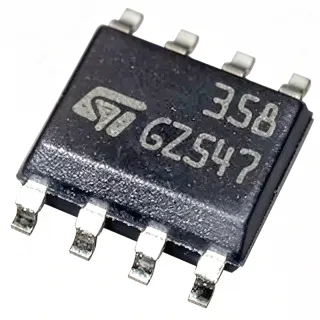
OPA2375IDGKR - Dual 10MHz Rail-to-Rail Op Amp | TI
MPN: OPA2375IDGKR ✓ Active| Qty | Unit Price | Extended |
|---|---|---|
| 1 | $1.28 | $1.28 |
| 10 | $1.15 | $11.50 |
| 100 | $0.94 | $94.00 |
| 500 | $0.81 | $405.00 |
| 1,000 | $0.68 | $680.00 |
OPA2375IDGKR Overview
An operational amplifier (op amp) is a high-gain voltage amplifier with differential inputs that, when combined with external feedback networks, performs amplification, filtering, buffering, and signal conditioning. Within the signal-chain hierarchy, the op amp sits between sensors and data converters: it is a core analog building block of the amplifiers and buffer amplifiers category, and the OPA2375 belongs to the OPAx375 general-purpose CMOS family that also includes the single OPA375 and quad OPA4375.
Key differentiating features include the extremely low 4.6 nV/√Hz broadband noise figure, a wide 10 MHz gain-bandwidth, a fast 4.6 V/µs slew rate (per distributor package data), and rail-to-rail output swing that maximizes dynamic range in low-voltage systems. The maximum 500 µV offset and only 3 pA input bias current make the device suitable for high-impedance sources.
Technically, the OPA2375 uses a CMOS input architecture with a rail-to-rail output stage, which allows output swings to within millivolts of either supply rail. This CMOS design delivers low noise without the input bias currents of bipolar alternatives, and the low-voltage 5.5 V maximum supply rating aligns the amplifier directly with 3.3 V and 5 V single-supply systems, ADC drivers, and portable designs.
Typical applications include sensor signal conditioning and transimpedance amplification for photodiodes (enabled by the 3 pA bias current), active anti-alias filters ahead of SAR and delta-sigma ADCs, and general-purpose precision amplification in industrial and portable instrumentation. The dual channel integration saves board area versus two single amplifiers.
When designing, account for supply decoupling with 0.1 µF ceramics close to each V+ pin, and verify that closed-loop gain and load capacitance keep the amplifier comfortably within its 10 MHz bandwidth and phase-margin limits for stability.
This page synthesizes distributor pricing, drop-in alternatives, design notes, and pin-to-pin replacement guidance not found in the manufacturer datasheet alone.
Drop-in alternatives for OPA2375IDGKR — same package, pin-to-pin compatible. Different-package parts requiring PCB rework are excluded.
Variants in this series
Same-series models that are drop-in compatible with OPA2375IDGKR (same form factor and footprint) — differing in Amplifier Type, Gain Bandwidth Product, Input Offset Voltage, Input Voltage Noise, Mounting Type.
Quick Comparison Tool — Select alternative parts for side-by-side comparison:
OPA2375AIDGKR
✅ Drop-In ⚠️ Specs Unverified📋 Reference alternative (not in catalog)
OPA2330AIDGKR
✅ Drop-In📋 Reference alternative (not in catalog)
OPA2335AIDGKTG4
✅ Drop-In📋 Reference alternative (not in catalog)
OPA2375IDGKR Maximum Ratings & Electrical Characteristics
| Amplifier Type | CMOS Operational Amplifier (General Purpose) |
| Number of Channels | 2 (Dual) |
| Gain Bandwidth Product | 10 MHz |
| Input Voltage Noise | 4.6 nV/sqrt(Hz) |
| Input Offset Voltage | 500 uV (maximum) |
| Input Bias Current | 3 pA |
| Slew Rate | 4.6 V/us (nominal) |
| Output Type | Rail-to-Rail Output (RRO) |
| Supply Voltage Maximum | 5.5 V |
| Package | 8-VSSOP (DGK), 3.00 mm width |
| Mounting Type | Surface Mount (Gull Wing) |
| Number of Terminals | 8 |
| Family | OPAx375 (OPA375 single / OPA2375 dual / OPA4375 quad) |
| RoHS Status | Compliant (per distributor listings) |
OPA2375IDGKR Pin Configuration
| Pin 1 | OUT A — Channel A output |
| Pin 2 | -IN A — Channel A inverting input |
| Pin 3 | +IN A — Channel A non-inverting input |
| Pin 4 | V- — Negative supply (or GND in single-supply use) |
| Pin 5 | +IN B — Channel B non-inverting input |
| Pin 6 | -IN B — Channel B inverting input |
| Pin 7 | OUT B — Channel B output |
| Pin 8 | V+ — Positive supply, up to 5.5 V |
Typical Applications
OPA2375IDGKR is suitable for 6 applications: Photodiode Transimpedance Amplification, ADC Signal Conditioning and Anti-Alias Filtering, Battery-Powered Portable Instrumentation, Industrial Sensor Signal Conditioning, Active Audio and Sensor Front-End Filtering, Medical and Diagnostic Sensing Front Ends.
Photodiode Transimpedance Amplification
The OPA2375IDGKR fits photodiode transimpedance amplifiers because its CMOS input stage draws only 3 pA of bias current, so photocurrent conversion error is negligible, while the 4.6 nV/√Hz input voltage noise limits the dominant amplifier noise term in the feedback resistor path. The 10 MHz gain-bandwidth supports transimpedance stages with feedback resistors in the hundreds of kilo-ohms to megohm range at bandwidths of hundreds of kilohertz, adequate for optical sensing, pulse detection, and industrial light measurement. Used as a photodiode current-to-voltage converter with a precision feedback resistor and a small feedback capacitor for stability, the rail-to-rail output maximizes usable swing on a 3.3 V or 5 V single supply. The dual channel allows a second stage of gain or filtering in the same 3x3 mm VSSOP-8 footprint, halving board area versus two single amplifiers.
Recommended
ADC Signal Conditioning and Anti-Alias Filtering
Driving precision ADCs requires an amplifier whose bandwidth, noise, and output swing do not limit converter performance, and the OPA2375IDGKR aligns well: 10 MHz GBW supports active anti-alias filters with corner frequencies in the hundreds of kilohertz while retaining gain-bandwidth margin for low distortion, and 4.6 nV/√Hz noise keeps the amplifier below the quantization and thermal noise floor of mid-resolution converters. The rail-to-rail output stage uses the full ADC input range on 3.3 V or 5 V single supplies, maximizing signal-to-noise ratio. The 500 µV maximum offset preserves DC accuracy in single-ended front ends. Implemented as a Sallen-Key or multiple-feedback active filter followed by a direct ADC driver stage, both amplifier channels of the dual package can be used in one signal chain, reducing component count and layout complexity versus discrete op amps.
Recommended
Battery-Powered Portable Instrumentation
Portable and battery-operated instruments benefit from the OPA2375IDGKR's CMOS architecture and 5.5 V maximum single-supply rating, which lets the amplifier operate directly from a single lithium cell or a 3.3 V/5 V regulated rail without a dual supply. The rail-to-rail output recovers every millivolt of headroom as battery voltage decays, extending usable measurement range late in discharge, and the 3 pA bias current permits high-impedance sensors such as pH electrodes, piezoelectric elements, and electret microphones without input-current error. The dual channels in one 3x3 mm VSSOP-8 package reduce board area and assembly cost for compact handheld designs. In a typical two-stage chain - high-impedance buffer followed by gain stage - the 10 MHz bandwidth leaves ample margin, while the low 4.6 nV/√Hz noise preserves weak-signal resolution for portable medical, environmental, and measurement products.
Recommended
Industrial Sensor Signal Conditioning
Industrial 24 V systems frequently need amplifiers that bridge sensor outputs to 3.3 V or 5 V logic, and the OPA2375IDGKR serves this role for bridge, resistive, and capacitive sensor interfaces where its 500 µV maximum offset and 3 pA bias current keep measurement error small over temperature. The 10 MHz bandwidth supports fast control loops such as position feedback and vibration monitoring, while 4.6 nV/√Hz noise resolves millivolt-level strain-gauge and bridge signals after amplification. Operating the amplifier from a locally regulated 5 V rail derived from the industrial bus, with RC or LC filtering ahead of the supply pins, protects the CMOS input stage from transients. The rail-to-rail output drives ADCs or comparators directly without headroom loss. Using the dual package for a differential-to-single-ended converter plus gain stage completes a compact conditioning channel on one footprint.
Recommended
Active Audio and Sensor Front-End Filtering
The OPA2375IDGKR's combination of 4.6 nV/√Hz broadband noise and 10 MHz bandwidth makes it effective in active filter and buffer roles for audio-band and ultrasonic signal chains, where low noise directly sets the achievable dynamic range. As a multiple-feedback or Sallen-Key filter element, the 10 MHz GBW provides two to three orders of magnitude of margin over audio corner frequencies, so filter response stays accurate and distortion remains low; the 4.6 V/µs slew rate handles full-scale audio swings without slew-induced distortion. The rail-to-rail output allows AC-coupled stages referenced to mid-supply on single 3.3 V or 5 V rails, common in portable and USB-powered audio and sensor products. The 3 pA input bias current permits megohm bias networks in electret and MEMS microphone front ends without DC drift. Both dual channels serve as filter plus output buffer in one package.
Recommended
Medical and Diagnostic Sensing Front Ends
Medical diagnostic equipment such as patient-connected sensors and bio-signal acquisition demands low input current for electrode safety and signal fidelity, and the OPA2375IDGKR's 3 pA CMOS bias current directly addresses this, avoiding electrode polarization and baseline drift. The 4.6 nV/√Hz noise floor resolves microvolt-level bio-potential signals after gain staging, and the 500 µV maximum offset keeps DC-coupled stages within range on 3.3 V or 5 V supplies. The 10 MHz bandwidth comfortably covers diagnostic bandwidths while providing margin for sharp anti-alias roll-off filters. Implemented with the dual package as a high-impedance buffer plus gain stage, the design minimizes component count in the analog front end. The rail-to-rail output maximizes resolution into the subsequent ADC, and the amplifier's CMOS supply current suits battery-powered ambulatory monitoring equipment where every microamp affects operating life.
Recommended
Recommended Products Summary
Engineering reference data for OPA2375IDGKR — comparison, design guidance, and compliance information.
Selection Guide
Comparison with Alternatives
| Parameter | This Product | OPA2375AIDGKR | OPA2330AIDGKR | OPA2335AIDGKTG4 |
|---|---|---|---|---|
| Package | 8-VSSOP (DGK), 3.00 mm | 8-VSSOP (DGK) - same | 8-VSSOP (DGK) - same | 8-VSSOP (DGK/DGKT) - same footprint |
| Brand | Texas Instruments | Texas Instruments | Texas Instruments | Texas Instruments |
| Channels | 2 (Dual) | 2 (Dual) | 2 (Dual) | 2 (Dual) |
| Architecture | General-purpose CMOS, rail-to-rail output | General-purpose CMOS, rail-to-rail output | Micropower auto-zero (chopper) | Auto-zero (chopper) |
| Best Use Case | Wideband low-noise precision signal conditioning | Same, with tighter offset grading | Ultra-low-power DC precision measurement | Zero-drift DC precision measurement |
Key Differentiators
- Widest bandwidth in the pin-compatible substitute set (vs OPA2330AIDGKR)
- Low broadband noise without chopper artifacts (vs OPA2335AIDGKTG4)
- Cost-optimized catalog grade availability (vs OPA2375AIDGKR)
Design Notes
Place a 0.1 uF ceramic decoupling capacitor within 2-3 mm of the V+ pin (pin 8), with a low-impedance via to the ground plane, and add 4.7-10 uF of bulk capacitance per power domain. Keep the feedback network of each channel tight and short, and route high-impedance input traces (+IN/-IN, pins 2, 3, 5, 6) away from output traces (pins 1, 7) to prevent unintended coupling and oscillation at the amplifier's 10 MHz bandwidth. Use a guard ring driven by the source's reference potential around very high impedance input nodes to reduce leakage from the 3 pA bias-current level.
At 10 MHz GBW, capacitive load drive is limited: direct capacitive loads of more than roughly 100 pF can erode phase margin and cause ringing. If driving long cables or ADC input capacitance, isolate the load with a small series resistor (typically 20-50 ohm at the output) or place the amplifier inside the feedback loop of an RC isolation network. Verify closed-loop gain against the 10 MHz bandwidth so high-gain stages (e.g., gain of 100 leaves ~100 kHz bandwidth) do not unexpectedly limit signal bandwidth.
Do not exceed the 5.5 V maximum supply rating - the OPA2375 is a 5.5 V maximum device, not a wide-supply amplifier, so protect it with local regulation or series impedance when used downstream of industrial 24 V buses. When substituting an auto-zero alternative such as OPA2330AIDGKR or OPA2335AIDGKTG4 on the same footprint, remember their bandwidth is far below 10 MHz and their chopper clocking can introduce spectral artifacts; re-verify the circuit rather than assuming functional equivalence. Estimated substitution risk is high for AC-coupled paths above a few hundred kilohertz.
Compliance Information
RoHS compliance per distributor listings (DigiKey, Mouser, LCSC). REACH, halogen-free, and conflict-minerals status should be confirmed on the TI.com product quality page for the specific date code.