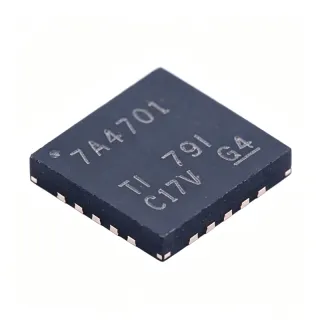
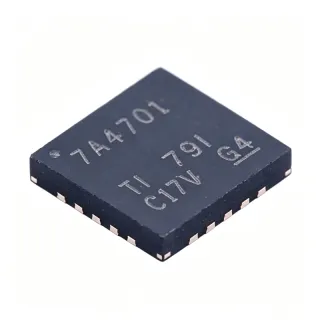
PCA9452AHNE - PMIC for i.MX 93, 6 Buck + 3 LDO | NXP
MPN: PCA9452AHNE ✓ Active| Qty | Unit Price | Extended |
|---|---|---|
| 1 | $6.9 | $6.90 |
| 10 | $6.21 | $62.10 |
| 100 | $5.52 | $552.00 |
| 500 | $4.97 | $2,485.00 |
| 1,000 | $4.48 | $4,480.00 |
PCA9452AHNE Overview
A power management IC is a highly integrated voltage regulator subsystem that consolidates multiple buck converters, LDOs, power sequencing logic, and supervisory functions into one device. In the system hierarchy, the PMIC sits at the top of the power tree: it converts a single system input (here 5V) into the multiple voltage rails (core, SoC, memory, I/O) that a modern application processor requires, replacing a discrete multi-rail regulator design with one qualified component.
Key features of the PCA9452 include 11 regulated outputs, I2C-bus control supporting Standard-mode (100 kbit/s), Fast-mode (400 kbit/s) and Fast-mode plus (1 Mbit/s) per the NXP PCA9452 datasheet, and an IRQ_B interrupt output that pulls LOW when any unmasked interrupt bit in the INT1 register changes status, giving the application processor a hardware notification channel for fault and event management.
Three of the buck regulators support dynamic voltage scaling (DVS) with programmable ramp-up and ramp-down times, and support remote sense to compensate IR drop between the regulator and the load - critical for maintaining accurate core voltages on high-current i.MX 93 rails. The device is characterized across an ambient temperature range of -40 C to +105 C, matching automotive AEC-grade deployment requirements.
Typical applications include i.MX 93-based automotive human-machine interface (HMI) displays, extended industrial gateways and edge-AI boxes, and telematics or ADAS peripheral compute modules that need a qualified, sequenced multi-rail power solution in a single IC.
Design consideration: because the rail sequencing and voltage levels are I2C-programmable, always validate the power-up register defaults against your i.MX 93 boot requirements before layout freeze, and budget PCB copper for the buck regulator hot loops.
This page synthesizes distributor availability data, the manufacturer datasheet, and practical design guidance not found on any single source.
Drop-in alternatives for PCA9452AHNE — same package, pin-to-pin compatible. Different-package parts requiring PCB rework are excluded.
Variants in this series
Same-series models that are drop-in compatible with PCA9452AHNE (same form factor and footprint) — differing in Control Interface, Product Type.
Quick Comparison Tool — Select alternative parts for side-by-side comparison:
PCA9452CHNE
✅ Drop-In ⚠️ 参数待验证📋 Reference alternative (not in catalog)
PCA9452AHNE Maximum Ratings & Electrical Characteristics
| Product Type | Power Management IC (PMIC) for i.MX 93x processors |
| Input Voltage | 5 V |
| Number of Buck Regulators | 6 |
| Number of LDO Regulators | 3 |
| Total Regulated Outputs | 11 |
| Maximum Buck Output Current | 6 A |
| Dynamic Voltage Scaling (DVS) | Supported on 3 buck regulators |
| Remote Sense | Supported on DVS buck regulators |
| Control Interface | I2C |
| I2C Speed Modes | 100 kbit/s, 400 kbit/s, 1 Mbit/s |
| Interrupt Output | IRQ_B open-drain, INT1 register status |
| Operating Temperature Range | -40 C to +105 C (ambient) |
| Target Processor Family | NXP i.MX 93x |
| Qualification Segment | Automotive and extended industrial |
| Mounting Type | Surface Mount |
| Lifecycle Status | Active (per NXP product page) |
PCA9452AHNE standard Pin Configuration Guide
Pin configuration for PCA9452AHNE (standard package). This power device features gate, drain, and source terminals. For non-polarized packages, refer to the manufacturer datasheet for exact pin 1 orientation and footprint details. Common applications include power supply design, motor driving, and load switching.

No detailed pinout data available for PCA9452AHNE.
Refer to the datasheet for full pin configuration.
Typical Applications
PCA9452AHNE is suitable for 6 applications: Automotive HMI and Cluster Displays, Industrial Edge-AI Gateways, Telematics and ADAS Peripheral Compute Modules, Battery-Powered Portable Industrial Devices, Camera and Vision Systems, Network Infrastructure and IoT Edge Nodes.
Automotive HMI and Cluster Displays
Automotive human-machine interface and instrument-cluster displays built on the i.MX 93 require a precise, sequenced multi-rail power tree: core, DDR memory, GPU/DPU, and I/O rails must ramp in a defined order during boot. The PCA9452AHNE integrates 6 buck regulators and 3 LDOs (11 outputs) that implement this tree from a single 5V input, with DVS on three bucks allowing the i.MX 93 to dynamically scale core voltage to balance performance and thermal budget in a sealed, fan-less dashboard environment. Remote sense compensates the IR drop across long PCB traces typical in display assemblies, keeping core voltage accurate under 1-6 A load transients. The IRQ_B interrupt line gives the system controller immediate notification of regulator fault events via the INT1 register, supporting the fast fault reporting expected in automotive platforms characterized from -40 C to +105 C ambient.
Recommended
Industrial Edge-AI Gateways
Extended industrial gateways running i.MX 93-based machine-learning inference need a compact, reliable multi-rail supply that survives -40 C to +105 C ambient conditions inside sealed DIN-rail or wall-mount enclosures. The PCA9452AHNE delivers this with 11 regulated outputs from 5V, including high-current bucks for the SoC core and memory rails and low-noise LDOs for analog and PHY supplies. Dynamic voltage scaling lets firmware lower the core voltage during idle networking periods, cutting power dissipation and junction temperature. Because the I2C interface runs at up to 1 Mbit/s (Fast-mode plus), the host can reconfigure rail voltages quickly during operating-mode transitions. Using one qualified PMIC instead of a discrete regulator stack also simplifies industrial EMC pre-compliance, since the buck switching hot loops and sequencing are characterized by NXP in the reference layout.
Recommended
Telematics and ADAS Peripheral Compute Modules
Telematics control units and ADAS sensor-fusion peripheral modules increasingly use i.MX 93 processors for camera bridging, sensor aggregation, and V2X protocol handling. These modules are typically powered from a vehicle 5V rail or a downstream post-regulated supply, exactly matching the PCA9452AHNE input. The PMIC's three DVS-capable bucks with programmable ramp-up/down times let the module throttle compute performance in response to thermal conditions in a cramped, convection-limited housing, while remote sensing keeps the core rail within tolerance across connector and harness drops. The automotive characterization range of -40 C to +105 C and the IRQ_B fault-interrupt channel align with module-level functional monitoring requirements. Integrating sequencing in silicon also removes the risk of latch-up during cold-crank power sequences.
Recommended
Battery-Powered Portable Industrial Devices
Handheld industrial scanners, diagnostic tablets, and portable test equipment built on i.MX 93 benefit from the PCA9452AHNE's ability to derive all 11 rails from one 5V input, which a single-cell boost converter or USB-PD input can provide. Dynamic voltage scaling on three bucks lets firmware trade peak compute for battery runtime: dropping core voltage at light load directly reduces dynamic power. The low-noise LDO outputs serve audio codec, touch controller, and sensor rails without adding switching ripple. Because the entire power tree is I2C-programmable, a single firmware driver manages sleep, standby, and active power modes through register writes, and the IRQ_B pin wakes the host on fault conditions. Characterization to 105 C ambient covers use in vehicles and outdoor equipment left in direct sun.
Recommended
Camera and Vision Systems
Automotive surround-view and machine-vision camera modules based on i.MX 93 image-processing pipelines require clean analog rails for image sensors and serializers alongside high-current digital rails for the processor. The PCA9452AHNE's 3 LDO regulators provide low-noise supplies for these sensitive analog blocks, while the 6 bucks carry the SoC core (with DVS to manage thermal load in sun-exposed camera housings) and DDR memory. Remote sense on the DVS bucks is valuable in distributed camera assemblies where regulator and processor sit on different board areas. The -40 C to +105 C ambient characterization matches automotive exterior camera mounting requirements, and the INT1-register-driven IRQ_B output lets the vision ECU log power-integrity events for functional-safety diagnostics.
Recommended
Network Infrastructure and IoT Edge Nodes
Compact IoT edge nodes and networking accessories built on i.MX 93 - such as protocol converters, secure element gateways, and building-automation controllers - need a small-footprint power solution with minimal external component count. The PCA9452AHNE consolidates the whole power tree (6 bucks + 3 LDOs, 11 outputs) into one HVQFN package fed by 5V, freeing board area for radios and connectors. Standard/Fast/Fast-mode plus I2C (100/400/1000 kbit/s) means even low-cost controllers can configure and monitor the PMIC, and the documented power-on-reset I2C address (datasheet Table 17) simplifies multi-device bus design. DVS reduces average power draw in duty-cycled edge nodes, extending passive-cooling and battery-backup budgets, while 105 C ambient capability suits sealed pole-mount and rooftop enclosures.
Recommended
Recommended Products Summary
Engineering reference data for PCA9452AHNE — comparison, design guidance, and compliance information.
Selection Guide
Comparison with Alternatives
| Parameter | This Product | PCA9452CHNE |
|---|---|---|
| Package | HVQFN | HVQFN - same |
| Brand | NXP Semiconductors | NXP Semiconductors - same |
| Target Processor | i.MX 93x | i.MX 93x (family variant) |
| I2C Speed | 100 / 400 / 1000 kbit/s | 100 / 400 / 1000 kbit/s (per family datasheet) |
Key Differentiators
- Application-specific sequencing for i.MX 93x (vs Generic multi-rail PMICs)
- Remote sense on DVS bucks (vs PMICs without remote sense)
- Wide automotive temperature range (vs Consumer-grade PMICs)
Design Notes
Feed the PCA9452AHNE from a clean, well-decoupled 5V rail. Place a minimum 10 uF ceramic capacitor directly at the VIN pin and bulk capacitance near the module input. The 6 A main buck requires a tight input hot loop: keep the input capacitor, high-side switch node, and freewheeling ground return within a few millimeters. Since three bucks support DVS, verify that your upstream 5V source can tolerate simultaneous voltage-step load transients on multiple rails during operating-mode changes.
Use the NXP i.MX 93 reference design layout for the PCA9452, which defines the buck hot loops, inductor placement, and remote-sense Kelvin routing. Route remote-sense traces as a differential pair directly from the load point (i.MX 93 core supply pins) back to the PMIC sense inputs, away from switching nodes, to avoid corrupting the IR-drop compensation. Connect the exposed HVQFN pad to a solid ground plane with a full via array for thermal and electrical performance.
Do not rely on default power-up register settings without checking them against your i.MX 93 boot-mode requirements: sequencing and rail voltages are I2C-programmable and the POR address is defined in datasheet Table 17. Also remember IRQ_B is only released when the host reads the INT1 register - an unread register leaves the line asserted and can mask new faults. Keep I2C bus pull-ups sized for 1 Mbit/s Fast-mode plus if you use that speed.
Compliance Information
NXP product page lists environmental quality information under the PCA9452AHN 'Environmental Quality' section; specific RoHS/REACH/AEC-Q100 statuses were not present in the retrieved data and should be confirmed from the NXP product page.