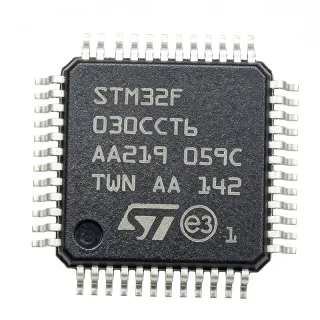
PIC12LF1571T-I/MS - 8-bit 32MHz MCU, 1.75KB Flash, MSOP-8
MPN: PIC12LF1571T-I/MS ✓ Active| Qty | Unit Price | Extended |
|---|---|---|
| 1 | $1.21 | $1.21 |
| 10 | $1.1 | $11.00 |
| 100 | $0.95 | $95.00 |
| 500 | $0.85 | $425.00 |
| 1,000 | $0.78 | $780.00 |
| 2,500 | $0.7 | $1,750.00 |
PIC12LF1571T-I/MS Overview
An 8-bit microcontroller (MCU) is a small computing system-on-chip that combines a CPU, RAM, non-volatile program memory, and peripherals into a single IC. The PIC12 family sits within Microchip's PIC architecture family of microcontrollers -> 8-bit MCU category -> embedded computing IC -> semiconductor device. 8-bit MCUs are widely deployed in cost- and power-constrained embedded applications because they deliver deterministic instruction execution and very low active/standby current at low BOM cost.
Key features of this device include a maximum 32MHz internal oscillator, six general-purpose I/O pins, a 10-bit ADC with up to 4 input channels, one comparator with selectable reference, a 5-bit DAC, three independent 16-bit PWMs, and an Enhanced Universal Synchronous Asynchronous Receiver Transmitter (EUSART). The 'LF' prefix denotes the wide-voltage low-power variant supporting 1.8V to 3.6V operation, ideal for battery-powered designs.
Architecturally, the PIC12LF1571 uses Microchip's enhanced mid-range 8-bit core with a single-cycle instruction set, hardware stack, and interrupt controller. The 16-bit PWM modules with independent timers deliver high-resolution pulse-width modulation that competes with 16-bit MCU peripherals at 8-bit cost, enabling precision control loops for LED drivers, fans, and small motor drives without external timer ICs.
Typical applications include LED lighting color-mixing and dimming control, battery-powered IoT sensor nodes, small DC fan or motor PWM control, consumer remote controls, and general-purpose logic replacement where simple sequencing and analog measurement are required. The on-chip comparator and 5-bit DAC allow threshold detection and waveform generation without external components.
When designing with this device, evaluate whether the 1.75KB Flash and 128 bytes of RAM meet application requirements - small protocol stacks or BLE radio drivers typically cannot fit. Plan for ICSP programming header access (PGD/PGC) and ensure adequate decoupling per the manufacturer application notes for noise-sensitive ADC measurements.
This page synthesizes distributor pricing, drop-in alternatives within the PIC12/MSOP-8 footprint, and practical design notes not consolidated in the manufacturer datasheet.
Drop-in alternatives for PIC12LF1571T-I/MS — same package, pin-to-pin compatible. Different-package parts requiring PCB rework are excluded.
Variants in this series
Same-series models that are drop-in compatible with PIC12LF1571T-I/MS (same form factor and footprint) — differing in Operating Temperature, Package, ADC, Core, I/O Pins.
Quick Comparison Tool — Select alternative parts for side-by-side comparison:
PIC12LF1571-I/MS
✅ Drop-In📋 Reference alternative (not in catalog)
PIC12LF1571-E/MS
✅ Drop-In📋 Reference alternative (not in catalog)
PIC12LF1572-I/MS
✅ Drop-In ⚠️ 参数待验证✓ In Stock
$0.65 / Unit
View Datasheet →PIC12F1571-I/MS
✅ Drop-In✓ In Stock
$0.58 / Unit
View Datasheet →PIC12F1571T-I/MS
✅ Drop-In ⚠️ 参数待验证✓ In Stock
$0.46 / Unit
View Datasheet →PIC12LF1571T-I/MS Maximum Ratings & Electrical Characteristics
| Core | PIC12 (8-bit RISC, enhanced mid-range) |
| Program Memory (Flash) | 1.75 KB (1K x 14) |
| Data SRAM | 128 bytes |
| Data EEPROM | 128 bytes |
| Maximum CPU Clock | 32 MHz |
| Operating Voltage (VDD) | 1.8 V to 3.6 V |
| Number of I/O Pins | 6 |
| ADC Resolution | 10-bit |
| Number of Comparators | 1 |
| DAC | 5-bit |
| PWM Channels | 3 x 16-bit |
| EUSART | Yes |
| Operating Temperature | -40 C to +85 C (Industrial) |
| Package | MSOP-8 |
| Mounting Type | Surface Mount |
| RoHS Status | Compliant |
PIC12LF1571T-I/MS Pin Configuration
| Pin 1 | VDD — Positive supply voltage (1.8V to 3.6V) |
| Pin 2 | RA5 — Bidirectional I/O pin / PWM3 output |
| Pin 3 | RA4 — Bidirectional I/O pin / PWM2 output |
| Pin 4 | RA3/MCLR — Input only / Master Clear reset (active low) |
| Pin 5 | RA2 — Bidirectional I/O pin / analog input / comparator output |
| Pin 6 | RA1 — Bidirectional I/O pin / ICSPCLK / analog input |
| Pin 7 | RA0 — Bidirectional I/O pin / ICSPDAT / analog input |
| Pin 8 | VSS — Ground reference |
Typical Applications
PIC12LF1571T-I/MS is suitable for 6 applications: LED Lighting Color Mixing and Dimming, Battery-Powered IoT Sensor Node, Small DC Fan PWM Controller, Consumer Remote Control and HID Interface, Capacitive Touch Button Replacement, Automotive Accessory Aftermarket Module.
LED Lighting Color Mixing and Dimming
The PIC12LF1571T-I/MS is ideally suited for RGB or RGBW LED color-mixing and dimming controllers. Its three independent 16-bit PWM channels map directly to R, G, B outputs, providing 65535-step resolution per channel - far beyond what 8-bit PWM can deliver. Combined with the 1.8V-3.6V wide-voltage operation, the LF variant runs directly from a single Li-ion or 2xAA battery stack without a boost converter. The 32MHz CPU executes color-space conversion (HSV->RGB) and gamma correction in real time while leaving headroom for UART command processing. Designers can implement smooth fades, breathing effects, and color loops in firmware without external LED driver ICs, reducing BOM cost and PCB area in smart-bulb and architectural-lighting products.
Recommended
Battery-Powered IoT Sensor Node
For coin-cell or single-cell Li-ion sensor nodes, the PIC12LF1571T-I/MS offers the right balance of compute, peripherals, and power. The 1.8V-3.6V operation eliminates the need for a boost regulator when running from 2xAA alkalines (3.0V) or a CR2032 coin cell. The 10-bit ADC reads thermistor, LDR, or analog sensor outputs directly, while the integrated comparator enables window-watchdog battery-voltage monitoring without software ADC scans. Sleep current is microamp-range, allowing multi-year battery life in duty-cycled wake-measure-transmit applications. The MSOP-8 footprint occupies under 9 mm^2 of PCB area, fitting inside miniature wearable or remote-sensor enclosures where 32-bit MCUs would be over-spec and over-priced.
Recommended
Small DC Fan PWM Controller
The 16-bit PWM resolution of the PIC12LF1571T-I/MS enables ultra-smooth 25kHz+ PWM fan-speed control that eliminates audible switching tones. The hardware PWM frees the CPU from interrupt-driven toggle work, allowing the MCU to also monitor tachometer feedback via the input-capture or comparator and implement closed-loop PID speed control in firmware. The 1.8V-3.6V supply range is compatible with 3.3V fan subsystems, and the 6 I/O pins are sufficient for PWM-out, tach-input, fault-output, and a UART/SMBus service interface. Compared with discrete 555-timer fan controllers, this PIC provides firmware-tunable acceleration curves, fault logging, and field-upgrade capability.
Recommended
Consumer Remote Control and HID Interface
In IR remote controls, BLE-button replacement, or simple human-interface devices, the PIC12LF1571T-I/MS delivers a low-cost programmable solution. The 32MHz core easily generates 38kHz carrier-frequency IR protocols (RC5, NEC, SIRC) via the 16-bit PWM, while the EUSART provides UART for BLE bridge chips or debug logging. The 1.75KB Flash holds complete protocol stacks for multiple device brands, supporting universal-remote products. Sleep current under 1 uA extends coin-cell life to multi-year spans, and the MSOP-8 footprint fits inside slim remote enclosures. The integrated comparator can wake the MCU on button-press events, enabling zero-standby-current mechanical input detection.
Recommended
Capacitive Touch Button Replacement
Using Microchip's mTouch sensing framework, the PIC12LF1571T-I/MS can implement up to 6 capacitive touch buttons on its 6 I/O pins without external touch ICs. The on-chip comparator with selectable voltage reference measures charge-transfer time from each sensor pad, supporting reliable touch detection through 3mm plastic overlays. The 32MHz instruction cycle measures sub-microsecond timing differences for water-tolerant firmware algorithms. The 1.8V-3.6V operation is ideal for battery-powered touch interfaces on personal care appliances, white-goods control panels, and wearable devices where mechanical buttons would compromise the IP rating or aesthetics.
Recommended
Automotive Accessory Aftermarket Module
While the PIC12LF1571T-I/MS is not AEC-Q100 qualified, its industrial -40C to +85C range and wide 1.8V-5.5V-tolerant I/O make it suitable for under-hood-adjacent aftermarket accessories such as LED accent drivers, interior RGB controllers, and HVAC servo controllers when paired with external automotive-grade protection (TVS diodes, load-dump filter, watchdog supervisor). The three 16-bit PWMs drive RGB strips or servo motors with high resolution; the EUSART interfaces with CAN bridges (MCP2515) or LIN transceivers. The MSOP-8 footprint and sub-$1 price in volume make it attractive for cost-sensitive aftermarket products where full AEC-Q100 is unnecessary.
Recommended
Recommended Products Summary
Engineering reference data for PIC12LF1571T-I/MS — comparison, design guidance, and compliance information.
Selection Guide
Comparison with Alternatives
| Parameter | This Product | PIC12LF1571-I/MS | PIC12LF1572-I/MS | PIC12F1571-I/MS |
|---|---|---|---|---|
| Package | MSOP-8 | MSOP-8 - same | MSOP-8 - same | MSOP-8 - same |
| Brand | Microchip Technology | Microchip Technology | Microchip Technology | Microchip Technology |
| Program Memory (Flash) | 1.75 KB | 1.75 KB - same | 3.5 KB (+100%) | 1.75 KB - same |
| Operating Voltage | 1.8V to 3.6V | 1.8V to 3.6V - same | 1.8V to 3.6V - same | 1.8V to 5.5V (wider) |
| Max CPU Clock | 32 MHz | 32 MHz - same | 32 MHz - same | 32 MHz - same |
| PWM Channels | 3 x 16-bit | 3 x 16-bit - same | 3 x 16-bit - same | 3 x 16-bit - same |
| ADC Resolution | 10-bit | 10-bit - same | 10-bit - same | 10-bit - same |
| Data SRAM | 128 bytes | 128 bytes - same | 256 bytes (+100%) | 128 bytes - same |
Key Differentiators
- Three independent 16-bit PWM channels in MSOP-8 (vs PIC12F617-I/P (10-bit PWM only))
- On-chip 5-bit DAC plus 10-bit ADC plus comparator (vs PIC12F509-I/MS (no ADC/DAC/comparator))
- EUSART for asynchronous serial communication (vs PIC12F675-I/P (no UART, only LIN-friendly PWM))
- 1.8V minimum VDD for deep-discharge battery operation (vs PIC12F1571-I/MS (1.8V-5.5V))
Design Notes
Place a 100nF X7R decoupling capacitor as close as possible to the VDD pin (pin 1) and a bulk 1-10uF tantalum or ceramic capacitor near the MCU. For ADC measurements, add a 10uF + 100nF pair on AVVDD if separate analog supply is used. The PIC12LF1571T-I/MS has a maximum VDD of 3.6V; exceeding this absolute-maximum rating can cause latch-up. Add a TVS diode or Zener clamp for transient protection when the supply comes from a long cable or inductive source.
Route the ICSPDAT (RA0) and ICSPCLK (RA1) lines with short, direct traces to a 2x3 or 1x6 0.1-inch programming header. Keep these traces away from switching PWM signals to avoid noise coupling during in-circuit programming. The MSOP-8 thermal pad is not present; however, ground flooding under the package improves thermal dissipation and reduces EMI. Maintain at least 8 mil trace/space rules for hand-reworkable prototypes.
RA3 is input-only on PIC12F/LF1571; do not configure it as an output in firmware or attempt to drive a load. The MCLR function shares RA3 - if MCLR is disabled in configuration bits, RA3 becomes a general digital input. Brown-out reset (BOR) must be enabled for reliable battery designs or the MCU may execute corrupted code below 1.8V. When migrating PIC12F1571 firmware to PIC12LF1571, double-check that no code path assumes 5V I/O tolerance, as the LF variant only supports 3.6V on I/O pins.
The 16-bit PWM outputs can produce fast 32MHz-edge transitions; add 100 ohm series resistors near the MCU pin when driving long cables or capacitive loads (>50 pF) to limit ringing. For ADC accuracy, set the ADC acquisition time to at least 1 us for high-impedance sources (>10 kohm) and use the dedicated analog input channels (RA0-RA2, RA4) for best linearity. The internal FRC oscillator is factory-calibrated to within +/- 2 percent, but EUSART baud-rate-sensitive links benefit from an external crystal.
Compliance Information
RoHS and REACH compliant per Microchip product page. Not AEC-Q100 qualified - not suitable for OEM automotive without external qualification. Industrial -40C to +85C temperature range only.