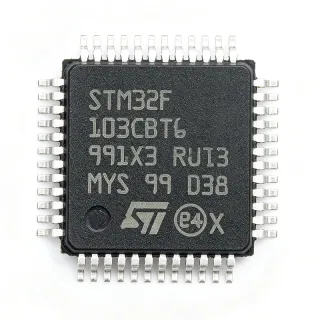
PIC16C57C-04E/SP - 8-Bit 4MHz OTP MCU, 3KB, 28-SPDIP | Microchip
MPN: PIC16C57C-04E/SP ✓ Active| Qty | Unit Price | Extended |
|---|---|---|
| 1 | $1.82 | $1.82 |
| 10 | $1.74 | $17.40 |
| 100 | $1.55 | $155.00 |
| 500 | $1.45 | $725.00 |
| 1,000 | $1.38 | $1,380.00 |
PIC16C57C-04E/SP Overview
A microcontroller (MCU) is a single-chip computer that integrates a CPU core, program memory, working RAM, and peripheral I/O into one IC. The PIC16C5X family sits at the low-cost end of the 8-bit microcontroller taxonomy, between simple 4/8-bit PIC10/PIC12 devices and the more feature-rich PIC16 enhanced and PIC18 families. By using 12-bit-wide instructions with 33 single-word instruction set, the PIC16C57C achieves roughly 2:1 code compression versus competitive 8-bit MCUs, allowing small OTP programs to fit cost-sensitive assemblies without external memory.
Key features of the PIC16C57C-04E/SP include 100 ns instruction cycle time at 4 MHz oscillator input, a wide 3.0 V to 5.5 V single-supply operating range, a programmable 8-bit timer (TMR0) with 8-bit prescaler, watchdog timer with on-chip RC oscillator for reliable reset behavior, power-saving SLEEP mode, and on-chip power-on reset (POR). The 20 I/O pins support individual direction control, with high-current sink/source capability for direct LED and relay drive. Code protection and a 12-bit instruction word target compact, deterministic control loops rather than complex protocol stacks.
Architecturally, the PIC16C57C uses a Harvard RISC core with separate program and data buses, a hardware ALU, and an 8-level deep stack that supports interrupt-free subroutine nesting. The OTP program memory is programmed once via Microchip's standard ICSP serial protocol and cannot be erased, making this part best suited for mature production where firmware is final; for field-reprogrammable designs, a Flash-based PIC16F57 is the closest replacement with the same pinout and peripheral set.
Typical applications include appliance control boards, automotive body modules (seat, mirror, lighting), industrial sensor interfaces, low-end remote controls, simple user-interface panels, and battery-powered smart sensors. The wide supply range, robust ESD/latch-up characteristics, and extended temperature grade make the -04E/SP variant especially attractive for under-hood automotive, outdoor industrial, and HVAC systems.
When designing with the PIC16C57C, keep the oscillator selection short and use a 100 nF decoupling capacitor close to VDD, plus a 10-47 uF bulk capacitor. Note that OTP memory cannot be re-programmed; budget engineering time for prototype validation on a windowed (JW) or Flash equivalent before committing firmware to OTP.
This page combines verified distributor pricing, parametric alternatives, application guidance, and AEO-optimized FAQs drawn from Microchip PIC16C5X datasheet content, with value beyond the bare manufacturer datasheet.
Drop-in alternatives for PIC16C57C-04E/SP — same package, pin-to-pin compatible. Different-package parts requiring PCB rework are excluded.
Variants in this series
Same-series models that are drop-in compatible with PIC16C57C-04E/SP (same form factor and footprint) — differing in Package, Program Memory Size, Program Memory Type, Instruction Cycle Time, I/O Pins.
Quick Comparison Tool — Select alternative parts for side-by-side comparison:
PIC16C57C-04/SP
✅ Drop-In📋 Reference alternative (not in catalog)
PIC16C57-10I/P
✅ Drop-In✓ In Stock
$1.75 / Unit
View Datasheet →PIC16F57-I/P
✅ Drop-In📋 Reference alternative (not in catalog)
PIC16C56-LP/P
✅ Drop-In✓ In Stock
$3.39 / Unit
View Datasheet →PIC16C554-04/P
✅ Drop-In✓ In Stock
$2.85 / Unit
View Datasheet →PIC16C558-04/P
✅ Drop-In✓ In Stock
$4.2 / Unit
View Datasheet →PIC16C57C-04E/SP Maximum Ratings & Electrical Characteristics
| Core Architecture | PIC 8-bit RISC (Harvard) |
| Program Memory Type | OTP EPROM |
| Program Memory Size | 3 KB (2K x 12) |
| RAM | 72 bytes |
| CPU Speed | 4 MHz (max) |
| Instruction Cycle Time | 100 ns at 4 MHz |
| Instruction Set Size | 33 single-word instructions |
| Instruction Width | 12 bits |
| Operating Voltage | 3.0 V to 5.5 V |
| I/O Pins | 20 |
| Timers | 1 x 8-bit (TMR0) with 8-bit prescaler |
| Watchdog Timer | Yes (on-chip RC oscillator) |
| Package | 28-SPDIP (Skinny Plastic DIP, 0.300 inch / 7.62 mm) |
| Pin Count | 28 |
| Operating Temperature Range | -40C to +125C (extended) |
| Mounting Type | Through-Hole |
| Shipping Format | Tube |
PIC16C57C-04E/SP Pin Configuration
| Pin 1 | RA0 — Bidirectional I/O, PORTA bit 0 |
| Pin 2 | RA1 — Bidirectional I/O, PORTA bit 1 |
| Pin 3 | RA2 — Bidirectional I/O, PORTA bit 2 |
| Pin 4 | RA3 — Bidirectional I/O, PORTA bit 3 |
| Pin 5 | MCLR — Master Clear reset (active-low) |
| Pin 6 | RB0 — Bidirectional I/O, PORTB bit 0 / interrupt |
| Pin 7 | RB1 — Bidirectional I/O, PORTB bit 1 |
| Pin 8 | RB2 — Bidirectional I/O, PORTB bit 2 |
| Pin 9 | RB3 — Bidirectional I/O, PORTB bit 3 |
| Pin 10 | RB4 — Bidirectional I/O, PORTB bit 4 |
| Pin 11 | RB5 — Bidirectional I/O, PORTB bit 5 |
| Pin 12 | RB6 — Bidirectional I/O, PORTB bit 6 |
| Pin 13 | RB7 — Bidirectional I/O, PORTB bit 7 |
| Pin 14 | VSS — Ground reference |
| Pin 15 | RC0 — Bidirectional I/O, PORTC bit 0 |
| Pin 16 | RC1 — Bidirectional I/O, PORTC bit 1 |
| Pin 17 | RC2 — Bidirectional I/O, PORTC bit 2 |
| Pin 18 | RC3 — Bidirectional I/O, PORTC bit 3 |
| Pin 19 | RC4 — Bidirectional I/O, PORTC bit 4 |
| Pin 20 | RC5 — Bidirectional I/O, PORTC bit 5 |
| Pin 21 | RC6 — Bidirectional I/O, PORTC bit 6 |
| Pin 22 | RC7 — Bidirectional I/O, PORTC bit 7 |
| Pin 23 | VSS — Ground reference |
| Pin 24 | VDD — Positive supply (3.0 V to 5.5 V) |
| Pin 25 | OSC2 — Oscillator output (crystal/RC) |
| Pin 26 | OSC1 — Oscillator input (crystal/RC/external clock) |
| Pin 27 | T0CKI — Timer0 clock input / PORTA shared pin |
| Pin 28 | VDD — Positive supply (3.0 V to 5.5 V) |
Typical Applications
PIC16C57C-04E/SP is suitable for 6 applications: Automotive Body Control Modules, Appliance Control Boards, Industrial Sensor Interface Modules, Remote Control and User Input Panels, Lighting Control and LED Drivers, HVAC and Climate Control Sub-modules.
Automotive Body Control Modules
The PIC16C57C-04E/SP's extended -40C to +125C operating range, robust ESD/latch-up immunity, and OTP program memory make it well-suited for automotive body control modules such as seat position controllers, mirror adjusters, and interior lighting drivers. Its 20 I/O pins directly switch LED arrays and small relay coils without external drivers, reducing BOM cost. With 3 KB of OTP code and 100 ns instruction cycle at 4 MHz, it executes deterministic state-machine control loops in real time. The 3.0-5.5 V supply range tolerates cranking transients typical of 12 V automotive rails. Microchip's PIC16C5X family is explicitly designed for automotive adaptation.
Recommended
Appliance Control Boards
White-goods appliance control boards - washing machines, dishwashers, microwave ovens, and refrigerators - rely on cost-optimized 8-bit MCUs with OTP memory for final firmware. The PIC16C57C-04E/SP's 3 KB OTP holds mode logic, timer state machines, and user-interface scanning code. Its 4 MHz execution rate handles button-matrix debouncing and 7-segment LED multiplexing at refresh rates above 100 Hz without flicker. The 20 high-current I/O pins drive relay coils, triac gates, and buzzer transducers directly. Operating from 3.0-5.5 V, the part accepts the regulated 5 V rail typical in appliance power supplies.
Recommended
Industrial Sensor Interface Modules
Industrial sensor interface modules - thermocouple conditioners, proximity detector front-ends, and 4-20 mA loop translators - need an 8-bit MCU for linearization, scaling, and HART-style communication. The PIC16C57C-04E/SP's 8-bit ADC-friendly I/O count and 100 ns cycle time deliver sub-millisecond conversion-to-output latency. Extended temperature operation accommodates factory-floor and outdoor installations. The PIC16C5X's 33-instruction RISC core makes assembly firmware easy to audit for functional-safety review. OTP memory protects against firmware tampering in deployed field equipment.
Recommended
Remote Control and User Input Panels
Low-end remote controls, garage-door keypads, and HVAC wall thermostats use the PIC16C57C-04E/SP for its tiny footprint, OTP memory, and low power consumption in SLEEP mode. With 20 I/O pins, the MCU scans 4x4 key matrices, drives IR LEDs at 38 kHz carrier, and reads temperature sensors via RC timing. Battery-life benefits come from the PIC16C5X's SLEEP current in single-digit microampere range. OTP memory eliminates firmware read-back concerns, suitable for anti-clone applications. The 28-SPDIP package also simplifies hand-assembly and rework during prototyping.
Recommended
Lighting Control and LED Drivers
Architectural and decorative LED lighting controllers - RGB strips, dimmer modules, and signage scanners - use the PIC16C57C-04E/SP to generate PWM dimming signals and chase-pattern algorithms. The 4 MHz core produces PWM frequencies above 1 kHz to avoid visible flicker, and the 20 I/O pins can drive multiple MOSFET gates directly. The wide 3.0-5.5 V supply allows operation from 5 V USB or 3.3 V regulated rails. OTP memory locks the final light pattern into production units, preventing unauthorized pattern changes. Extended temperature grade supports outdoor fixture installations.
Recommended
HVAC and Climate Control Sub-modules
HVAC sub-modules for fan-speed control, damper actuation, and zone-valve drivers use the PIC16C57C-04E/SP's extended temperature range, OTP memory, and 20 I/O count for compact, deterministic control loops. The MCU reads NTC thermistors via RC timing, drives triac outputs for AC load switching, and implements safety watchdogs via the on-chip WDT. Operating from 3.0-5.5 V matches 5 V powered system designs, and the 4 MHz execution handles 60 Hz zero-crossing detection plus PWM ramp generation in real time. OTP memory secures proprietary control algorithms.
Recommended
Recommended Products Summary
Engineering reference data for PIC16C57C-04E/SP — comparison, design guidance, and compliance information.
Selection Guide
Comparison with Alternatives
| Parameter | This Product | PIC16C57C-04/SP | PIC16C57-10I/P | PIC16F57-I/P | PIC16C56-LP/P | PIC16C554-04/P | PIC16C558-04/P |
|---|---|---|---|---|---|---|---|
| Brand | Microchip Technology | Microchip Technology | Microchip Technology | Microchip Technology | Microchip Technology | Microchip Technology | Microchip Technology |
| Package | 28-SPDIP | 28-SPDIP | 28-SPDIP | 28-SPDIP | 28-SPDIP | 28-SPDIP | 28-SPDIP |
| Program Memory | 3 KB OTP | 3 KB OTP | 2 KB OTP | 3 KB Flash | 1 KB OTP | 768 B OTP | 2 KB OTP |
| Memory Type | OTP EPROM | OTP EPROM | OTP EPROM | Flash | OTP EPROM | OTP EPROM | OTP EPROM |
| Maximum Frequency | 4 MHz | 4 MHz | 10 MHz | 20 MHz | 4 MHz (low-power variant) | 4 MHz | 4 MHz |
| Instruction Set | 12-bit, 33 instructions | 12-bit, 33 instructions | 12-bit, 33 instructions | 14-bit, 35 instructions | 12-bit, 33 instructions | 14-bit, 35 instructions | 14-bit, 35 instructions |
| Operating Temperature | -40C to +125C | 0C to +70C | -40C to +85C | -40C to +85C | 0C to +70C | 0C to +70C | 0C to +70C |
| I/O Pins | 20 | 20 | 20 | 20 | 12 | 13 | 13 |
Key Differentiators
- Extended industrial temperature grade -40C to +125C (vs PIC16C57C-04/SP)
- Largest OTP memory in the PIC16C5X family (3 KB) (vs PIC16C56-LP/P)
- Field-reprogrammable Flash alternative with same pinout (vs PIC16F57-I/P)
- Lowest cost OTP MCU at extended temperature (vs PIC16C554-04/P)
Design Notes
The PIC16C57C-04E/SP requires a decoupling capacitor of 100 nF placed within 5 mm of the VDD pin (pin 24 and pin 28 are both VDD; connect them together with a wide trace). Add a bulk capacitor of 10-47 uF on the supply rail to absorb switching transients from relay coils or inductive loads driven by the I/O pins. The PIC16C5X datasheet recommends a single-point ground connection between VSS pins and the supply return to avoid digital switching noise coupling into the analog references.
Place the 4 MHz crystal or ceramic resonator within 10 mm of pins 25 (OSC2) and 26 (OSC1) to minimize loop area and stray capacitance. Use a ground guard ring around the oscillator traces to reduce EMI coupling into adjacent signal lines. Estimated: with a 4 MHz fundamental crystal and 22 pF load capacitors, oscillator start-up time is typically 1-5 ms per typical PIC16C5X oscillator characterization. Verify timing margin at the worst-case 3.0 V / +125C corner.
OTP EPROM memory cannot be re-programmed - any firmware bug in the OTP image requires scrapping and re-programming the part. Always validate firmware on a Flash-equivalent PIC16F57-I/P or windowed PIC16C57C-JW device before committing to OTP volume. Additionally, the PIC16C5X core has only an 8-level hardware stack - deep subroutine nesting or excessive interrupt nesting will overflow the stack and cause unpredictable resets. Keep call depth shallow or migrate to PIC16F57 if stack depth is a concern.
The PIC16C57C-04E/SP in 28-SPDIP is a low-power CMOS device with typical active current under 2 mA at 4 MHz and 5 V. Estimated: at 5 V / 4 MHz / all I/O static, power dissipation is approximately 10 mW, well below the thermal limit. In SLEEP mode, current drops to single-digit microamperes, enabling battery-powered remote-sensor designs. No heatsink or thermal management is required for typical MCU operation.
Compliance Information
RoHS, REACH, lead-free, halogen-free, and conflict-mineral status were not present in the verified web data. Marked as [DATA_NEEDED] in specs. The /SP package historically shipped as tin-lead finish - verify the RoHS suffix (-04E/SP versus -04E/SO for lead-free) with Microchip ordering code documentation.