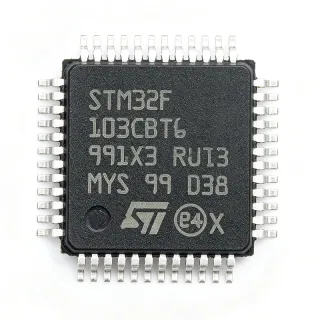
PIC16C62A-20I/SS - 8-bit PIC MCU, 3.5KB EPROM, 20MHz, SSOP-28 | Microchip
MPN: PIC16C62A-20I/SS ✗ End of Life| Qty | Unit Price | Extended |
|---|---|---|
| 1 | $2.4418 | $2.44 |
| 10 | $2.3 | $23.00 |
| 100 | $2.1 | $210.00 |
| 500 | $1.95 | $975.00 |
| 1,000 | $1.8 | $1,800.00 |
PIC16C62A-20I/SS Overview
An 8-bit microcontroller (MCU) is a single-chip computer that integrates a CPU, RAM, program memory, and peripherals on one die. The PIC16C family belongs to Microchip's mid-range 8-bit MCU lineup, which sits hierarchically between the baseline PIC10/12/16 families and the higher-performance PIC18 and dsPIC families. Mid-range PIC16C devices use a 14-bit instruction word and a RISC-like Harvard design (separate program and data buses), providing deterministic instruction timing and low power consumption that is widely adopted in industrial control, automotive, and consumer embedded designs.
Key features include 35 single-cycle instructions (200ns at 20MHz), EPROM program memory for prototype and pre-production code, 128 bytes of data RAM, an 8-bit timer/counter with 8-bit prescaler, a Watchdog Timer with on-chip RC, and two analog comparators. The PIC16C62A-20I/SS supports in-circuit serial programming (ICSP) via clock and data lines, enabling firmware updates without removing the device from the board.
Architecturally, the PIC16C62A uses a 14-bit instruction set, an 8-bit data path, and a fully static design that allows the clock to be stopped without losing register state. The integrated EPROM cell (windowed ceramic or OTP plastic) was standard for late-1990s production, prior to the flash-based PIC16F family's widespread adoption, making this part of interest for legacy equipment maintenance, industrial retrofit, and hobbyist retro-projects.
Typical applications include industrial control logic, motor control (small DC/stepper driver sequencing), sensor interfacing (with the on-chip comparators), simple user-interface controllers, and embedded instrumentation. This device is also widely used in educational settings and legacy aerospace/defense systems where the PIC16C62A is qualified into long-lived programs.
When designing with this device, note that the PIC16C62A is One-Time-Programmable (OTP) in plastic and obsolete on Microchip's website for new designs; pin-compatible PIC16F-series flash parts (PIC16F72, PIC16F716) are the recommended migration path. A proper reset circuit (MCLR pull-up) and decoupling (0.1uF + 10uF near VDD) is required for reliable operation across the industrial temperature range.
Drop-in alternatives for PIC16C62A-20I/SS — same package, pin-to-pin compatible. Different-package parts requiring PCB rework are excluded.
Variants in this series
Same-series models that are drop-in compatible with PIC16C62A-20I/SS (same form factor and footprint) — differing in Instruction Set, Timers, Program Memory Size, Oscillator Type, Program Memory Type.
Quick Comparison Tool — Select alternative parts for side-by-side comparison:
PIC16C62A-20E/SS
✅ Drop-In✓ In Stock
$5.65 / Unit
View Datasheet →PIC16C62AT-20I/SS
✅ Drop-In✓ In Stock
$2.46 / Unit
View Datasheet →PIC16C622-20I/SS
✅ Drop-In✓ In Stock
$1.44 / Unit
View Datasheet →PIC16F72-I/SO
✅ Drop-In📋 Reference alternative (not in catalog)
PIC16F716-I/SO
✅ Drop-In📋 Reference alternative (not in catalog)
PIC16F648A-I/SS
✅ Drop-In📋 Reference alternative (not in catalog)
PIC16C62A-20I/SS Maximum Ratings & Electrical Characteristics
| Product Type | 8-bit CMOS Microcontroller |
| Family | PIC16C (Mid-Range) |
| Program Memory Type | EPROM (OTP in plastic package) |
| Program Memory Size | 3.5 KB (2K x 14) |
| RAM Size | 128 x 8 bytes |
| Number of I/O Pins | 22 |
| Maximum CPU Speed | 20 MHz |
| Instruction Set | 14-bit RISC (35 instructions) |
| Supply Voltage Range | 2.5 V to 6.0 V |
| Oscillator Type | External (RC/HS/XT/LP modes via configuration) |
| Package | 28-pin SSOP (7.50mm body width) |
| Mounting Type | Surface Mount |
| Temperature Grade | Industrial (-40C to +85C) |
| Timers | 1 x 8-bit Timer/Counter with prescaler |
| Watchdog Timer | Yes (on-chip RC oscillator) |
| Analog Comparators | 2 |
| In-Circuit Serial Programming | Yes (ICSP) |
PIC16C62A-20I/SS Pin Configuration
| Pin 1 | RA2 — PORTA bit 2 / analog input |
| Pin 2 | RA3 — PORTA bit 3 / analog input |
| Pin 3 | RA4 — PORTA bit 4 (open-drain) |
| Pin 4 | MCLR — Master Clear (reset, active-low) |
| Pin 5 | VSS — Ground reference |
| Pin 6 | RB0/INT — PORTB bit 0 / external interrupt |
| Pin 7 | RB1 — PORTB bit 1 |
| Pin 8 | RB2 — PORTB bit 2 |
| Pin 9 | RB3 — PORTB bit 3 |
| Pin 10 | RB4 — PORTB bit 4 |
| Pin 11 | RB5 — PORTB bit 5 |
| Pin 12 | RB6 — PORTB bit 6 / ICSP clock |
| Pin 13 | RB7 — PORTB bit 7 / ICSP data |
| Pin 14 | VSS — Ground (digital) |
| Pin 15 | VDD — Positive supply voltage (2.5V-6.0V) |
| Pin 16 | RC0 — PORTC bit 0 |
| Pin 17 | RC1 — PORTC bit 1 |
| Pin 18 | RC2 — PORTC bit 2 |
| Pin 19 | RC3 — PORTC bit 3 |
| Pin 20 | RC4 — PORTC bit 4 |
| Pin 21 | RC5 — PORTC bit 5 |
| Pin 22 | RC6 — PORTC bit 6 |
| Pin 23 | RC7 — PORTC bit 7 |
| Pin 24 | OSC2/CLKOUT — Oscillator output / clock out |
| Pin 25 | OSC1/CLKIN — Oscillator input / clock in |
| Pin 26 | VDD — Positive supply voltage |
| Pin 27 | RA0 — PORTA bit 0 / analog input |
| Pin 28 | RA1 — PORTA bit 1 / analog input |
Typical Applications
PIC16C62A-20I/SS is suitable for 6 applications: Industrial Control Logic, Motor Control Sequencing, Sensor Interfacing and Signal Conditioning, User Interface Controllers, Educational and Development Platforms, Legacy Equipment Maintenance and Retrofit.
Industrial Control Logic
The PIC16C62A-20I/SS is well-suited for industrial control logic applications including relay driving, switch debouncing, and PLC I/O expansion. Its 22 digital I/O pins provide sufficient channels for multi-input control loops, while the 20MHz clock delivers deterministic 200ns instruction cycles essential for real-time response in motor sequencing, solenoid drivers, and conveyor systems. The 128-byte RAM accommodates small state machines and lookup tables common in PID-style control. The PIC16C62A-20I/SS's industrial temperature grade (-40C to +85C) ensures reliable behavior in factory floor environments with wide thermal variation, and its 2.5V to 6.0V supply range supports both 3.3V and 5V logic interfaces used in legacy industrial automation. The on-chip comparators enable direct sensor thresholding without external op-amps, reducing BOM cost.
Recommended
Motor Control Sequencing
The PIC16C62A-20I/SS is widely deployed in small DC motor and stepper motor control applications such as HVAC damper drivers, valve actuators, and printer stepper sequencing. Its 8-bit timer with 8-bit prescaler provides accurate PWM generation at motor-control frequencies, while the 35-instruction RISC core executes commutation logic in microseconds. The PIC16C62A-20I/SS's 22 I/O pins support quadrature encoder inputs, direction control, and enable signals for dual-axis stepper drives. The 20MHz clock rate produces 5MHz instruction throughput, sufficient for trapezoidal acceleration profiles in stepper motion. Although the EPROM-based OTP variant requires pre-programmed firmware, the established PIC16C toolchain and reference designs simplify deployment in volume industrial motor control boards.
Recommended
Sensor Interfacing and Signal Conditioning
The PIC16C62A-20I/SS provides an integrated solution for sensor interfacing with its two on-chip analog comparators and 22 digital I/O pins. Sensor applications include temperature threshold detection, light-level switching, and proximity sensor signal conditioning. The PIC16C62A-20I/SS's comparators can be configured for window detection or single-threshold comparison, eliminating external op-amps in simple alarm and threshold circuits. The 128-byte RAM supports calibration constants and sensor fusion data, while the 3.5KB EPROM accommodates interrupt-driven sampling routines. The industrial temperature grade makes it suitable for outdoor sensor enclosures and automotive cabin applications. The device's low-power consumption (15uA typical at 4MHz, 5V) supports battery-backed sensor nodes with intermittent wake cycles.
Recommended
User Interface Controllers
The PIC16C62A-20I/SS serves as a user-interface controller for simple HMI panels, button matrices, and LED/LCD multiplexed displays. Its 22 I/O pins support 4x4 keypads with row/column scanning, 7-segment LED multiplexing up to 8 digits, and character LCD interfaces in 4-bit mode. The PIC16C62A-20I/SS's 20MHz clock drives LED multiplexing refresh rates above 100Hz, eliminating visible flicker, while the 3.5KB EPROM stores character tables, menu state machines, and debounce algorithms. Industrial-grade operation supports appliance front panels, security keypads, and instrument control surfaces. The on-chip Watchdog Timer with dedicated oscillator prevents UI lockup in unattended equipment, and the comparator inputs can detect analog key-press or touch-sense signals.
Recommended
Educational and Development Platforms
The PIC16C62A-20I/SS has a long history as a teaching microcontroller in university embedded systems courses and electronics training programs. Its simple 14-bit RISC instruction set (only 35 instructions) provides an accessible introduction to assembly and C programming for embedded applications. The PIC16C62A-20I/SS's SSOP-28 package is breadboard-friendly through SSOP-to-DIP adapter boards, and the established MPLAB IDE, ICD-3, and PICkit programmer toolchain supports the PIC16C family with extensive tutorial content available online. Although newer PIC16F and PIC18 parts offer flash and enhanced peripherals, the PIC16C62A-20I/SS remains a reference device in textbooks and lab exercises because of its mid-range position in the PIC family hierarchy.
Recommended
Legacy Equipment Maintenance and Retrofit
The PIC16C62A-20I/SS is a critical part for maintaining and retrofitting legacy equipment where the original Microchip PIC16C-series controller is no longer manufactured. Industrial machinery, medical instruments, and aerospace subsystems designed in the late 1990s and early 2000s used PIC16C62A-20I/SS as a control MCU, and field-service organizations require ongoing supply for repair and overhaul. The PIC16C62A-20I/SS's SSOP-28 footprint and pinout allow drop-in replacement on existing PCBs without reworking the board. Microchip's product longevity program and authorized distributors maintain stock for legacy industrial customers, and third-party distributors offer factory-sealed obsolete stock with traceability. For end-of-life systems, designing a flash-based PIC16F-series adapter board that mounts in the same SSOP-28 footprint can extend equipment service life without cabinet-level rework.
Recommended
Recommended Products Summary
Engineering reference data for PIC16C62A-20I/SS — comparison, design guidance, and compliance information.
Selection Guide
Comparison with Alternatives
| Parameter | This Product | PIC16C62A-20E/SS | PIC16C62AT-20I/SS | PIC16C622-20I/SS | PIC16F72-I/SO | PIC16F716-I/SO | PIC16F648A-I/SS |
|---|---|---|---|---|---|---|---|
| Package | 28-SSOP (7.50mm) | 28-SSOP (7.50mm) - same | 28-SSOP (7.50mm) - same | 28-SSOP (7.50mm) - same | 28-SOIC (0.300") | 28-SOIC (0.300") | 28-SSOP (7.50mm) - same |
| Brand | Microchip Technology | Microchip Technology | Microchip Technology | Microchip Technology | Microchip Technology | Microchip Technology | Microchip Technology |
| Program Memory Type | EPROM (OTP) | EPROM (OTP) | EPROM (OTP) | EPROM (OTP) | Flash (in-circuit programmable) | Flash (in-circuit programmable) | Flash (in-circuit programmable) |
| Program Memory Size | 3.5 KB | 3.5 KB | 3.5 KB | 3.5 KB | 3.5 KB | 14 KB | 7 KB |
| Maximum Clock | 20 MHz | 20 MHz | 20 MHz | 20 MHz | 20 MHz | 20 MHz | 20 MHz |
| RAM Size | 128 bytes | 128 bytes | 128 bytes | 128 bytes | 128 bytes | 128 bytes | 256 bytes |
| Temperature Grade | Industrial (-40C to +85C) | Extended (-40C to +125C) | Industrial (-40C to +85C) | Industrial (-40C to +85C) | Industrial (-40C to +85C) | Industrial (-40C to +85C) | Industrial (-40C to +85C) |
| Lifecycle Status | Obsolete | Obsolete | Obsolete | Obsolete | Active | Active | Active |
Key Differentiators
- EPROM-based OTP architecture (vs PIC16F648A-I/SS)
- Industrial temperature grade standard (vs PIC16C62A-20E/SS)
- PIC16C mid-range family positioning (vs PIC16F716-I/SO)
Design Notes
Place a 0.1uF ceramic decoupling capacitor as close as possible to the VDD pin (pin 15) and a bulk 10uF tantalum or ceramic capacitor on the VDD rail within 1cm of the device. The PIC16C62A-20I/SS draws approximately 15uA at 4MHz/5V and scales linearly with clock frequency up to ~10mA at 20MHz. In noisy industrial environments, add a ferrite bead on VDD to suppress conducted EMI from switching loads sharing the same supply.
Route the MCLR pin (pin 4) with a 10k pull-up resistor to VDD and a 100nF capacitor to VSS for proper reset behavior. For ICSP programming, dedicate RB6 (pin 12) and RB7 (pin 13) as ICSPCLK and ICSPDAT respectively, and ensure these traces are short and not loaded with heavy capacitance. Avoid long parallel runs between OSC1/OSC2 (pins 27-28) and high-current switching traces to minimize clock jitter.
Do not exceed absolute maximum VDD of 7.0V or the device will be damaged. Ensure the MCLR pin does not float - a floating MCLR can cause intermittent resets or unpredictable startup behavior. For new designs, prefer the PIC16F648A-I/SS flash-based SSOP-28 replacement to avoid EPROM OTP constraints and gain in-circuit programmability. When migrating firmware, note that the PIC16F-series CONFIG bits differ from PIC16C-series and require reconfiguration in source code.
The SSOP-28 package has a thermal resistance of approximately 80 C/W theta-JA, which is adequate for the PIC16C62A's typical <50mW dissipation. Ground the exposed die paddle (if present in your SSOP variant) to a large ground pour on the top layer to reduce thermal stress. For high-IO-count applications using all 22 I/O pins, route the traces between SSOP pads with 0.1mm clearance to avoid solder bridge shorts during reflow.
Compliance Information
RoHS status not explicitly confirmed in the verified web data for this legacy Microchip part. The PIC16C62A-20I/SS was designed prior to widespread RoHS adoption; modern Microchip PIC16F-series replacements are typically RoHS compliant. AEC-Q100 qualification is not applicable for this industrial-grade PIC16C part.