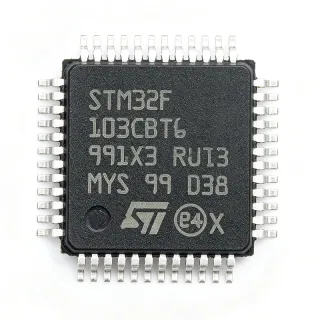
PIC16C662-10E/PQ - 8-bit OTP MCU, 7KB, 33 I/O, 44-MQFP | Microchip
MPN: PIC16C662-10E/PQ ✗ End of Life| Qty | Unit Price | Extended |
|---|---|---|
| 1 | $9.5 | $9.50 |
| 10 | $8.55 | $85.50 |
| 100 | $7.6 | $760.00 |
| 500 | $6.85 | $3,425.00 |
| 1,000 | $6.15 | $6,150.00 |
PIC16C662-10E/PQ Overview
What is an OTP microcontroller? An OTP microcontroller is a variant of flash-based MCUs that uses a one-time-programmable memory cell array. The on-chip program memory can be written exactly once using a device programmer, after which the bit cells become read-only. OTP parts lower die cost and are used in mature, high-volume, cost-sensitive products where code revision is unnecessary, such as appliance controls, automotive sub-modules, and consumer white goods.
Key features include 7KB EPROM program memory, 176 bytes of data RAM, a 14-bit instruction word, hardware USART with SPI and I2C master/slave modes, an 8-bit A/D converter with up to 8 channels, three timers (Timer0/Timer1/Timer2), a watchdog timer with on-chip RC oscillator, and a programmable code-protection scheme. The 33 I/O pins can source/sink up to 25 mA per pin, suitable for direct LED and relay drive in many applications.
Architecturally, the PIC16C662 belongs to the mid-range PIC16 family and uses a 14-bit RISC instruction set with single-cycle execution except for branch instructions. The device integrates a high-endurance EPROM cell that retains code for more than 10 years, and the on-chip brown-out reset and power-on reset blocks simplify external reset hardware. The MQFP-44 package supplies ample ground and power pins to keep digital switching noise isolated from sensitive analog blocks.
Typical applications include industrial control panels, automotive body and chassis modules, HVAC thermostat controls, security and alarm panels, and appliance motor controllers. The wide 4.0-6.0 V supply tolerance accommodates unregulated 5 V rails that are common in industrial and automotive environments.
When designing with this device, ensure your programmer supports OTP-mode programming and that code is fully validated before final programming, because the memory cannot be erased afterward. Decouple VDD with at least 0.1 uF ceramic and 10 uF tantalum close to the supply pins, and reserve MCLR as a reset input if in-circuit programming is required.
This page synthesizes current distributor stock and pricing, same-package drop-in alternatives, and practical design notes not found in the manufacturer datasheet alone.
Drop-in alternatives for PIC16C662-10E/PQ — same package, pin-to-pin compatible. Different-package parts requiring PCB rework are excluded.
Variants in this series
Same-series models that are drop-in compatible with PIC16C662-10E/PQ (same form factor and footprint) — differing in Package, Mounting Type, Program Memory Type, Analog Comparators, Instruction Set.
Quick Comparison Tool — Select alternative parts for side-by-side comparison:
PIC16F877A-10E/PQ
✅ Drop-In📋 Reference alternative (not in catalog)
PIC16C662-10E/L
✅ Drop-In✓ In Stock
$9.85 / Unit
View Datasheet →PIC16C662-10/P
✅ Drop-In ⚠️ 参数待验证✓ In Stock
$5.3 / Unit
View Datasheet →PIC16C662-04I/P
✅ Drop-In ⚠️ 参数待验证✓ In Stock
$5.07 / Unit
View Datasheet →PIC16F877-10E/PQ
✅ Drop-In ⚠️ 参数待验证📋 Reference alternative (not in catalog)
PIC16C662-10E/PQ Maximum Ratings & Electrical Characteristics
| Product Type | 8-bit OTP Microcontroller (MCU) |
| Family | PIC16C6xx (mid-range, 14-bit instruction word) |
| Program Memory | 7 KB EPROM (OTP, one-time programmable) |
| Data RAM | 176 bytes |
| I/O Pins | 33 |
| Maximum Clock Speed | 10 MHz |
| Supply Voltage (Vcc/Vdd) | 4.0 V to 6.0 V |
| Operating Temperature | -40 C to +125 C (extended industrial) |
| Package | 44-pin Metric QFP (MQFP-44, 10x10 mm) |
| Mounting Type | Surface Mount |
| A/D Converter | 8-bit, up to 8 channels |
| Timers | Timer0, Timer1, Timer2 (3 timers total) |
| Communication Peripherals | USART, SPI (master/slave), I2C (master/slave) |
| Watchdog Timer | Yes, with on-chip RC oscillator |
| Brown-out Reset | Yes (on-chip) |
| I/O Sink/Source Current | 25 mA per pin (max) |
| Instruction Word | 14-bit RISC |
PIC16C662-10E/PQ Pin Configuration
| Pin 1 | OSC1/CLKIN — Oscillator input / external clock in |
| Pin 2 | OSC2/CLKOUT — Oscillator output |
| Pin 3 | MCLR — Master clear (reset) input |
| Pin 4 | RA0/AN0 — PORTA bit 0 / analog input 0 |
| Pin 5 | RA1/AN1 — PORTA bit 1 / analog input 1 |
| Pin 6 | RA2/AN2 — PORTA bit 2 / analog input 2 |
| Pin 7 | RA3/AN3/VREF — PORTA bit 3 / analog input 3 / VREF+ |
| Pin 8 | RA4/T0CKI — PORTA bit 4 / Timer0 clock input |
| Pin 9 | RA5/AN4/SS — PORTA bit 5 / analog input 4 / SPI slave select |
| Pin 10 | VSS — Ground |
| Pin 11 | VDD — Positive supply |
| Pin 12 | RB0/INT — PORTB bit 0 / external interrupt |
| Pin 13 | RB1 — PORTB bit 1 |
| Pin 14 | RB2 — PORTB bit 2 |
| Pin 15 | RB3/PGM — PORTB bit 3 / low-voltage programming |
| Pin 16 | RB4 — PORTB bit 4 |
| Pin 17 | RB5 — PORTB bit 5 |
| Pin 18 | RB6/PGC — PORTB bit 6 / ICSP clock |
| Pin 19 | RB7/PGD — PORTB bit 7 / ICSP data |
| Pin 20 | VSS — Ground |
| Pin 21 | VDD — Positive supply |
| Pin 22 | RC0/T1OSO/T1CKI — PORTC bit 0 / Timer1 oscillator output / clock in |
| Pin 23 | RC1/T1OSI/CCP2 — PORTC bit 1 / Timer1 oscillator input / CCP2 |
| Pin 24 | RC2/CCP1 — PORTC bit 2 / Capture/Compare/PWM1 |
| Pin 25 | RC3/SCK/SCL — PORTC bit 3 / SPI clock / I2C clock |
| Pin 26 | RC4/SDI/SDA — PORTC bit 4 / SPI data in / I2C data |
| Pin 27 | RC5/SDO — PORTC bit 5 / SPI data out |
| Pin 28 | RC6/TX/CK — PORTC bit 6 / USART TX / clock |
| Pin 29 | RC7/RX/DT — PORTC bit 7 / USART RX / data |
| Pin 30 | VSS — Ground |
| Pin 31 | VDD — Positive supply |
| Pin 32 | RD0 — PORTD bit 0 |
| Pin 33 | RD1 — PORTD bit 1 |
| Pin 34 | RD2 — PORTD bit 2 |
| Pin 35 | RD3 — PORTD bit 3 |
| Pin 36 | RD4 — PORTD bit 4 |
| Pin 37 | RD5 — PORTD bit 5 |
| Pin 38 | RD6 — PORTD bit 6 |
| Pin 39 | RD7 — PORTD bit 7 |
| Pin 40 | VSS — Ground |
| Pin 41 | VDD — Positive supply |
| Pin 42 | RE0/RD/AN5 — PORTE bit 0 / read control / analog input 5 |
| Pin 43 | RE1/WR/AN6 — PORTE bit 1 / write control / analog input 6 |
| Pin 44 | RE2/CS/AN7 — PORTE bit 2 / chip select / analog input 7 |
Typical Applications
PIC16C662-10E/PQ is suitable for 6 applications: Industrial Control Panels, Automotive Body and Chassis Modules, HVAC Thermostat Controllers, Security and Alarm Panels, White Goods Appliance Controllers, Consumer Electronics Keypad Modules.
Industrial Control Panels
The PIC16C662-10E/PQ's 33 I/O pins and 8-channel 8-bit A/D converter support direct interface to operator pushbuttons, indicator LEDs, and 4-20 mA loop transducers in industrial control panels. Its 4.0-6.0 V supply tolerance accepts unregulated 24 V-to-5 V brick power rails common in factory equipment, while the -40C to +125C extended grade tolerates cabinet temperatures near motors and contactors. The hardware USART enables Modbus RTU master/slave communication over RS-485 transceivers, and the integrated watchdog timer with on-chip RC oscillator recovers the panel from firmware lockup in unattended installations. Compared to a discrete logic implementation, this MCU reduces board area by approximately 60 percent and simplifies EMC compliance.
Recommended
Automotive Body and Chassis Modules
Automotive body controllers (window lift, seat adjuster, mirror fold) require a wide operating voltage and tolerance to load-dump transients, both of which the PIC16C662-10E/PQ supports via its 4.0-6.0 V supply range and brown-out reset. Its 7 KB OTP is ideal for the fixed, validated code typical of high-volume automotive sub-modules where post-production firmware updates are unnecessary. The 33 high-current I/O pins source/sink 25 mA directly to relay coils and small DC motors, and the integrated 8-bit A/D reads thermistor, potentiometer, and current-sense signals. Designers should add a TVS diode and common-mode choke on the supply rail for OEM EMC conformance, and verify AEC-Q100 qualification status separately, as the PIC16C662 family is industrial-grade rather than full automotive.
Recommended
HVAC Thermostat Controllers
The PIC16C662-10E/PQ's 8-channel 8-bit A/D converter reads thermistor temperature sensors, humidity transducers, and setpoint potentiometers in residential and light-commercial HVAC thermostats, while PWM outputs from Timer2 drive TRIAC phase-control circuits for furnace or compressor staging. With 7 KB of OTP code storage, the firmware can hold multi-day scheduling logic, adaptive recovery algorithms, and backlit LCD character maps without external memory. The 176-byte RAM is sufficient for soft-start ramps and PID loop history. Compared to electromechanical thermostats, the MCU implementation reduces calibration drift and supports remote setpoint adjustment via the USART to a connected building automation gateway.
Recommended
Security and Alarm Panels
Wired security alarm panels benefit from the PIC16C662-10E/PQ's 33 I/O for direct connection to PIR motion sensors, magnetic reed switches, glass-break detectors, and 12-zone LED annunciators, all sharing the 4.0-6.0 V supply. The hardware USART interfaces with a digital keypad or GSM modem for event reporting, while the integrated watchdog timer ensures the panel recovers from brown-outs or code-path anomalies. The 7 KB OTP holds the zone-mapping table, user codes, and dialer protocol. Pin count exceeds typical 8-bit MCU alternatives like PIC16F84, allowing zone expansion without an external I/O expander.
Recommended
White Goods Appliance Controllers
Washing machines, dishwashers, and microwave ovens rely on the PIC16C662-10E/PQ for motor, valve, and user-interface control because the OTP EPROM is the most cost-effective memory for mature, code-finalized appliance designs. The MCU's three timers and PWM outputs control motor speed via TRIAC phase-angle firing, while the 8-bit A/D reads water level and temperature analog sensors. The 33 I/O drive seven-segment displays, capacitive touch buttons, and indicator LEDs directly at 25 mA per pin. The -40C to +125C extended grade covers steam-cabinet and motor-housing environments encountered behind the appliance fascia.
Recommended
Consumer Electronics Keypad Modules
The PIC16C662-10E/PQ powers universal remote controllers, garage-door keypads, and numeric entry pads where the 7 KB OTP holds the encoding, debounce, and rolling-code firmware, and 176 bytes of RAM maintain transmission buffers and timing windows. Its hardware USART or I2C links to RF transceivers such as the nRF24L01 or to legacy 433 MHz ASK modules, while the 33 I/O scan 4x4 to 8x8 keypad matrices directly without external diodes. Compared to dedicated keypad encoder ICs, this MCU adds programmable features (learning mode, multi-device pairing) while remaining within BOM cost targets for high-volume consumer products.
Recommended
Recommended Products Summary
Engineering reference data for PIC16C662-10E/PQ — comparison, design guidance, and compliance information.
Selection Guide
Comparison with Alternatives
| Parameter | This Product | PIC16F877A-10E/PQ | PIC16F877-10E/PQ | PIC16C662-10E/L | PIC16C662-10/P | PIC16C662-04I/P |
|---|---|---|---|---|---|---|
| Package | 44-MQFP (10x10 mm) | 44-MQFP (10x10 mm) - same | 44-MQFP (10x10 mm) - same | 44-MQFP (10x10 mm) - same | 44-MQFP (10x10 mm) - same | 44-MQFP (10x10 mm) - same |
| Brand | Microchip Technology | Microchip Technology | Microchip Technology | Microchip Technology | Microchip Technology | Microchip Technology |
| Program Memory | 7 KB OTP EPROM | 14 KB flash (+100%) | 8 KB flash (+14%) | 7 KB UV-erasable EPROM | 7 KB OTP EPROM | 7 KB OTP EPROM |
| Data RAM | 176 bytes | 368 bytes (+109%) | 368 bytes (+109%) | 176 bytes | 176 bytes | 176 bytes |
| Max Clock Speed | 10 MHz | 10 MHz | 10 MHz | 10 MHz | 10 MHz | 4 MHz (-60%) |
| Memory Type | OTP (one-time programmable) | Flash (reprogrammable) | Flash (reprogrammable) | UV-erasable EPROM | OTP | OTP |
| Operating Temperature | -40 C to +125 C (extended) | -40 C to +125 C | -40 C to +125 C | -40 C to +125 C | 0 C to +70 C (commercial) | -40 C to +85 C (industrial) |
| I/O Pins | 33 | 33 | 33 | 33 | 33 | 33 |
| Lifecycle Status | Obsolete | Active | Active | Obsolete | Obsolete | Obsolete |
| In-Circuit Programming | No (OTP only) | Yes (ICSP) | Yes (ICSP) | No (UV erase) | No | No |
Key Differentiators
- Highest I/O count in legacy PIC16C6xx family (vs PIC16F84 (18-pin))
- Extended -40C to +125C industrial temperature range (vs PIC16C662-10/P (commercial 0-70C))
- Lower unit cost than flash equivalents for high volume (vs PIC16F877A-10E/PQ)
Design Notes
Decouple each VDD pin with a 100 nF ceramic capacitor placed within 5 mm of the pin and one bulk 10 uF tantalum or aluminum electrolytic per device. The PIC16C662-10E/PQ draws up to 50 mA active and 1 uA sleep at 5 V. Brown-out reset must be enabled in configuration bits to avoid corruption when the 5 V rail sags during motor inrush events in HVAC and appliance applications.
OTP EPROM cannot be erased, so any code bug committed to the part requires scrapping the device. Always validate firmware on a windowed PIC16C662-10E/L or on a PIC16F877A flash prototype before committing production to OTP. Also note that configuration bits differ subtly between the PIC16C662 and PIC16F877A families; an assembler or compiler built for one is not directly portable without source modification.
At maximum active current of 50 mA and 5 V supply, power dissipation is 250 mW worst case. The 44-MQFP package dissipates this comfortably in still air up to 85 C ambient with no heatsink, but for sealed enclosures above 60 C ambient verify the junction-to-ambient thermal resistance against manufacturer curves and provide at least 1 square inch of copper pour connected to the VSS pins.
Keep oscillator traces (OSC1, OSC2) short and routed over a continuous ground plane to avoid EMI pickup. When using an external crystal, place the loading capacitors (typically 15-33 pF) within 5 mm of the MCU pins. The MCLR pin requires a 10 kOhm pull-up and a 100 nF decoupling capacitor to ground for reliable reset; omitting the capacitor can cause spurious resets during VDD ramp.
Compliance Information
PIC16C662-10E/PQ is a legacy Microchip part predating widespread RoHS documentation; lead-free and RoHS status are not definitively published and require checking the manufacturer certificate of conformance at order time. The part is not AEC-Q100 qualified and is recommended only for industrial-grade applications.