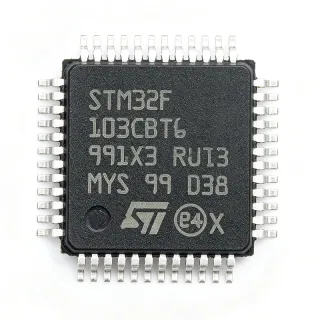
PIC16F15376-E/MV - 8-Bit MCU, 32MHz, 28KB Flash, 40-UQFN | Microchip
MPN: PIC16F15376-E/MV ✓ Active| Qty | Unit Price | Extended |
|---|---|---|
| 1 | $3.42 | $3.42 |
| 10 | $3.08 | $30.80 |
| 100 | $2.74 | $274.00 |
| 500 | $2.45 | $1,225.00 |
| 1,000 | $2.18 | $2,180.00 |
PIC16F15376-E/MV Overview
A microcontroller (MCU) is a single-chip computer that integrates a CPU core, non-volatile program memory, working RAM, and a range of peripheral IP into one package, enabling compact embedded control. The PIC16F15376 specifically sits in the 8-bit MCU class (PIC -> 8-bit microcontroller -> microcontroller -> embedded processor) and uses Microchip's enhanced mid-range core with a 14-bit instruction word, making it more code-efficient than legacy baseline PIC cores while retaining the family ecosystem of compilers, programmers, and CIPs.
Key features include four 10-bit PWMs with Complementary Waveform Generator (CWG), two rail-to-rail Comparators, a 5-bit DAC, four Configurable Logic Cells (CLC), two EUSART (LIN-capable), two SPI, and two I2C peripherals, plus an on-chip 32 MHz internal oscillator that eliminates the external crystal in many designs. The 'E' temperature grade supports -40C to +125C operation, suitable for automotive and harsh-environment deployments.
The device is fabricated on a CMOS process with XLP power management, allowing Active mode current in the microamp range and deep-sleep currents typically below 100 nA. This makes the part attractive for battery-powered sensor nodes that must wake periodically, take a measurement, transmit over UART or SPI, and return to sleep. The CIPs (CLC, NCO, CWG) let designers implement glue logic in silicon, reducing BOM cost and freeing the CPU from bit-banging tasks.
Typical applications include IoT sensor end-nodes, low-power wireless modules, HVAC and white-goods control panels, automotive body and lighting controllers, and consumer appliances. Combined with the generous 28 KB Flash, the part fits medium-complexity state-machine firmware while leaving headroom for bootloaders or wireless stacks.
Designers should pay attention to the UQFN EP exposed pad - it must be soldered to the board ground pour for thermal and electrical performance, and decoupling requires a 0.1 uF VDD cap within 3 mm of each power pin. For production programming, use the 4-wire In-Circuit Serial Programming (ICSP) header defined in the family datasheet.
This page synthesizes XAIPART distributor pricing, a curated drop-in alternative list limited to same-package 40-UQFN variants, and engineering design notes compiled from Microchip's family datasheet and TB documents, going beyond what the manufacturer datasheet alone offers.
Drop-in alternatives for PIC16F15376-E/MV — same package, pin-to-pin compatible. Different-package parts requiring PCB rework are excluded.
Variants in this series
Same-series models that are drop-in compatible with PIC16F15376-E/MV (same form factor and footprint) — differing in Package, ADC, DAC, Operating Temperature, Comparators.
Quick Comparison Tool — Select alternative parts for side-by-side comparison:
PIC16F15376-I/MV
✅ Drop-In✓ In Stock
$1.18 / Unit
View Datasheet →PIC16F15376-E/ML
✅ Drop-In✓ In Stock
$1.45 / Unit
View Datasheet →PIC16F15356-I/MV
✅ Drop-In✓ In Stock
$1.18 / Unit
View Datasheet →PIC16F15356T-I/MV
✅ Drop-In✓ In Stock
$1.42 / Unit
View Datasheet →PIC16F1512-I/MV
✅ Drop-In✓ In Stock
$0.99 / Unit
View Datasheet →PIC16F15376-E/MV Maximum Ratings & Electrical Characteristics
| Core Architecture | PIC16 8-bit RISC (enhanced mid-range, 14-bit instruction word) |
| Maximum CPU Frequency | 32 MHz |
| Program Memory (Flash) | 28 KB |
| Data Memory (SRAM) | 2 KB |
| Data EEPROM | 0 bytes (none on this family) |
| Operating Voltage Range | 2.3 V to 5.5 V |
| ADC | 10-bit, up to 35 channels |
| DAC | 5-bit DAC |
| Comparators | 2 (rail-to-rail) |
| PWM Channels | 4 (10-bit) with Complementary Waveform Generator (CWG) |
| Configurable Logic Cells (CLC) | 4 |
| EUSART | 2 (LIN-capable) |
| SPI | 2 |
| I2C | 2 |
| Timers | 5 (8-bit and 16-bit mix) |
| Operating Temperature | -40C to +125C (E grade, extended) |
| Package | 40-pin UQFN (MV), 5x5 mm with exposed pad |
| Mounting Type | Surface Mount |
| RoHS Status | Compliant |
| Lead-Free / Halogen-Free | Yes / Yes |
PIC16F15376-E/MV Pin Configuration
| Pin 1 | RA0/ANA0 — Bidirectional I/O / analog input / 5-bit DAC output |
| Pin 2 | RA1/ANA1 — Bidirectional I/O / analog input |
| Pin 3 | RA2/ANA2 — Bidirectional I/O / analog input |
| Pin 4 | RA3/ANA3 — Bidirectional I/O / analog input / MCLR (input only) |
| Pin 5 | RA4/ANA4 — Bidirectional I/O / analog input |
| Pin 6 | RA5/ANA5 — Bidirectional I/O / analog input |
| Pin 7 | RA6/ANA6 — Bidirectional I/O / analog input |
| Pin 8 | RA7/ANA7 — Bidirectional I/O / analog input |
| Pin 9 | VSS — Ground reference |
| Pin 10 | RA8 — Bidirectional I/O |
| Pin 11 | RA9 — Bidirectional I/O |
| Pin 12 | RA10 — Bidirectional I/O |
| Pin 13 | RA11 — Bidirectional I/O |
| Pin 14 | RA12 — Bidirectional I/O |
| Pin 15 | RA13 — Bidirectional I/O |
| Pin 16 | RA14 — Bidirectional I/O |
| Pin 17 | RA15 — Bidirectional I/O |
| Pin 18 | VSS — Ground (second pad) |
| Pin 19 | VDD — Positive supply (2.3 V to 5.5 V) |
| Pin 20 | RB0/ANB0 — Bidirectional I/O / analog input |
| Pin 21 | RB1/ANB1 — Bidirectional I/O / analog input |
| Pin 22 | RB2/ANB2 — Bidirectional I/O / analog input |
| Pin 23 | RB3/ANB3 — Bidirectional I/O / analog input |
| Pin 24 | RB4/ANB4 — Bidirectional I/O / analog input |
| Pin 25 | RB5/ANB5 — Bidirectional I/O / analog input |
| Pin 26 | RB6/ICSPCLK — Bidirectional I/O / ICSP clock |
| Pin 27 | RB7/ICSPDAT — Bidirectional I/O / ICSP data |
| Pin 28 | VSS — Ground |
| Pin 29 | VDD — Positive supply |
| Pin 30 | RC0/ANC0 — Bidirectional I/O / analog input |
| Pin 31 | RC1/ANC1 — Bidirectional I/O / analog input |
| Pin 32 | RC2/ANC2 — Bidirectional I/O / analog input |
| Pin 33 | RC3/ANC3 — Bidirectional I/O / analog input |
| Pin 34 | RC4/ANC4 — Bidirectional I/O / analog input |
| Pin 35 | RC5/ANC5 — Bidirectional I/O / analog input |
| Pin 36 | RC6/ANC6 — Bidirectional I/O / analog input |
| Pin 37 | RC7/ANC7 — Bidirectional I/O / analog input |
| Pin 38 | RE3 — Bidirectional I/O |
| Pin 39 | VSS — Ground |
| Pin 40 | VDD — Positive supply |
Typical Applications
PIC16F15376-E/MV is suitable for 6 applications: IoT Wireless Sensor End-Node, Automotive Body and Lighting Controller, HVAC and White-Goods Control Panel, Portable Medical Monitoring Accessory, Industrial Sensor Transmitter (4-20 mA Loop), USB-C Consumer Accessory Controller.
IoT Wireless Sensor End-Node
The PIC16F15376-E/MV is well matched to battery-powered IoT sensor nodes because its 28 KB Flash and 2 KB SRAM are sufficient to hold a simple wireless stack plus application firmware, while the 4 CLC blocks and CWG can offload bit-banging glue logic from the CPU. The E-grade -40C to +125C range supports outdoor and industrial deployments, and XLP deep-sleep current under 100 nA stretches coin-cell lifetime beyond typical service intervals. The 32 MHz HFINTOSC eliminates the external crystal, saving board area and BOM cost for cost-sensitive sensor beacons.
Recommended
Automotive Body and Lighting Controller
In automotive body-control modules such as LED drivers, mirror controllers, or seat adjusters, the PIC16F15376-E/MV provides two LIN-capable EUSARTs, four 10-bit PWMs with the Complementary Waveform Generator (CWG) for half-bridge LED strings, and the AEC-style E-grade temperature range. The 35-channel 10-bit ADC handles multiple analog sensors (current shunt, temperature, position feedback), while the on-chip comparators and 5-bit DAC close the loop without external components. LIN auto-baud detection reduces firmware complexity for body-network slaves.
Recommended
HVAC and White-Goods Control Panel
Appliance control boards for HVAC, refrigerators, and washing machines benefit from the PIC16F15376-E/MV's generous peripheral set: four PWMs drive compressor, fan, or valve control, two I2C buses talk to sensor hubs and EEPROM, and the 35 ADC channels accept thermistor, pressure, and humidity inputs. The CIPs (CLC, NCO, CWG) implement zero-cross detection and motor commutation logic in silicon, freeing the CPU for user-interface tasks and reducing overall BOM cost for high-volume appliance production.
Recommended
Portable Medical Monitoring Accessory
For portable medical accessories such as pulse-oximeter probes, handheld thermometers, or pill dispensers, the PIC16F15376-E/MV's XLP sleep modes and rail-to-rail comparators enable battery life measured in months on two AA cells. The 10-bit ADC captures photodiode or thermistor signals directly, while the 4 CLC blocks can synthesize timing-critical pulse sequences in hardware. The 32 MHz performance supports simple LCD or segment-display driving through the PWM outputs.
Recommended
Industrial Sensor Transmitter (4-20 mA Loop)
Loop-powered industrial sensors use the PIC16F15376-E/MV to digitize bridge or RTD inputs through its 35-channel 10-bit ADC and drive the 4-20 mA current loop via a PWM-filtered DAC output. The 2 KB SRAM is enough for linearization tables and digital filtering, and the EUSART ports connect to calibration UART or HART modems. E-grade operation from -40C to +125C covers outdoor process-industry environments and field cabinets.
Recommended
USB-C Consumer Accessory Controller
Low-speed consumer accessories such as smart LED strips, fan hubs, or programmable buttons can use the PIC16F15376-E/MV to implement button-matrix scanning, RGB PWM dimming, and UART/SPI command interpretation over USB-CDC bridges. The two SPI and two I2C buses let the MCU fan out to multiple peripheral chips while keeping the CPU lightly loaded, and the 28 KB Flash fits color-table plus command-parser firmware in a single MCU without external storage.
Recommended
Recommended Products Summary
Engineering reference data for PIC16F15376-E/MV — comparison, design guidance, and compliance information.
Selection Guide
Comparison with Alternatives
| Parameter | This Product | PIC16F15376-I/MV | PIC16F15376-E/ML | PIC16F15356-I/MV |
|---|---|---|---|---|
| Brand | Microchip Technology | Microchip Technology | Microchip Technology | Microchip Technology |
| Package | 40-UQFN (MV) 5x5 mm | 40-UQFN (MV) 5x5 mm - same | 44-QFN (ML) 8x8 mm - drop-in compatible silicon, larger PCB pad | 40-UQFN (MV) 5x5 mm - same |
| Flash Memory | 28 KB | 28 KB | 28 KB | 28 KB |
| SRAM | 2 KB | 2 KB | 2 KB | 2 KB |
| Maximum CPU Frequency | 32 MHz | 32 MHz | 32 MHz | 32 MHz |
| Operating Temperature | -40C to +125C (E grade) | -40C to +85C (I grade) | -40C to +125C (E grade) | -40C to +85C (I grade) |
| ADC Channels | 35 (10-bit) | 35 (10-bit) | 35 (10-bit) | 35 (10-bit) |
| EUSART / SPI / I2C | 2 / 2 / 2 | 2 / 2 / 2 | 2 / 2 / 2 | 2 / 2 / 2 |
| CLC / CWG / PWM | 4 CLC / CWG / 4 PWM | 4 CLC / CWG / 4 PWM | 4 CLC / CWG / 4 PWM | 4 CLC / CWG / 4 PWM |
Key Differentiators
- Industrial -40C to +125C E-grade support in the 40-UQFN package (vs PIC16F15376-I/MV)
- 40-UQFN (MV) compact 5x5 mm footprint with full peripheral set (vs PIC16F15376-E/ML (44-QFN 8x8 mm))
- 28 KB Flash with 2 KB SRAM in the PIC16 enhanced mid-range family (vs PIC16F1512-I/MV)
Design Notes
The 40-pin UQFN (MV) package uses a large center exposed pad that doubles as the primary thermal path and must be soldered to a ground copper pour. Estimated: with theta_JA around 30 C/W for a 1 sq. inch 4-layer board, the MCU can dissipate roughly 1.6 W at 70C ambient before hitting the 125C E-grade junction limit. For applications driving heavy GPIO loads at high duty cycle, increase the copper pour area or add thermal vias to keep Tj within spec.
Place a 0.1 uF decoupling capacitor within 3 mm of every VDD pin and a bulk 1-10 uF capacitor near the package exposed pad. The PIC16F15376 has four VDD/VSS pairs that must all be connected; the UQFN EP must be soldered to the board ground pour through an array of thermal vias. Avoid long traces on the ICSP clock and data lines (RB6/RB7) to keep programming reliable in production.
Do not leave the MCLR pin floating - tie RA3/MCLR to VDD through a 10 kohm resistor with a 100 nF cap to ground if reset is required, or configure it as a digital input only when not used. The PIC16F15376 has no data EEPROM, so any non-volatile user data must be emulated in Flash using the FFS library from MCC. When migrating from PIC16F182x or PIC16F193x, verify the PPS remapping for peripheral pins, since the 15376 family uses different PPS input/output maps.
When using the on-chip HFINTOSC at 32 MHz, place sensitive analog traces (ADC inputs, comparator inputs) away from high-frequency digital lines such as PWM outputs and clock traces. The 10-bit ADC achieves typical ENOB of 9.5 bits if the acquisition time is set correctly via the ADCON registers; for precision work, average multiple samples and use the on-chip DAC as a calibration reference. Keep analog and digital ground returns separated at the IC and join only at the board ground pour.
Compliance Information
RoHS and REACH compliance per Microchip product page. AEC-Q100 automotive qualification status not explicitly confirmed in the verified web data; E temperature grade (-40C to +125C) is supported but does not imply full AEC-Q100 certification. For AEC-Q100-qualified PIC16, consult Microchip's automotive-grade ordering codes.