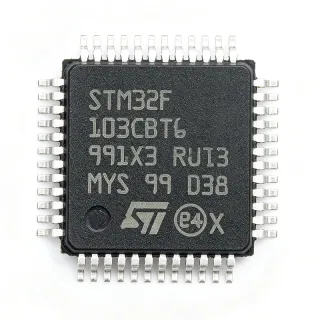
PIC16F1825-I/JQ - 8-Bit 32MHz MCU, 14KB Flash, 16-UQFN | Microchip
MPN: PIC16F1825-I/JQ ✓ Active| Qty | Unit Price | Extended |
|---|---|---|
| 1 | $1.78 | $1.78 |
| 10 | $1.62 | $16.20 |
| 100 | $1.42 | $142.00 |
| 500 | $1.21 | $605.00 |
| 1,000 | $1.05 | $1,050.00 |
PIC16F1825-I/JQ Overview
A microcontroller (MCU) is a single-chip computer that integrates a CPU, memory (Flash/RAM/EEPROM), peripherals, and I/O onto one die. The PIC16F1825-I/JQ belongs to the broader taxonomy: PIC16 family -> 8-bit PIC microcontrollers -> microcontrollers -> integrated circuits. Within Microchip's portfolio it sits in the PIC16F182x enhanced mid-range series alongside the PIC16F1823 (8-pin), PIC16F1824 (14-pin) and PIC16F1829 (20-pin) siblings, and is widely used as a low-power general-purpose MCU in cost-sensitive embedded designs.
Key features include up to 32 MHz internal oscillator, 1.8-5.5V wide operating voltage, 12-bit ADC with computation (ADC2), 5-bit DAC, 8-/16-bit timers, PWM/SCCP/MCCP capture-compare modules, on-chip mTouch capacitive sensing, integrated temperature indicator, and zero-crossing detection. The nanoWatt XLP technology delivers typical sleep currents as low as 20 nA, ideal for battery-powered and energy-harvesting systems.
The PIC16F1825-I/JQ supports in-circuit serial programming (ICSP) via two pins and integrates the debug circuitry on-die, removing the need for an external debug header. The UQFN-16 package with exposed pad provides a small 4x4 mm footprint suitable for high-density boards, while the wide VDD range and 32 MHz speed comfortably handle communication protocols such as UART, SPI, I2C, and LIN.
Typical applications include IoT sensor nodes, low-power remote controls, capacitive touch user interfaces, LED lighting controls, small motor control loops, and battery-backed smart-home devices. The combination of 14 KB Flash and the ADC2 auto-acquisition peripheral enables compact firmware with on-chip signal processing without an external DSP.
Designers should use the device's internal 32 MHz HFINTOSC to reduce external component count, but should budget decoupling capacitance (typically 100 nF plus 10 uF bulk) within 5 mm of the VDD pin. The UQFN-16 package requires careful PCB layout to ensure the exposed thermal pad is soldered to a sufficient copper pour for both electrical grounding and thermal dissipation.
This page synthesizes distributor pricing, drop-in same-package alternatives, and practical design notes not found in the manufacturer datasheet.
Drop-in alternatives for PIC16F1825-I/JQ — same package, pin-to-pin compatible. Different-package parts requiring PCB rework are excluded.
Variants in this series
Same-series models that are drop-in compatible with PIC16F1825-I/JQ (same form factor and footprint) — differing in ADC, Package, Timers, Program Memory (Flash), Communication.
Quick Comparison Tool — Select alternative parts for side-by-side comparison:
PIC16F1825T-I/JQ
✅ Drop-In✓ In Stock
$0.58 / Unit
View Datasheet →PIC16F1824-I/JQ
✅ Drop-In✓ In Stock
$1.05 / Unit
View Datasheet →PIC16F1823-I/JQ
✅ Drop-In✓ In Stock
$0.85 / Unit
View Datasheet →PIC16F1574-I/JQ
✅ Drop-In📋 Reference alternative (not in catalog)
PIC16F1575T-I/JQ
✅ Drop-In✓ In Stock
$1.05 / Unit
View Datasheet →PIC16F1825-I/JQ Maximum Ratings & Electrical Characteristics
| Product Type | 8-bit Microcontroller (MCU) |
| Series | PIC16F182x, PIC XLP mTouch |
| Core | PIC16 (Enhanced Mid-Range, Harvard) |
| Program Memory (Flash) | 14 KB (8K x 14 words) |
| RAM | 1 KB |
| EEPROM | 256 bytes |
| Maximum CPU Speed | 32 MHz (200 ns instruction cycle) |
| Operating Voltage Range | 1.8 V to 5.5 V |
| I/O Pins | 12 |
| Package | 16-pin UQFN (4x4 mm) with Exposed Pad |
| ADC | 12-bit ADC with Computation (ADC2) |
| DAC | 5-bit DAC |
| Timers | 8-bit and 16-bit, plus PWM/SCCP/MCCP |
| Communication | UART, SPI, I2C, LIN |
| Special Features | mTouch capacitive sensing, nanoWatt XLP, ICSP/debug on-chip |
| Operating Temperature | -40 C to +85 C (Industrial, 'I' grade) |
| Mounting Type | Surface Mount |
| RoHS Status | Compliant |
PIC16F1825-I/JQ Pin Configuration
| Pin 1 | RA5 — Bidirectional I/O; ICSPCLK |
| Pin 2 | RA4 — Bidirectional I/O; ICSPDAT |
| Pin 3 | RA3 — Bidirectional I/O; MCLR/VPP |
| Pin 4 | RA2 — Bidirectional I/O |
| Pin 5 | RA1 — Bidirectional I/O; ICSPCLK alt |
| Pin 6 | RA0 — Bidirectional I/O; ICSPDAT alt |
| Pin 7 | VDD — Positive supply voltage (1.8-5.5 V) |
| Pin 8 | VSS — Ground reference |
| Pin 9 | RC5 — Bidirectional I/O |
| Pin 10 | RC4 — Bidirectional I/O |
| Pin 11 | RC3 — Bidirectional I/O; SCL |
| Pin 12 | RC2 — Bidirectional I/O |
| Pin 13 | RC1 — Bidirectional I/O; SDA |
| Pin 14 | RC0 — Bidirectional I/O |
| Pin 15 | RB5 — Bidirectional I/O |
| Pin 16 | RB4 — Bidirectional I/O |
Typical Applications
PIC16F1825-I/JQ is suitable for 7 applications: Battery-Powered IoT Sensor Nodes, Capacitive Touch User Interface, LED Lighting Control, Low-Power Remote Control, Small Brushless-DC Motor Control, Industrial Sensor Transmitter, Smart Home Edge Node.
Battery-Powered IoT Sensor Nodes
The PIC16F1825-I/JQ's nanoWatt XLP sleep current of approximately 20 nA and 1.8-5.5V wide VDD range make it a strong fit for coin-cell and Li-ion powered IoT sensor nodes. The on-chip 32 MHz HFINTOSC eliminates external crystals and the 12-bit ADC2 supports direct connection to temperature, humidity, and gas sensors. With 14 KB Flash it accommodates protocol stacks such as UART-based sensor aggregators while consuming minimal standby power over multi-year battery life cycles.
Recommended
Capacitive Touch User Interface
The PIC16F1825-I/JQ integrates Microchip's mTouch peripheral that uses ADC2 with computation for capacitive touch sensing, supporting up to 12 touch channels from the UQFN-16 pinout. The 32 MHz CPU and 1 KB RAM allow real-time touch scanning at sub-10 ms response rates with on-chip debouncing. Compared to discrete touch ICs, the PIC16F1825-I/JQ saves PCB area while keeping code in a single MCU, ideal for white goods and consumer HMI panels.
Recommended
LED Lighting Control
The PIC16F1825-I/JQ drives multiple PWM channels through its 16-bit CCP/10-bit PWM peripherals and 5-bit DAC, making it suitable for dimmable LED driver control in architectural and industrial lighting. The 32 MHz instruction rate allows color-mixing math in real time while the 14 KB Flash stores fade curves and lighting presets. Combined with a 1.8-5.5V VDD range the device can be powered directly from a 3.3V or 5V LED-driver auxiliary rail.
Recommended
Low-Power Remote Control
For handheld IR/RF remote controls, the PIC16F1825-I/JQ's deep-sleep current under 100 nA and ability to wake on pin-change or RTCC interrupt allow multi-year battery life on two AAA cells. Its internal 16 MHz HFINTOSC and the 14 KB Flash accommodate remote protocol stacks (RC5, NEC, BLE HID) without external oscillators. The UQFN-16 (4x4 mm) footprint fits within the constrained PCB area typical of slim remote housings.
Recommended
Small Brushless-DC Motor Control
The PIC16F1825-I/JQ drives 6-step or back-EMF brushless DC motors using its PWM, ADC2, and zero-crossing detection peripherals. The 32 MHz CPU executes commutation loops with sub-microsecond resolution while the 14 KB Flash holds lookup tables for trapezoidal or sinusoidal commutation. For a 4x4 mm footprint 16-pin UQFN it is one of the smallest BEMF-capable PIC16 MCUs available, fitting into compact fan and pump motor control boards.
Recommended
Industrial Sensor Transmitter
The PIC16F1825-I/JQ's 1.8-5.5V supply range, 12-bit ADC2, and industrial -40 to +85 C temperature rating suit it for 4-20 mA loop-powered sensor transmitters. Its UART and I2C peripherals connect to HART or IO-Link physical layers while the on-chip temperature indicator provides local cold-junction compensation for thermocouples. The 14 KB Flash holds calibration coefficients and PID loops for accurate analog output drive.
Recommended
Smart Home Edge Node
The PIC16F1825-I/JQ acts as a low-cost edge node in smart-home networks, combining 14 KB Flash for thread-friendly protocol stacks and the UART/SPI/I2C peripherals for communicating with radios (such as sub-GHz or BLE modules) and sensors. Its nanoWatt XLP sleep (~20 nA) supports battery or energy-harvested nodes that must wake occasionally to push sensor data. The 16-pin UQFN footprint supports very small PCB modules that fit inside standard wall-switch boxes.
Recommended
Recommended Products Summary
Engineering reference data for PIC16F1825-I/JQ — comparison, design guidance, and compliance information.
Selection Guide
Comparison with Alternatives
| Parameter | This Product | PIC16F1825T-I/JQ | PIC16F1824-I/JQ | PIC16F1823-I/JQ | PIC16F1574-I/JQ | PIC16F1575T-I/JQ |
|---|---|---|---|---|---|---|
| Brand | Microchip Technology | Microchip Technology | Microchip Technology | Microchip Technology | Microchip Technology | Microchip Technology |
| Package | 16-pin UQFN (4x4 mm) | 16-pin UQFN (4x4 mm) - same | 16-pin UQFN (4x4 mm) - same | 16-pin UQFN (4x4 mm) - same | 16-pin UQFN (4x4 mm) - same | 16-pin UQFN (4x4 mm) - same |
| Flash Memory | 14 KB | 14 KB | 7 KB | 7 KB | 7 KB | 7 KB |
| RAM | 1 KB | 1 KB | 256 B | 384 B | 512 B | 512 B |
| EEPROM | 256 B | 256 B | 256 B | 256 B | 256 B | 256 B |
| CPU Speed | 32 MHz | 32 MHz | 32 MHz | 32 MHz | 32 MHz | 32 MHz |
| ADC | 12-bit ADC2 | 12-bit ADC2 | 12-bit ADC2 | 10-bit ADC | 10-bit ADC | 10-bit ADC |
| mTouch Cap-Sense | Yes | Yes | Yes | No | No | No |
| Operating Voltage | 1.8-5.5 V | 1.8-5.5 V | 1.8-5.5 V | 1.8-5.5 V | 1.8-5.5 V | 1.8-5.5 V |
| Temperature Grade | -40 to +85 C Industrial | -40 to +85 C Industrial | -40 to +85 C Industrial | -40 to +85 C Industrial | -40 to +85 C Industrial | -40 to +85 C Industrial |
Key Differentiators
- Highest Flash density in 16-pin UQFN PIC16F182x family (vs PIC16F1824-I/JQ)
- Integrated mTouch capacitive-sensing peripheral (vs PIC16F1574-I/JQ)
- Same-package compatibility with code-budget sibling (vs PIC16F1823-I/JQ)
Design Notes
Place a 100 nF ceramic decoupling capacitor within 5 mm of VDD (pin 7) and a 10 uF bulk capacitor near the device for transient load support. The PIC16F1825-I/JQ draws up to 8 mA at 32 MHz VDD=5V, so the source impedance of the supply rail must be kept low at high frequency. The nanoWatt XLP sleep mode cuts quiescent current to ~20 nA typical but requires the RTCC or IOC to be the wake source - do not poll peripherals in a busy-wait loop.
The UQFN-16 (4x4 mm) package uses an exposed thermal pad (EP) that must be soldered to a copper pour on the PCB for both electrical ground and thermal dissipation. At 32 MHz and 5 V the device dissipates roughly 40 mW (8 mA x 5 V), which is well within the package's thermal envelope without an external heatsink, but a stitched ground pour improves EMI and thermal performance.
Route the ICSP lines (ICSPCLK/RA1 and ICSPDAT/RA0) with short traces and avoid placing high-current traces parallel to them to prevent programming glitches. When laying out the UQFN-16 land pattern, follow IPC-7351 nominal-density recommendations with 0.4 mm pitch pads; ensure no solder mask slivers between pads. The exposed pad must have at least 4 thermal vias to the inner ground plane.
Do not assume all PIC16F1825 variants run at 5 V - the 'LF' (e.g. PIC16LF1825T-I/JQ) is rated only to 3.6 V and will latch-up above that. Likewise, the 'E' temperature grade is -40 to +125 C extended, while 'I' is -40 to +85 C industrial; using 'E' parts in industrial designs is fine but more expensive. Lastly, ensure the HFINTOSC PLL is enabled and tuned (TUN) before relying on 32 MHz timing for UART.
For capacitive touch (mTouch) layouts, keep the touch sensor pads connected to RA0/RA1/RA2/RA4/RA5/RC0-RC5 via short traces with no series resistance, and surround each pad with a hatched ground pour to maintain a clean coupling reference. Use guard rings around sensitive analog traces to block injected currents from digital lines. ADC2 conversions near the touch sampling time should be scheduled in firmware to avoid charge-pump crosstalk.
Compliance Information
RoHS and REACH compliance per Microchip product page. Industrial temperature grade -40 to +85 C (I suffix). Not AEC-Q100 qualified for automotive - choose PIC16F1825-I/JQ automotive equivalents from Microchip for vehicular applications.