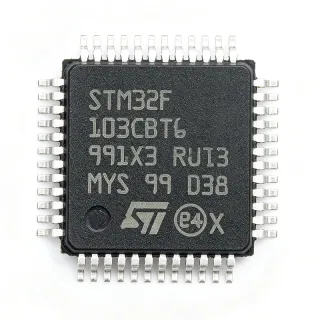
PIC16F1936-I/ML - 8-Bit 32MHz 14KB Flash MCU LCD XLP | Microchip
MPN: PIC16F1936-I/ML ✓ Active| Qty | Unit Price | Extended |
|---|---|---|
| 1 | $3.45 | $3.45 |
| 10 | $3.1 | $31.00 |
| 100 | $2.72 | $272.00 |
| 500 | $2.42 | $1,210.00 |
| 1,000 | $2.15 | $2,150.00 |
PIC16F1936-I/ML Overview
What is an 8-bit microcontroller? An 8-bit microcontroller (MCU) is a single-chip computer with an 8-bit data path that integrates a CPU, non-volatile Flash program memory, volatile SRAM, EEPROM data memory, and a set of peripherals (timers, ADC, communication, I/O). The PIC16F1936 belongs to the broader hierarchy: microcontroller -> embedded controller -> semiconductor. nanoWatt XLP technology is Microchip's branded ultra-low-power architecture that lets the device run in sleep modes drawing microamp currents, ideal for battery-operated equipment.
Key differentiating features include 25 general-purpose I/O pins, an integrated LCD driver (up to 96 segments), a 10-bit ADC with up to 17 channels, four 10-bit PWM modules, two comparators, an EUSART, plus master/slave I2C and SPI. The device ships with nanoWatt XLP sleep currents as low as 1.8 uA typical, enabling coin-cell-powered designs that wake periodically to service sensors.
The PIC16F1936 uses a 14-bit instruction word RISC architecture with a hardware stack, hardware register file, and a configurable instruction set that delivers deterministic throughput and tight interrupt latency. Its peripheral pin select (PPS) allows most digital I/O to be remapped to alternate pins, simplifying PCB routing. Internal oscillator blocks (LF, MF, HF) reduce external component count, and the integrated LCD charge pump allows direct segment driving without an external bias network.
Typical applications include battery-powered consumer appliances, low-cost LCD user interfaces in home appliances, sensor node data acquisition, and industrial controls with segmented displays. The wide 1.8 V to 5.5 V supply range supports direct connection to Li-ion, 2xAA, and 3.3 V regulated rails.
Designers should budget for at least one decoupling capacitor near each supply pin and follow Microchip's 28-pin QFN PCB layout guidelines to dissipate heat via the exposed pad. The internal oscillator accuracy is approximately +/- 2% over voltage and temperature; an external crystal is recommended when the UART must meet tight baud-rate tolerances.
This page combines verified distributor pricing, drop-in same-package alternatives, and practical design notes synthesized beyond the manufacturer datasheet for engineers sourcing a production-ready 8-bit MCU with LCD support.
Drop-in alternatives for PIC16F1936-I/ML — same package, pin-to-pin compatible. Different-package parts requiring PCB rework are excluded.
Variants in this series
Same-series models that are drop-in compatible with PIC16F1936-I/ML (same form factor and footprint) — differing in LCD Driver, Package, Timers, Communication, ADC.
Quick Comparison Tool — Select alternative parts for side-by-side comparison:
PIC16F1934-I/ML
✅ Drop-In ⚠️ 参数待验证✓ In Stock
$1.74 / Unit
View Datasheet →PIC16F1936-I/ML
✅ Drop-In ⚠️ 参数待验证✓ In Stock
$2.15 / Unit
View Datasheet →PIC16F1936-E/ML
✅ Drop-In ⚠️ 参数待验证📋 Reference alternative (not in catalog)
PIC16F1936-E/MV
✅ Drop-In ⚠️ 参数待验证✓ In Stock
$1.72 / Unit
View Datasheet →PIC16F1936-I/ML Maximum Ratings & Electrical Characteristics
| Family | PIC16 (L)F1934/6/7 |
| Core Architecture | Enhanced Mid-Range 8-bit PIC RISC |
| Program Memory (Flash) | 14 KB (8K x 14 words) |
| RAM | 512 bytes |
| EEPROM | 256 bytes |
| Maximum CPU Speed | 32 MHz (8 MIPS) |
| Supply Voltage Range | 1.8 V to 5.5 V |
| I/O Pins | 25 |
| ADC | 10-bit, up to 11 channels |
| PWM Modules | 4 x 10-bit |
| Comparators | 2 |
| LCD Driver | Yes, up to 96 segments |
| Communication | EUSART, I2C (master/slave), SPI |
| Timers | 5 (Timer0/1/2/4/6) |
| Package | 28-pin VQFN with Exposed Pad (6 x 6 mm) |
| Mounting Type | Surface Mount |
| Operating Temperature | -40C to +85C (Industrial, -I suffix) |
| nanoWatt XLP Sleep Current | 1.8 uA typical |
| RoHS Status | Compliant |
PIC16F1936-I/ML Pin Configuration
| Pin 1 | MCLR/Vpp/RE3 — Master Clear (reset) input or programming voltage; also digital input-only RE3 |
| Pin 2 | RA0 — PORTA I/O pin 0; analog AN0 input |
| Pin 3 | RA1 — PORTA I/O pin 1; analog AN1 input |
| Pin 4 | RA2 — PORTA I/O pin 2; analog AN2 input |
| Pin 5 | RA3 — PORTA I/O pin 3; analog AN3 input |
| Pin 6 | RA4 — PORTA I/O pin 4; analog AN4 input |
| Pin 7 | RA5 — PORTA I/O pin 5; analog AN5 input |
| Pin 8 | VSS — Ground reference |
| Pin 9 | RA7 — PORTA I/O pin 7; analog AN7 input |
| Pin 10 | RA6 — PORTA I/O pin 6; analog AN6 input |
| Pin 11 | RC0 — PORTC I/O pin 0; analog AN16 input; peripheral pin select capable |
| Pin 12 | RC1 — PORTC I/O pin 1; analog AN17 input |
| Pin 13 | RC2 — PORTC I/O pin 2; analog AN18 input |
| Pin 14 | RC3 — PORTC I/O pin 3; analog AN19 input; peripheral pin select capable |
| Pin 15 | RC4 — PORTC I/O pin 4; peripheral pin select capable |
| Pin 16 | RC5 — PORTC I/O pin 5; peripheral pin select capable |
| Pin 17 | RC6 — PORTC I/O pin 6; peripheral pin select capable |
| Pin 18 | RC7 — PORTC I/O pin 7; peripheral pin select capable |
| Pin 19 | VSS — Ground reference |
| Pin 20 | VDD — Positive supply voltage 1.8 V to 5.5 V |
| Pin 21 | RB0 — PORTB I/O pin 0; interrupt-on-change capable |
| Pin 22 | RB1 — PORTB I/O pin 1; interrupt-on-change capable |
| Pin 23 | RB2 — PORTB I/O pin 2; interrupt-on-change capable |
| Pin 24 | RB3 — PORTB I/O pin 3; interrupt-on-change capable |
| Pin 25 | RB4 — PORTB I/O pin 4; interrupt-on-change capable |
| Pin 26 | RB5 — PORTB I/O pin 5; interrupt-on-change capable |
| Pin 27 | RB6 — PORTB I/O pin 6; ICSPCLK programming |
| Pin 28 | RB7 — PORTB I/O pin 7; ICSPDAT programming |
| Pin EP | Exposed Pad (GND) — Thermal pad, must be soldered to ground for heat dissipation |
Typical Applications
PIC16F1936-I/ML is suitable for 6 applications: Battery-Powered Sensor Node, Consumer Appliance LCD Interface, Industrial Control Panel, Home Automation Controller, Automotive Interior Module, Portable Medical Monitoring Device.
Battery-Powered Sensor Node
The PIC16F1936-I/ML suits battery-powered sensor nodes because its nanoWatt XLP sleep current drops to 1.8 uA typical while the 1.8 V minimum supply lets it run directly off a single CR2032 coin cell. The 10-bit ADC with up to 11 channels acquires temperature, light, or motion sensor data on demand, and the device wakes from sleep on interrupt or watchdog to transmit via EUSART or SPI. With 14 KB Flash and 512 B RAM, the PIC16F1936-I/ML fits typical sensor-firmware footprints without external memory, and the 32 MHz CPU executes signal-conditioning routines quickly enough to return to sleep within milliseconds. This combination of low quiescent current and deterministic RISC throughput distinguishes it from generic 8-bit MCUs lacking XLP.
Recommended
Consumer Appliance LCD Interface
The PIC16F1936-I/ML drives segmented LCD user interfaces on consumer appliances such as washing machines, microwave ovens, and thermostats, thanks to its integrated LCD controller supporting up to 96 segments. The on-chip charge pump eliminates external bias resistors, reducing BOM cost and PCB area, while the 1.8 V to 5.5 V supply lets the MCU share the appliance's 5 V or 3.3 V rail. The device's 25 GPIO pins handle keypad scanning, rotary encoders, and buzzer control without external I/O expanders, and 14 KB Flash is sufficient for state-machine user-interface code plus menu translations. Compared to MCUs requiring an external LCD driver, the PIC16F1936-I/ML offers a single-chip BOM with nanoWatt XLP sleep behavior during user inactivity.
Recommended
Industrial Control Panel
The PIC16F1936-I/ML serves industrial control panels that combine segmented displays, push-button keypads, and 4-20 mA loop interfaces. Its 10-bit ADC with up to 11 channels reads sensor inputs directly, while the four 10-bit PWM modules drive valve actuators and LED indicators. The 32 MHz CPU maintains deterministic response times for safety-critical interlocks, and the 1.8 V to 5.5 V supply operates from 24 V industrial loops via external LDO. Compared with discrete logic designs, the PIC16F1936-I/ML consolidates display driving, sensing, and actuation into one device, shrinking PCB real estate and BOM cost in a 28-pin VQFN (6 x 6 mm) footprint.
Recommended
Home Automation Controller
The PIC16F1936-I/ML runs home automation controllers that aggregate wireless sensor data over SPI-linked radios and drive wall-mounted segmented displays. The integrated EUSART plus I2C master/slave and SPI ports support multiple sensor buses simultaneously, while the LCD driver displays room status without external glass-driver chips. nanoWatt XLP sleep modes keep wall-mounted units drawing minimal standby current between user interactions. Compared with 32-bit Cortex-M0 alternatives, the PIC16F1936-I/ML delivers lower cost and simpler interrupt architecture for applications that do not require an RTOS.
Recommended
Automotive Interior Module
The PIC16F1936-I/ML powers non-safety automotive interior modules such as HVAC controls and seat-position memory units, using its integrated 96-segment LCD driver for status displays. Although the -I/ML is industrial-grade, its sibling PIC16F1936-E/ML with extended temperature or the automotive-graded variant offers higher operating temperature tolerance. The 32 MHz MIPS performance reads rotary encoders and push buttons in real time without jitter, and the 10-bit ADC monitors temperature sensors. Compared with AEC-Q100-only controllers, the PIC16F1936-I/ML is a cost-effective choice for non-safety interior functions when paired with automotive-grade external regulators.
Recommended
Portable Medical Monitoring Device
The PIC16F1936-I/ML supports portable medical devices like pill-bottle reminders and low-rate physiological monitors that demand deterministic 8-bit behavior, low sleep current, and an on-chip LCD to display readings without external drivers. The nanoWatt XLP 1.8 uA sleep current extends battery life across multi-month deployments, while the 10-bit ADC captures temperature, impedance, or photodiode sensor data. The integrated LCD driver simplifies EN 60601-1-compliant user interfaces that show readings, battery state, and alarm icons. Compared with higher-end ARM Cortex controllers, the PIC16F1936-I/ML reduces firmware complexity for Class-A devices where verification cost outweighs processing throughput.
Recommended
Recommended Products Summary
Engineering reference data for PIC16F1936-I/ML — comparison, design guidance, and compliance information.
Selection Guide
Comparison with Alternatives
| Parameter | This Product | PIC16F1934-I/ML | PIC16F1936-E/ML | PIC16F1936-E/MV |
|---|---|---|---|---|
| Brand | Microchip Technology | Microchip Technology | Microchip Technology | Microchip Technology |
| Package | 28-pin VQFN EP (6x6 mm) | 28-pin VQFN EP (6x6 mm) - same | 28-pin VQFN EP (6x6 mm) - same | 28-pin VQFN EP (6x6 mm) - same |
| Flash Memory | 14 KB | 7 KB | 14 KB | 14 KB |
| RAM | 512 B | 256 B | 512 B | 512 B |
| EEPROM | 256 B | 256 B | 256 B | 256 B |
| Max CPU Speed | 32 MHz / 8 MIPS | 32 MHz / 8 MIPS | 32 MHz / 8 MIPS | 32 MHz / 8 MIPS |
| Operating Temperature | -40C to +85C | -40C to +85C | -40C to +125C | -40C to +125C |
| LCD Driver | Up to 96 segments | Up to 96 segments | Up to 96 segments | Up to 96 segments |
Key Differentiators
- All four alternatives share the same 28-pin VQFN (6x6 mm) footprint, enabling single-source PCB design (vs PIC16F1934-I/ML)
- Extended-temperature grade available on the same die (vs PIC16F1936-E/ML)
- Peripheral Pin Select (PPS) remaps most digital functions (vs Generic PIC16F1xxx competitors without PPS)
Design Notes
Estimated: at 32 MHz CPU and 5.5 V VDD core dissipation is below 50 mW and self-heating is negligible, but the exposed thermal pad under the VQFN-28 must be soldered to a 1 square inch copper pour tied to GND. Without the EP connection, junction-to-ambient thermal resistance rises sharply and reliability suffers in enclosed industrial cabinets where ambient exceeds 60C.
Place a 100 nF decoupling capacitor within 3 mm of the VDD pin and a bulk 1 uF to 10 uF capacitor adjacent to the exposed pad. For LCD applications, route the segment and common pins on inner layers to reduce parasitic capacitance, and keep the charge-pump flying capacitor within 2 mm of the C1LC/C2LC pins to maintain waveform integrity.
Do not leave the MCLR pin floating; tie it to VDD through a 10 kohm pull-up with a 100 nF cap to ground for noise immunity, or wire it directly to the programmer for in-circuit serial programming (ICSP). Confusing the -I (industrial) and -E (extended) suffixes is a frequent sourcing error that yields incorrect temperature-range parts at the same package.
Compliance Information
RoHS compliant per Microchip product page. Industrial-grade -40C to +85C; not AEC-Q100 automotive qualified (choose PIC16F1936-E/ML with extended temperature or the automotive-graded sibling for harsh environments). Reach and conflict-minerals status per Microchip supplier declarations.